




 Delaware (USA)
  Vietnam
  Singapore
  Hong Kong
  United Kingdom
 Setting up a restaurant business in Vietnam is the crucial first step in realizing your culinary vision in one of Southeast Asia's most dynamic markets. With a burgeoning middle class, a deep-rooted food culture, and a rapidly expanding tourism sector, Vietnam offers lucrative opportunities for foreign investors. However, navigating the legal labyrinth of strict licensing requirements, fire safety compliance, and capital regulations requires precise knowledge and strategic planning. This article will explore legal structures, licensing procedures, and operational nuances to successfully launch your F&B venture in Vietnam.
Vietnam’s F&B market
The Vietnam food and beverage (F&B) sector is currently experiencing a transformative phase, driven by rapid urbanization and shifting consumer habits. Understanding these semantic entities - market growth, consumer behavior, and economic context - is essential for any investor before committing capital.
Vietnam F&B market growth trends and consumer behavior
Vietnam’s F&B market is projected to maintain a strong compound annual growth rate (CAGR), fueled by a young demographic and rising disposable incomes. Modern Vietnamese consumers are increasingly spending on eating out, trying international cuisines, and prioritizing food safety. Key trends dominating the market include:
- The rise of the middle class: As GDP per capita rises, the demand for mid-range to high-end dining experiences has surged, particularly in major hubs like Ho Chi Minh City and Hanoi.
- Digitalization: Food delivery apps (GrabFood, ShopeeFood) and digital payment methods (MoMo, ZaloPay) are now integral parts of the dining ecosystem.
- Health consciousness: There is a growing preference for organic, traceable, and healthy ingredients, influencing menu designs across the country.
Why Vietnam is attractive for foreign-owned restaurants
Foreign direct investment (FDI) in the culinary sector is welcomed because it brings diversity and elevated standards to the local market. Vietnam’s WTO commitments allow foreign investors to own 100% of a restaurant business, unlike in many other Asian nations where local partners are mandatory. However, while the market potential is high, legal compliance remains the primary barrier to entry. Strict enforcement regarding food hygiene, fire safety, and labor regulations means that investors must prioritize regulatory adherence over speed during the setup phase.
Legal business structures for foreign investors opening a restaurant in Vietnam
Choosing the correct legal structure is foundational to your business's longevity and operational flexibility. The Law on Enterprises and the Law on Investment provide specific frameworks for foreign investors.
Opening a 100% foreign-owned restaurant company in Vietnam
Under Vietnam’s WTO commitments, foreign investors can register a 100% foreign-owned enterprise (FOE) in the restaurant sector. This structure is typically established as a Limited Liability Company (LLC).
- Ownership rights: The foreign investor retains full control over business decisions, branding, and profit repatriation.
- Liability: As an LLC, the investor’s financial liability is limited strictly to the chartered capital contributed to the company.
- Process: This route requires a two-step licensing process: Obtaining the Investment Registration Certificate (IRC) followed by the Enterprise Registration Certificate (ERC).
Setting up a joint venture restaurant with a Vietnamese partner
A Joint Venture (JV) involves establishing a company with both foreign and Vietnamese ownership.
- Capital contribution: Parties contribute capital according to the agreed percentage, which dictates profit sharing.
- Control issues: While a local partner can assist with navigating bureaucracy and sourcing locations, disagreements regarding management direction are common risks.
- Legal risks: Investors must draft a precise Shareholders Agreement or Members' Council Agreement to protect their interests, particularly regarding decision-making power and dispute resolution.
Using a nominee structure for a restaurant in Vietnam
Some investors attempt to bypass foreign investment procedures by having a Vietnamese national hold 100% of the shares (Nominee Structure).
- Compliance risks: This structure is legally precarious. If the nominee claims ownership, the foreign investor has little legal recourse.
- Real enforcement issues: Vietnamese courts often invalidate "side agreements" intended to prove the foreigner is the true owner.
Expanding into Vietnam through a restaurant franchise model
Franchising is an alternative to direct investment, suitable for established global brands.
- Efficiency: Instead of managing daily operations, the foreign brand licenses its IP and operational model to a local master franchisee.
- Regulation: Franchising activities must be registered with the Ministry of Industry and Trade (MoIT). This model reduces capital expenditure (CAPEX) risk but dilutes control over brand consistency.
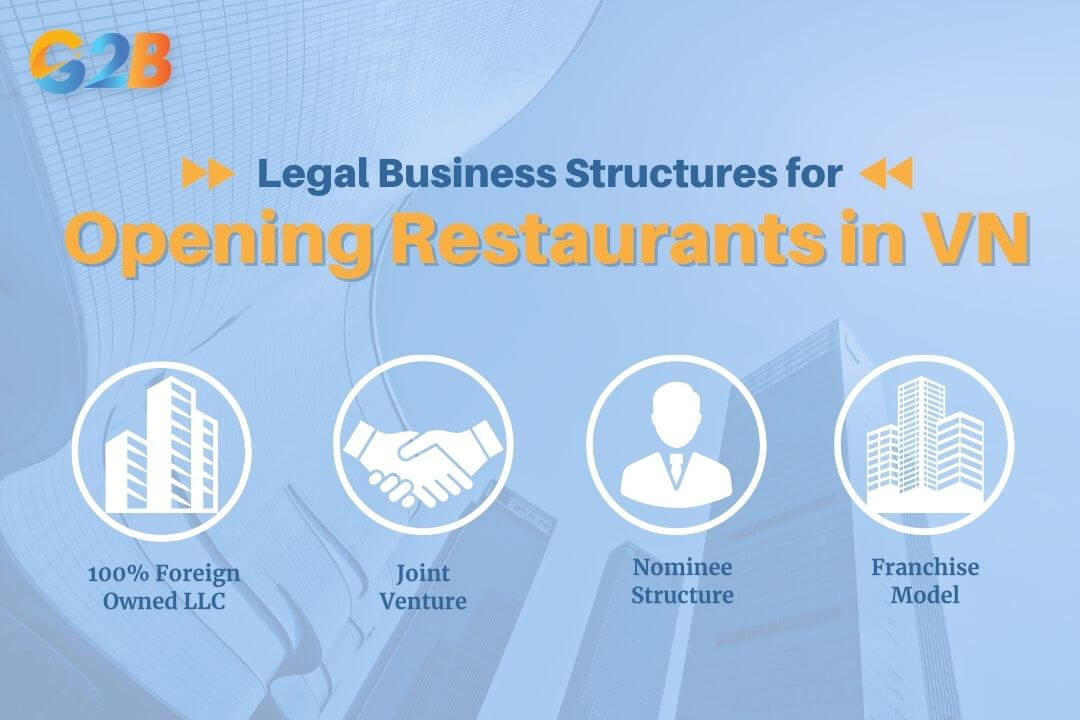
Key legal structures for foreign-owned restaurant businesses in Vietnam
Step-by-step licensing process to open a foreign-owned restaurant in Vietnam
The administrative procedure for setting up a restaurant business in Vietnam is rigorous. Investors must strictly follow the sequence of obtaining permits to avoid penalties or closure.
Obtaining the Investment Registration Certificate for a restaurant project
The IRC is the first mandatory document for any foreign investor. It signifies the government’s approval of your specific project.
- Conditions: The investor must prove financial capacity (bank statements) and a clear location for the project.
- Required documents: Passport copies, bank balance confirmation, lease agreement, and a detailed project proposal.
- Processing timeline: Typically takes 15 to 20 working days from the submission of a valid dossier to the Department of Planning and Investment (DPI).
Registering the company and receiving the Enterprise Registration Certificate
Once the IRC is issued, the investor applies for the ERC. This document legally births the company.
- Tax code issuance: The ERC number serves as the company's tax identification number.
- Company seal: After receiving the ERC, the company must engrave its legal seal and publicly announce its establishment on the National Business Registration Portal.
- Legal establishment: At this stage, the company exists legally, but it cannot yet operate the restaurant until sub-licenses are obtained.
Mandatory sub licenses required to operate a restaurant in Vietnam
Post-incorporation, a restaurant must acquire specific operational licenses. Operating without these can lead to immediate shutdown.
Food safety and hygiene certificate for restaurant operations
- Authority: Issued by the Department of Food Safety or district-level health authorities.
- Requirements: Staff must undergo health checks and food safety training. The kitchen must follow the one-way kitchen principle (raw and cooked foods never cross paths).
- Inspection: Authorities will physically inspect the premises before issuing the certificate.
Fire prevention and fighting approval for restaurants in Vietnam
As of 2024–2025, Fire Prevention and Fighting (FPF) regulations have become extremely strict.
- Practical difficulties: Many existing buildings in city centers do not meet the new, heightened standards.
- Compliance risks: You must obtain a Certificate of Fire Safety Design Approval and passing acceptance minutes before operation. Failure to secure this is currently the #1 reason for delays in restaurant openings in Vietnam.
Alcohol retail license for restaurants serving beer, wine or spirits
If your menu includes alcohol, you must apply for an alcohol retail license (for on-site consumption).
- Entities: The Department of Industry and Trade handles this.
- Conditions: You must show contracts with valid alcohol suppliers who hold their own wholesale licenses.
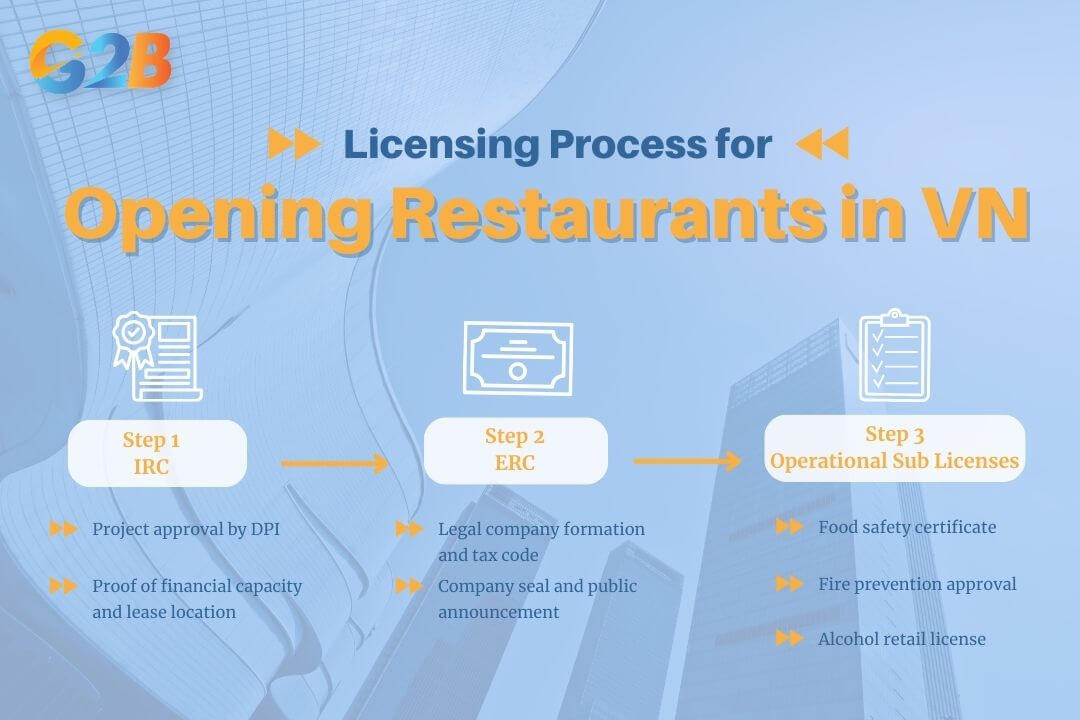
Licensing roadmap to legally open a foreign-owned restaurant in Vietnam
Restaurant location selection and physical setup requirements in Vietnam
The physical location dictates not only your revenue potential but also your licensing feasibility.
Choosing the right city and area for a restaurant in Vietnam
- Ho Chi Minh City (HCMC): The commercial hub with the highest spending power and a vibrant nightlife. District 1 and Thao Dien (District 2) are expatriate strongholds.
- Hanoi: The capital offers a more traditional market. Customers here value brand heritage and aesthetics.
- Da Nang: A tourism-focused market. Seasonal fluctuations are more pronounced here compared to HCMC or Hanoi.
Commercial lease agreements and land law compliance for restaurants
- Land use rights certificate (LURC): The landlord must provide a copy of the LURC (Red Book) showing that the property’s purpose allows for commercial business.
- Lease terms: Ensure the lease term covers the duration of your IRC project timeline.
- Risk: Renting a residential-only house for a restaurant often leads to licensing rejection by the DPI.
Restaurant design, kitchen layout, and construction standards for licensing approval
- One-way kitchen principle: The flow from input (ingredients) -> prep -> cooking -> serving must be unidirectional to prevent cross-contamination.
- Waste treatment: You must install a grease trap system and sign a contract with a certified waste collection company.
- Ventilation: Smoke and odor exhaust systems must be installed according to construction standards to avoid complaints from neighbors, which can trigger inspections.
Capital investment, financial planning and tax obligations for restaurants in Vietnam
Opening a restaurant in Vietnam requires careful capital planning to cover initial setup costs, ongoing operations, and contingency reserves. Investors must also develop a clear financial strategy and understand applicable tax obligations to ensure sustainable and compliant business operations.
Minimum capital expectations for foreign-owned restaurants in Vietnam
Vietnam law does not state a hard "minimum capital" number for restaurants, but the capital must be "feasible" for the project scale.
- Reasonable capital levels: For a standard restaurant, the Department of Planning and Investment usually expects a charter capital of at least $12,000 to $20,000 USD.
- Risk: Declaring capital too low (e.g., $5,000) often results in rejection of the IRC application because authorities doubt the project's viability.
Tax obligations for restaurant businesses in Vietnam
Restaurants are subject to several taxes:
- Value-added tax (VAT): Typically 10% (or 8% depending on government reduction policies). Restaurants must issue VAT invoices (e-invoices) to customers.
- Corporate income tax (CIT): The standard rate is 20% on net profits.
- Business license tax: An annual fixed fee based on charter capital (usually between 2,000,000 and 3,000,000 VND).
Opening capital and operational bank accounts for restaurant companies
Foreign investors must strictly separate capital flows:
- Direct investment capital account (DICA): You must transfer your initial charter capital into this specific account type. Transferring to a normal current account is a violation and makes profit repatriation impossible later. The capital must be fully contributed within 90 days from ERC issuance.
- Current account: Used for daily transactions, paying salaries, and receiving revenue.
Recruitment, employment, and labor compliance for restaurant operations
The hospitality industry relies heavily on human resources. Vietnam’s Labor Code protects employees strictly.
Hiring local staff and complying with Vietnam labor regulations
- Employment contracts: Must be in writing. Probation periods cannot exceed 6 working days for service staff or 30 days for specialized roles.
- Social insurance (SHUI): Employers must contribute to social, health, and unemployment insurance for all Vietnamese staff on contracts over 1 month.
- Trade union: Companies are often required to pay Trade Union fees (2% of the payroll fund).
Work permits and VISAs for foreign chefs, managers, and directors
- Work permit: Required for foreign chefs and managers. You must prove that the position cannot be filled by a local (e.g., a specialized French pastry chef).
- Temporary Residence Card (TRC): Once a Work Permit is obtained, the foreigner can apply for a TRC (valid for 2 years).
- Investor visa: The legal representative or owner can apply for an Investor Visa (DT), usually exempt from a Work Permit if they are the owner, depending on capital thresholds.
Key challenges and local insights for foreign restaurant owners in Vietnam
- Administrative complexity: Regulations change frequently. What worked in 2023 regarding Fire Safety may not work in 2025. Patience and professional counsel are required.
- Dining culture: Vietnamese diners enjoy a "sharing style" of eating. Menu engineering should reflect this. Peak hours are often later in the evening in HCMC compared to Hanoi.
- Supply chain risks: Cold chain logistics in Vietnam are improving but can be inconsistent. Diversify your supplier base for critical ingredients to avoid stockouts.
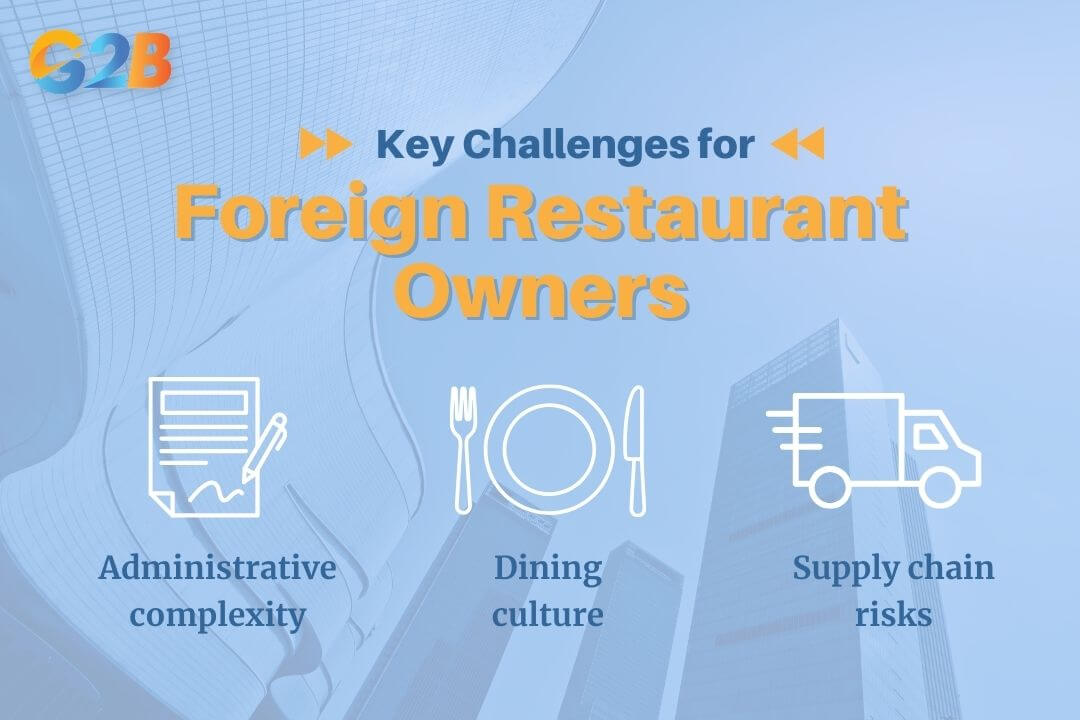
Key operational challenges for foreign restaurant owners in Vietnam
Frequently asked questions about opening a restaurant in Vietnam as a foreigner
This section addresses the most frequently asked questions about opening a restaurant in Vietnam as a foreign investor.
Can a foreigner own 100% of the restaurant in Vietnam?
Yes. Under Vietnam’s WTO commitments, foreign investors can own 100% of the capital in a restaurant business through a Limited Liability Company structure.
How long does it take to set up a restaurant business in Vietnam?
The entire process, from applying for the Investment Registration Certificate (IRC) to obtaining the Food Safety and Alcohol licenses, typically takes 3 to 4 months. This timeline can extend if renovations or fire safety approvals encounter delays.
What is the minimum investment capital required for a restaurant in Vietnam?
While there is no legal minimum, authorities (DPI) generally expect a registered capital of $12,000 USD or more to approve a foreign-owned restaurant project. This amount demonstrates financial capability to cover rental deposits, renovation, and initial operations.
Setting up a restaurant business in Vietnam offers immense potential but demands rigorous adherence to legal, safety, and financial regulations. From securing the Investment Registration Certificate to finalizing the "one-way" kitchen design for food safety compliance, every step requires precision. Attempting to navigate this landscape without local expertise can lead to costly delays or non-compliance penalties.
Ready to start your journey in Vietnam? Contact G2B today for a consultation on how to establish a company in Vietnam and to follow annual compliance requirements during operations. Let us handle the bureaucracy so you can focus on your business.
