




 Delaware (USA)
  Vietnam
  Singapore
  Hong Kong
  United Kingdom
 Social insurance in Vietnam is a statutory obligation that bridges the gap between legal entity establishment and operational human resource management. Social insurance is a fundamental aspect of the broader labor law in Vietnam, which every legal entity must strictly follow. For foreign investors and expats, navigating the shift from voluntary to mandatory contributions can be complex, yet it remains a critical pillar of corporate compliance. Failing to adhere to the regulations can result in severe financial penalties and jeopardize the validity of Work Permits.
This article highlights the key aspects of Vietnam’s social insurance system to help businesses better understand their statutory obligations and compliance requirements. We specialize in company formation in Vietnam and do not provide social insurance consulting or legal advisory services. For complex social insurance matters, please consult a qualified labor or social insurance professional.
Is social insurance mandatory for foreigners in Vietnam?
Yes, participation in the compulsory Social Insurance (SI) scheme is mandatory for foreign employees working in Vietnam.
According to Decree 143/2018/ND-CP and the updated Law on Social Insurance No. 41/2024/QH15, a foreign national is required to contribute if they meet the following two criteria:
- They possess a valid Work Permit, Practicing Certificate, or Practice License issued by the competent Vietnamese authorities.
- They have signed an indefinite-term labor contract or a definite-term labor contract with a duration of one year or longer with an employer based in Vietnam.
What are the exemptions for foreign employees?
While the scope of coverage is broad, the law provides specific exemptions to prevent double taxation and acknowledge specific employment structures. A foreign employee is exempt from compulsory Social Insurance if they fall into one of these categories:
- Intra-corporate transferees: This applies to foreign nationals who are internally transferred within a company (managers, executives, experts) from a parent company abroad to a subsidiary in Vietnam. To qualify, the employee must have been employed by the foreign entity for at least 12 months prior to the transfer and must have the specific "Intra-Corporate Transferee" designation on their Work Permit.
- Retirement age: Employees who have reached the statutory retirement age in Vietnam are exempt.
- Note on 2026 Retirement Ages: Under the progressive increase roadmap, the retirement age in 2026 is 61 years and 6 months for men and 57 years for women.
How does social insurance relate to work permits and company formation?
Many foreign investors view Company formation and HR compliance as separate silos. However, under Vietnamese law, they are intrinsically linked. Understanding this connection is vital during the company setup process and requirements in Vietnam.. The Work Permit acts as the legal trigger for Social Insurance liability.
The connection between work permits and social insurance eligibility
The Department of Labor, Invalids and Social Affairs (DOLISA) shares data with the Social Insurance agency. Once a Work Permit is issued to a foreign national, the authorities anticipate a corresponding Social Insurance registration.
If a company employs a foreigner without a Work Permit (illegal employment), they cannot legally register that employee for Social Insurance. Conversely, possessing a Work Permit but failing to pay Social Insurance constitutes a violation of labor laws.
Post-incorporation steps: Registering the company for social insurance
Immediately following the issuance of the Enterprise Registration Certificate (ERC), a new entity must establish its relationship with the insurance authorities. This is a critical "Phase 2" step in the Company formation process.
- Timeframe: The company must register with the district-level Social Insurance agency within 30 days of signing the first labor contract.
- The initial code: The company is assigned a unique Social Insurance Code. This code is used for all future filings regarding Health Insurance (HI), Social Insurance (SI), and Unemployment Insurance (UI).
- Digital signature: Modern compliance requires the company’s Digital Signature (Token) to submit monthly declarations via the electronic VSS portal.
Pro Tip: After receiving your ERC, as detailed in our Company Formation Checklist, ensure your initial labor contracts are drafted to align specifically with your declared salary scales to avoid discrepancies during the initial registration.
What are the social insurance contribution rates in 2026?
As we move through the 2026 fiscal year, contribution rates remain stable, but the value of contributions has adjusted due to changes in the Reference Salary.
Contribution rates for foreign employees
Foreign employees are subject to a different contribution structure than Vietnamese locals, primarily because foreigners are not currently eligible for Unemployment Insurance (UI).
Table 1: 2026 Social Insurance Contribution Rates for Foreigners
| Fund Category | Employer Contribution | Employee Contribution | Total Contribution |
|---|---|---|---|
| Sickness & Maternity | 3.0% | 0% | 3.0% |
| Occupational Accident & Disease | 0.5% | 0% | 0.5% |
| Retirement & Survivorship | 14.0% | 8.0% | 22.0% |
| Health Insurance (HI) | 3.0% | 1.5% | 4.5% |
| Unemployment Insurance (UI) | Exempt | Exempt | 0% |
| GRAND TOTAL | 20.5% | 9.5% | 30.0% |
Note: The employer’s 0.5% contribution to the Occupational Accident and Disease fund may be reduced to 0.3% if the enterprise meets high standards of Occupational Safety and Health (OSH) compliance and has no accidents, subject to Ministry approval.
Contribution rates for Vietnamese employees
For businesses hiring local staff, the obligation includes Unemployment Insurance. This distinction is vital for HR Managers calculating the "Total Cost of Employment" (TCOE). When hiring employees in Vietnam, businesses must factor in these rates to ensure accurate budgeting
- Social insurance (SI): Employer 17.5% | Employee 8%
- Health insurance (HI): Employer 3% | Employee 1.5%
- Unemployment insurance (UI): Employer 1% | Employee 1%
- Total: Employer pays 21.5%; Employee pays 10.5%.
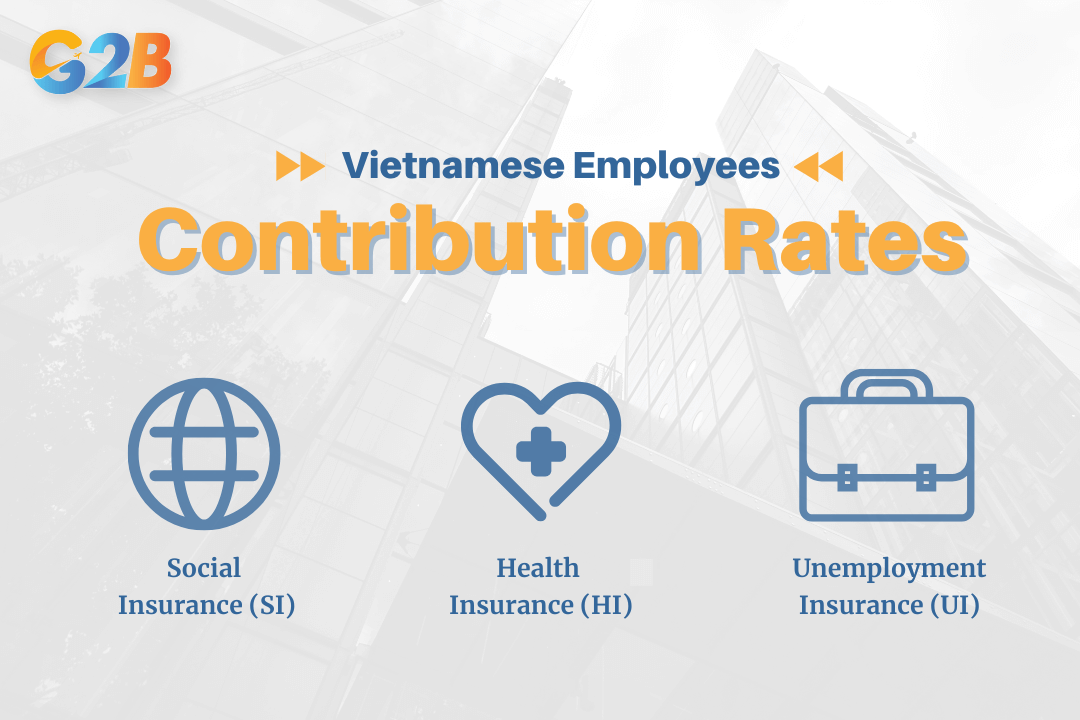
Contribution rates for Vietnamese employees
What is the salary base for calculation?
The contribution rates above are percentages of the employee's monthly salary. However, this is not always the total gross salary. It includes the job-based salary, position allowances, and other regular supplements.
Crucially, there is a Cap (Ceiling) on contributions. For 2026, the maximum salary used to calculate Social Insurance is capped at 20 times the Statutory Reference Salary. While the reference salary is a base for insurance, it is distinct from Vietnam's minimum wage, which dictates the lowest legal pay for workers
- Historical Context: Law 41/2024/QH15 officially replaced the old "Base Salary" concept with the "Reference Salary."
- If an expat earns $5,000 USD, but the cap is significantly lower (e.g., approx. 46,800,000 VND depending on the current Reference Salary set by the National Assembly), contributions are calculated on the capped amount, not the full $5,000.
What are the new updates in the Vietnam social insurance law (effective July 2025)?
The Law on Social Insurance No. 41/2024/QH15, which took effect on July 1, 2025, introduced transformative changes to the system. These updates are now fully operational in 2026.
Expanded coverage for part-time and managerial roles
The definition of compulsory participants has expanded. Previously, there was ambiguity regarding part-time workers and business managers.
- Part-time workers: Employees working on part-time contracts with a monthly salary equal to or higher than the minimum monthly reference level are now explicitly covered.
- Business managers: Managers of enterprises (LLC Directors, JSC Board Members) and managers of household businesses who receive a salary are now compulsory participants.
Changes to pension eligibility (15 years vs. 20 years)
One of the most significant benefits for long-term expats and locals alike is the reduction in the minimum contribution period for pension eligibility.
- Old law: Required 20 years of contributions to receive a monthly pension.
- New law (2025/2026): Employees are now eligible for a pension after paying social insurance for 15 years. This makes the prospect of retiring in Vietnam more attainable for foreigners who have committed a decade and a half to the market.
Stricter penalties for late payment
The 2025 Law introduced a clearer definition of "Social Insurance Evasion." Authorities now have stronger mechanisms to enforce compliance.
- Late payment interest: Calculated at 0.03% per day on the overdue amount.
- Suspension of invoice usage: In severe cases of non-compliance, tax authorities can suspend the company’s ability to issue VAT invoices, effectively freezing business operations.
What benefits do employees receive from social insurance?
For the 9.5% deduction from their salary, foreign employees are entitled to a robust safety net. Understanding these benefits helps HR managers justify the deductions to their expat staff.
Sickness and maternity benefits
- Sickness: Employees can take paid leave (paid by the Social Insurance agency, not the employer) when sick or caring for a sick child under 7 years old. A doctor’s certificate (form C65-HD) is required.
- Maternity: Female employees are entitled to 6 months of maternity leave. The allowance is 100% of the average monthly salary on which social insurance premiums were based for the 6 months preceding the leave. Foreign men are also entitled to 5-14 days of paid leave if their wife gives birth.
Occupational accident and disease
If an employee suffers an accident at the workplace or during the direct commute to/from work, they are eligible for:
- Coverage of medical expenses.
- A monthly or one-off allowance depending on the reduction of working capacity (assessed by the Medical Assessment Council).
Retirement and survivorship allowance
- Retirement: Upon reaching retirement age and meeting the 15-year contribution threshold, the employee receives a monthly pension.
- Survivorship: In the unfortunate event of the employee's death, their dependents (children under 18, elderly parents, or spouses above retirement age) may be eligible for a monthly survivorship allowance or a one-off funeral allowance (10x Reference Salary).
How to withdraw the one-off social insurance payment?
This is the most frequently asked question by the expatriate community. Since most foreigners do not stay in Vietnam for 15 years to qualify for a pension, they are entitled to a One-off lump sum withdrawal (often called the "Lump Sum Payout") upon leaving the country.
Eligibility for lump sum withdrawal
Foreign employees can request a one-off payment under the following circumstances:
- They have terminated their labor contract.
- Their work permit has expired or been revoked.
- They are no longer residing in Vietnam (or are suffering from a terminal illness).
Employers should follow the correct legal steps for terminating employees in Vietnam to ensure the employee's social insurance book is closed properly for withdrawal
Unlike Vietnamese locals, who (under the new law) face stricter restrictions on withdrawing lump sums early, foreign nationals leaving the country retain a streamlined path to withdrawal.
The application process and documents
To process this withdrawal, the employee generally needs to submit a dossier to the Social Insurance agency.
- Social insurance book: The physical booklet recording all contribution history. The employer is legally required to return this to the employee upon termination.
- Application form: Form No. 14-HSB.
- Passport: A certified copy or translation of the passport.
- Proof of termination: Decision on job severance or expired Work Permit.
Timeline: The payment is typically processed within 10 working days of submission. The calculation is generally 2 months of the average salary for every year of contribution (for years 2014 onwards).
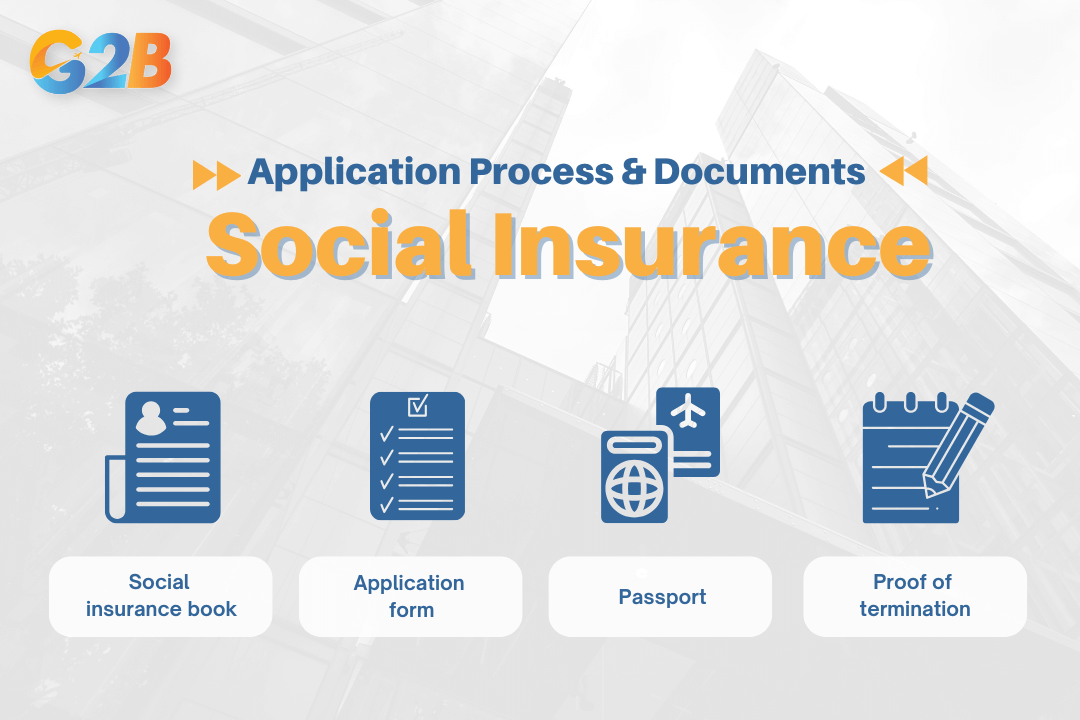
Documents that an employee generally needs to submit
Common questions about social insurance and business compliance
This section addresses common questions related to social insurance obligations and business compliance in Vietnam.
Can a company pay social insurance without a work permit?
No. This is a critical compliance error. The social insurance system validates identity against the labor database. Without a Work Permit (or a confirmed exemption certificate), the system views the foreigner as an illegal worker. Attempting to register them may trigger an audit from DOLISA or the Immigration Department.
What are the penalties for non-compliance?
Failure to register or pay social insurance results in:
- Administrative fines: Ranging from 12% to 15% of the total amount of compulsory social insurance that was not paid.
- Remedial measures: Mandatory payment of the full outstanding amount plus interest.
- Criminal liability: Under Article 216 of the Penal Code, willful evasion of insurance obligations for a large number of employees or large sums can lead to criminal prosecution for the Legal Representative.
Can the employer pay the "employee share" (9.5%) on their behalf?
Yes. This is common in "Net Salary" contracts. If the contract states the salary is Net, the employer is responsible for grossing up the salary to calculate the tax and insurance, and then paying both the employer (20.5%) and employee (9.5%) portions directly to the insurance agency. Managing these complex 'gross up' calculations and ensuring tax compliance is a primary responsibility of a chief accountant in Vietnam
Social insurance in Vietnam is more than a monthly deduction; it is a mechanism that validates your business's standing and your employees' legal status. With the enforcement of Law No. 41/2024/QH15 in 2026, the government has signaled a move towards stricter compliance, broader coverage, and better benefits for long-term contributors.
