




 Delaware (USA)
  Vietnam
  Singapore
  Hong Kong
  United Kingdom
 Transferring capital to Vietnam is an essential step for foreign investors looking to establish or expand their business in the country. Navigating Vietnam’s robust foreign exchange control systems requires absolute precision to avoid severe administrative fines, licensing revocations, or blocked profit repatriation. Unlike ordinary international wire transfers, sending investment capital into Vietnam demands strict adherence to specific banking frameworks.
What does transferring capital to Vietnam mean?
Transferring capital to Vietnam refers specifically to the legal inflow of financial assets by foreign individuals or foreign corporate entities for investment purposes, rather than for standard commercial trade. Distinguishing between an ordinary remittance and an official capital contribution is critical under Vietnamese financial law:
- When an overseas company pays a Vietnamese vendor for manufacturing services, this constitutes an ordinary commercial payment processed through standard current accounts. Conversely, when an overseas investor funds a subsidiary's charter capital, purchases equity in an existing Vietnamese enterprise, or issues a corporate loan to a local entity, this constitutes an official capital transfer.
The Vietnamese government monitors all foreign direct investment (FDI) inflows to maintain macroeconomic stability and regulate currency reserves. Consequently, investors cannot merely wire funds to a standard corporate bank account. All investment-related fund movements must pass through an officially registered Direct Investment Capital Account (DICA). Failure to route funds through this designated account permanently invalidates the capital contribution, blocking future profit repatriation and preventing the legal recognition of ownership.
Legal framework for capital transfer to Vietnam
Vietnam's financial ecosystem operates under strict foreign exchange control mechanisms. To establish topical authority regarding financial compliance in Vietnam, foreign investors must understand the specific legislative documents and regulatory bodies governing capital mobility. Two primary government entities oversee foreign capital inflows: the State Bank of Vietnam (SBV), which manages monetary policy and foreign currency control, and the Ministry of Planning and Investment (MPI), which regulates investment licensing and enterprise registrations. The statutory framework governing capital transfers includes multiple foundational laws and sub-law documents:
- The Law on Investment 2020: Dictates the conditions, procedures, and guarantees for foreign investors entering the Vietnamese market.
- The Law on Enterprises 2020: Outlines the strict corporate governance rules regarding charter capital establishment, timelines, and the legal responsibilities of shareholders.
- The foreign exchange ordinance (amended 2013): Serves as the bedrock for Vietnam's currency control, mandating that all transactions within Vietnamese territory must be denominated in Vietnamese Dong (VND), barring specific statutory exceptions.
- Circular 06/2019/TT-NHNN: The definitive SBV regulation outlining foreign exchange management for foreign direct investment activities, dictating the exact mechanics of the Direct Investment Capital Account (DICA).
This legal framework establishes a definitive regulatory difference between FDI enterprises (companies established by foreign investors) and local companies with foreign shareholders (where a foreign investor acquires shares in a pre-existing 100% Vietnamese-owned entity). FDI enterprises must operate a Direct Investment Capital Account (DICA), whereas indirect investments require an Indirect Investment Capital Account (IICA). Complying with these specific decrees guarantees that the investor retains the right to repatriate profits and liquidate assets in the future.
Types of capital transfer to Vietnam
Foreign capital enters Vietnam through four primary investment structures. Each structural type triggers different licensing procedures, banking requirements, and regulatory approvals.

Foreign capital enters Vietnam through 04 primary investment structures
Company establishment (initial charter capital)
When foreign investors establish a new legal entity in Vietnam, they must define and register a specific amount of "Charter capital" on their licensing documents. Transferring this capital involves wiring funds from the founding investor's offshore account directly into the newly established Vietnamese company's Direct Investment Capital Account (DICA). This initial injection provides the fundamental liquidity required to commence business operations, lease commercial property, and hire personnel.
Additional capital injection
Successful enterprises frequently require capital expansion to scale operations, purchase real estate, or upgrade manufacturing facilities. Before investors can transfer additional funds, the Vietnamese entity must legally amend its corporate licenses, specifically the Investment Registration Certificate (IRC) and the Enterprise Registration Certificate (ERC), to reflect the increased charter capital. Once the MPI approves the updated licenses, the foreign investor remits the newly registered capital amount through the existing DICA.
Share purchase / Mergers & acquisitions (M&A)
Transferring capital to acquire existing equity requires a distinct procedural pathway. When a foreign investor purchases shares or capital contributions in an existing Vietnamese company, the transaction frequently requires prior "M&A Approval" from the local Department of Planning and Investment (DPI). The capital transfer mechanics depend on the target company's status. If the target company already possesses a DICA, the funds flow accordingly. If the transaction transforms a local company into a foreign-invested enterprise, the company must open a new DICA to process the acquisition payment.
Shareholder loan
Foreign investors frequently use debt financing to fund their Vietnamese subsidiaries without permanently altering the registered charter capital. However, shareholder loans are subject to rigorous foreign exchange control in Vietnam. Short-term loans (maturing in ≤ 364 days) must be disbursed and repaid exclusively through the DICA. Medium and long-term loans (exceeding 364 days) trigger a mandatory compliance step: the loan agreement must receive formal registration and approval from the State Bank of Vietnam before any capital crosses the border.
Step-by-step process to transfer capital to Vietnam
Executing a compliant cross-border transfer requires precise chronological sequencing. Transferring funds prematurely or using incorrect payment narratives will result in rejected transactions.
Step 1: Obtain the required corporate licenses: Before opening the necessary banking infrastructure, the foreign-invested enterprise must formally exist. The investor must secure statutory licenses, including the Investment Registration Certificate (IRC) and the Enterprise Registration Certificate (ERC).
Step 2: Open the Direct investment capital account (DICA): The legal representative of the newly formed Vietnamese entity must approach a licensed commercial bank in Vietnam to open the DICA. This process requires submitting highly specific legal documents, such as the notarized IRC, the legalized ERC, the appointed Chief Accountant's certification, and the corporate seal registration.
Step 3: Initiate the offshore wire transfer: The foreign investor must instruct their overseas bank to initiate the transfer. The remitting account must precisely match the investor's name listed on the IRC and ERC. The transfer must include the exact SWIFT code of the Vietnamese bank and specifically designate the Vietnamese entity’s DICA as the beneficiary account.
Step 4: Provide an exact transfer description: The payment narrative (remittance purpose) on the SWIFT message must explicitly state that the transfer is for capital contribution. A legally sound description reads: "Capital contribution for [Company Name] according to ERC No. [ERC Number]". Vague descriptions like "company funding" or "business transfer" will trigger banking compliance holds.
Step 5: Obtain the bank confirmation letter: Once the Vietnamese bank clears the funds into the DICA, the company must request a formal Credit Advice or Bank Confirmation Letter. This document serves as the absolute legal proof that the investor has fulfilled their statutory capital contribution obligations.
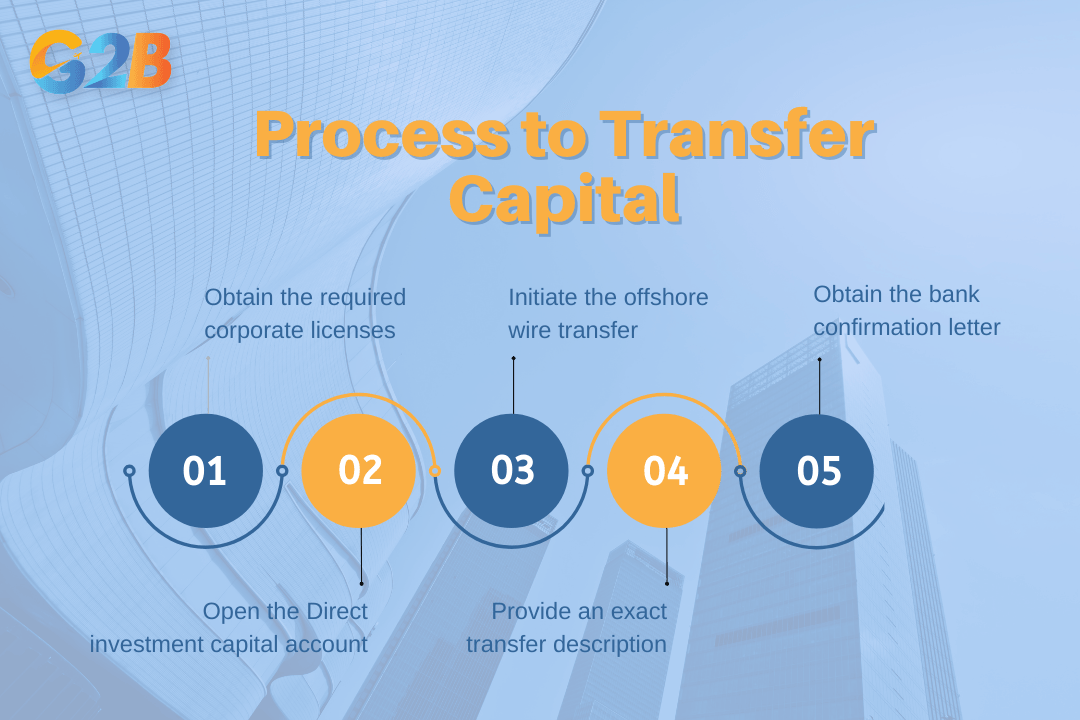
Process with 5 steps to transfer capital to Vietnam
Bank account requirements in Vietnam
Operating a foreign-invested enterprise in Vietnam requires a multi-tiered corporate banking structure. Understanding how to open an Investment Capital Account in Vietnam is merely the foundation; investors must understand how these accounts interact.
The Direct Investment Capital Account (DICA): The DICA is a specialized, restricted-use account designed solely to monitor foreign investment flows. A foreign-invested enterprise may open a DICA in a foreign currency (e.g., USD, EUR, SGD) or in Vietnamese Dong (VND), depending on the currency explicitly stated on the Investment Registration Certificate. The DICA must strictly be used for specific compliance-driven transactions, such as receiving charter capital contributions, receiving foreign shareholder loans, disbursing loan principal repayments, and executing profit repatriation to the parent company.
The operational payment account (current account): The DICA cannot be used for daily commercial operations. Once the foreign capital lands in the DICA, the company must transfer those funds internally to its standard VND Operational Payment Account. This standard account handles all domestic commercial activities, including paying local supplier invoices, processing employee payroll, and fulfilling monthly tax obligations.
Periodic foreign exchange reports: Maintaining these accounts requires ongoing compliance. Commercial banks operating in Vietnam act as proxies for the State Bank of Vietnam. Consequently, companies utilizing a DICA must submit periodic foreign exchange reports detailing capital usage, outstanding loan balances, and compliance with registered investment timelines. Failure to accurately report triggers automatic audits by the central banking authority.
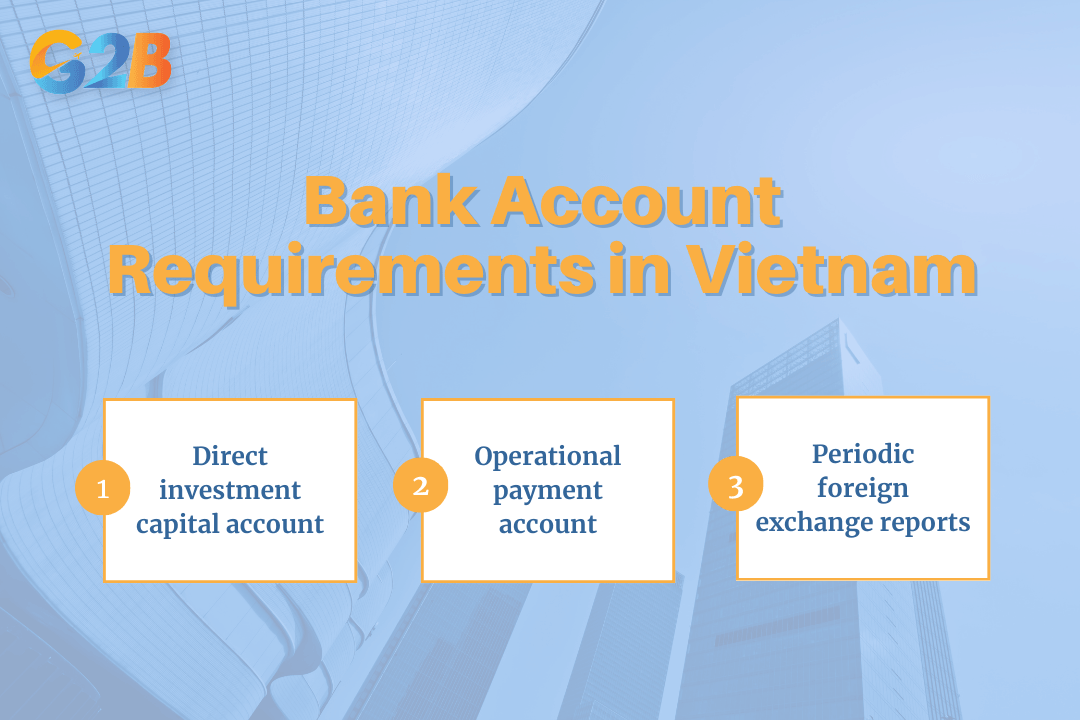
3 Types of bank account requirements in Vietnam
Capital contribution timeline & penalties
The Vietnamese government strictly enforces the capital contribution deadline in Vietnam to ensure foreign investors execute their proposed business plans rather than squatting on corporate licenses.
Vietnam requires capital contribution within 90 days from the issuance date of the Enterprise Registration Certificate (ERC). This 90-day window is a hard statutory deadline. Delays in opening the DICA or international banking holidays do not pause this countdown.
Failure to inject the fully registered charter capital within this 90-day timeframe subjects the foreign-invested enterprise to immediate statutory consequences. Initially, the company faces severe administrative fines ranging from tens of millions to over one hundred million VND. Furthermore, the local licensing authority (DPI) will force the company to execute mandatory capital reduction procedures, legally lowering the registered charter capital to the exact amount actually contributed.
Beyond financial penalties, failing to meet this deadline destroys the company's compliance standing. The company will face "locked" licensing status, preventing it from amending licenses, opening new branches, obtaining work permits for foreign executives, or legally distributing dividends, until the violation is financially settled and legally rectified.
Taxes & financial implications
Transferring capital into Vietnam and subsequently generating returns creates specific tax liabilities. Understanding these financial implications allows corporate treasurers to optimize cross-border structures.
- Taxation on initial capital transfers: Vietnam does not levy taxation on the principal amount of charter capital injected into a company. When an investor wires $500,000 USD to fund their subsidiary's charter capital, that entire amount remains tax-exempt upon entry.
- Corporate income tax (CIT) on operational profits: Once the capital is deployed, the resulting operational profits are subject to Corporate Income Tax (CIT). The standard CIT rate in Vietnam is currently 20%. The company must fulfill its annual CIT obligations before any dividends can be legally declared or repatriated.
- Foreign contractor tax (FCT) on shareholder loans: If the foreign investor transfers capital via a shareholder loan, the interest payments remitted back to the overseas investor are subject to Vietnam's Foreign Contractor Tax. The local Vietnamese subsidiary must withhold a 5% tax on gross interest payment before wiring the funds offshore.
- Capital gains tax (capital assignment tax): If an investor decides to transfer their capital by selling their equity stake in the Vietnamese enterprise, the resulting profits face heavy taxation. For standard limited liability companies, Vietnam applies a 20% tax on the net capital gain (the transfer price minus the initial invested capital and transfer expenses).
- Double taxation agreements (DTAs): Vietnam possesses an extensive network of Double Taxation Agreements with over 80 countries. Foreign investors from treaty nations can frequently apply for tax exemptions or reduced withholding tax rates on dividends, interest, and royalties.
Common mistakes when transferring capital to Vietnam
Despite clear regulations, foreign investors frequently commit structural banking errors that block their investments and trigger licensing audits.
- Using a third-party account: The most critical compliance failure involves mismatched remitting parties. The bank account sending the funds from overseas must belong to the exact individual or corporate entity named as the investor on the Vietnamese licenses. If the investor is "ABC Holdings LLC", the money cannot legally come from the personal bank account of ABC Holdings' CEO. If third-party funds enter the DICA, the Vietnamese bank will refuse to recognize it as official charter capital, forcing a highly complicated international refund process.
- Transferring the wrong currency: The Investment Registration Certificate clearly stipulates the currency of the investment capital (e.g., USD or VND). Investors must wire the exact currency stated on the licenses into the corresponding DICA. Transferring Euros into a USD-designated DICA forces an unapproved currency conversion, causing the final recorded capital amount to mismatch the legally registered charter capital due to daily exchange rate fluctuations.
- Unregistered foreign loans: Parent companies often wire emergency funds to their Vietnamese subsidiaries to cover unexpected payroll or lease expenses, categorizing them internally as short-term loans. If these funds bypass the DICA or if the loan duration quietly exceeds 364 days without official State Bank of Vietnam registration, the funds become "trapped". The subsidiary will be legally barred from repaying the principal or remitting interest back to the parent company.
FAQs about capital transfer to Vietnam
How long does the capital transfer process take?
The international wire transfer typically takes 1 to 3 business days, but completing the full compliance process takes several weeks. Establishing the company licenses requires approximately 3 to 4 weeks. Opening the DICA takes an additional 1 to 2 weeks, depending on bank KYC procedures. Investors must factor this entire timeline into their statutory 90-day contribution window.
Can I use a personal bank account to transfer corporate capital?
No, personal accounts cannot be used if the registered investor is a corporate entity. The remitting account must precisely match the legal name of the investor registered on the Enterprise Registration Certificate. An individual can only use their personal offshore account if they are personally registered as the founding individual shareholder of the Vietnamese company.
What currency must be used for capital contribution?
Foreign investors may contribute capital in freely convertible foreign currencies (like USD, EUR, JPY) or in Vietnamese Dong (VND). However, the chosen currency must perfectly match the currency denomination explicitly registered and approved on the company’s Investment Registration Certificate (IRC).
Strict compliance with Vietnam's foreign exchange regulations is the cornerstone of a secure and profitable investment. Successfully transferring capital requires flawless execution across multiple regulatory domains - from securing precise corporate licenses and adhering to the unforgiving 90-day statutory deadline, to selecting the correct Direct or Indirect Investment Capital Accounts. A single administrative oversight, such as an incorrect SWIFT description or a mismatched remitting bank account, can trigger severe financial penalties and block future profit repatriation.
Planning to launch your business in Vietnam? Get in touch with G2B for expert guidance on setting up a company in Vietnam and ongoing annual compliance. We will take care of the regulatory procedures so you can concentrate on growing your business.
