




 Delaware (USA)
  Vietnam
  Singapore
  Hong Kong
  United Kingdom
 Establishing a company in Vietnam is the strategic gateway for investors targeting Southeast Asia and looking to diversify supply chains outside of traditional manufacturing hubs. As we approach 2026, Vietnam continues to solidify its position as a premier destination for Foreign Direct Investment (FDI). The Investment Law 2020 and Enterprise Law 2020 have created a more transparent pathway for foreign entities. In this article, let’s explore how foreign investors can set up a company in Vietnam.
Types of legal entities for foreign investors
Selecting the correct corporate structure is the foundational step of your investment. The structure dictates your liability, statutory reporting obligations, and management control. Foreign investors typically choose between three primary legal entities: the Limited Liability Company (LLC), the Joint Stock Company (JSC), or a Representative Office (RO).
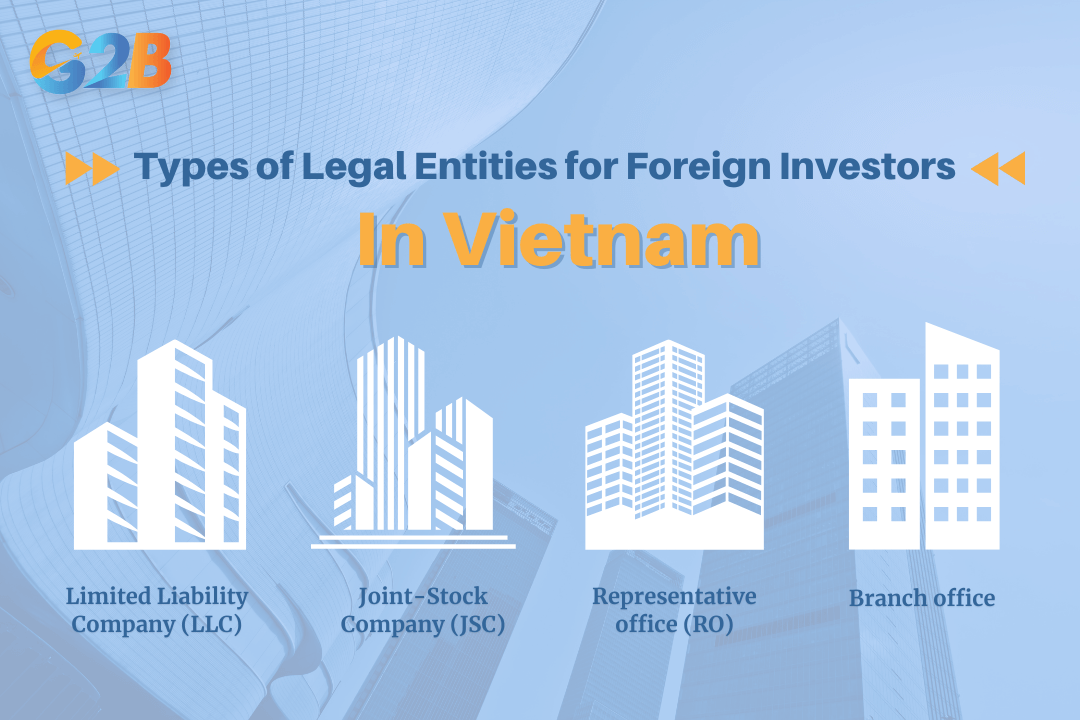
There are 4 common types of legal entities for foreign investors
1. Limited liability company (LLC)
The LLC is the most common entity structure for Small and Medium Enterprises (SMEs) and foreign investors seeking full control. In Vietnam, an LLC is a distinct legal entity where the liability of the owner is limited to the contributed capital.
- Single-member LLC: This structure is owned by one organization or individual. It offers a streamlined management structure and total decision-making authority.
- Multi-member LLC: This structure requires at least two members but no more than fifty. It is suitable for joint ventures or partnerships where capital and risk are shared.
2. Joint stock company (JSC)
A JSC is recommended for medium to large enterprises planning to raise capital or list on the stock exchange in the future.
- Shareholders: It requires a minimum of three shareholders (founders) and has no maximum limit.
- Capital structure: Capital is divided into shares. It is the only corporate form in Vietnam allowed to issue shares to the public.
- Complexity: The corporate governance requirements (Shareholder Meetings, Board of Management, Inspection Committee) are more rigorous than an LLC.
3. Representative office (RO)
An RO is not a separate legal entity and cannot generate revenue or enter into commercial contracts.
- Function: It is strictly limited to market research, liaison activities, and promoting the parent company’s business.
- Risk: If an RO is caught engaging in profit-generating activities, it faces severe penalties.
4. Branch office
Foreign companies can open a branch, but this is generally restricted to specific sectors such as banking, non-life insurance, and legal services. For most trading or manufacturing businesses, a Branch Office is not a viable option due to regulatory restrictions.
Comparison of legal entities
| Feature | Limited Liability Company (LLC) | Joint Stock Company (JSC) | Representative Office (RO) |
|---|---|---|---|
| Foreign ownership | Up to 100% (Sector dependent) | Up to 100% (Sector dependent) | N/A (Dependent on Parent Co.) |
| Minimum investors | 1 Member | 3 Shareholders | N/A |
| Revenue generation | Allowed | Allowed | Strictly prohibited |
| Liability | Limited to Capital Contribution | Limited to Share Capital | Parent Company is Liable |
| Ideal for | SMEs, Manufacturing, Services | Large Corps, IPO Candidates | Market Research only |
Requirements to establish a company in Vietnam
Before initiating the licensing procedures, investors must satisfy specific pre-conditions. The licensing authorities verify these elements strictly to prevent "ghost" companies.
1. Minimum capital requirements
Unlike many jurisdictions, Vietnam does not legally mandate a fixed minimum capital for most business lines (except for regulated sectors such as banking, securities, insurance, and microfinance)
However, the Department of Planning and Investment (DPI) assesses capital based on the "feasibility" of the project.
- The "Sufficient capital" rule: Your Charter capital must be sufficient to cover projected expenses until the company generates revenue.
2. Registered address (physical presence)
You must provide a legal address for the company headquarters.
- Documents required: You must submit a valid Lease Agreement and the landlord’s Certificate of Land Use Rights (LURC).
- Virtual offices: While legally grey, authorities are increasingly scrutinizing virtual offices. If the tax officer conducts a site visit and finds no physical presence, the tax code can be locked.
3. Resident legal representative
Every company in Vietnam must have at least one Legal representative (Director/General director).
- Residency: The company must always have at least one Legal Representative who resides in Vietnam. If they leave the country for more than 30 days, they must authorize another person to act on their behalf.
- Nationality: The representative can be a foreigner or a Vietnamese national.
Step-by-step procedure
The process to establish a company in Vietnam involves two primary licensing phases: The Investment Registration Certificate (IRC) and the Enterprise Registration Certificate (ERC).
To simplify this complex journey, many investors utilize a professional Vietnam Incorporation Service to handle IRC and ERC applications efficiently.
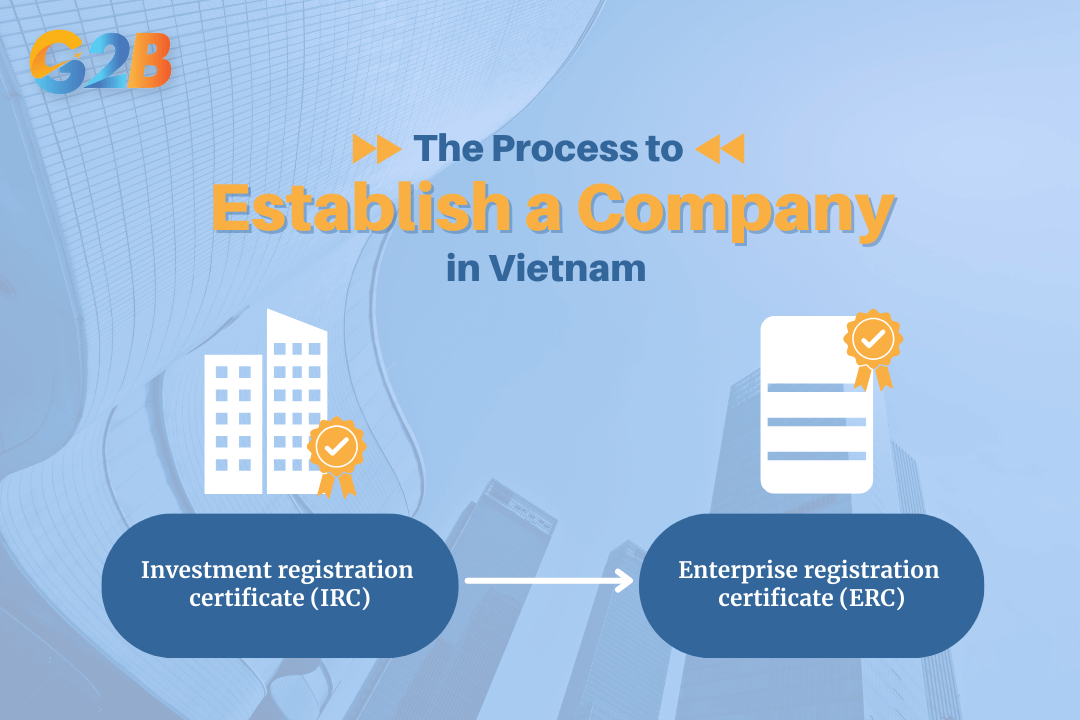
The process to establish a company in Vietnam involves two primary licensing phases
Step 1: Investment registration certificate (IRC)
This is unique to foreign investors. The government must approve your "project" before you form the company.
- Authority: Department of Planning and Investment (DPI).
- Timeline: Approximately 15 working days from the submission of a complete dossier.
- Key documents: You must submit consular legalized documents, such as the investor’s passport (individual) or business license (organization), and a commitment to financial capabilities (bank statements are required only for large-scale projects).
- Outcome: Issuance of the IRC, which outlines the project scope, location, and capital.
Step 2: Enterprise registration certificate (ERC)
Once the IRC is issued, you apply for the ERC. This is equivalent to the Certificate of Incorporation.
- Authority: Business Registration Office (under DPI).
- Timeline: Approximately 3 to 5 working days.
- Outcome: Issuance of the ERC, which contains your Tax Identification Number and company registration details.
- Legal status: Upon ERC issuance, the company legally exists.
Step 3: Post-licensing compliance
Many investors believe the process ends at the ERC. It is warned that failing to complete post-licensing steps results in penalties.
- Seal carving: Create the company seal and manage it internally (notification to the police is no longer required, but internal management is vital).
- Bank accounts: Open two types of accounts:
- Direct Investment Capital Account (DICA): Strictly for receiving capital injection from abroad.
- Current account: For daily operational transactions.
- Capital injection: You must transfer the full Charter Capital within 90 days from the date of IRC issuance. Failure to do so results in fines up to 30 million VND and potential license revocation.
- Digital signature (Token): Purchase an electronic signature token for tax filing.
- Business license tax: Pay the annual license fee (exempt for the first year under 2025 regulations).
- Public announcement: Publish the registration information on the National Business Registration Portal.
Timeline and costs
Planning your budget and schedule is essential for a smooth market entry.
Estimated timeline
- Standard service/Trading company: 1 to 1.5 months.
- Manufacturing company: 2 to 3 months (requires environmental and fire safety permits).
- Conditional sectors (e.g., Retail, education, cosmetics): 3 to 4 months due to ministry-level approvals.
Cost structure
Costs are divided into State fees and Legal/Service fees.
- State fees: These are relatively nominal (approx. $100-$200 USD for basic filings).
- Service fees: Professional fees for legal counsel, drafting, translation, and representation typically range from $1,500 to $5,000 USD, depending on the complexity of the business lines.
- Retainer: Be prepared for costs associated with the registered address (rent) and consular legalization of foreign documents in your home country.
Important 2025 legal updates
The regulatory landscape in Vietnam is dynamic. As of 2025, several key updates impact how you establish a company in Vietnam.
1. Beneficial ownership transparency (effective July 1, 2025)
New regulations aim to align Vietnam with international anti-money laundering standards. Companies must now maintain and submit a register of Beneficial Owners - individuals who ultimately own or control more than 25% of the charter capital.
- Implication: Investors using nominee structures must be cautious. The DPI requires transparency regarding the ultimate individual behind the investment.
2. Global minimum tax (pillar two)
Vietnam has adopted the Global Minimum Tax (GMT) rate of 15% for multinational enterprises (MNEs) with consolidated revenue exceeding €750 million.
- Impact: While this affects large MNEs, it signals a shift away from "tax holidays" as the primary incentive. Vietnam is now pivoting toward cost-based incentives (e.g., subsidies for high-tech training or R&D) rather than pure tax breaks.
3. Mandatory e-invoicing
Electronic invoicing is now mandatory nationwide for all enterprises. New companies must register for e-invoices immediately upon incorporation. The General Department of Taxation has implemented real-time data tracking, meaning discrepancies in revenue reporting are flagged instantly.
Ongoing compliance and tax obligations
Operating a company in Vietnam requires strict adherence to tax laws. G2B provides Incorporation services that include corporate secretarial service to help you not miss any deadline. This includes managing your company's financial structure and ensuring all reporting requirements are met
Additionally, companies must appoint a chief accountant in Vietnam to oversee statutory bookkeeping and audited financial statements
Corporate income tax (CIT)
- Standard rate: 20% on net profits.
- Incentives: Preferential rates (10%, 15%, or 17%) are available for projects in high-tech zones, socio-economically difficult areas, or specific sectors like software development and environmental protection.
Value-added tax (VAT)
- Standard rate: 10% for most goods and services.
- Updates: Certain goods previously enjoying VAT reductions may revert to standard rates in 2026.
Mandatory auditing
Unlike local Vietnamese companies, all Foreign-Invested Enterprises (FIEs) are required by law to have their annual financial statements audited by an independent auditing firm.
- Deadline: The audited report must be submitted within 90 days from the end of the fiscal year (usually March 31st).
Foreign contractor tax (FCT)
If your Vietnam company pays for services provided by foreign entities (e.g., software licensing from a US parent, management fees), you must withhold FCT (a combination of VAT and CIT) before remitting payment.
Challenges foreign investors face
While the opportunities are vast, the road to establish a company in Vietnam is not without hurdles.
1. Consular legalization delays
Documents issued overseas (Passports, Articles of Incorporation, Bank Statements) must be notarized, certified by the Ministry of Foreign Affairs in the home country, and legalized by the Vietnamese Embassy. This process often causes the most significant delays in the timeline.
2. Conditional business lines
Sectors such as logistics, retail distribution, and education are "conditional." This means they require sub-licenses (e.g., a Trading license for retail) after the ERC is issued.
- The "retail" hurdle: Foreign retailers opening their first outlet often face the "Economic Needs Test" (ENT), although this is being phased out under recent Free Trade Agreements like the EVFTA.
3. Banking and capital flows
Vietnam maintains strict foreign exchange controls.
- Strictness: Banks require precise documentation for every transfer. If capital is not transferred into the correct Direct Investment Capital Account, it cannot be legally repatriated as profit later.
To establish a company in Vietnam in 2026 positions your business in one of Asia’s most resilient and dynamic economies. The combination of a young workforce, competitive labor costs, and an expanding network of Free Trade Agreements makes Vietnam an irresistible destination for global capital. G2B provides Incorporation services with an excellent customer experience, helping you do right from the start and minimising risk when setting up a company in this dynamic environment.
Whether you need a full Vietnam Incorporation Service or specific advice on company setup process and requirements in Vietnam, G2B is here to support your success
