




 Delaware (USA)
  Vietnam
  Singapore
  Hong Kong
  United Kingdom
 Vietnam visa extension allows a foreign citizen to prolong their legal stay in Vietnam without leaving the country. The Vietnam Immigration Department manages this procedure and updates the stay duration for eligible foreigners. Visa policies require applicants to follow specific rules based on their entry purpose. Foreigners must prepare the correct documents, submit applications to local immigration offices, and pay the required government fees. This guide explains the required documents, costs, processing times, and steps to successfully extend a visa in Vietnam.
What is a Vietnam visa extension?
A Vietnam visa extension allows a foreigner to extend their legal stay without leaving Vietnam. The Immigration Department processes these extensions and adds a new stay duration stamp directly into the applicant's passport. The Vietnam Immigration Department evaluates extension requests based on the applicant's visa type, nationality, and sponsor. Foreigners submit their passports to the government office. Officials review the entry history and the current visa status. The government issues a stamp that shows the new exit date. This process keeps the original visa valid. The applicant does not receive a new visa sticker.
An extension differs significantly from a visa renewal and a visa run. A visa extension simply adds days to the current stay. A visa renewal issues a completely new visa sticker. A visa run requires the foreigner to exit Vietnam, enter a neighboring country, and return with a new entry stamp. The extension process saves time and reduces travel expenses for foreigners who want to stay in the country continuously.
What are the types of Vietnam visa extensions?
The Vietnam Immigration Department provides single-entry and multiple-entry visa extensions. Authorities classify these extensions by specific visa symbols, such as DL for tourists, DN for business, TT for family visits, and LD for workers. Foreigners must apply for the extension type that matches their current visa category. The government strictly enforces this rule. A tourist cannot apply for a business extension without changing their visa status. The primary visa extension categories include:
- DL Visa (Tourist): The government issues this extension to foreigners traveling for leisure.
- DN Visa (Business): The government issues this extension to foreigners working with local companies.
- LD Visa (Labor): The government issues this extension to foreigners holding a valid work permit.
- TT Visa (Family tie): The government issues this extension to foreigners visiting family members in Vietnam.
- DT Visa (Investor): The government issues this extension to foreign investors with capital in local businesses.
Authorities grant single-entry extensions to most applicants. A single-entry extension means the foreigner loses the extended visa if they leave Vietnam. Authorities grant multiple-entry extensions for specific business or investor visas. A multiple-entry extension allows the foreigner to leave and return to Vietnam during the extended period.
How do visa types affect extension eligibility?
Visa types determine the maximum extension duration and the required sponsor documents. Tourist visas (DL) typically allow 15 to 45 days of extra stay, while business visas (DN) permit longer extensions with company sponsorship. The Immigration Department limits tourist visa (DL) extensions. Authorities usually grant 15 to 45 days for tourist extensions. The government changes tourist extension policies frequently based on national tourism goals.
Business visas (DN) offer more flexibility. Foreigners can extend a DN visa up to 3 months per extension. A local company must sponsor the DN visa extension. The company provides legal documents to prove the business relationship. Work visas (LD) allow long-term extensions. Foreigners can extend an LD visa for up to the work permit's expiration (typically 6-24 months). The applicant must possess a valid Vietnam work permit. The duration of the LD extension directly matches the expiration date of the work permit. If the work permit expires in eight months, the visa extension will only cover eight months.
Who is eligible for a Vietnam visa extension?
Foreign passport holders qualify for a Vietnam visa extension if their current visa remains valid before the expiration date. Applicants also need a recognized sponsor entity, such as a company or relative, to support the application. The Immigration Department checks the applicant's background. Officials review the entry port, the date of entry, and the activities of the foreigner in Vietnam. The government approves foreigners who follow local laws.
The sponsor entity plays a major role in the eligibility process. A sponsor takes legal responsibility for the foreigner during their stay in Vietnam. For business visas, the local company acts as the sponsor. For family visas, a Vietnamese citizen or a foreign resident acts as the sponsor. Tourists use designated travel agencies as sponsors when the government requires it. The Immigration Department rejects applicants with poor immigration records. Officials deny extensions to foreigners who overstay their current visas. The government also rejects applicants listed on the immigration blacklist. Foreigners enter the blacklist if they commit crimes, work illegally, or violate visa rules.
What conditions must you meet for approval?
The Immigration Department requires applicants to hold a passport with at least six months of validity. Applicants must also strictly comply with their original entry purpose and ensure their documents match their visa category. Approval depends on several strict government rules. Foreigners must meet the following conditions to secure an extension:
- Hold a passport with two or more blank visa pages
- Maintain a passport valid for at least six months beyond the requested extension date
- Reside legally in Vietnam and register their temporary address with the local police
- Hold a visa category that the government currently allows for extension
- Provide accurate sponsor documents that match the original entry purpose
Address registration is a mandatory condition. Vietnamese landlords or hotel managers must register the foreigner's stay on the national police system. Immigration officers check this online database before approving any visa extension.
What documents are required for a Vietnam visa extension?
Applicants must submit their original passport, a copy of their current visa, and the completed NA5 application form. The sponsoring entity must also provide legal business documents or official proof of family relationship. Document preparation is the most critical part of the extension process. The Vietnam Immigration Department refuses incomplete dossiers. Both the foreigner and the sponsor must prepare specific forms. The standard document package includes:
- Original passport: The passport must contain the current Vietnam visa and entry stamp
- Application form (NA5): The sponsor and the applicant must fill out and sign the NA5 form
- Temporary residence registration: The applicant must print the online police registration confirmation
- Sponsor documents: The sponsor must provide certified copies of their legal status
The NA5 form is the official government document for visa issuance and stay extension. The applicant writes their personal details, passport information, and requested stay duration on this form. The sponsor stamps and signs the bottom section of the NA5 form to confirm their responsibility.
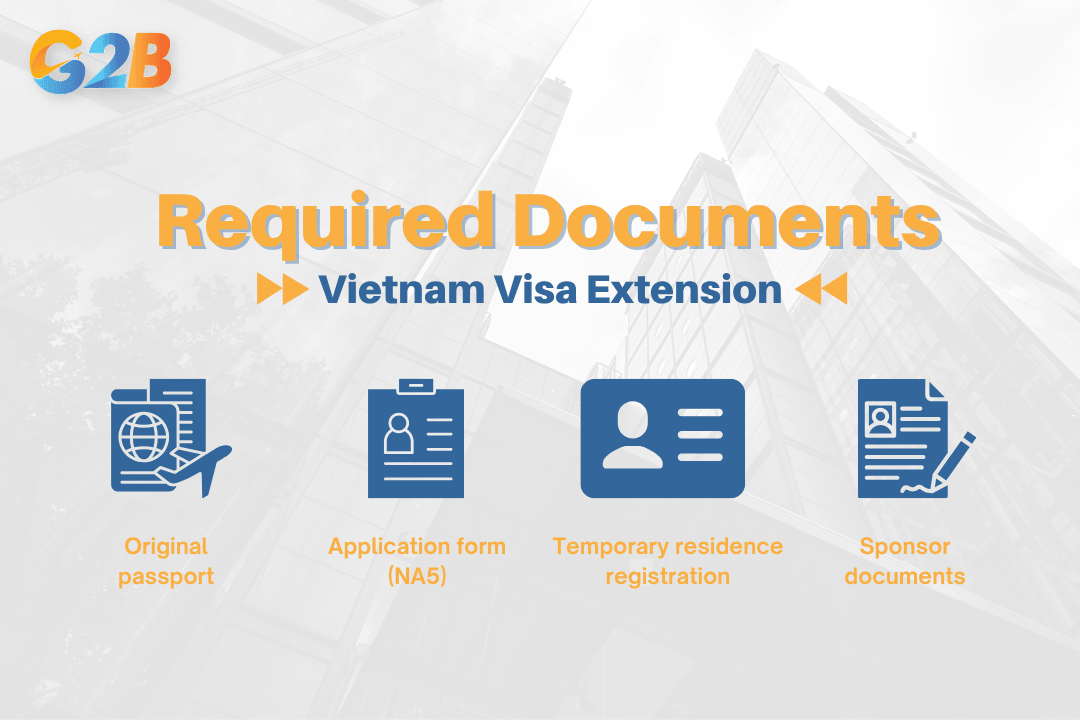
There are 04 required documents for the Vietnam visa extension
Which documents vary by visa type?
Tourist visas require fewer documents, usually only the passport and the NA5 form. Business visas require a company introduction letter, while work visas mandate a valid work permit or a work permit exemption certificate. Different visa symbols require different supporting evidence. The Immigration Department uses these documents to verify the applicant's activities in Vietnam:
- Tourist visa (DL) documents: Tourists provide the simplest dossiers. Applicants submit their original passport, the NA5 form, and the temporary residence confirmation. Sometimes, the government requires a licensed travel agency to stamp the NA5 form as a sponsor
- Business visa (DN) documents: Business extensions require extensive corporate paperwork. The required business documents include:
- A certified copy of the company's Business Registration Certificate
- A certified copy of the Investment Certificate (if applicable)
- Company tax code and decision appointing the legal representative
- A formal introduction letter from the sponsoring company
- Work visa (LD) documents: Foreign workers must prove their legal employment status. The required labor documents include:
- A certified copy of the valid Vietnam Work Permit
- The original passport and NA5 form signed by the employer
- The company's Business Registration Certificate
- The employee's temporary residence registration
- Employer's decision on foreign worker employment
- Family tie visa (TT) documents: Family visitors must prove their relationship with the sponsor. The required family documents include:
- A certified marriage certificate for spouses
- A certified birth certificate for children
- The sponsor's Vietnamese ID card or a valid foreign residence card
How to extend a Vietnam visa step by step?
Foreigners extend a Vietnam visa by preparing the required documents, submitting the dossier to the Immigration Office, and waiting for verification. Officials process the request and return the passport with the new extension stamp. The extension process follows a strict timeline. Applicants must complete each step correctly to avoid rejection. The government operates Immigration Offices in major cities like Hanoi, Da Nang, and Ho Chi Minh City.
Follow these exact steps to complete a Vietnam visa extension:
- Prepare the application dossier: Gather the original passport, the completed NA5 form, and the specific sponsor documents based on the visa type. Check all signatures and company stamps
- Submit documents to the Immigration Office: Take the physical dossier to the nearest Vietnam Immigration Department office. The officer will review the documents at the counter
- Receive the receipt and pay fees: The officer issues a receipt (appointment slip) if the dossier is complete. Pay the government processing fee at the cashier counter
- Wait for processing: The Immigration Department verifies the documents. Officials check police records and sponsor validity during this time
- Collect the extended visa: Return to the Immigration Office on the date printed on the receipt. Present the receipt, and receive the passport with the new visa extension stamp
Applicants can also submit documents through the National Public Service Portal online. However, the online system still requires the applicant to mail or deliver the physical passport to the Immigration Office to receive the final stamp. Many foreigners use consulting agencies to handle this physical submission step.
How long does a Vietnam visa extension take?
The Vietnam Immigration Department generally processes visa extensions within 5 to 7 working days. Applicants can use urgent processing services through specialized agencies to reduce the waiting time to 2 to 3 working days. Working days exclude weekends and Vietnamese public holidays. If an applicant submits their dossier on a Friday, the processing time starts on the following Monday. The Immigration Department holds the applicant's original passport during the entire processing period. Foreigners cannot travel internationally or check into new hotels easily without their passports. Urgent processing is available for emergencies. Consulting agencies coordinate with immigration officials to speed up the verification process. Urgent services require higher service fees.
What factors affect processing time?
Processing times depend on the complexity of the visa type, the applicant's nationality, and the completeness of the application. Incomplete dossiers or high-risk nationalities often cause significant delays in the government verification process. Several factors increase the waiting period for an extension:
- Visa category: Tourist visas process faster than business or investor visas. Business visas require officials to verify the local company's tax status and operational history
- Application completeness: Missing signatures, incorrect company stamps, or outdated forms force officers to pause the process. The applicant must fix the errors and restart the waiting period
- Public holidays: Vietnam celebrates long holidays, such as the Lunar New Year (Tet). The Immigration Department closes during these periods. Applications submitted near holidays face major delays
- Nationality restrictions: The government applies stricter security checks to certain nationalities. Citizens from countries with high rates of visa violations experience longer verification times
- Location: Provincial immigration offices sometimes send complex dossiers to the central headquarters in Hanoi or Ho Chi Minh City. This transfer adds extra transit days to the process
How much does a Vietnam visa extension cost?
A Vietnam visa extension costs between $60 and $500, depending on the visa category, the requested duration, and the applicant's nationality. Government fees and agency service charges determine the final price of the extension. The cost of a visa extension includes two main parts. First, the applicant pays the mandatory government stamping fee. Second, the applicant pays a service fee if they use an agency or a sponsor company. Tourist extensions generally cost less than business extensions. Long-term work visa extensions carry the highest costs due to the required legal verification.
| Visa type | Extension duration | Estimated total fee (USD) | Primary user |
|---|---|---|---|
| Tourist (DL) | 15-45 days | $50 - $120 | Travelers, backpackers |
| Business (DN) | Up to 3 months | $100 - $300 | Meeting attendees, corporate guests |
| Work (LD) | up to a work permit | $150 - $400 | Employed expatriates, managers |
| Family (TT) | 1-3 months | $80 - $200 | Spouses, children of residents |
Note: Extension fees fluctuate based on current immigration policies and agency service rates. The table represents average market estimates.
Applicants must pay government fees in Vietnamese Dong (VND) at the Immigration Office. Agencies usually accept payments in USD or VND. The government does not refund extension fees if they reject the application.
What is the difference between visa extension and visa renewal?
A visa extension keeps the current visa type and adds a new stay duration stamp to the passport. A visa renewal issues a completely new visa sticker with a new duration, often requiring different documents. Many foreigners confuse visa extensions with visa renewals. The Vietnam Immigration Department treats these as two separate legal procedures:
- Visa extension details: An extension simply pushes the exit date further into the future. The visa symbol remains exactly the same. The entry category remains the same (single or multiple). The government places a small ink stamp on a passport page indicating "Permitted to remain until [Date]". This process is cheaper and requires less paperwork.
- Visa renewal details: A renewal cancels the old visa and provides a brand-new visa sticker. The applicant receives a new visa number. A renewal allows the foreigner to change their visa category. For example, a foreigner can renew a 1-month single-entry visa into a 3-month multiple-entry visa. A renewal costs more because it involves issuing new secure stickers. Sometimes, the government requires the foreigner to exit Vietnam to activate a renewed visa.
Compare the two processes below:
| Feature | Visa extension | Visa renewal |
|---|---|---|
| Physical result | Ink stamp in passport | New visa sticker |
| Visa category | Remains the same | Can be changed |
| Entry type | Remains the same | Can upgrade to multiple-entry |
| Processing cost | Generally lower | Generally higher |
| Required action | Stay inside Vietnam | May require border exit |
What mistakes cause Vietnam visa extension rejection?
The Immigration Department rejects visa extensions when applicants submit incomplete documents or apply after their current visa expires. Officials also deny extensions if foreigners misuse their visa purpose, such as working illegally on a tourist visa. The government enforces strict immigration laws. Simple paperwork errors lead to immediate rejections. Understanding these common mistakes helps applicants prepare better dossiers.
Common reasons for rejection include:
- Overstaying the current visa: Applying after the visa expiration date is a serious violation. The government fines the applicant and often rejects the extension request.
- Misusing the visa purpose: Foreigners holding a DL (tourist) visa cannot engage in paid work. If officials discover illegal employment, they reject the extension and deport the foreigner.
- Using fake sponsor documents: Some foreigners buy fake company sponsorships to get DN visas. The Immigration Department verifies company tax records. Officials reject applications tied to fake or non-operational companies.
- Submitting incorrect forms: Using an outdated version of the NA5 form causes rejection.
- Failing police registration: Landlords must register foreigners online. If the Immigration Department cannot find the applicant's name in the police database, they reject the application.
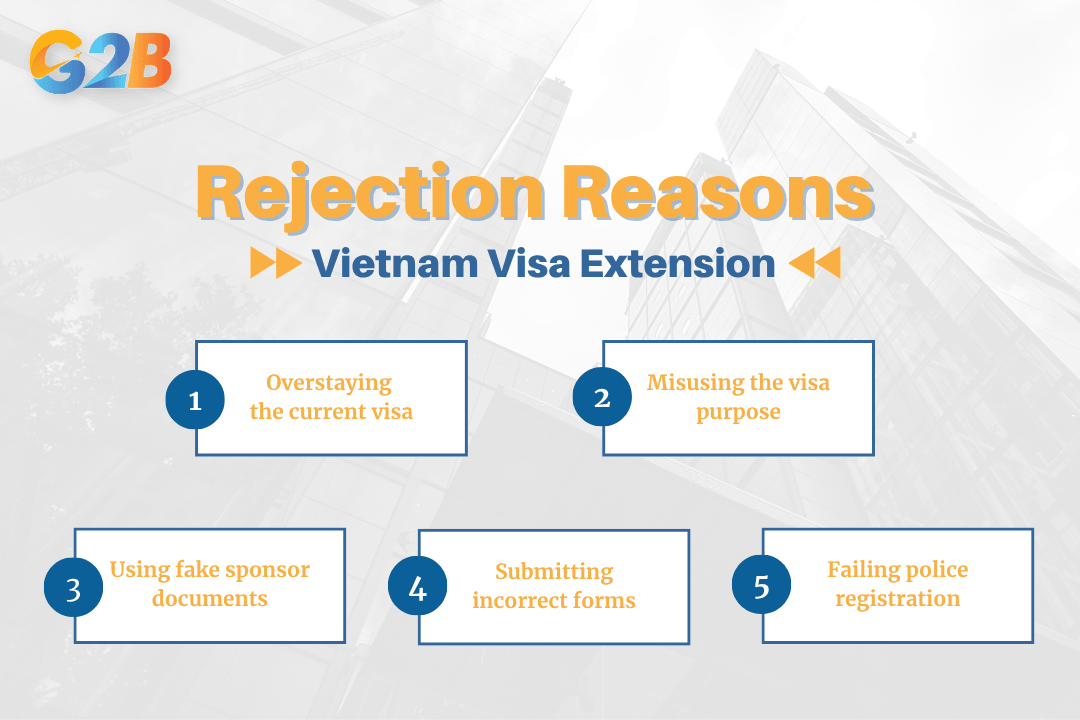
5 possible reasons for rejection of the visa extension
How can you avoid rejection?
Foreigners avoid visa rejection by submitting accurate documents and applying at least 5 to 7 days before their visa expires. Applicants should also consult licensed visa agencies when handling complex business or work visa extensions. Preparation is the best defense against rejection. Applicants must double-check all documents before visiting the Immigration Office.
Required steps to prevent rejection include:
- Ask the landlord to print the police residence registration receipt immediately upon check-in.
- Submit the NA5 form to the Immigration Office at least one week before the current visa expires.
- Ensure the passport has a minimum of six months validity and two blank pages.
- Verify that the sponsor company has paid all local taxes and maintains an active business license.
- Hire professional consultants.
Should you extend a visa or do a visa run in Vietnam?
A visa extension saves travel time and flight costs by allowing foreigners to stay continuously inside the country. A visa run requires the foreigner to exit and re-enter Vietnam to reset the visa duration completely. Foreigners choose between an extension and a visa run based on their budget, location, and long-term plans. Both methods achieve the goal of staying in Vietnam legally, but they serve different needs:
- Choosing a visa extension: An extension suits foreigners who want to avoid travel disruptions. It works best for individuals settled in a specific city who cannot take days off from work. Extensions cost more in government processing fees but save money on flights and hotel bookings. Extensions keep the current visa active without changing the entry conditions.
- Choosing a visa run: A visa run suits foreigners who need a completely new visa type. A visa run involves traveling to a land border (like Moc Bai or Lao Bao) or taking a short flight to a neighboring country (like Thailand or Cambodia). The foreigner exits Vietnam, applies for a new evisa or sponsor visa, and re-enters.
Visa runs provide specific advantages:
- They reset the visa duration completely (e.g., getting a new 90-day evisa).
- They allow foreigners to change their visa symbol (e.g., switching from a DL tourist visa to a DN business visa).
- They bypass strict extension limits placed on certain tourist visas.
However, visa runs cost money for transportation, border fees, and new evisa applications. They also require physical travel, which takes one or two full days.
What are practical tips for extending a Vietnam visa?
Foreigners must apply early to avoid daily overstay penalties and confirm their specific visa symbol before starting the process. Applicants should also track policy updates from the Vietnam Immigration Department to ensure compliance with rules. Navigating the immigration system requires attention to detail. Foreigners who prepare well experience smooth processing times. Follow these practical tips for a successful extension:
- Apply early: Submit the dossier 7 days before the visa expires. The Immigration Department accepts early applications. Early submission prevents overstay fines if the dossier needs corrections.
- Check overstay fines: The government charges high penalties for expired visas. Fines range from 500,000 VND to several million VND per day. Prolonged overstays result in deportation and blacklisting.
- Monitor policy changes: The Vietnam government updates visa rules frequently. Check official portals for the latest NA5 forms and duration limits.
- Secure the passport: Do not plan domestic flights or train travel during the extension period. The Immigration Department keeps the original passport for 5 to 7 days.
- Work with reliable sponsors: Ensure the sponsoring company operates legally. Ghost companies trigger immigration audits.
- Prepare extra photos: Always carry extra 4x6 cm passport photos with a white background. Officials sometimes request additional photos for system updates.
Extending a visa in Vietnam involves strict adherence to government regulations. Foreigners must identify their visa type, secure a valid sponsor, and prepare the exact documents required by the Immigration Department. Tourist visas require simple paperwork, while business and work visas demand comprehensive corporate dossiers. Processing generally takes 5 to 7 working days, and costs vary based on the duration and visa category. By applying early and maintaining legal residence registration, applicants avoid overstay penalties and rejection.
Ready to work or stay in Vietnam? Contact G2B today for a consultation on Work permit/TRC/Business visa services in Vietnam. Our team will guide you through the procedures and required documents to help ensure a smooth and compliant application process.
