





 Delaware (USA)
  Vietnam
  Singapore
  Hong Kong
  United Kingdom
 Registering a company in Da Nang provides foreign investors with strategic access to Central Vietnam's most dynamic economic hub. Da Nang consistently ranks among the top provinces in Vietnam’s Provincial Competitiveness Index (PCI), offering unparalleled infrastructure, a highly skilled workforce, and transparent administrative procedures. The city acts as the primary gateway to the East-West Economic Corridor, making foreign investment in Da Nang highly attractive for global corporations.
Types of companies to establish in Da Nang
Selecting the correct corporate structure dictates your legal liability, management hierarchy, tax obligations, and ability to raise external capital. Foreign investors must carefully evaluate their business model against the statutory frameworks provided by the Vietnamese legal system.
Limited liability company (LLC)
The Limited Liability Company (LLC) stands as the most popular and efficient corporate structure for foreign investors entering Vietnam. An LLC accommodates 1 to 50 members, and the legal liability of each member is strictly capped at the exact amount of charter capital they contribute to the enterprise. This structure offers a streamlined management system, making it highly advantageous for small to medium-sized enterprises (SMEs) and wholly foreign-owned enterprises (WFOEs). A Single-Member LLC is entirely owned by one individual or corporate entity, governed by a Company President or a Members' Council, and managed by a General Director. The lack of public share issuance protects the company from hostile takeovers and simplifies internal decision-making processes.
Joint stock company (JSC)
A Joint Stock Company (JSC) is the mandatory corporate structure for enterprises seeking to raise capital through public markets or issue stock. A JSC requires a minimum of three founding shareholders, with no legal maximum limit on the total number of shareholders. The company's charter capital is divided into equal units known as shares. This structure mandates a more complex governance framework, requiring a General Assembly of Shareholders, a Board of Management, a General Director, and an Inspection Committee. While the administrative and reporting requirements are significantly heavier than LLC, JSC is the ideal vehicle for large-scale startups, heavy manufacturing projects, or entities planning a future Initial Public Offering (IPO) in Vietnam.
Representative office
A Representative Office (RO) operates as a dependent unit of a foreign parent company. The Vietnamese Commercial Law strictly prohibits a Representative Office from conducting any revenue-generating or commercial activities. The authorized functions of an RO are limited to specific non-commercial operations, such as market research, brand promotion, establishing local business contacts, and monitoring the implementation of the parent company's existing contracts in Vietnam. Setting up an RO allows foreign corporations to maintain a legal presence in Da Nang, hire local staff, and evaluate the market potential before committing substantial capital to open a company in Da Nang.
Branch office
A Branch Office functions as a direct legal extension of a foreign parent company and is fully authorized to conduct commercial, revenue-generating activities within Vietnam. However, the Vietnamese government permits Branch Offices for foreign enterprises operating at least 5 years in sectors aligned with Vietnam's WTO commitments and international treaties (e.g., banking, insurance, aviation, construction, and certain distribution services), subject to DPI approval. Unlike an LLC, the parent company retains full financial liability for all debts and obligations incurred by the Branch Office.
Legal requirements for company formation in Da Nang
To successfully complete a business setup Vietnam, foreign investors must fulfill exact statutory conditions enforced by the Da Nang Department of Planning and Investment (DPI).
Company name rules
The Vietnamese Enterprise Law enforces stringent regulations regarding corporate naming. A valid company name must consist of two mandatory components: The corporate form followed by the proper name. The proposed name must not identically match or cause phonetic confusion with any previously registered enterprise in the National Business Registration Portal. Furthermore, businesses are strictly prohibited from using the names of state agencies, military units, or political organizations. Foreign investors commonly register three variations of the name: The primary Vietnamese name, the English translation, and an abbreviated corporate name.
Registered office address
Every enterprise must declare a legitimate, physical registered office address located within the territory of Da Nang. The address requires detailed geographic identifiers, including the house number, street, ward, district, and city. Foreign-owned enterprises are strictly prohibited from utilizing residential apartment buildings or condominiums as commercial office addresses. The investor must present an official commercial lease agreement, accompanied by the landlord's legal documentation, such as the Certificate of Land Use Rights (Red Book), the construction permit, and the landlord's enterprise registration certificate (if the landlord is a real estate company).
Charter capital
Charter capital represents the total value of assets contributed or committed by members upon the establishment of the enterprise. While there is no general statutory minimum capital requirement for most commercial sectors, conditional sectors (e.g., logistics, education) impose specific thresholds (such as 10 billion VND for logistics). the Da Nang DPI requires the declared capital to logically align with the operational scale and expenses of the business plan. Investors must fulfill their capital contribution strictly within 90 days from the date the Enterprise Registration Certificate (ERC) is issued. Foreign investors must transfer these funds from their overseas bank accounts directly into a specific Vietnamese bank account known as the Direct Investment Capital Account (DICA) to comply with foreign exchange control regulations.
Business lines
Foreign companies operating in Da Nang must register their commercial activities using the Vietnam Standard Industrial Classification (VSIC) codes. During the company registration Da Nang process, the DPI cross-references these VSIC codes against Vietnam's World Trade Organization (WTO) commitments and bilateral investment treaties. Certain business lines - such as education, healthcare, logistics, and real estate - are classified as "conditional sectors." Entering conditional sectors requires the investor to satisfy additional criteria, such as minimum capital thresholds, specialized sub-licenses, joint-venture requirements with local partners, and professional capability certifications.
Step-by-step process of company formation in Da Nang
The procedure to start a business in Da Nang requires methodical execution. Missing a single legal step or submitting incorrectly formatted documentation will result in immediate rejection by the licensing authorities.
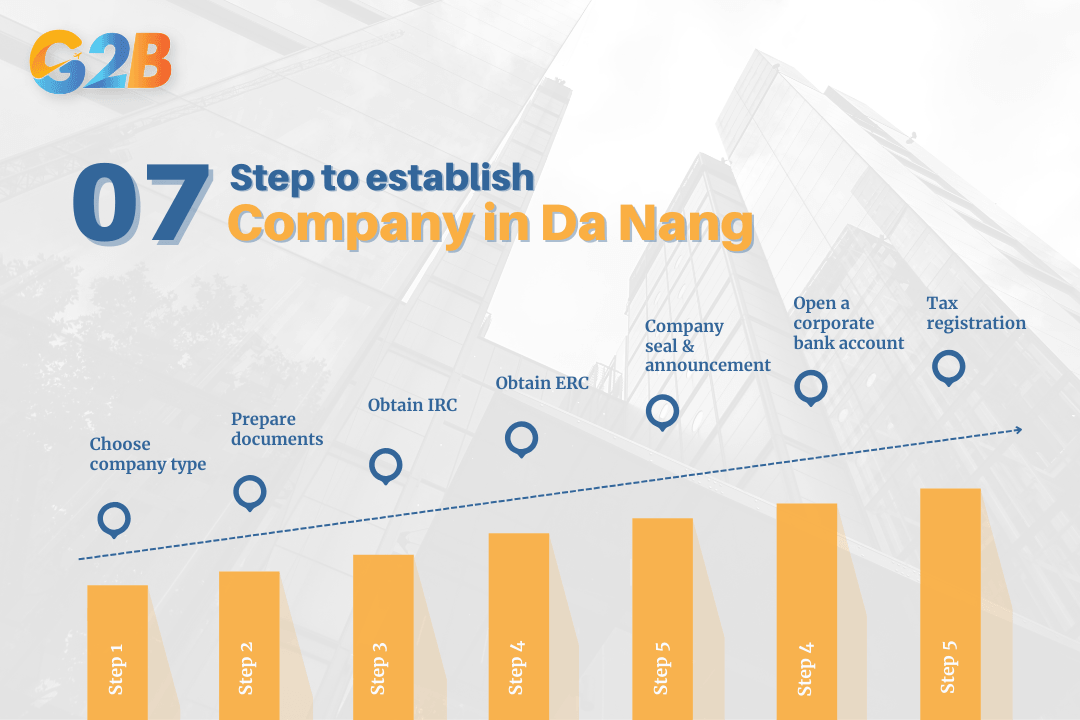
7-step process of establishing a company in Da Nang
Step 1: Choose company type
Evaluate your business plan, intended market scale, and long-term capital requirements to select the appropriate corporate vehicle. For over 90% of foreign SMEs entering Da Nang, the Single-Member LLC or Multi-Member LLC serves as the optimal structure due to its operational flexibility and limited liability protection.
Step 2: Prepare documents
Document preparation involves gathering all personal, corporate, and financial records. Foreign-issued documents must undergo Consular Legalization. This exact legal procedure requires the documents to be notarized in the home country, authenticated by the home country's foreign affairs department, and finally legalized by the Vietnamese Embassy or Consulate. Once imported into Vietnam, these documents must be translated into Vietnamese and certified by a state-appointed notary public.
Step 3: Obtain Investment Registration Certificate (IRC)
The Investment Registration Certificate (IRC) is the foundational legal document mandatory for all foreign direct investment (FDI) projects in Vietnam. The IRC evaluates the investment project rather than the corporate entity. Applications are submitted to the Da Nang DPI or, if locating within an industrial zone, the Da Nang Hi-Tech Park and Industrial Zones Authority (DHPIZA). The licensing authority evaluates the project based on criteria such as environmental impact, land use requirements, technology transfer, and socio-economic benefits to Da Nang. Securing the IRC proves that the Vietnamese government officially approves the foreign investor's project.
Step 4: Obtain Enterprise Registration Certificate (ERC)
Upon successful issuance of the IRC, the investor submits a secondary dossier to obtain the Enterprise Registration Certificate (ERC). The ERC functions as the official certificate of incorporation, officially recognizing the company as a legal entity under Vietnamese law. This document contains the enterprise's unique tax identification number, legal representative details, and registered charter capital. Both the IRC and ERC are absolutely vital for a foreign-owned enterprise to operate legally in Vietnam.
Step 5: Company seal and announcement
After receiving the ERC, the newly established enterprise must design and manufacture a corporate seal (company stamp). Under the Enterprise Law of 2020, companies hold the authority to determine the physical form, content, and quantity of their corporate seals or use digital seals (Digital Seal) via the National Business Registration Portal since 2024. Simultaneously, the company must pay a statutory fee to publish its business registration information on the National Business Registration Portal within 30 days of ERC issuance. Failure to publish this announcement results in administrative financial penalties.
Step 6: Open a corporate bank account
The legal representative must visit a legally recognized commercial bank in Da Nang to open the corporate accounts. A foreign-owned enterprise must open two distinct accounts: a Direct Investment Capital Account (DICA) specifically designed to receive the initial charter capital and facilitate future profit repatriation, and a standard Current Account (VND) used for daily domestic transactions, payroll, and local tax payments.
Step 7: Tax registration
The final step in company formation requires activating the company's tax profile. The company must purchase a Digital Signature Token (USB Token) used to sign electronic tax declarations. The chief accountant or legal representative logs into the General Department of Taxation portal to register the digital signature, activate the electronic invoice system (e-invoices), and submit the initial tax registration forms, including the declaration of the annual business licensing tax.
Required documents for company registration
The licensing authorities require an exhaustive dossier of verified documents to approve an FDI project. The exact requirements vary based on the legal status of the investor:
For individual investors: Individual foreign investors must provide a consular-legalized copy of their valid passport. Additionally, they must prove financial capacity to fund the company. This is demonstrated by providing an official bank statement showing a cash balance equal to or exceeding the intended charter capital. The bank statement must be recently issued (typically within the last 30 to 90 days).
For corporate investors: Foreign corporate entities must present a complex legal dossier. Required documents include the parent company’s Certificate of Incorporation (or equivalent business license), the company’s Articles of Association (Company Charter), and audited financial statements for the two most recent fiscal years. Furthermore, the parent company must draft an official Board Resolution authorizing the investment in Da Nang and appointing an Authorized Representative to manage the subsidiary in Vietnam.
Other documents: Regardless of the investor's status, the dossier must include operational documents, such as the proposed company charter, the detailed investment project proposal, the commercial lease agreement in Da Nang, and the landlord's legal ownership certificates.
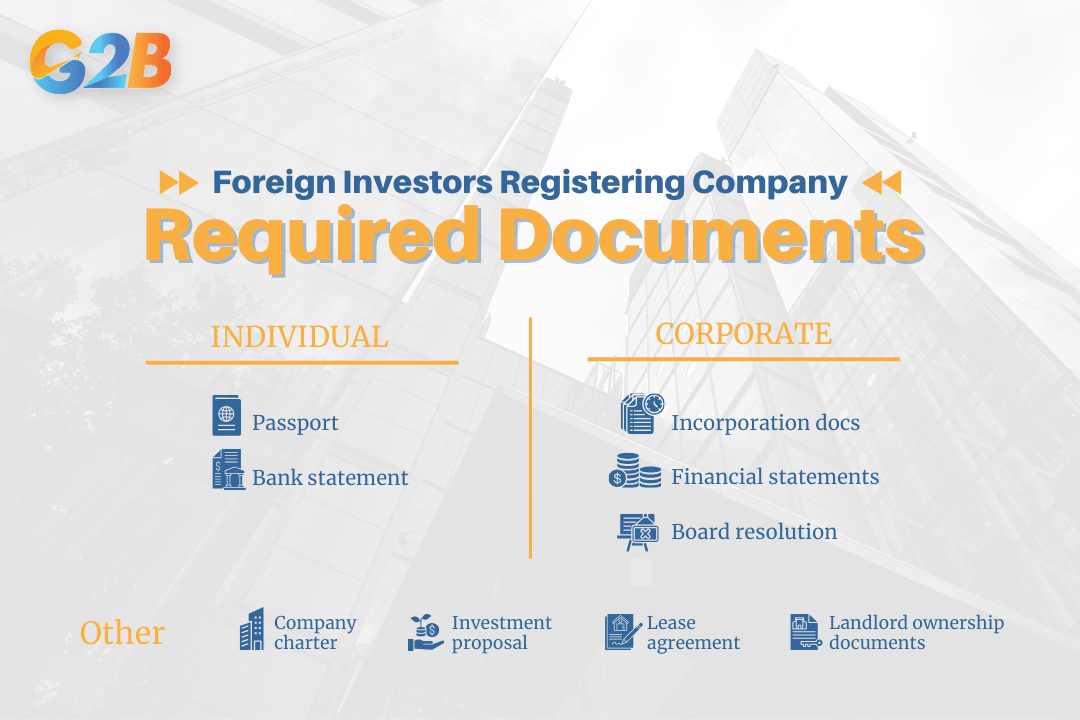
Required documents for company registration for individual investors and corporate investors
Costs of company formation in Da Nang
Understanding the exact financial requirements ensures accurate budgeting for your market entry. The total cost of establishment is divided into mandatory state fees, operational setup costs, and professional advisory fees. State administrative fees cover the processing of the IRC, ERC, and the mandatory publication fee on the National Business Registration Portal. Operational setup costs include physical assets and software required by law, such as the corporate seal engraving, the digital signature token subscription, electronic invoice software licensing, and the initial business license tax.
Office rental costs in Da Nang are significantly more competitive than in Hanoi or Ho Chi Minh City. A standard commercial office lease in central districts (Hai Chau or Son Tra) requires a deposit (usually equivalent to 2 to 3 months of rent) and advance rental payments. Legal and consulting fees vary depending on the complexity of the business lines.
Timeline for setting up a company
The statutory timeline for registering a foreign-owned enterprise strictly depends on the accuracy of the submitted dossier. Any errors in translation, consular legalization, or formatting will trigger official requests for modification, resetting the official timeline.
| Step | Time | Description |
|---|---|---|
| Document Preparation | 14 - 21 days | Consular legalization, notarization, and translations. |
| IRC | 15 - 20 days | Statutory review period by DPI or DHPIZA. |
| ERC | 3 - 7 days | Issuance of the corporate entity license and Tax Code. |
| Post-licensing | 3 - 5 days | Seal engraving, portal publishing, and Digital Token setup. |
| Bank account | 1 week | Verification of legal representative and DICA activation. |
Note: Conditional business sectors requiring additional sub-licenses will extend this timeline by 30 to 60 days. Projects under 300 billion VND skip IRC, reducing total time to 20-30 days.
Post-registration compliance
Securing the business licenses only marks the beginning of corporate compliance in Vietnam. The General Department of Taxation enforces strict reporting deadlines, and failure to comply results in severe financial penalties or the revocation of the ERC:
- Companies must pay the annual Business License Tax no later than January 30th of each fiscal year. The company must implement a compliant Vietnamese Accounting System (VAS) to handle ongoing reporting. The enterprise is legally required to submit quarterly Value Added Tax (VAT) reports, Personal Income Tax (PIT) declarations for employees, and Corporate Income Tax (CIT) provisional payments. The standard CIT rate in Vietnam is 20%.
- Employers must register with the Da Nang Department of Labor, Invalids, and Social Affairs to pay mandatory state insurance. This includes social insurance, health insurance, and unemployment insurance for all contracted employees. Finally, wholly foreign-owned enterprises must conduct an independent audit of their financial statements and submit the annual audited report to the local tax authority, the statistical office, and the DPI within 90 days of the fiscal year-end.
Best industries for foreign investors in Da Nang
Da Nang’s targeted economic strategy prioritizes clean, high-value industries. The city government actively deploys investment incentives, including CIT reductions and land rent exemptions, for specific strategic sectors:
- IT & Software development: Da Nang has positioned itself as the "Silicon Valley of Central Vietnam". The Da Nang IT Park offers state-of-the-art infrastructure specifically designed to attract software development, AI research, and high-tech startups.
- Tourism & Hospitality: With pristine coastlines and proximity to UNESCO World Heritage sites, Da Nang is a premier international tourist destination. Investing in boutique resorts, specialized tour operations, and high-end hospitality services yields substantial returns.
- Logistics & Supply chain: Anchored by the expansion of the Lien Chieu deep-water port and the Da Nang International Airport, the city acts as a critical node for maritime and aviation logistics connecting ASEAN markets.
- High-tech manufacturing: The Da Nang High-tech park heavily incentivizes advanced manufacturing processes, precision engineering, and renewable energy production, moving away from labor-intensive factories toward automated industrial setups.
Benefits of setting up a company in Da Nang
Foreign investors strategically choose Da Nang to optimize their operational frameworks and maximize profitability. The city guarantees substantial economic advantages over traditional Asian megacities:
- The operational and living costs in Da Nang remain exceptionally competitive. Office leasing rates, industrial land rentals, and local utility costs are considerably lower than those found in Ho Chi Minh City or Hanoi. This cost-efficiency accelerates the enterprise's timeline to profitability.
- Da Nang boasts a highly skilled, multilingual workforce. Top-tier educational institutions, such as the University of Da Nang and specialized technical colleges, continuously supply a robust talent pool of engineers, software developers, and bilingual managers.
- The local government provides an exceptionally supportive, transparent administrative environment. Da Nang’s DPI operates a centralized "single-window" public service system, effectively streamlining bureaucratic procedures and prioritizing foreign direct investment. Furthermore, enterprises investing in specialized high-tech zones benefit from aggressive tax holidays, including four years of absolute CIT exemption followed by nine years at a reduced 50% rate.
Common challenges for foreign investors when setup company in Da Nang
While the investment climate is highly favorable, foreign investors still encounter distinct operational bottlenecks during the initial market entry phase. The most prominent challenges include navigating licensing complexity, overcoming deep language barriers with local administrative bodies, and interpreting frequent updates to tax and labor regulations. Submitting an application with a single formatting error or an incorrect VSIC code mismatch often leads to prolonged legal deadlocks and capital deployment delays.
Registering a legal entity in Da Nang presents a highly lucrative opportunity for foreign investors seeking a foothold in Southeast Asia. By meticulously following the statutory procedures to secure the Investment Registration Certificate (IRC) and Enterprise Registration Certificate (ERC), complying with complex capital contribution laws, and executing precise post-licensing tax protocols, foreign enterprises can establish a highly resilient and profitable operation.
Da Nang's unparalleled combination of low operational costs, a robust technical workforce, and proactive government incentives solidifies its status as Central Vietnam's premier economic hub. For international entrepreneurs demanding a flawless, legally secure market entry, the expertise of a dedicated local partner is indispensable. Contact G2B today to initiate your company registration in Vietnam, secure your licenses, and successfully launch your business setup with confidence!
