




 Delaware (USA)
  Vietnam
  Singapore
  Hong Kong
  United Kingdom
 Labor law in Vietnam governs the complex relationship between employers, employees, and representative organizations, creating a legal framework that all businesses must navigate. For foreign investors and local enterprises alike, a comprehensive understanding of these regulations is not just a matter of compliance but a cornerstone of sustainable and ethical business practice. This guide provides a comprehensive overview of the Labor Code 2019, designed to help employers ensure full compliance and avoid legal risks.
This article highlights the key aspects of labor law in Vietnam to help businesses better understand. We specialize in Vietnam Incorporation Service and do not provide legal representation or labor litigation advisory services. For complex labor dispute cases, businesses should consult a qualified labor lawyer or legal professional.
Overview of labor law in Vietnam
Navigating the Vietnamese business landscape, which is currently seeing strong Vietnam economic growth, requires a solid foundation. The primary legislation sets the standards for labor relations, protecting the rights of employees while outlining the obligations of employers.
What is the Vietnam labor code?
The primary governing document is the Labor Code 2019 (No. 45/2019/QH14), which officially took effect on January 1, 2021, replacing the previous 2012 version. This code is the principal source of labor law in Vietnam, prescribing labor standards, and defining the rights and responsibilities of employees, employers, and their representative organizations. A significant update in the 2019 code is its expanded scope, which now officially covers employees with and without written contracts, reflecting a move towards greater protection for all workers. The Labor Code is further supported by a series of guiding documents, such as Decrees and Circulars, which provide detailed instructions for its implementation.
Key authorities governing labor law
The central authority for labor matters in Vietnam is the Ministry of Labor, Invalids and Social Affairs (MOLISA). MOLISA is responsible for developing labor policies, issuing regulations, and overseeing their implementation nationwide. At the local level, enforcement is carried out by provincial and district-level labor departments and inspectors who conduct workplace inspections and handle disputes. These bodies ensure that businesses adhere to the standards set forth in the Labor Code.
Who must comply with Vietnam labor law?
The labor code applies broadly to a wide range of entities and individuals involved in labor relations. This includes Vietnamese enterprises, foreign-invested companies, branches, and representative offices of foreign entities operating in Vietnam. It also covers all employees, including Vietnamese citizens and foreign nationals working in Vietnam, as well as trainees and apprentices. Essentially, any organization or individual employing staff within Vietnam's borders must adhere to the provisions of the Labor Code.
Employment contracts in Vietnam
The employment contract is the legal foundation of the relationship between an employer and an employee, making it one of the most critical documents in human resource management in Vietnam.
Are written labor contracts mandatory?
Yes, in most cases, a written labor contract is mandatory for hiring employees in Vietnam. The Labor Code 2019 stipulates that an employer must enter into a written contract with any prospective employee before they commence work. The only exception is for temporary jobs with a duration of less than one month, for which a verbal contract is permitted. Failure to use a written contract for longer-term employment can lead to administrative fines and create significant difficulties in resolving disputes.
Types of employment contracts
The Labor Code 2019 simplified the types of employment contracts to two main categories, officially abolishing seasonal or specific-job contracts. The two valid types are:
- Indefinite-term contracts: This is an agreement where the two parties do not specify a fixed term or a predetermined end date for the contract.
- Fixed-term contracts: In this type of contract, the parties agree on a specific duration, which cannot exceed 36 months from the date of commencement. An employer can only renew a fixed-term contract once for another fixed term. After the second renewal, if the employee continues to work, an indefinite-term contract must be signed.
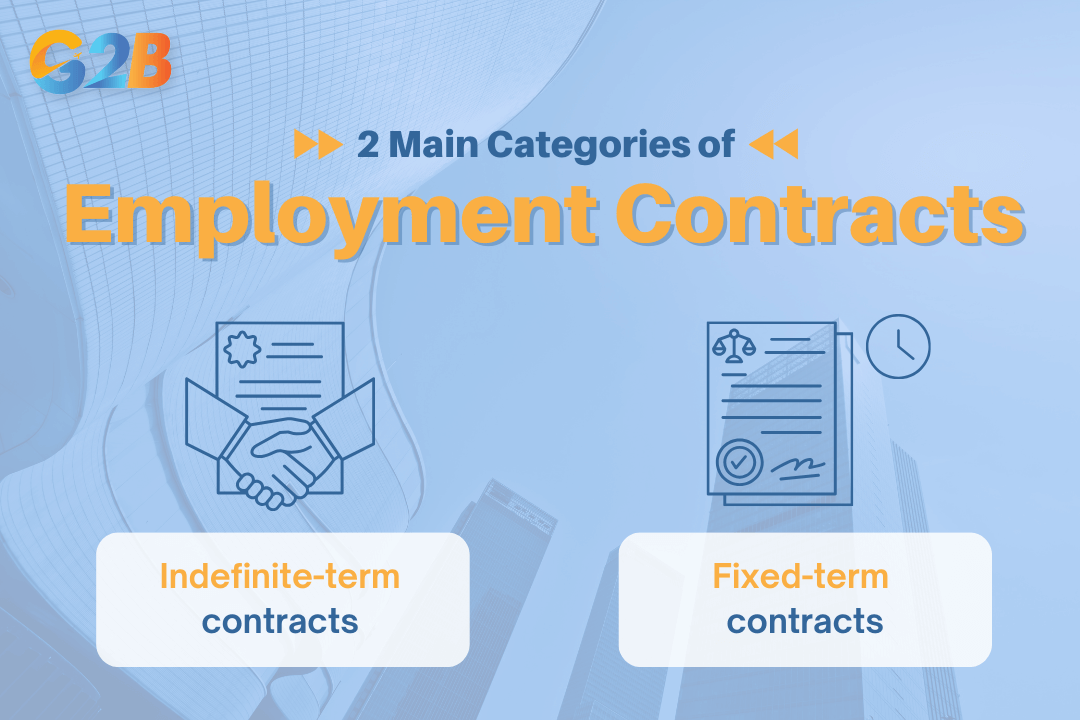
Employment contracts have two main categories
Electronic labor contracts (e-contracts)
Yes, electronic labor contracts are legally valid and have the same enforceability as traditional written contracts. The Labor Code 2019 officially recognizes e-contracts, acknowledging the shift towards digital business practices. To be enforceable, these contracts must comply with the Law on Electronic Transactions, ensuring the integrity, confidentiality, and accessibility of the data for future reference.
Mandatory contents of a labor contract
A Vietnamese labor contract must include several mandatory clauses to be legally compliant. These essential provisions ensure clarity and protect both parties. A Vietnamese labor contract must include several mandatory clauses, such as the name and address of the employer, the full name and personal details of the employee, the job description and workplace location, the contract term, salary details including the rate, payment form and schedule, and obligations regarding social, health, and unemployment insurance. Other required contents include working hours, rest periods, and provisions for occupational safety and health.
Probation period rules
The rules for probationary periods are clearly defined to prevent misuse. The maximum duration of a probation period depends on the complexity of the job:
- 180 days for enterprise managers.
- 60 days for positions requiring a college degree or higher.
- 30 days for positions requiring intermediate-level technical skills or vocational training.
- 6 working days for most other jobs.
During the probation period, the employee's salary must be at least 85% of the official salary for that job. An employer is only permitted to apply a probationary period once for any given job.
Wages, salary & mandatory contributions
Compensation in Vietnam is more than just a base salary. It involves a structured system of minimum wages, mandatory insurance contributions, and specific rules on payment to ensure fair remuneration for employees.
Understanding Vietnam's minimum wage
Vietnam's minimum wage is not a single national rate but varies by geographical location. The government divides the country into four regions based on socio-economic development.
- Region I (urban Hanoi and Ho Chi Minh City) has the highest minimum wage.
- Region IV (rural and less developed areas) has the lowest.
These regional minimum wages are updated periodically by the National Wage Council to reflect changes in the cost of living and economic conditions. Employers must pay unskilled workers no less than the applicable regional minimum wage. For skilled workers who have undergone vocational training, the salary must be at least 7% higher than the regional minimum wage.
Salary, allowances & bonuses
While the government does not regulate specific salary policies at individual companies, it mandates that every employer must establish its own pay scale and payroll system.
- Salary: This is the base pay agreed upon in the labor contract. Salaries stated in contracts for Vietnamese employees must be in Vietnamese Dong (VND), while foreign employees may have their salaries denominated in a foreign currency.
- Allowances: Many employers offer various allowances to cover expenses, such as for transportation, housing, or meals. These must be clearly defined in the labor contract or a collective bargaining agreement.
- Bonuses: Bonuses are not mandatory unless specified in a contract or company policy. A common practice in Vietnam is the "13th-month bonus," which is a customary but not legally required payment, typically based on the company's performance and the employee's contribution.
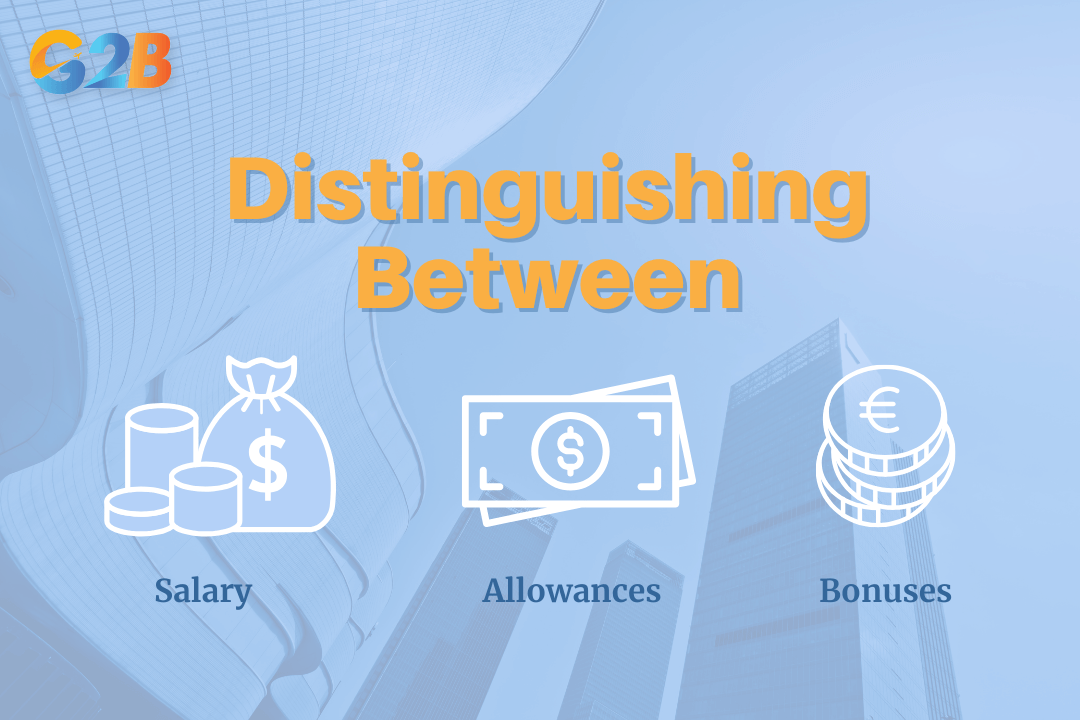
Distinguishing between salary - allowances - bonuses
Mandatory social, health, and unemployment insurance
Employers and employees must contribute to three mandatory insurance schemes, namely social insurance (SI), health insurance (HI), and unemployment insurance (UI). These contributions are calculated based on the employee's contractual salary.
- Social insurance: Covers sickness, maternity, occupational accidents, retirement, and death.
- Health insurance: Provides for medical examination and treatment expenses.
- Unemployment insurance: Offers financial support during periods of unemployment.
The contribution rates for both the employer and employee are set by the government and are subject to change.
Working hours, overtime, and leave
The Labor Code provides a clear framework for working hours, rest periods, and leave entitlements to protect employee well-being and ensure a healthy work-life balance.
Standard working hours
The normal working hours shall not exceed 08 hours per day or 48 hours per week. The government encourages employers to adopt a 40-hour workweek. The employer has the right to determine whether to apply daily or weekly working hours, but this must be specified in the internal labor regulations and communicated to employees. Working hours at night are defined as the period from 10 p.m. to 6 a.m. the following day.
Overtime regulations and calculation
Overtime work is permitted only with the employee's consent. The regulations place strict limits on overtime to prevent worker exploitation. These limitations include several key caps:
- Overtime cannot exceed 50% of the normal working hours in a day.
- Total working hours, including overtime, must not exceed 12 hours in a single day.
- The monthly overtime limit is capped at 40 hours.
- The standard annual overtime limit is 200 hours.
In certain specific industries, such as manufacturing or electronics, this annual cap can be extended to 300 hours per year, provided it is agreed upon with the employee. Overtime pay is calculated at a higher rate: at least 150% of the normal hourly wage for regular weekdays, 200% for weekends, and 300% for public holidays and paid leave days.
Public holidays and annual leave
Employees in Vietnam are entitled to paid leave for public holidays. The total number of public holidays is 11 days annually.
In addition to public holidays, employees are entitled to paid annual leave. The basic entitlement for employees working under normal conditions is 12 days per year after having worked for a full 12 months. This entitlement increases with seniority; for every five years of service with one employer, an employee is granted one additional day of annual leave.
Other statutory leave entitlements
The law also provides for other types of paid leave:
- Personal leave: Employees can take paid leave for their own marriage (3 days), the marriage of their child (1 day), or the death of a parent, spouse, or child (3 days).
- Sick leave: Employees covered by social insurance are entitled to paid sick leave. The allowance is paid by the Social Insurance fund, not the employer, and is calculated at 75% of the previous month's salary.
- Maternity leave: Female employees are entitled to six months of fully paid maternity leave, with the allowance covered by the Social Insurance fund.
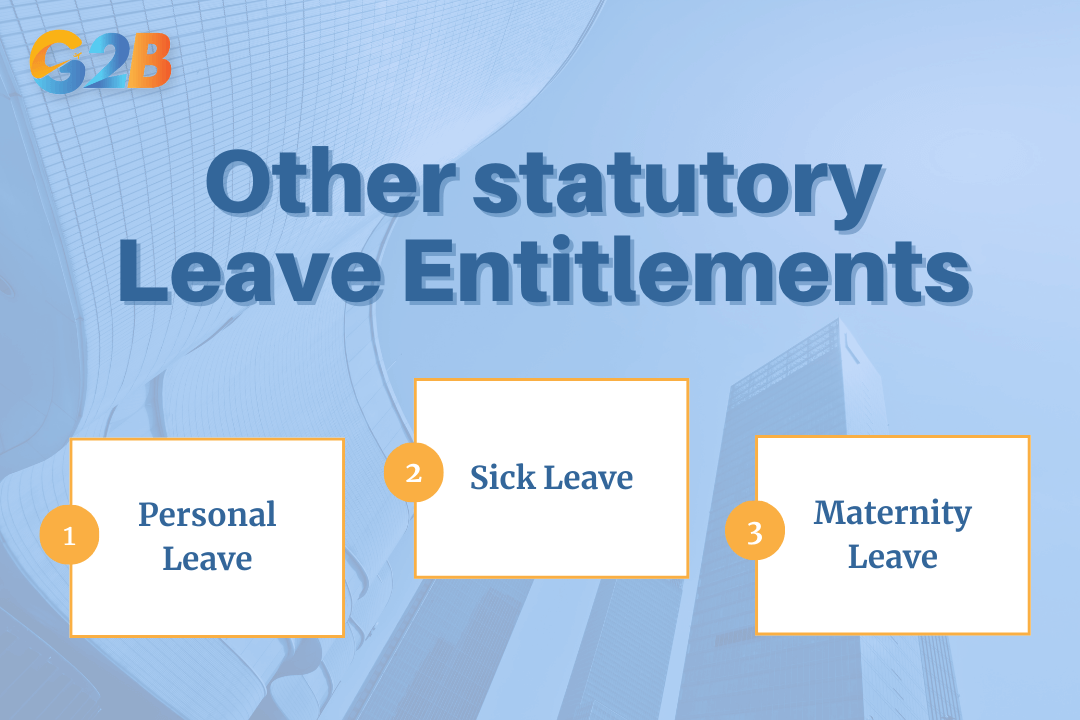
There are other types of paid leave
Termination of employment
The termination of an employment contract in Vietnam is strictly regulated to protect employees from arbitrary dismissal. Employers must have legal grounds and follow precise procedures to terminate an employment relationship lawfully.
Legal grounds for termination by the employer
No, an employer cannot terminate an employee without a lawful reason as stipulated in the Labor Code. Vietnamese labor law is generally employee-friendly, and employers may only unilaterally terminate a contract in a limited number of specific cases. These legal grounds include situations where an employee repeatedly fails to perform their duties, has a prolonged illness or injury, or in cases of force majeure such as natural disasters or significant economic changes that force the employer to reduce its workforce.
Can an employee be terminated for poor performance?
Yes, but it is not straightforward and requires a clear, documented process. An employer can terminate an employee for poor performance if the employee consistently fails to complete their assigned tasks according to the criteria set out in the employment contract or internal labor regulations. The employer must be able to prove this non-performance, and the evaluation criteria must have been clearly communicated to the employee beforehand.
Unilateral termination by the employee
An employee has the right to unilaterally terminate their labor contract for any reason, provided they give the required advance notice. In certain situations, such as not being paid on time, being mistreated, or being assigned a job not stated in the contract, an employee can terminate the contract immediately without prior notice.
Required notice periods
When unilaterally terminating a labor contract, both employers and employees must adhere to statutory minimum notice periods. The notice period depends on the type of contract:
- 45 days for an indefinite-term contract.
- 30 days for a fixed-term contract (from 12 to 36 months).
- 3 working days for contracts with a term of less than 12 months.
Severance allowance and final payments
Upon termination, an employer is responsible for making several final payments.
- Severance allowance: An employee who has worked for the company for 12 months or more may be entitled to a severance allowance. The allowance is calculated as half a month's salary for each year of service. This is not payable if the employee is terminated for disciplinary reasons or is eligible for a pension.
- Final Salary and Unused Leave: The employer must pay all outstanding salary and pay the employee for any unused annual leave days within 14 working days of the termination date.
Internal labor regulations (ILR) and discipline
A structured approach to workplace conduct and discipline is essential for legal compliance and effective management.
What are internal labor regulations?
Internal Labor Regulations (ILR) are a written set of rules that govern employee conduct, workplace safety, and disciplinary procedures within a company. They function as the company's internal legal framework for labor matters.
Is an ILR mandatory for all businesses?
An ILR is mandatory for any employer with ten (10) or more employees. For businesses with fewer than 10 employees, an ILR is not required, but having one is still highly recommended to ensure clarity and consistency in managing the workforce. The ILR must be registered with the provincial Department of Labor, Invalids and Social Affairs (DOLISA) to be legally effective.
Disciplinary actions and procedures
An employer can only apply disciplinary measures that are stipulated in their registered ILR. The Labor Code specifies four forms of disciplinary action:
- Reprimand: A verbal or written warning.
- Deferral of wage increase: For a period not exceeding six months.
- Demotion: Assigning the employee to a lower-paid position.
- Dismissal: The most severe form of disciplinary action.
Before applying any disciplinary measure, the employer must follow a strict procedure that includes holding a hearing with the employee and any relevant employee representative organization, and properly documenting the entire process.
Foreign employees in Vietnam
Vietnam's growing economy has attracted a large number of foreign workers. However, employing foreign nationals involves specific legal requirements that differ from those for local employees.
Work permit requirements
Yes, in most cases, foreign nationals require a work permit before they can legally begin working in Vietnam. The work permit is typically valid for a maximum of two years and can be renewed once for an additional two years. Employers are responsible for applying for the work permit on behalf of their foreign employees.
Work permit exemptions
There are several specific cases where a foreigner may be exempt from the work permit requirement. These exemptions often apply to individuals such as members of a limited liability company, owners of a sole proprietorship, members of the board of directors of a joint-stock company, or foreign experts entering Vietnam for short-term projects. Even if exempt, these individuals usually still need to obtain a work permit exemption certificate from the labor authorities.
Labor contracts for foreign employees
The duration of a labor contract for a foreign employee must not exceed the term of their work permit. Unlike Vietnamese employees, foreign employees can sign multiple consecutive fixed-term contracts without being required to transition to an indefinite-term contract. As mentioned, their salary can also be stated and paid in a foreign currency.
Navigating the intricacies of Vietnamese labor law is a critical task for any business operating in the country. From drafting compliant contracts and establishing fair wage structures to managing termination and employing foreign staff, adherence to the Labor Code 2019 is paramount. Beyond labor issues, investors must also fulfill other post-incorporation tasks such as opening a bank account in Vietnam and appointing a chief accountant in Vietnam to maintain full compliance.
