




 Delaware (USA)
  Vietnam
  Singapore
  Hong Kong
  United Kingdom
 A visa and an employment permit in Vietnam are the critical legal foundation for any foreigner planning to work, invest, or manage business operations long-term in the country. This process is often the final piece of the puzzle after completing your company establish in Vietnam. As of 2025, the Vietnamese government has tightened adherence to labor regulations while simultaneously digitizing administrative procedures to facilitate foreign investment. For HR managers of Multinational Corporations (MNCs) and individual investors, navigating the intersection of immigration law and labor compliance is no longer just about filling out forms; it is about strategic planning to ensure business continuity.
Understanding the legal framework and 2026 updates
To successfully secure a work permit, one must understand the specific decrees governing foreign labor. Citing specific laws is not merely a formality; it builds authority with local officials and ensures your application dossier is legally watertight. The Vietnamese immigration system operates on a hierarchy of laws, decrees, and circulars.
Currently, the primary legal instruments you must comply with include:
- Decree 152/2020/ND-CP: This remains the foundational decree governing foreign workers in Vietnam, recruitment, and management procedures.
- Decree 70/2023/ND-CP: This crucial amendment modified the reporting requirements and, most importantly, mandated the online submission of labor demand reports via the National Public Service Portal, reducing physical paperwork but increasing data transparency.
- Decree 219/2025/ND-CP (New Updates): Implemented in early 2025, this decree introduces specific relaxations for high-tech industries and streamlines the exemption process for priority sectors, reflecting Vietnam's push toward a digital economy.
The shift to digital governance means that the Department of Labor, Invalids and Social Affairs (DOLISA) now cross-references data with the Immigration Department more efficiently. Consequently, discrepancies between your entry visa purpose and your work permit application are flagged immediately.
Key insight: In 2026, you cannot simply apply for a permit upon arrival. You must demonstrate a pre-approved labor usage plan at least 15 days before the foreigner is expected to start work.
Distinguishing between visa types for work
Foreigners often confuse business visas with work visas. While they sound similar, they serve vastly different legal functions and carry different limitations regarding employment. Entering on the wrong visa category can lead to deportation or blacklisting. A "Business Visa" generally allows for meetings and signing contracts, whereas a "Work Visa" (typically LD) is tied strictly to a Work Permit or a Work Permit Exemption Certificate.
Below is the definitive comparison table for 2025:
| Visa Code | Target Audience | Purpose & Validity | Work Permit Requirement |
|---|---|---|---|
| DN1 / DN2 | Business Travelers | For working with Vietnamese enterprises, attending meetings, or market research. Valid for 1 to 3 months (rarely 1 year). | No Work Permit required for short visits. Cannot be used for long-term employment or receiving a salary in Vietnam. |
| LD1 | Investors / Internal Transfers | For foreigners exempt from work permits (e.g., Heads of Representative Offices, owners). Valid for up to 2 years. | Exempt, but requires a "Certificate of Work Permit Exemption." |
| LD2 | Standard Employees | For foreigners entering to work under a labor contract. Valid for up to 2 years. | Requires a full Work Permit issued by DOLISA before the visa can be granted or extended. |
| DT (1, 2, 3, 4) | Foreign Investors | Issued to foreign investors and lawyers. The duration of DT visas depends on the capital contributed to the Limited Liability Company or Joint Stock Company | Exempt from Work Permit if the capital contribution meets the threshold (usually >3 billion VND). |
Vietnam employment permit requirements
To secure a Vietnam work permit, applicants must satisfy strict criteria designed to prioritize local labor while welcoming genuine foreign expertise. The days of "teaching English on a tourist visa" are effectively over. The requirements in 2025 focus heavily on proving that the foreigner possesses skills that local Vietnamese workers cannot currently provide.
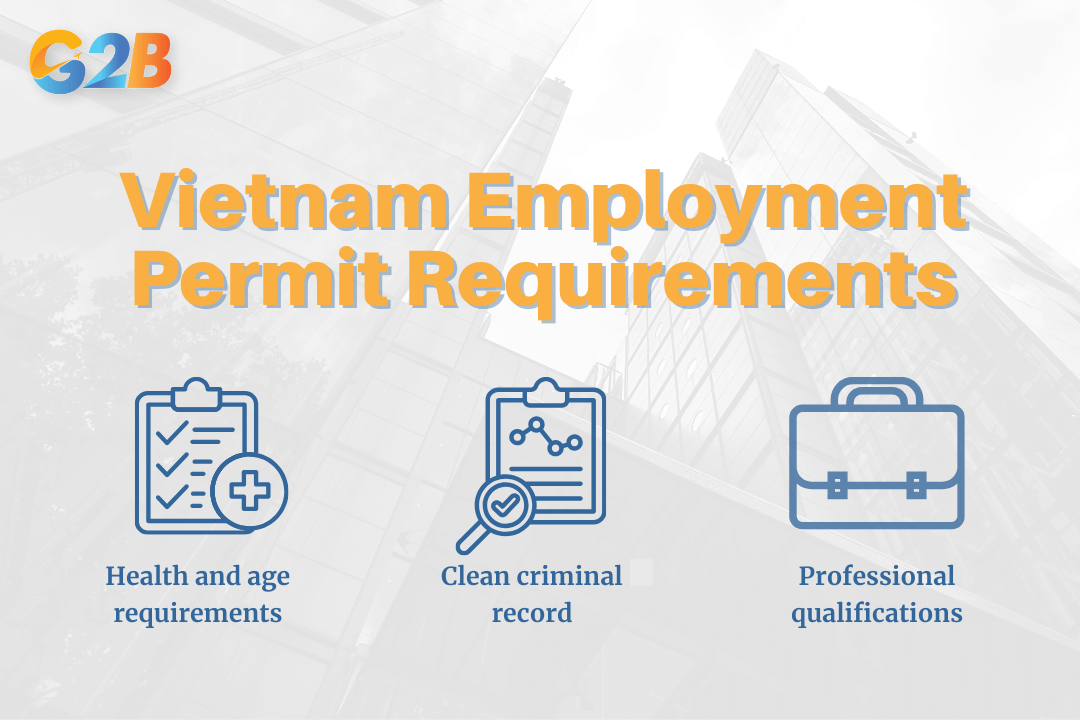
1. Health and age requirements
- Age: The applicant must be at least 18 years old.
- Health capacity: You must submit a health check certificate issued by designated hospitals (such as Cho Ray Hospital, French Hospital in Hanoi, or SOS International). The certificate is valid for 12 months and must specifically state that the applicant is "Fit for work."
2. Clean criminal record
You must provide a Criminal Record Certificate
- If you have resided in Vietnam for more than 6 months, you need Record No. 1 issued by the Vietnamese Department of Justice.
- If applying from abroad, you need the equivalent document from your home country.
- Crucial rule: The document must be issued within 6 months of the submission date.
3. Professional qualifications (the "3-5 year" rule)
This is the most scrutinized section. To be classified as an "Expert" or "Technical Worker," you must prove:
- Education: A Bachelor’s degree or higher relevant to the job position.
- Experience: A confirmation letter verifying at least 3 years of work experience in a relevant field abroad.
- Nuance: Under Decree 219/2025, there is slightly more flexibility for IT and high-tech sectors where a degree might not match the job title exactly, provided the experience letter explicitly details relevant skills.
For more detailed criteria on these categories, refer to our comprehensive guide to getting a work permit in Vietnam
However, for management positions (Executive Director), the requirement shifts to proving your appointment decision and management experience, rather than just technical skills.
Vietnam employment permit requirements
Step-by-step guide to applying for a work permit
The process involves multiple government agencies and strict timelines. We recommends starting this process 4-6 weeks before the intended start date.
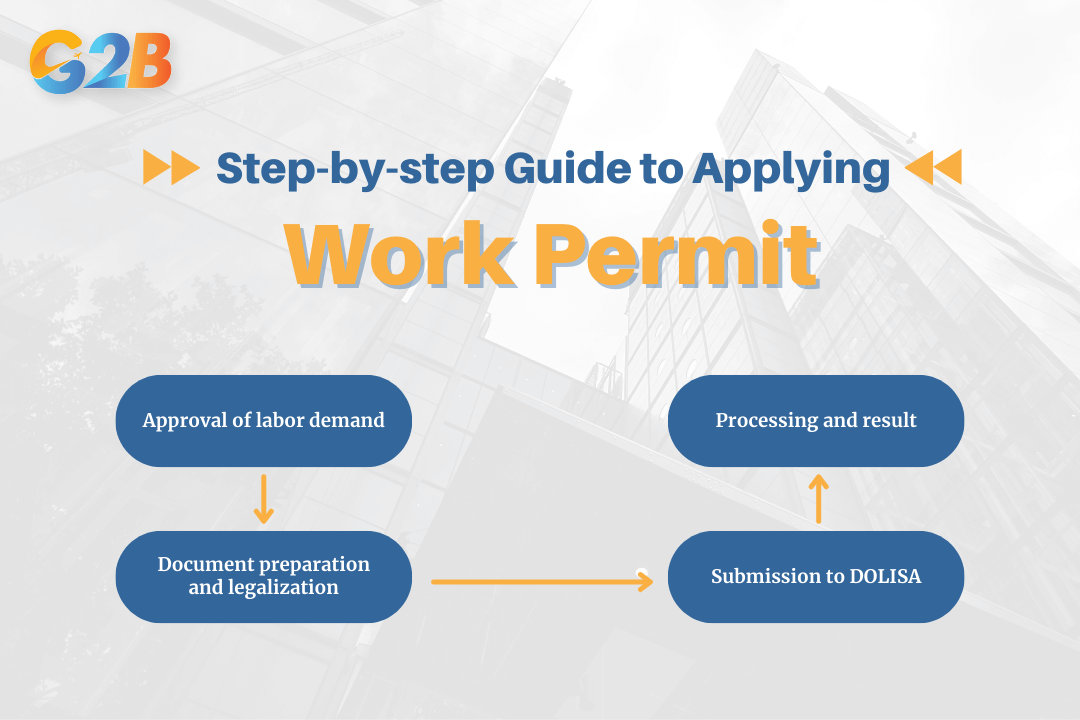
Step 1: Approval of labor demand (the employer's duty)
Before you even submit individual documents, the sponsoring company must request permission to hire a foreigner. This step is integrated into the broader hiring employees in Vietnam strategy, where local recruitment must be prioritized first
- Action: Submit the "Explanation of Demand for Foreign Labor" to the provincial DOLISA or Industrial Zone Management Board.
- Timeline: This must be done at least 15 days before the expected start date.
- Platform: Under Decree 70, this is primarily done via the National Public Service Portal, requiring a digital signature token.
Step 2: Document preparation and legalization
This is where most delays occur. You must gather and process:
- Passport: Certified copy.
- Health check: Original.
- Photos: 4x6cm, white background, no glasses.
- Foreign documents (degree, experience letter, criminal record): These must undergo Consular Legalization. This involves notarization in the home country, authentication by the home country's Ministry of Foreign Affairs, and final stamping by the Vietnamese Embassy/Consulate.
Step 3: Submission to DOLISA
Once the labor demand is approved and documents are legalized:
- Action: Submit the full dossier (Form 11/PLI) to the local DOLISA.
- Check: Ensure the job title in the application matches the experience letter exactly. A mismatch between "Marketing Manager" and "Marketing Specialist" can cause rejection.
Step 4: Processing and result
- Official timeline: The law states 5 working days.
- Reality: Due to backlog and requests for clarification, it often takes 10 to 15 business days.
- Outcome: If approved, you receive the Work Permit (hard copy). If rejected, you receive a written explanation (usually requesting document amendments).
Navigating these steps requires precision. G2B offers work permit consultation service to handle the liaison with DOLISA, ensuring your dossier is perfect on the first submission.
Step-by-step guide to applying for a work permit
Work permit exemptions and when you can skip the permit
Not all foreigners need a full work permit, but this does not mean they are free from paperwork. Exemptions are strictly governed by the labor law in Vietnam, focusing on investors and high-level managers.
Who qualifies?
According to Decree 152 and the updated Decree 219, the following entities are eligible:
- Owners of LLCs: Specifically, the owner of a single-member Limited Liability Company (LLC) or the Chairman of the Board of a multi-member LLC.
- Board members: Members of the Board of Directors of a Joint Stock Company (JSC) with a certain capital contribution threshold.
- Intra-corporate transferees: Employees moving internally within companies operating in 11 service sectors listed in Vietnam’s WTO commitments (e.g., Business Services, Construction, Distribution, Education, Finance).
- Foreign lawyers: Those issued a license to practice law in Vietnam by the Ministry of Justice.
- Short-term experts: Those entering for less than 30 days per entry and no more than 3 times a year.
The "certificate" requirement
Do not assume you can just show up. You must apply for a Certificate of Work Permit Exemption. The process mirrors the work permit application (Labor Demand -> Document Submission -> Approval) but results in an exemption certificate valid for 2 years. Failure to obtain this certificate is treated legally the same as working without a permit.
Obtaining a temporary residence card after the work permit
A Temporary Residence Card (TRC) is essentially a long-term visa that allows you to reside in Vietnam without constant visa runs. It is the ultimate goal for most expats.
The prerequisites
You cannot apply for a TRC without a valid Work Permit or Work Permit Exemption Certificate. The TRC is tied directly to the validity of your work permit.
Benefits of the TRC
- Validity: Up to 2 years (matching the Work Permit) or up to 5-10 years for major investors (DT1/DT2).
- Mobility: Unlimited entry and exit without applying for new visas.
- Lifestyle: Required for opening personal bank accounts in Vietnam, registering vehicles, and signing long-term apartment leases.
- Family: Allows you to sponsor your spouse and children for TT (Dependent) Visas or their own TRCs.
Required documents for TRC
- Original Passport.
- Original Work Permit.
- Forms NA6 (Company sponsorship) and NA8 (Application).
- Notarized copy of the Company’s Business License (ERC).
- Proof of temporary residence registration (Police registration).
Common mistakes to avoid
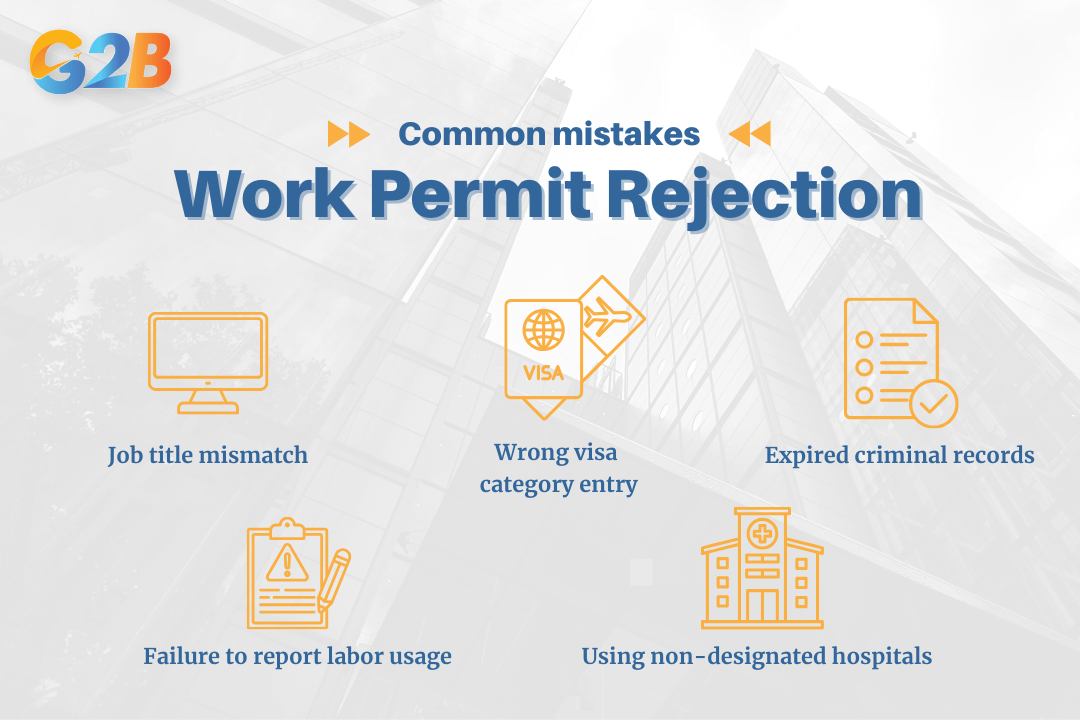
Based on our audit of over 500 applications in the last year, these are the most frequent reasons for rejection or legal trouble:
- Job title mismatch: The job title on your Letter of experience (e.g., "Software Developer") does not match the title on the Labor Demand Approval (e.g., "IT Manager"). DOLISA requires semantic consistency.
- Expired criminal records: Submitting a criminal record check that is 7 months old. It must be strictly under 6 months.
- Wrong visa category entry: Entering on a Tourist Visa (DL) and hoping to convert it to a Work Permit and TRC without leaving the country. This is illegal under the current Law on Entry, Exit, Transit, and Residence. You generally must leave and re-enter on the correct business invitation visa.
- Failure to report labor usage: Employers forgetting to submit the biannual labor usage reports (Decree 152 re), leading to fines and blocking of future permits. Regular compliance audits by your chief accountant in Vietnam can help ensure that all labor-related reports and taxes are handled on time
- Using non-designated hospitals: Going to a local clinic that is not on the Ministry of Health’s approved list for foreign work permit health checks.
5 most frequent reasons for rejection
FAQs for visa and employment permit in Vietnam
This FAQ section addresses common questions related to visas and employment permits in Vietnam, helping foreign employers and expatriates understand key requirements and procedures.
Can I work in Vietnam on a tourist visa?
No. Working on a tourist visa (DL) is strictly illegal. If caught, you face deportation, heavy fines, and a potential ban from re-entering Vietnam. You must obtain a work permit and the appropriate work visa (LD) or business visa (DN).
How long is a Vietnam work permit valid for?
A Vietnam work permit is valid for a maximum of 2 years. It can be extended once for another 2-year period. After that, a completely new application must be submitted.
What happens to my Temporary Residence Card if I quit my job?
If you terminate your labor contract, your employer is legally required to revoke your Work Permit and Temporary Residence Card and return them to the immigration authorities. You will typically be granted a short exit visa (15 days) to leave the country or transition to a new sponsor.
Is a degree required for all work permits?
Generally, yes. For the "Expert" category, a Bachelor’s degree is required. However, for "Technical Workers," a certificate of training (1+ year) combined with 3 years of experience may suffice. Decree 219/2025 provides some flexibility, but proof of qualification remains mandatory.
Securing a Visa and Employment Permit in Vietnam is a structured, multi-step process that demands attention to detail and adherence to strict timelines. From the initial labor demand explanation to the final issuance of the Temporary Residence Card, every document plays a pivotal role in your legal status.
Navigating the intersection of immigration and business law is complex. G2B provides a specialized Vietnam Incorporation Service that includes end-to-end support for your visa and work permit needs. Contact G2B today to secure your legal stay in Vietnam
