




 Delaware (USA)
  Vietnam
  Singapore
  Hong Kong
  United Kingdom
 Minimum capital in Vietnam dictates the legal and financial framework required for foreign investors establishing a corporate presence within the jurisdiction. The Vietnamese government provides a flexible investment environment by not imposing a universal statutory minimum capital threshold for the vast majority of commercial sectors. Instead, the licensing authority, explicitly the Department of Planning and Investment, evaluates the proposed investment capital against the scale, core objectives, and operating costs of the registered commercial project. However, foreign investors must navigate conditional business sectors.
General regulations on minimum capital in Vietnam
Vietnamese enterprise law establishes a highly adaptable regulatory mechanism regarding initial capital commitments for foreign direct investment (FDI). For standard business activities, including manufacturing, software development, management consulting, and wholesale trade, the government does not mandate a specific, fixed monetary floor. The fundamental legal principle dictates that the proposed capital must precisely align with the documented financial requirements of the overarching business plan.
Licensing authorities assess the feasibility of the investment project by conducting a strict comparative analysis between the stated capital and the projected expenditures required for the initial operational phase. Authorities mandate that the registered capital must fully cover fixed capital costs and operational overheads, encompassing office leasing contracts, employee payroll, machinery procurement, and initial marketing operations, until the enterprise reaches a state of independent revenue generation.
When a foreign investor submits an application for an Investment Registration Certificate, the Department of Planning and Investment meticulously scrutinizes the Investment Proposal. An investor proposing a mathematically unfeasible capital figure - for instance, proposing $5,000 for a large-scale industrial manufacturing facility - faces immediate rejection of their corporate dossier. The state demands a logical correlation between the financial capital and the commercial scope. To legally register the business, the legal representative must submit formal financial proof, such as certified bank statements, audited financial reports, or equity commitment letters, demonstrating the investor possesses the exact liquid funds proposed in the registration documents.
Sectors requiring a specific minimum capital
While standard commercial operations enjoy capital flexibility, the Vietnamese Law on Investment designates a specific roster of conditional business lines. Entering these highly regulated markets requires foreign investors to prove possession of legal capital - a legally mandated minimum financial threshold strictly enforced before licensing.
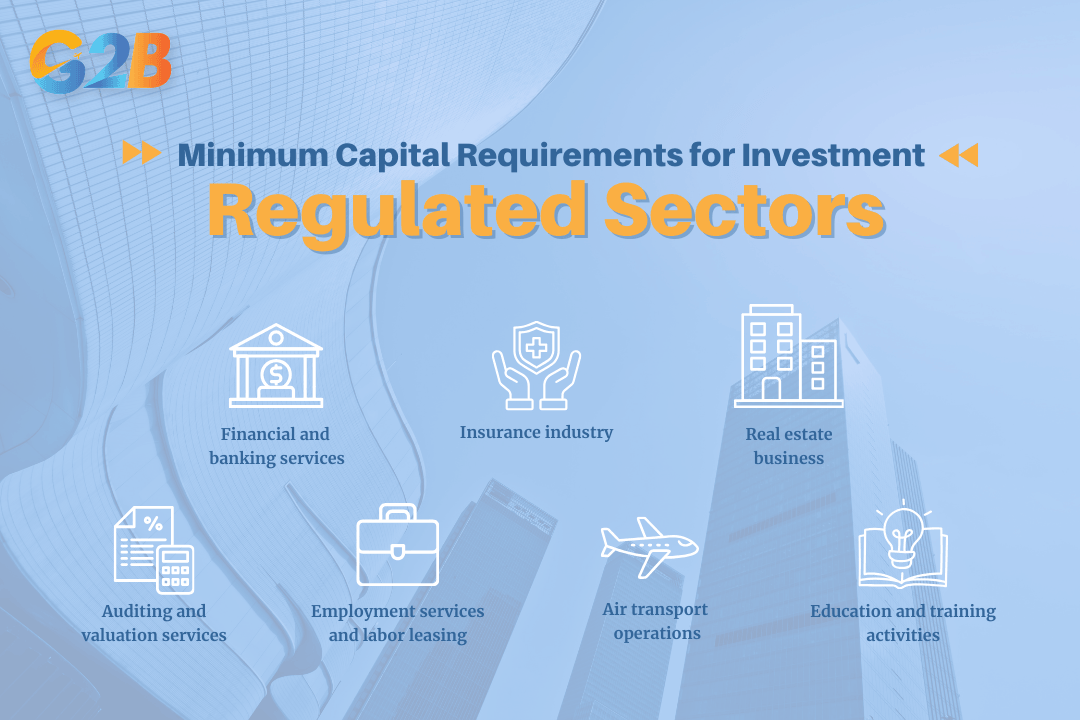
Minimum capital varies significantly across regulated sectors
Financial and banking services
The financial sector commands the highest regulatory scrutiny regarding legal capital due to its systemic impact on national macroeconomics. Commercial banks mandate a minimum legal capital of 3,000 billion VND to legally establish and operate within the domestic market. For foreign financial institutions seeking a narrower footprint, establishing a foreign bank branch requires a minimum legal capital of 15 million USD. Non-bank credit institutions, such as finance companies and specialized consumer lending firms, require a legally committed minimum of 500 billion VND. These exact figures act as an absolute barrier to entry, ensuring only highly capitalized global entities operate within the Vietnamese financial ecosystem.
Insurance industry
The Ministry of Finance legally bounds the insurance industry with strict capital thresholds tied directly to the specific class of insurance products offered to the public. To register a life insurance enterprise providing life insurance (excluding unit-linked insurance and pension) and health insurance, an investor must secure a minimum legal capital of 750 billion VND. If the life insurance firm simultaneously offers the insurance as mentioned above, including unit-linked insurance or pension, the statutory requirement strictly escalates to 1,000 billion VND; including both unit-linked insurance and pension: 1,300 billion VND. Conversely, establishing a non-life insurance company commands a baseline minimum legal capital of 300 billion VND (excluding aviation and satellite insurance) and health insurance. Insurance brokerage firms face a lower threshold, mandating exactly 4 billion VND. Furthermore, insurance enterprises must maintain a strict security deposit at a domestic commercial bank, locking in a specific percentage of their legal capital to guarantee policyholder payouts.
Real estate business
Recent legislative reforms have profoundly altered the minimum capital dynamics for foreign entities engaging in the real estate business. Previously, a fixed legal capital of 20 billion VND applied universally. Currently, the law replaces this flat rate with rigorous project-based equity ratios. For real estate development projects utilizing land parcels less than 20 hectares, the investor’s equity capital must constitute at least 20% of the total project investment. For massive developmental projects exceeding 20 hectares, the required equity capital floor is 15% of the total investment. Investors must formally prove this specific financial capacity through independently audited financial statements prior to acquiring land use rights or participating in real estate development bidding processes.
Auditing and valuation services
Professional financial services that dictate market trust and corporate transparency strictly require baseline financial commitments. Operating an independent auditing firm in Vietnam necessitates a specific legal capital mechanism designed to cover professional liability. Auditing firms require a minimum legal capital of 5 billion VND to secure an Enterprise Registration Certificate and the specialized Certificate of Eligibility for Auditing Business. Furthermore, the firm must consistently maintain this precise capital level throughout its operational lifespan. If the firm's equity falls below this 5 billion VND threshold, the Ministry of Finance immediately suspends its auditing license until the financial deficit is fully rectified by the corporate shareholders.
Employment services and labor leasing
Entities providing workforce management, human resources dispatch, and labor leasing assume significant legal responsibility for worker compensation and labor rights. Consequently, the government demands a highly specific financial safeguard. Enterprises operating in labor leasing must establish a strict escrow deposit of precisely 2,000,000,000 VND (2 billion VND) at an authorized Vietnamese commercial bank. This specific deposit operates independently from the enterprise's operating cash flow and functions exclusively to guarantee wage payments, social insurance contributions, and occupational accident compensation in the event the labor leasing enterprise breaches its contractual obligations to the dispatched workforce.
Air transport operations
The civil aviation sector bases its minimum legal capital exclusively on the scale of the aviation fleet and the geographical scope of the flight routes. For airlines providing international air transport services, with a fleet of up to 10 aircraft strictly demands a minimum legal capital of 700 billion VND; fleet size between 11 and 30 aircraft: 1,000 billion VND; exceeding 30 aircraft: 1,300 billion VND. For airlines operating solely domestic commercial flights, the minimum legal capital is 300 billion VND (up to 10 aircraft), 600 billion VND (11 to 30 aircraft), and 700 billion VND (over 30 aircraft). Investors must park these specific funds in an operational blockaded account prior to receiving the Air Transport Business License.
Education and training activities
Foreign direct investment in the Vietnamese educational sector mandates specific capital floors scaled directly to the nature of the educational institution. Establishing a foreign language center, specialized IT training facility, or vocational short-term training center requires a minimum investment capital of precisely 20 million VND per registered student (excluding land rental costs). Opening a comprehensive foreign-invested kindergarten or primary school strictly requires 50 million VND per student, with an absolute baseline minimum of 50 billion VND for the entire institution. Developing a full-scale foreign-invested university demands a massive capital commitment, requiring an absolute baseline of 1,000 billion VND, entirely independent of the underlying land leasing values.
Distinguishing between charter capital and investment capital
Foreign investors systematically confuse charter capital and investment capital during the preliminary corporate structuring phase. Misunderstanding these exact legal concepts leads to severe licensing delays, capital contribution penalties, and rejected corporate dossiers.
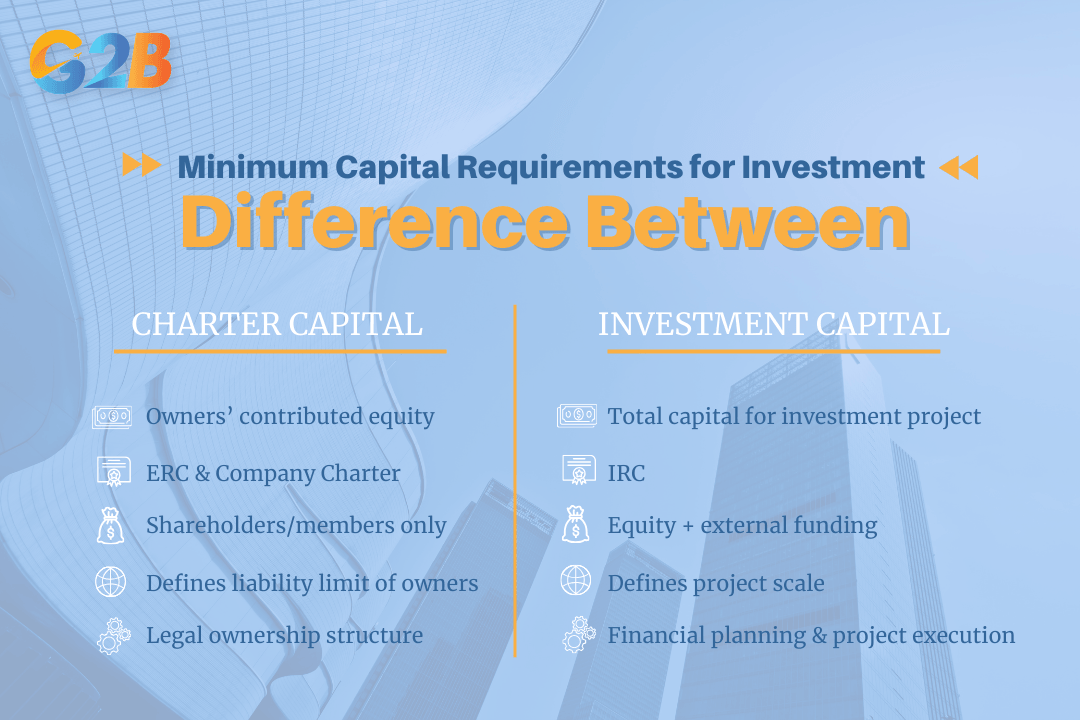
Distinguishing between charter capital and investment capital
Understanding charter capital
Charter capital is the exact total asset value formally committed by company members or shareholders within a specific legally mandated timeframe. Authorities legally record this precise figure directly into the company's internal corporate charter and formally print it on the Enterprise Registration Certificate. Charter capital defines the absolute financial liability limit for shareholders operating within Limited Liability Companies and Joint Stock Companies. If the enterprise defaults on its corporate debt obligations, the shareholders face personal liability strictly up to the precise amount of their registered charter capital. Charter capital serves as the internal equity foundation that the owners inject directly into the business entity.
Understanding investment capital
Investment capital represents the total projected financial cost to comprehensively execute a specific commercial investment project. The Department of Planning and Investment explicitly records this overarching figure on the Investment Registration Certificate. The total investment capital fundamentally consists of two distinct financial components: the investor’s contributed equity and mathematically projected mobilized funds. Mobilized capital includes financial resources sourced from external origins, including commercial bank loans, parent company financing, offshore debt structures, and third-party corporate bonds. Investment capital defines the macroeconomic scale of the business project rather than internal shareholder equity.
The relationship between the two types of capital
The legal correlation between these two financial metrics is absolute and mathematically defined. Total investment capital directly equals the registered charter capital plus all mobilized capital. Charter capital functions as a strict subset of the broader investment capital framework. For example, an investor seeking to build an advanced semiconductor assembly plant may register a total investment capital of $10,000,000. Within this structured framework, the investor explicitly registers a charter capital (equity) of $3,000,000, while the remaining $7,000,000 functions as mobilized capital sourced via a strictly documented offshore corporate loan. The investor must fully prove the viability of both the equity source and the mobilized debt structure during the formal licensing procedure.
How to determine a reasonable investment capital level
Because Vietnamese regulatory frameworks omit an arbitrary minimum baseline for unrestricted sectors, the sole burden of determining an exact, legally acceptable capital figure falls squarely on the foreign investor. Formulating this precise number requires an intensive evaluation of strict operational realities, commercial scale, and financial compliance metrics.
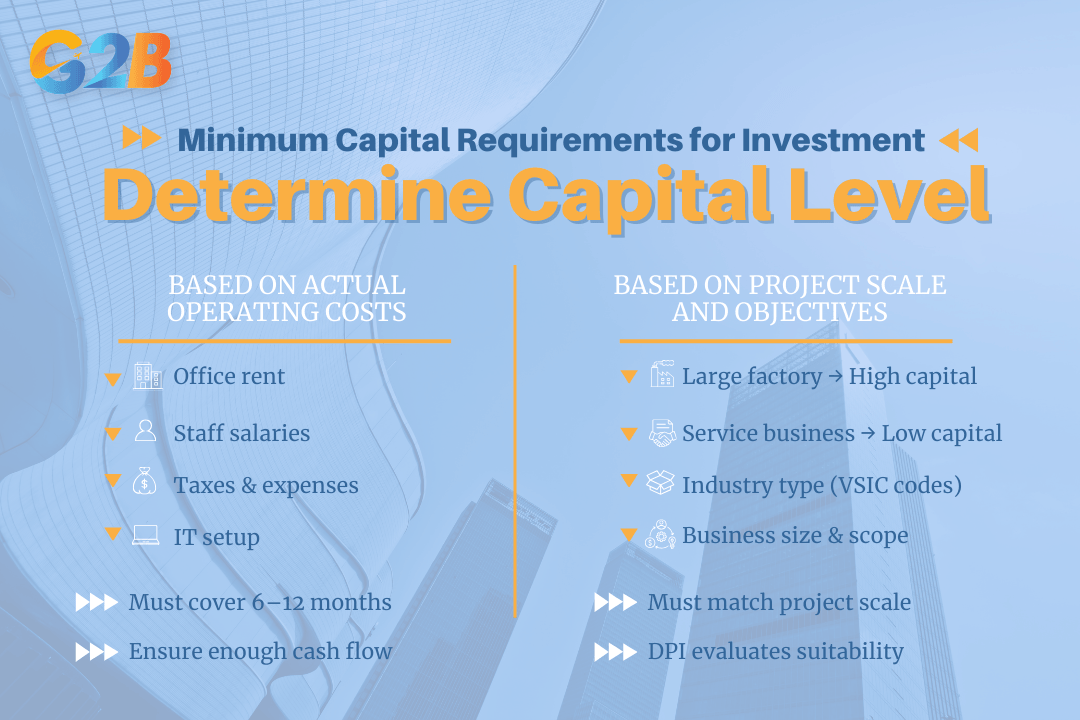
Ways to determine a reasonable investment capital level
Based on actual operating costs
Investors must construct an exact, highly detailed operational budget spanning the first 6 to 12 months of domestic commercial activity. Authorities demand that the registered charter capital mathematically covers initial fixed and variable corporate expenditures. Investors strictly calculate expected overhead metrics, encompassing commercial office rental deposits, legal representative salaries, local employee payroll, corporate tax obligations, and initial IT infrastructure deployments.
The objective of this exact calculation is to unequivocally prove the enterprise commands sufficient internal liquidity to sustain all local operations fully until the company bridges the gap to independent market profitability. Submitting an application with a capital amount that mathematically fails to cover a standard commercial lease agreement guarantees an immediate rejection by the licensing board.
Based on project scale and objectives
Capital calibration must inherently reflect the physical and commercial scale of the registered enterprise. A foreign investor establishing a lightweight digital marketing agency strictly requires lower capital parameters than an entity registering an export processing enterprise. Heavy industries, encompassing garment manufacturing facilities, consumer electronics assembly lines, and industrial warehousing hubs, inherently command massive capital allocations to satisfy machinery imports, land leasing rights, and intensive environmental impact assessments.
Conversely, purely service-driven models - where intellectual capital supersedes physical infrastructure - can logically justify substantially lower financial declarations. The Department of Planning and Investment strictly matches the stated capital against the exact business lines registered via the Vietnam Standard Industrial Classification (VSIC) codes.
The importance of demonstrating financial capacity
Proposing a strategically balanced capital figure is legally useless without strict evidentiary support. The Department of Planning and Investment enforces an absolute requirement for investors to present concrete financial documentation proving they hold liquid capital strictly equal to or greater than the proposed charter capital. Investors execute this by providing highly verifiable documents, primarily consisting of consular-legalized offshore bank statements, audited corporate balance sheets, or official bank guarantee letters.
If the foreign investor registers $500,000 in charter capital, the corporate bank statement submitted within the legal dossier must clearly display a liquid cash balance exceeding $500,000. Arbitrarily inflating the proposed capital without corresponding financial evidence halts the issuance of the Investment Registration Certificate.
Capital contribution procedures and timeline
After the state issues the corporate licenses, the investor triggers a strict, legally binding countdown to physically inject the liquid funds into the domestic banking system. Deviating from these exact procedural mandates triggers severe administrative penalties and initiates processes for forced corporate dissolution.
Statutory capital contribution deadline
Vietnamese law enforces a strict 90-day deadline originating from the exact issuance date printed on the Enterprise Registration Certificate. Within this rigid timeframe, the corporate shareholders must fully transfer 100% of the newly registered charter capital into the company's designated banking architecture. The law strictly prohibits extending this baseline 90-day window for standard capital contribution. Investors legally cannot contribute the funds via phased, multi-year installments outside of this 90-day statutory constraint unless specifically mandated by complex, multi-stage developmental milestones heavily pre-approved on the overarching Investment Registration Certificate.
Procedures for opening a direct investment capital account
To physically execute the capital contribution, a foreign-invested enterprise must strictly adhere to the State Bank of Vietnam's rigid foreign exchange controls. The newly established company must open a Direct Investment Capital Account (DICA) at a legally licensed commercial bank geographically operating within Vietnamese territory. The DICA serves as the sole, legally authorized financial gateway for transferring registered investment capital into Vietnam, repatriating offshore corporate profits, and processing offshore loan principal repayments.
Investors strictly execute a wire transfer directly from their respective offshore corporate or personal bank accounts, explicitly matching the exact name of the licensed investor, directly into the corporate DICA via the SWIFT network. Transferring capital through unauthorized channels, including carrying physical cash across borders, wiring funds to the legal representative's personal domestic account, or utilizing third-party payment gateways, constitutes a direct violation of Vietnamese foreign exchange law. The domestic commercial bank will explicitly flag these transactions, refusing to certify the capital contribution, rendering the investor legally non-compliant.
Consequences of late capital contribution
Failing to fully inject the exact registered charter capital within the 90-day statutory window exposes the foreign investor to immediate and severe legal consequences. The local Department of Planning and Investment strictly enforces administrative monetary fines ranging precisely from 30,000,000 VND to 50,000,000 VND for violating the capital contribution timeline.
Beyond the financial penalty, the enterprise faces mandatory structural restructuring. The law forces the company to formally adjust its registered charter capital downward to match the exact liquid amount actually contributed to the DICA. The company must execute this complex administrative adjustment within precisely 30 days following the expiration of the original 90-day deadline. Furthermore, failing to contribute the capital actively breaches the foundational terms of the Investment Registration Certificate, providing the state explicit legal grounds to unilaterally terminate the investment project, revoke the operating licenses, and force the immediate liquidation of the domestic commercial entity.
Frequently asked questions about minimum capital
Navigating the financial architecture of the Vietnamese corporate landscape demands exact legal clarity. The following details provide absolute, factual answers to the most critical queries foreign investors encounter regarding initial capitalization.
Is it mandatory to contribute 100% of the capital immediately?
No, investors are not required to contribute the capital prior to licensing, but they have exactly 90 days from the issuance date of the Enterprise Registration Certificate to formally transfer and contribute 100% of the registered charter capital into the DICA. No extensions apply to this legal window.
Is it difficult to change charter capital after establishment?
No, a company can rapidly and easily increase its registered charter capital at any time by executing an official capital increase registration with the Department of Planning and Investment. However, legally decreasing charter capital presents immense regulatory difficulty; it is entirely prohibited during the initial stages and strictly permissible only after the company actively operates for a minimum of two uninterrupted years, contingent upon strict proof of total debt settlement and complete financial solvency.
Does minimum capital apply to domestic enterprises?
Yes, the exact legal capital regulations governing specific conditional business lines apply universally and equally to both 100% domestic entities and foreign-invested enterprises. A domestic investor aiming to establish an airline, commercial bank, or auditing firm faces the exact same statutory capital baseline as an international corporation.
The regulatory landscape surrounding minimum capital in Vietnam provides structural corporate flexibility while demanding absolute financial transparency from all incoming foreign investors. By eliminating a universal, arbitrary baseline for standard commercial industries, the Vietnamese government actively facilitates highly diverse market entry strategies, accommodating both lightweight tech startups and massive industrial manufacturers.
