




 Delaware (USA)
  Vietnam
  Singapore
  Hong Kong
  United Kingdom
 Industrial zones in Vietnam serve as the foundational backbone for the nation's rapid economic transformation, offering foreign investors an unparalleled gateway into Southeast Asia's most dynamic manufacturing hub. Over the past three decades, the Vietnamese government has strategically developed these specialized economic areas to streamline foreign direct investment, optimize supply chain logistics, and accelerate national industrial output. For international corporations seeking to diversify their production lines and mitigate geopolitical supply chain risks, understanding the intricate landscape of these industrial parks is an absolute necessity.
Overview of industrial zones in Vietnam
Vietnam operates as the premier manufacturing hub in Southeast Asia, largely due to its systematic development of specialized industrial infrastructure. The national government designates specific geographic territories as industrial zones to manufacture industrial products and provide services for industrial production. These zones enforce distinct geographical boundaries and exclude residential populations, creating highly secure and optimized environments for heavy machinery, logistics, and large-scale manufacturing operations.
The scope of this infrastructure is massive. Currently, Vietnam has 413 approved industrial parks covering ~145,970 hectares of land across multiple provinces. Out of this total allocated number, there are over 300 operational industrial parks actively hosting domestic and international enterprises. The remaining zones sit in various stages of site clearance, legal planning, or active construction.
These industrial parks function as the primary engine for FDI attraction. Historical and current economic data demonstrate that these zones attract 55-60% of total FDI into Vietnam, pulling capital from leading global economies. Multinational corporations channel billions of dollars into these areas to construct highly advanced manufacturing facilities. The continuous modernization of industrial infrastructure, including dedicated power grids, high-capacity water treatment plants, and internal road networks, ensures that foreign investors encounter minimal operational downtime with an average occupancy rate of ~76% nationwide. Furthermore, the government strictly regulates these areas to provide aggressive tax incentives, streamlined customs procedures, and robust intellectual property protection, cementing Vietnam's absolute dominance as the preferred destination for global supply chain relocation.
Industrial zone map of Vietnam
Understanding the geographic distribution of industrial clusters requires a detailed examination of the industrial zone map of Vietnam. Investors must select locations based on proximity to vital logistical nodes, such as deep-water seaports, international airports, and cross-border railway systems. When evaluating the map on a macro level, the government has authorized 413 industrial parks nationwide (as of 2025 context) within its master spatial planning framework for immediate foreign consideration.
The distribution of these zones divides the country into 03 distinct regional economic hubs, each offering unique logistical advantages and catering to specific industry verticals. Due to massive influxes of foreign capital, the Northern occupancy rate stands at ~85-87%, driven heavily by electronics manufacturing. Meanwhile, the Southern occupancy rate exceeds >90%, fueled by consumer goods production, logistics hubs, and long-standing foreign investments.
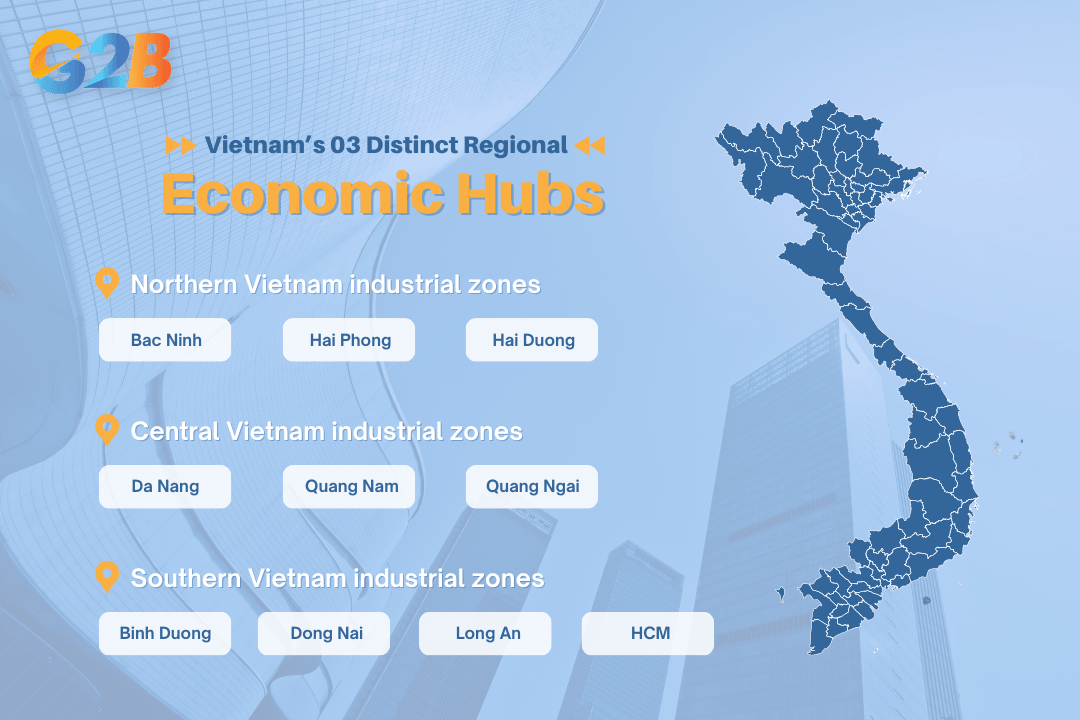
There are 03 distinct regional economic hubs in Vietnam
Northern Vietnam industrial zones
Northern Vietnam serves as the absolute epicenter for heavy industry and advanced electronics manufacturing. Its direct land border with China allows corporations to seamlessly import raw materials and intermediate components, process them in Vietnam, and export finished goods globally. The region benefits from world-class infrastructure, including the Hanoi-Hai Phong Expressway and the Lach Huyen Deep-Sea Port.
- Bac Ninh province: Bac Ninh operates as the undisputed capital of electronics assembly in the North. It hosts massive production facilities for global tech giants. The province features a highly concentrated network of suppliers, ensuring that companies operating here experience zero supply chain friction.
- Hai Phong city: As a premier coastal city, Hai Phong provides the ultimate logistical advantage. It contains massive economic zones directly attached to deep-water ports, eliminating internal trucking costs for import-export dependent manufacturers.
- Hai Duong province: Positioned perfectly between Hanoi and Hai Phong, Hai Duong offers a strategic middle ground. It provides highly competitive land rates while maintaining immediate access to both the capital's specialized labor pool and the coast's shipping lanes.
Central Vietnam industrial zones
Central Vietnam represents the rapidly emerging frontier for industrial investment. Historically overshadowed by the North and South, the Central region now offers massive tracts of available industrial land at highly competitive rates. The government heavily subsidizes infrastructure here to attract heavy manufacturing, renewable energy projects, and automotive production.
- Da Nang city: Da Nang serves as the commercial and logistical anchor of Central Vietnam. Its high-tech parks attract IT, software development, and precision engineering firms, supported by an international airport and a major seaport.
- Quang Nam province: Home to the massive Chu Lai Open Economic Zone, Quang Nam dominates the domestic automotive manufacturing and assembly sector. The province provides deep tax incentives for mechanical engineering and heavy industrial projects.
- Quang Ngai province: Centered around the Dung Quat Economic Zone, Quang Ngai houses Vietnam's heavy industries, including oil refineries, steel production plants, and large-scale maritime engineering facilities.
Southern Vietnam industrial zones
Southern Vietnam remains the traditional economic powerhouse of the nation, boasting the most mature industrial ecosystem. The region centers around Ho Chi Minh City and specializes in diverse manufacturing sectors, such as textiles, footwear, food processing, packaging, and high-tech electronic components. The South relies on the Cat Lai Port and the Cai Mep - Thi Vai deep-water port complex to handle the majority of the nation's container traffic.
- Binh Duong province: Binh Duong acts as the most successful model for industrial development in Vietnam. It operates dozens of world-class, fully occupied industrial parks featuring impeccable infrastructure and a highly skilled expatriate and local workforce.
- Dong Nai province: Bordering Ho Chi Minh City, Dong Nai provides massive land areas for heavy and light manufacturing. The ongoing construction of the Long Thanh International Airport further elevates Dong Nai's status as a supreme logistical hub.
- Long An province: Located in the Mekong Delta but directly adjacent to Ho Chi Minh City, Long An bridges the agricultural wealth of the delta with the commercial power of the city. It excels in food processing, consumer goods, and light manufacturing.
- Ho Chi Minh city: While large-scale heavy manufacturing has moved to neighboring provinces, Ho Chi Minh City strictly focuses on high-tech manufacturing, software development, and specialized research and development (R&D) centers.
Number of industrial zones in Vietnam
To comprehend the scale of the country's manufacturing capacity, investors must analyze the exact statistical breakdown of the nation's industrial real estate. The government consistently tracks and updates these figures to manage macroeconomic growth and allocate infrastructure budgets effectively.
| Industrial zone metric | Current statistical data (2025) |
|---|---|
| Total planned industrial parks | 478 |
| Operational industrial parks | 324 |
| Parks under construction/clearance | 153 |
| Total industrial land area | 145,970 hectares |
This vast network of production hubs dictates the nation's economic trajectory. The data confirms that industrial parks contribute ~25-30% to Vietnam's industrial GDP (12-15% of national GDP), making them the most critical asset in the government's economic portfolio. The ~100 parks currently under construction represent the future supply of industrial land, designed specifically to accommodate the ongoing wave of multinational corporations executing the China+1 strategy. As these under-construction parks come online, they will provide modern, ecologically sustainable infrastructure tailored for next-generation manufacturing demands.
Types of industrial zones in Vietnam
Vietnam utilizes a highly categorized system for its industrial areas, applying specific legal definitions and regulatory frameworks to different zones. By understanding these classifications, investors can optimize their operational structures, reduce tax liabilities, and ensure total compliance with Vietnamese corporate law.
Export processing zones (EPZ)
Export Processing Zones operate as heavily regulated enclaves strictly dedicated to the production of export-oriented goods. Enterprises located within an EPZ must export 100% of their manufactured products. In exchange for this strict requirement, the Vietnamese government grants EPZ enterprises a "non-tariff" status. This means companies face absolutely zero import duties on raw materials, zero export duties on finished goods, and zero Value Added Tax (VAT) on goods transferred between the EPZ and foreign markets. Customs procedures occur directly at the factory gate, drastically reducing logistical delays.
High-tech parks
High-Tech Parks specifically target foreign investors operating in advanced scientific and technological fields. The government uses these parks to elevate the national workforce's skill level and transition the economy away from labor-intensive manufacturing. Companies investing in High-Tech Parks receive the highest tier of tax incentives available in Vietnam, including prolonged Corporate Income Tax (CIT) holidays. Prominent examples include the Saigon Hi-Tech Park (SHTP) in Ho Chi Minh City and the Hoa Lac Hi-Tech Park in Hanoi, which currently host multi-billion dollar R&D centers and semiconductor fabrication plants.
Economic zones
Economic Zones represent massive, geographically defined areas that encompass not just industrial facilities, but also residential neighborhoods, commercial centers, and international ports. These zones cover tens of thousands of hectares and aim to transform entire regional economies. Operating within an Economic Zone provides investors with a blended environment where they can build factories, house expatriate staff, and utilize specialized deep-water ports. Key examples include the Dinh Vu - Cat Hai Economic Zone in the North and the Chu Lai Economic Zone in the Central region.
Industrial clusters
Unlike massive industrial parks funded by international developers, Industrial Clusters cater specifically to small and medium-sized enterprises (SMEs) and traditional craft villages. These clusters generally cover less than 75 hectares and sit closer to residential areas. They serve a vital role in integrating local Vietnamese suppliers into the broader global supply chain. Foreign investors rarely build primary manufacturing plants in Industrial Clusters, but they heavily rely on the domestic suppliers located within these zones to provide essential packaging, intermediate components, and localized raw materials.
Major industrial parks in Vietnam
Selecting the correct industrial park guarantees operational efficiency, workforce stability, and logistical supremacy. Foreign investors consistently target a specific tier of elite industrial parks known for their flawless infrastructure, transparent management, and immediate access to vital supply chains.
Northern Vietnam
The Northern region houses some of the most technologically advanced manufacturing ecosystems on the planet, heavily dominated by South Korean, Japanese, and Taiwanese capital.
- Yen Phong industrial park (Bac Ninh): Yen Phong stands as the absolute crown jewel of Northern Vietnam's electronics sector. It hosts Samsung's largest global manufacturing facility, alongside hundreds of tier-1 and tier-2 suppliers. The park offers an independent water supply, ultra-stable power grids, and direct highway access to Noi Bai International Airport.
- Que Vo industrial park (Bac Ninh): Located near Yen Phong, Que Vo provides massive scale and operational maturity. It focuses heavily on precision engineering, plastic molding, and electronic component manufacturing, attracting global brands such as Canon and Foxconn.
- VSIP Bac Ninh (Vietnam Singapore Industrial Park): Developed through a strategic joint venture between the Vietnamese and Singaporean governments, VSIP Bac Ninh sets the gold standard for management and eco-friendly infrastructure. It provides investors with premium wastewater treatment facilities, lush green spaces, and a rigorously maintained internal road network.
Central Vietnam
Central Vietnam offers expansive land plots designed for heavy industrial applications and massive logistical operations, supported by aggressive local government incentives.
- Chu Lai industrial zone (Quang Nam): Situated within the broader Chu Lai Open Economic Zone, this area serves as the undisputed hub for automotive manufacturing. Truong Hai Auto Corporation (THACO) operates massive assembly lines here for brands like Mazda, Kia, and Peugeot. The zone features its own dedicated seaport, dramatically lowering shipping costs for heavy machinery and vehicle exports.
- Dung Quat economic zone (Quang Ngai): Dung Quat operates as the backbone of Vietnam's heavy industry. It houses the nation's first oil refinery, massive steel production complexes, and heavy maritime engineering facilities. Investors requiring massive energy consumption, chemical processing capabilities, or heavy shipping infrastructure immediately target Dung Quat.
Southern Vietnam
The Southern region maintains its legacy as the most diversified and commercially integrated industrial landscape, featuring unparalleled access to the nation's largest consumer market.
- VSIP Binh Duong: As the very first Vietnam Singapore Industrial Park established in the country, VSIP Binh Duong represents a flawless model of industrial success. It hosts thousands of multinational corporations specializing in everything from consumer electronics to advanced pharmaceuticals. Its management team provides world-class tenant support, ensuring seamless daily operations.
- Amata Dong Nai: Developed by a leading Thai industrial real estate conglomerate, Amata Dong Nai offers premium infrastructure strategically located along National Highway 1A. It provides immediate access to Ho Chi Minh City and the Cai Mep port, making it a prime location for export-driven manufacturers.
- Long Hau industrial park (Long An): Positioned at the exact intersection of Ho Chi Minh City and the Mekong Delta, Long Hau specializes in eco-friendly manufacturing, cold storage logistics, and food processing. It provides investors with rapid access to the massive agricultural output of the delta while maintaining immediate connectivity to the financial capital.
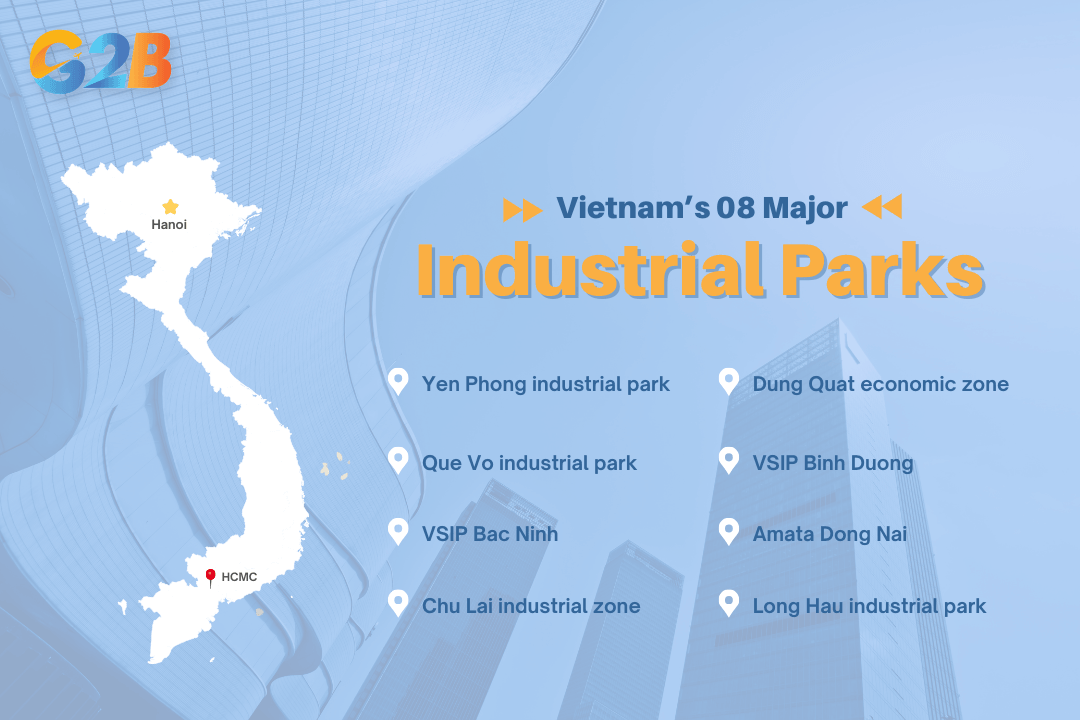
08 Major industrial parks in Vietnam
Industrial land prices in Vietnam
Securing industrial real estate requires a precise understanding of regional pricing dynamics. Land lease prices in Vietnam function on a long-term basis, typically allowing investors to lease the land until the industrial park's operational license expires (often a 50-year term). The massive influx of foreign direct investment actively drives these prices upward, necessitating swift decision-making from corporate boards.
| Region | Average land lease price (per lease term) | Primary cost drivers |
|---|---|---|
| Northern Vietnam | 120-150 USD/m² | Proximity to the Chinese border, electronics supply chain density, highway infrastructure. |
| Southern Vietnam | 150-200 USD/m² | Proximity to Cai Mep Port, mature commercial ecosystem, highly developed local consumer market. |
Market data firmly indicates that rental prices generally increase by 4 - 8% annually. This consistent year-over-year appreciation forces investors to secure their land leases rapidly during the initial market entry phase to lock in favorable rates. Furthermore, investors must account for additional monthly operational costs, such as management fees, wastewater treatment tariffs, and electricity consumption rates, which vary depending on the specific industrial park's infrastructure quality.
Key industries in the Vietnam industrial zones
Vietnam strategically diversifies its industrial output to protect its economy from global sector-specific downturns. The government actively tailors different industrial zones to support specialized manufacturing sectors, creating dense, highly efficient supply chain clusters. The manufacturing sector functions as the primary driver of industrial zone growth, heavily dominating the economic landscape.
- Electronics and electrical equipment: Electronics represent Vietnam's absolute largest export category. Parks in Bac Ninh, Thai Nguyen, and Bac Giang operate massive assembly lines producing smartphones, televisions, and home appliances for global brands like Samsung, LG, and Apple.
- Automotive and mechanical engineering: The automotive sector experiences explosive growth, concentrated heavily in Central Vietnam (Quang Nam) and the North (Vinh Phuc, Hai Phong). The rise of VinFast, Vietnam's domestic electric vehicle manufacturer, drastically accelerates the development of local tier-1 automotive parts suppliers.
- Textiles and garments: While considered a traditional industry, textiles remain a massive employer and export driver. Industrial zones in Nam Dinh, Binh Duong, and Dong Nai house highly advanced, automated textile mills and garment factories supplying global fast-fashion and athletic apparel brands.
- Logistics and warehousing: The explosion of e-commerce and export manufacturing necessitates massive logistical infrastructure. Industrial zones directly adjacent to Ho Chi Minh City and Hai Phong continuously expand their dedicated warehousing, cold chain storage, and fulfillment center capacities.
- Semiconductors and high-tech manufacturing: Vietnam aggressively positions itself as the next global hub for semiconductor packaging, testing, and eventual fabrication. The government provides maximum tax incentives to corporations like Intel and Amkor Technology, directing their investments into specialized High-Tech Parks.
Why investors choose industrial zones in Vietnam
Foreign investors do not deploy billions of dollars based on simple trends; they require concrete, mathematically proven macroeconomic advantages. Investors choose Vietnam for several strategic reasons, such as a highly competitive labor cost framework, impeccable geographic positioning, and deep integration into the global economy through bilateral agreements.
Strategic location
Vietnam possesses a flawless geographic position for global trade. Its long eastern coastline provides direct access to the South China Sea, one of the world's most critical maritime shipping routes. Most importantly, Northern Vietnam shares a direct land border with China's manufacturing heartland. This allows global corporations executing a "China+1" strategy to seamlessly truck intermediate components across the border into Vietnam for final assembly, bypassing the logistical delays of ocean freight while mitigating single-country geopolitical risks.
Competitive labor cost
Vietnam provides a highly compelling labor arbitrage advantage. The minimum wage in Vietnam remains significantly lower than in neighboring manufacturing hubs like China, Thailand, and Malaysia. Beyond the base cost, Vietnam boasts a young, highly literate, and remarkably adaptable workforce. The government continuously invests in vocational training programs specifically tailored to meet the exact mechanical and technical demands of the foreign enterprises operating within the industrial zones.
Free trade agreements
Vietnam's aggressive pursuit of economic integration makes it one of the most globally connected economies on earth. The nation participates in several transformative free trade agreements, guaranteeing foreign investors unparalleled access to global consumer markets with drastically reduced tariffs.
- CPTPP (Comprehensive and Progressive Agreement for Trans-pacific Partnership): Grants investors tariff-free access to major economies like Canada, Australia, and Japan.
- EVFTA (EU-Vietnam free trade agreement): Systematically eliminates 99% of all tariffs between Vietnam and the European Union, making Vietnam the ultimate production base for European exports.
- RCEP (Regional comprehensive economic partnership): Harmonizes rules of origin across Asia, allowing manufacturers in Vietnam to source raw materials from Japan, South Korea, or China, process them in Vietnam, and export them tariff-free throughout the entire RCEP bloc.
Investment process in industrial zones
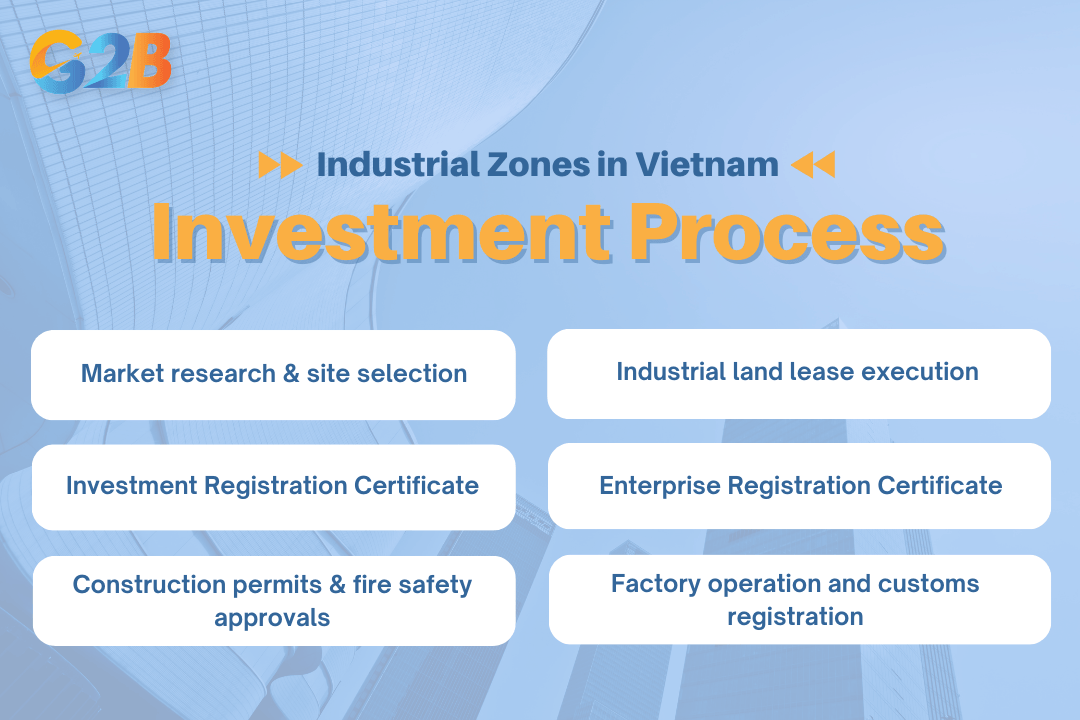
Establishing a fully operational manufacturing facility in a foreign jurisdiction demands absolute legal precision. A single missing document or incorrect bureaucratic filing causes massive operational delays. The mandatory legal framework requires investors to execute the following definitive steps:
- Market research and site selection: Investors must physically and financially evaluate multiple industrial zones.
- Investment Registration Certificate (IRC): The investor submits a comprehensive feasibility study, environmental impact assessment, and proof of financial capability to the provincial Department of Planning and Investment (DPI). The government issues the IRC to formally approve the foreign investment project.
- Enterprise Registration Certificate (ERC): Following the IRC, the investor registers the newly formed Vietnamese legal entity. The ERC acts as the company's official birth certificate and tax identification number.
- Industrial land lease execution: The newly formed enterprise signs the official land sub-lease agreement with the industrial park developer and transfers the required capital.
- Construction permits and fire safety approvals: Before laying a single brick, the company must submit detailed architectural blueprints to secure mandatory construction permits and highly rigorous fire safety certifications.
- Factory operation and customs registration: Upon completing construction, the facility undergoes final government inspections. The enterprise registers with local customs authorities to begin importing machinery and exporting finished goods.
Industrial zones drive Vietnam’s key manufacturing sectors
Future outlook (2025-2030) of industrial zones in Vietnam
The Vietnamese government actively executes a master development plan to drastically expand and modernize its industrial capacity over the next five years. The official national strategy aims to establish 600 industrial parks by 2030, with total industrial land reaching 1 million hectares (including eco-zones), pushing the total allocated target industrial park area to an astonishing 181,000 hectares. This massive expansion explicitly supports the permanent global supply chain relocation away from centralized single-country manufacturing.
Future industrial development completely abandons the traditional, highly polluting manufacturing models of the past. The government legally mandates the transition toward Green Industrial Parks (Eco-industrial parks). These futuristic zones implement mandatory circular economy principles, requiring factories to share centralized wastewater treatment facilities, utilize massive rooftop solar arrays, and recycle industrial byproducts into usable raw materials for neighboring facilities. Furthermore, the integration of smart manufacturing protocols - utilizing 5G networks, AI-driven logistics tracking, and automated port operations - will transform Vietnam's industrial zones into the most technologically sophisticated production environments in the global South.
Investors operating in Vietnam over the next decade will witness a historic transformation. Industrial zones in Vietnam represent much more than simple plots of land; they are highly optimized, legally secure, and incredibly lucrative platforms designed specifically for global corporate success. By analyzing the exact regional maps, securing prime real estate before land lease prices escalate further, and partnering with dedicated experts to handle the complex legal establishment process, foreign corporations guarantee their long-term dominance within the world's most vital manufacturing supply chain.
Ready to start your journey in Vietnam? Contact G2B today for a consultation on how to establish a company in Vietnam and to follow annual compliance requirements during operations. Let us handle the bureaucracy so you can focus on your business.
