





 Delaware (USA)
  Vietnam
  Singapore
  Hong Kong
  United Kingdom
 A shelf company in Vietnam is a formally incorporated business entity that possesses no active business operations, commercial assets, or financial liabilities. Corporate service providers, financial consultants, and law firms establish these legal entities specifically to let them age before transferring full ownership rights to a final buyer. This precise legal mechanism remains highly popular among foreign investors because it successfully bypasses the lengthy statutory incorporation periods dictated by the Ministry of Planning and Investment (MPI).
This article outlines the key aspects of shelf companies to help businesses and investors gain a clearer understanding of this option when entering the market. We specialize in company formation services and do not provide financial or investment advice. For specific guidance regarding transactions or investment decisions related to a shelf company, please consult a qualified financial advisor or relevant professional institution.
What is a shelf company?
A shelf company represents a legally dormant corporate structure holding a valid Enterprise Registration Certificate (ERC), an official corporate seal, and an active registered tax code from the General Department of Taxation. These entities perform zero commercial activities, hold zero physical inventory, and generate zero revenue during their dormant operational period. Corporate legal professionals structure and maintain these entities strictly for future resale. Maintaining this dormant status requires strict ongoing administrative upkeep. The corporate service provider must file regular zero-revenue tax declarations to ensure the entity remains in perfect standing with the state authorities.
How shelf companies work
The lifecycle of a shelf company follows a rigid, standardized legal sequence governed by the local Department of Planning and Investment (DPI). First, a corporate service provider registers the entity as a standard local company, capitalizing the business with minimal statutory requirements. Second, the provider places the entity "on a shelf" to age, submitting zero-revenue tax filings, annual license fees, and mandatory compliance reports to maintain pristine legal standing. Finally, the provider transfers 100% of the ownership shares to a buyer the moment a corporate acquisition request occurs. This legal transaction immediately activates the business for formal commercial use, granting the new foreign or domestic owner total control over the corporate structure.
Foreigners cannot establish a shelf company in Vietnam. Under the Investment Law 2020, foreign investors must register specific investment projects (detailing objectives, scale, location, and financial capacity) to obtain an Investment Registration Certificate (IRC), making it impossible to set up an inactive "off-the-shelf" entity.
However, foreigners can purchase an existing shelf company. Consulting firms offer pre-established LLCs (previously dormant) for foreign buyers, involving shareholder and director changes (foreign directors require work permits) plus IRC updates. Post-acquisition, the company must comply with tax and labor obligations like a new entity, including annual tax filings and social insurance contributions. Key benefits include faster setup (days vs. months), enhanced market credibility from the company's age, and pre-existing tax codes/VAT for easier banking.
Shelf company vs new company
Acquiring a pre-registered company provides vastly different operational metrics compared to establishing a new legal entity from scratch. The primary distinction centers on the immediate availability of the corporate framework. Buying a ready-made structure helps investors skip the setup time of a new company and start operations immediately.
| Factor | Shelf company | New company |
|---|---|---|
| Setup time | 10-20 working days for full legal transfer and ERC amendment | ~15-30 days (Includes streamlined IRC and ERC approval via National Portal) |
| Company age | Already aged (Ranges from months to several years) | 0 days (Brand new incorporation) |
| Cost | Higher (Includes historical maintenance and aging premium) | Lower (Standard state registration fees) |
| Corporate history | Established track record on the National Portal | No corporate history or searchable background |
| Immediate credibility | High (Preferred by banks and local partners) | Low (Subject to strict initial operational scrutiny) |
Shelf company vs shell company
International corporate terminology frequently confuses these two distinct legal classifications, leading to regulatory misunderstandings. A shelf company is a legal, ready-made company created for immediate business use. Law firms establish these entities transparently, legally, and specifically to accelerate market entry for legitimate foreign and domestic investors. They strictly maintain full compliance with local enterprise laws.
Conversely, a shell company is often used purely for financial structuring or hiding assets, sometimes carrying a negative connotation. Shell companies frequently operate in offshore tax havens, deliberately obfuscating ultimate beneficial ownership to evade domestic taxation, launder unauthorized capital, or execute illicit cross-border transfers. Vietnamese financial law, monitored by the State Bank of Vietnam and the Anti-Money Laundering Department, strictly prohibits illicit shell company activities. However, the state fully regulates, recognizes, and protects legitimate shelf company transactions executed through formal M&A protocols.
Why a shelf company?
Strategic corporate acquisitions solve critical logistical challenges for international businesses entering the Southeast Asian market. Purchasing an aged company directly addresses specific corporate bottlenecks.
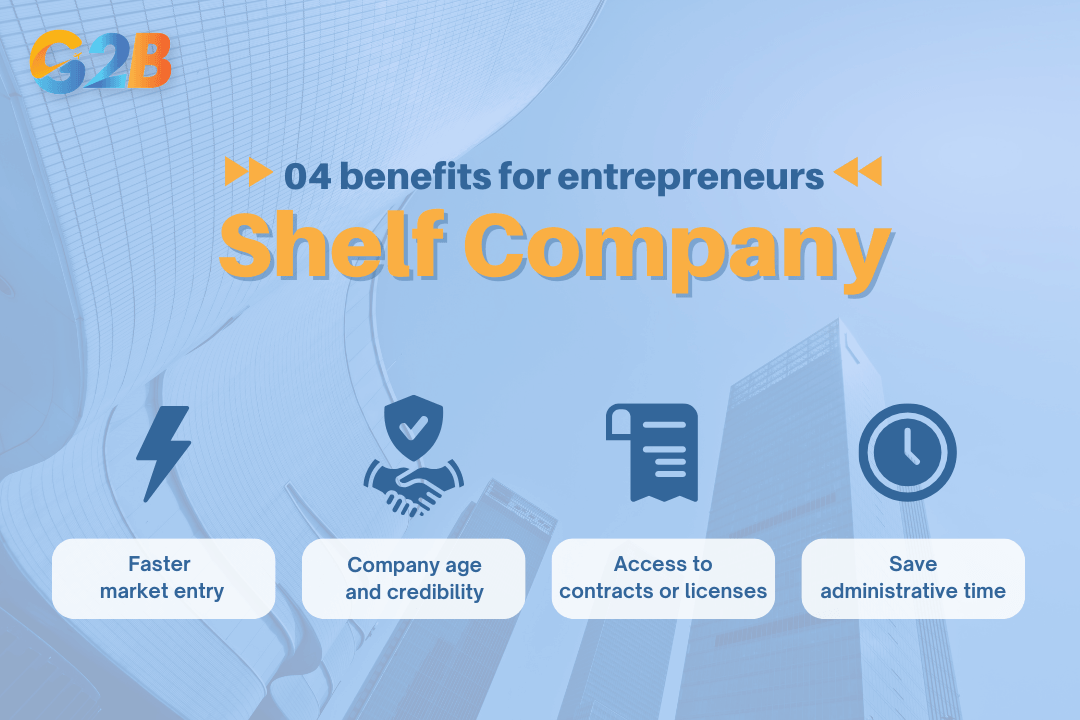
Shelf company brings four benefits for entrepreneurs
1. Faster market entry
Foreign investors permanently eliminate the mandatory statutory waiting periods associated with standard company registration procedures. Establishing a new Foreign Invested Enterprise (FIE) requires the issuance of both an Investment Registration Certificate (IRC) and an Enterprise Registration Certificate (ERC), consuming up to six weeks of administrative processing. The transfer of an existing entity requires only the amendment of the existing ERC. This allows corporate directors to commence commercial operations, sign vendor agreements, and execute labor contracts within a matter of days.
2. Company age & credibility
An older company builds immediate trust with local clients, manufacturing suppliers, and domestic financial institutions. Vietnamese commercial banks subject aged companies to less rigorous financial scrutiny when approving credit lines, issuing Letters of Credit (L/C), or authorizing corporate overdraft facilities. Domestic B2B partners strongly prefer signing high-value procurement contracts with entities demonstrating a multi-year history on the National Business Registration Portal, viewing them as stable commercial counterparts rather than high-risk startups.
3. Access to contracts or licenses
Specific commercial sectors enforce strict chronological prerequisites for vendor participation. Corporate bidding projects require a company to demonstrate a proven corporate track record to qualify for tender submission. Public procurement initiatives, state-sponsored infrastructure projects, and large-scale private construction bids automatically disqualify newly registered entities. Acquiring a three-year-old aged company immediately satisfies these chronological tender requirements. Furthermore, some pre-registered companies already possess difficult-to-obtain sub-licenses, eliminating secondary licensing delays.
4. Save administrative time
Investors achieve rapid market integration by bypassing initial state approvals, mandatory capital verification processes, and initial tax registration steps. The acquired entity possesses a fully functional corporate structure, complete with tax codes, electronic invoicing systems, and digital signatures. Executive management bypasses the entire bureaucratic setup phase, allowing them to focus operational resources entirely on revenue-generating activities, hiring essential personnel, and securing market share.
Who should buy a shelf company?
The strategic acquisition of a dormant corporate entity serves highly specific commercial profiles. The ideal candidates for this corporate transaction include specific buyer categories, such as:
- Foreign investors entering Vietnam require immediate operation to sign urgent commercial leases or secure time-sensitive vendor contracts.
- Entrepreneurs need immediate corporate frameworks to sponsor foreign work permits and secure temporary residence cards for expatriate staff.
- Companies bidding for specific projects that mandate a minimum corporate operational history to pass initial compliance screening.
- Investors strictly require an existing corporate history to satisfy the rigid compliance mandates of their overseas parent company.
- Cross-border eCommerce operators need an instant domestic legal entity to open local payment gateways and merchant accounts.
Types of shelf companies in Vietnam
The Vietnamese corporate registry accommodates several variations of pre-registered entities. Buyers select an exact entity type based on their intended statutory structure, capital mobility requirements, and operational readiness. The standard legal entity types include specific business forms, such as Limited Liability Companies (LLC), Joint Stock Companies (JSC), and Foreign-invested shelf companies.
A Single-member LLC represents the most common structure due to its simplified corporate governance and absolute control by a single corporate or individual owner. A JSC requires a minimum of three founding shareholders and permits the issuance of public shares, serving large-scale investment frameworks.
Corporate service providers also categorize these entities based on strict operational parameters:
- Company age: Entities aged 1 year, 3 years, or 5 years. Older entities command significantly higher acquisition premiums due to their enhanced market credibility.
- Industry license availability: Entities possessing pre-approved sub-licenses for restricted or conditional commercial sectors (e.g., retail trading, freight forwarding, or management consulting).
- Active banking status: Entities that already come with an active corporate bank account, bypassing the rigorous Know Your Customer (KYC) protocols currently enforced by the State Bank of Vietnam for new accounts.
Process of buying a shelf company in Vietnam
Executing the legal transfer of a corporate entity requires strict adherence to the Law on Investment and the Law on Enterprises. Buyers must follow a standardized legal sequence to ensure lawful corporate acquisition.
- Choose a suitable shelf company: The buyer selects a specific entity matching their required statutory age, preferred legal structure, and registered business lines compatible with the WTO schedule of commitments.
- Due diligence: Legal professionals audit the entity, rigorously checking legal status, hidden debts, tax filing histories, and labor compliance records to guarantee zero operational liabilities.
- Sign the share purchase agreement: Both participating parties execute binding capital transfer contracts transferring 100% of the equity or corporate shares to the new domestic or foreign owner.
- Transfer ownership and shareholders: Financial transactions are completed through a Direct Investment Capital Account (DICA), and ownership rights legally shift to the buyer upon payment confirmation.
- Update corporate records with local authorities: The buyer submits the amended corporate dossiers to the Department of Planning and Investment to formally register the ownership transition.
After purchasing, the buyer must change the shareholder, director, and registered office in the enterprise registry. The state mandates the immediate updating of the legal representative's details and the issuance of a newly amended Enterprise Registration Certificate.
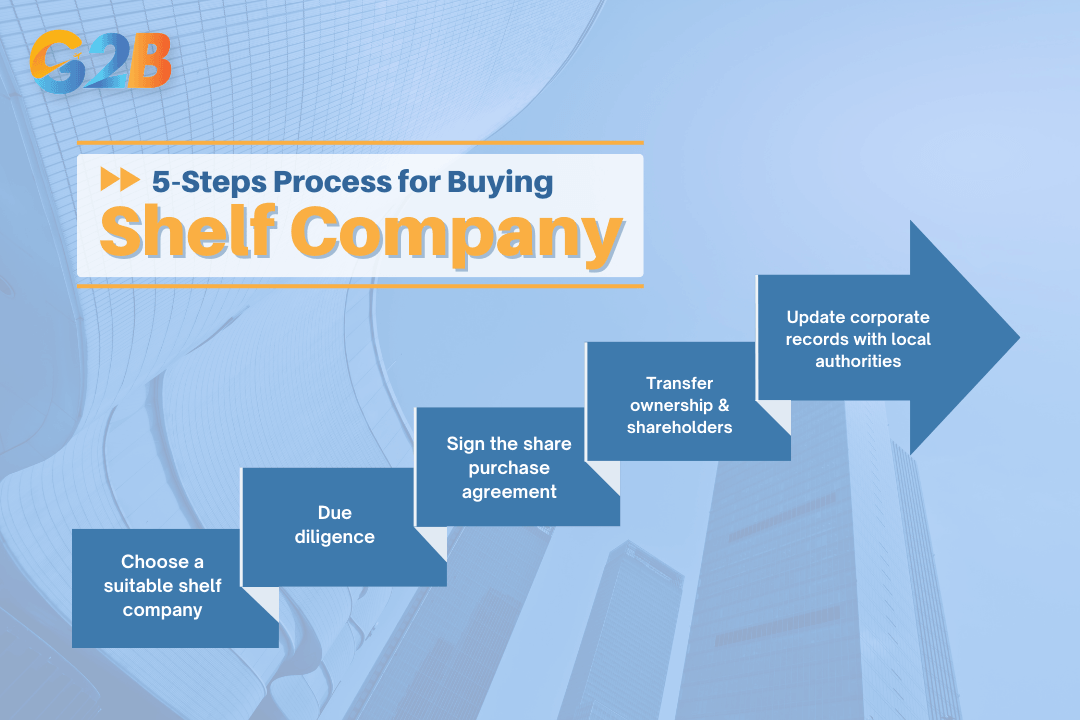
Process of 5 steps for buying a shelf company in Vietnam
Documents required
The local state authorities mandate strict documentary compliance to authorize the transfer of corporate equity. The process requires several corporate documents, such as the passports of individual shareholders, the complete shareholder list, certified bank reference letters, valid address proofs, and the legalized corporate documents of the purchasing entity.
Foreign corporate investors must authenticate, notarize, and consularize all foreign-issued corporate records at the Vietnamese embassy in their home country before submitting them to the Vietnamese government. Address proofs mandate the submission of a formalized commercial lease agreement accompanied by the landlord's notarized Certificate of Land Use Rights. The Department of Planning and Investment unequivocally rejects any application lacking properly certified, translated, and notarized documentation.
Tax and compliance for shelf companies in Vietnam
Acquiring an established entity permanently transfers all associated statutory compliance responsibilities directly to the new corporate owner. The regulatory framework dictates that shelf companies must follow the exact same tax regulations as new companies. There are zero exemptions for pre-registered entities once activated.
The General Department of Taxation enforces rigid financial reporting obligations upon all active enterprises under Decree 126/2020/ND-CP. The standard Corporate Income Tax (CIT) rate is 20%, applied strictly to all net profits generated immediately after the corporate acquisition. The new legal representative must execute the annual tax filing and submit the corporate tax finalization by the 90th day of the new fiscal year.
Furthermore, the company's appointed Chief Accountant must ensure the strict submitting of audited financial statements, quarterly Value Added Tax (VAT) declarations, and monthly Personal Income Tax (PIT) deductions for all hired staff. The entity must implement the mandatory electronic invoicing system (e-invoices) under Decree 123/2020/ND-CP. Finally, the new owner must enforce strict labor law compliance, guaranteeing mandatory social insurance (BHXH), health insurance (BHYT), and unemployment insurance contributions for every registered domestic employee.
Risks & things to check before buying
Acquiring a pre-existing corporate entity introduces distinct legal, financial, and administrative liabilities absent in brand-new incorporations. Thorough legal and financial due diligence remains absolutely mandatory. Prospective buyers must instruct their corporate legal counsel to conduct exhaustive background checks targeting specific risk factors, such as hidden corporate debts, tax compliance history, the validity of existing licenses, and any pending legal disputes.
A failure to rigorously verify the tax compliance history exposes the new corporate owner to inherited financial penalties, late payment interest, and tax arrears levied by the General Department of Taxation. The due diligence process must secure a formal tax clearance certificate to guarantee zero unpaid state levies. Furthermore, the audit must confirm that the entity faces no outstanding litigation from unrecorded vendors, former employees, or the General Department of Customs regarding unfulfilled import-export duties. Buyers must also verify that the registered headquarters address remains valid and not flagged as a "ghost address" by local tax inspectors.
Frequently asked questions (FAQs)
1. Is buying a shelf company legal in Vietnam?
Yes, buying a shelf company is legal in Vietnam. The Law on Enterprises and the Law on Investment explicitly permit the unrestricted transfer of shares, equities, and capital contributions between domestic founders and foreign investors, provided the M&A transaction satisfies all statutory reporting and capital transfer requirements.
2. How long does the transfer take?
The official legal transfer takes 10-20 working days. Submitting the formal Share Purchase Agreement and updating the Enterprise Registration Certificate (ERC) with the Department of Planning and Investment requires immediate state processing. The entire timeline ensures rapid market entry compared to the standard 15-30 day new incorporation process.
3. Can foreigners buy a shelf company in Vietnam?
Yes, foreign investors can legally buy a shelf company in Vietnam. Foreigners acquire 100% of the capital in a local domestic entity. Following the capital acquisition, the corporate lawyers register the M&A approval, converting the local entity into a Foreign Invested Enterprise (FIE) through the Department of Planning and Investment.
Securing a pre-registered corporate entity provides unparalleled strategic advantages for international investors demanding immediate and unhindered market entry. Purchasing a shelf company in Vietnam eliminates bureaucratic administrative waiting periods, immediately establishes corporate credibility with local financial institutions, and secures vital eligibility for rigorous commercial bidding processes. By legally bypassing the statutory incorporation timeline, business executives direct their immediate focus toward revenue generation, vendor contract execution, and aggressive operational scaling.
Planning to launch your business in Vietnam? Get in touch with G2B for expert guidance on setting up a company in Vietnam and ongoing annual compliance. We will take care of the regulatory procedures so you can concentrate on growing your business.
