




 Delaware (USA)
  Vietnam
  Singapore
  Hong Kong
  United Kingdom
 Vietnam eVisa business permits foreign professionals to enter the country for commercial activities. The Vietnam Immigration Department issues this digital document through an online national portal. Foreigners use this visa to attend corporate meetings, sign business contracts, and explore local economic markets. This guide explains the complete electronic application steps, document requirements, official visa fees, and government processing times.
What is a Vietnam eVisa for business purposes?
A Vietnam eVisa for business purposes is an electronic travel document that allows foreign nationals to enter Vietnam for short-term commercial activities. The Vietnam Immigration Department issues this digital visa directly through the national public service portal.
The electronic system replaces traditional paper visa applications previously handled at local embassies. Applicants submit their personal details online via a secure web interface. The system stores the applicant data in the national immigration database. Border police officers verify the eVisa in the system upon the traveler's arrival at the checkpoint. The digital format offers a maximum continuous stay of 30 days per entry. Foreigners choose between single-entry and multiple-entry options based on their specific corporate schedules.
The document supports commercial activities like market research, vendor negotiations, and attending industry conferences. It does not replace a formal Vietnamese work permit. Travelers print the approved PDF file on physical paper and present it at the passport control desk alongside their original passport. The government launched this system to simplify entry procedures for international investors.
Who can apply for a Vietnam business eVisa?
Citizens from approved countries can apply for a Vietnam business eVisa. The applicant must hold a valid passport with at least six months of validity and intend to perform commercial activities within Vietnam.
The applicant submits biographic information to the online immigration portal. The Vietnamese government updates the eligible nationality list according to diplomatic policies. Applicants must hold an ordinary machine-readable passport. Official or diplomatic passport holders follow different diplomatic entry procedures. The automated system requires clear identification data to process the security background check.
Eligible applicants must meet specific administrative conditions:
- Hold an ordinary passport valid for at least six months beyond the planned entry date
- Belong to a country included in the official eVisa eligibility list
- Provide accurate biographical data matching the passport exactly
- Declare the primary purpose of the visit as business or commercial activities
- Avoid previous immigration violations or overstays in Vietnam
Local immigration authorities check the applicant's history against national security databases. Individuals with past deportations face automatic system rejection. Business professionals use this electronic visa for temporary commercial stays. Long-term expatriates need formal visa sponsorship from registered local entities.
Which countries are eligible for the Vietnam eVisa business?
Vietnam allows citizens from all countries and territories to apply for the Vietnam eVisa business. The government expanded the eligibility list in August 2023 to include global nationalities under Resolution No. 127/NQ-CP.
Previously, the electronic system restricted access to citizens from 80 specific nations. The new comprehensive policy covers over 190 countries globally. Applicants from North America, Europe, Asia, and other regions access the exact same online system. The Vietnam Immigration Portal hosts the official nationality drop-down menu used during the application. Policy changes regarding border access happen through official government decrees.
| Attribute | Description |
|---|---|
| Eligible countries | All countries and territories globally |
| Excluded groups | Individuals on international travel ban lists |
| Governing resolution | Resolution No. 127/NQ-CP (August 2023) |
| Verification platform | Vietnam National Web Portal on Immigration |
Foreign investors check the portal for exact territory names. Dual citizens choose one passport for the entire application and travel process. The entry process at the border matches the nationality stated on the approved printed document. Traveling with a different passport from the one registered invalidates the eVisa immediately.
What documents are required for a Vietnam business eVisa?
Applicants need a clear passport data page scan and a recent portrait photo to apply for a Vietnam business eVisa. The system requires digital files formatted correctly for the online upload process. The immigration portal uses automated optical character recognition (OCR) systems to read document uploads. Low-quality digital images cause automatic application delays. The passport scan must show the full biographical page clearly. The image includes the Machine Readable Zone (MRZ) lines at the bottom of the passport page. Applicants must prepare the following digital items:
- Upload a passport data page image (JPEG format, clear text, no glare, full edges visible)
- Upload a portrait photo (4x6 cm ratio, white background, no glasses, looking straight)
- Declare the entry purpose specifically as business activities in the dropdown menu
- Provide the exact intended entry and exit checkpoints
- Supply a valid email address for receiving the electronic result
- Submit a temporary residential address in Vietnam (hotel booking or company apartment)
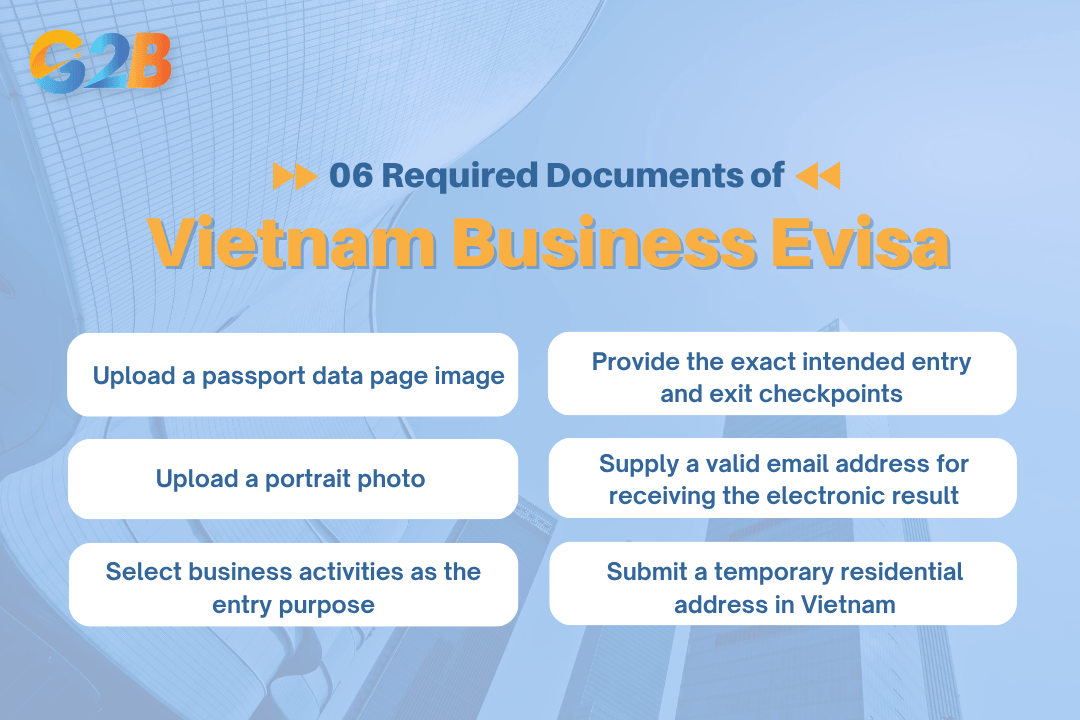
06 documents are required for a Vietnam business eVisa
The digital photo must represent the applicant's current physical appearance. The system rejects photos with hats, shadows, or heavy digital editing. Proper document preparation prevents standard rejection codes from the immigration office.
How to apply for a Vietnam eVisa for business?
Applicants apply for a Vietnam eVisa for business by submitting an online form through the official National Web Portal on Immigration. The process involves filling out personal data, uploading documents, and paying the required fee. The online government platform operates 24 hours a day. Users navigate to the specific portal section designed for foreigners applying directly. The digital form contains multiple mandatory text fields. Errors in data entry lead to rejected applications. The applicant receives a unique electronic registration code immediately after submission. This alpha-numeric code allows users to track the processing status on the portal.
Follow these precise steps:
- Access the official Vietnam Immigration eVisa portal
- Select the option for foreign citizens applying personally
- Upload the portrait photo and the passport data page scan
- Fill the application form with accurate personal, passport, and business contact details
- Select the required visa duration (up to 90 days) and number of entries
- Pay the non-refundable visa processing fee using an international credit or debit card
- Save the electronic registration code provided by the system
- Receive the approved eVisa via email in PDF format
Applicants print the final PDF document on physical paper. Border agents inspect the printed paper alongside the original physical passport. Presenting digital copies on mobile phones or tablets may face rejection at some border control desks.
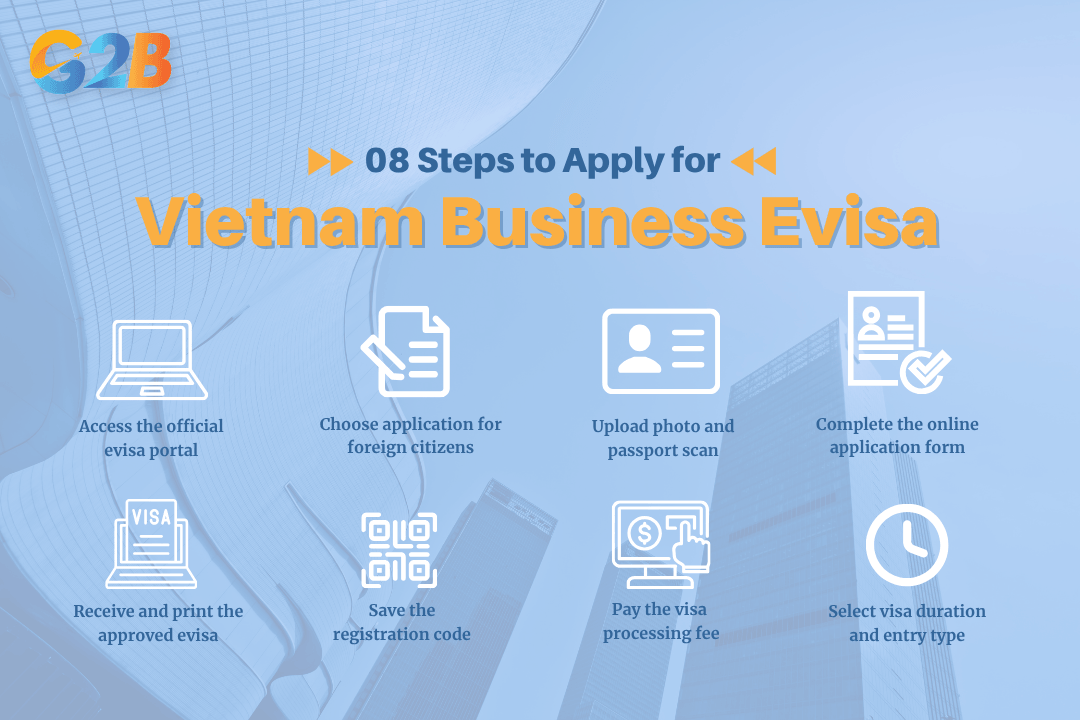
How to apply for a Vietnam eVisa for business
How long does a Vietnam business eVisa processing take?
A Vietnam business eVisa processing takes 3 to 5 working days under standard conditions. The Vietnam Immigration Department counts the processing time starting from the successful completion of the online fee payment. The stated processing timeline applies exclusively to error-free applications. Weekends and Vietnamese public holidays do not count as working days. The Tet holiday (Lunar New Year) significantly pauses government processing operations. High applicant volumes during peak international travel seasons cause additional administrative delays.
Factors affecting the timeline include:
- Apply at least 7 to 10 days before the planned flight departure.
- Ensure perfect document uploads to avoid administrative requests for amendments.
- Check the Vietnamese national holiday calendar before submitting the application.
- Monitor the email inbox and spam folder daily for official immigration notifications.
The government system sometimes requests a new photo or a clearer passport scan. These administrative requests reset the processing clock entirely. Applicants must wait another 3 to 5 working days after submitting the updated digital files. Official fast-track services do not exist on the public government portal.
What is the cost of a Vietnam eVisa for business?
The cost of a Vietnam eVisa for business is $25 for a single-entry visa and $50 for a multiple-entry visa. The applicant pays this fee online during the final application submission phase. The Ministry of Finance sets these flat administrative rates. The online payment gateway accepts major international cards like Visa, MasterCard, and JCB. The banking system adds a small processing surcharge for utilizing the international payment gateway.
| Visa type | Validity duration | Government fee (USD) |
|---|---|---|
| Single-entry | Up to 90 days | $25 |
| Multiple-entry | Up to 90 days | $50 |
The Immigration Department enforces a strict non-refundable fee policy. Rejected applications do not receive application money back. Applications containing typographical errors require a completely new online submission and a new fee payment. Users must wait for the green payment confirmation screen before closing the internet browser.
How long can you stay with a Vietnam business eVisa?
A Vietnam business eVisa allows foreign nationals to stay for a maximum continuous duration of 90 days. Applicants choose their exact stay duration and entry type during the online registration process. The 90-day maximum validity applies to both single-entry and multiple-entry options. The visa validity timeframe starts from the planned entry date specified on the application, not the actual arrival date. Travelers arriving days later than the approved start date lose those days from their total permitted duration.
Managing the approved stay period requires these specific actions:
- Select the exact 90-day travel period on the portal's online calendar
- Enter the country on or after the approved starting date
- Exit the Vietnamese territory before midnight on the printed expiry date
- Use the multiple-entry function to leave and return within the approved date limits
The border official stamps the final allowed exit date directly inside the physical passport. Overstaying the approved eVisa causes immediate administrative fines at the airport. Severe overstays lead to formal deportation and future entry bans. Foreigners must track their exit date carefully.
Can you extend a Vietnam business eVisa?
You cannot easily extend a Vietnam business eVisa from within the country. The Vietnam Immigration Department requires most foreign nationals to exit the country and apply for a new eVisa. The electronic visa system functions as a temporary entry mechanism. Standard tourist and business eVisas do not support automatic domestic extension procedures. Local immigration offices evaluate extension requests on a strict case-by-case basis. Only specific extreme situations, such as severe medical emergencies or sudden flight cancellations, qualify for internal administrative extensions.
Foreigners manage longer corporate stays by using these methods:
- Exit Vietnam to a neighboring country via an international land border (border run)
- Apply for a new business eVisa through the official portal
- Wait 3 to 5 working days for the new document approval
- Re-enter Vietnamese territory with the newly printed eVisa
Corporate investors needing long-term residency must transition to different formal visa categories. A local sponsor company applies for a formal DN (business) visa or a work permit.
Which entry points accept Vietnam eVisas?
Vietnam eVisas are accepted at 41 designated international entry checkpoints. These authorized points include major international airports, land border crossings, and international seaports across the country. The applicant selects the specific entry port from a drop-down menu during the application. The approved PDF document displays this specifically chosen port. Travelers face immediate denial of entry if they arrive at an unapproved local border gate or a different port than the one printed.
| Category | Examples of approved checkpoints |
|---|---|
| International airports | Noi Bai (Hanoi), Tan Son Nhat (HCMC), Da Nang, Cam Ranh, Phu Quoc |
| Land border gates | Moc Bai, Lao Bao, Cau Treo, Huu Nghi, Ha Tien |
| International seaports | Hai Phong, Ho Chi Minh City, Da Nang, Hon Gai, Nha Trang |
The traveler can change the exit port freely without notifying immigration authorities. However, the entry port must match the exact location printed on the eVisa. If a last-minute flight change forces an arrival at a different international airport, the traveler must apply for a completely new eVisa.
What are the common mistakes in Vietnam business eVisa applications?
Common mistakes in Vietnam business eVisa applications include entering incorrect passport numbers, uploading poor-quality photos, and mismatching personal names. These administrative errors cause immediate delays or outright rejections by immigration officials. The automated system cross-checks user text input against the uploaded passport data scan. Any minor spelling mistake invalidates the entire application. Applicants frequently confuse the letter "O" with the number "0" in passport alphanumeric strings.
Avoid these specific application errors:
- Match the full name exactly as printed in the passport MRZ line
- Format dates of birth and passport expiry dates correctly (DD/MM/YYYY)
- Upload photos without optical glasses, hats, or distracting colored backgrounds
- Select the correct entry port matching the finalized flight ticket
- Declare the exact business purpose instead of mistakenly choosing tourism
Arriving with an eVisa that contains a typographical error results in denied boarding at the departure airport. Commercial airlines check the document details strictly against the physical passport. The immigration department does not offer editing options after final submission. Users must submit a fresh application and pay the required fee again.
Does a Vietnam eVisa allow full business activities?
A Vietnam eVisa allows limited business activities such as attending meetings, conducting negotiations, and visiting conferences. The eVisa strictly prohibits formal employment, receiving a local salary, or signing long-term labor contracts. Foreign corporate professionals use this digital document for exploratory market visits. International companies send representatives to audit manufacturing factories or meet local supply chain partners. The eVisa serves strictly short-term commercial investigation purposes. Permitted activities include:
- Attend corporate meetings and international industry seminars
- Negotiate business contracts with prospective Vietnamese partners
- Conduct local market research and commercial feasibility studies
- Participate in short-term corporate training sessions
Working illegally on an eVisa violates Vietnamese national labor laws. Provincial labor authorities conduct random administrative checks at local workplaces. Violators face immediate deportation and heavy financial fines. Foreigners intending to work formally must secure a local labor contract. The local employer secures a Work Permit and a valid Temporary Residence Card for the foreign employee.
What is the difference between an eVisa and a business visa in Vietnam?
A Vietnam eVisa is an online document for short stays without a local sponsor, while a traditional business visa (DN visa) requires a local sponsoring company and allows much longer stays. The eVisa operates on a fully digital public platform. It offers high flexibility for independent foreign travelers. The traditional DN visa involves complex physical paperwork. The Vietnamese host company submits sponsorship documents to the Immigration Department directly.
| Feature | eVisa (Business purpose) | Traditional business visa (DN) |
|---|---|---|
| Application method | 100% Online portal | Embassy or sponsor submission |
| Sponsor required | No | Yes (Vietnamese registered company) |
| Maximum duration | Up to 90 days | Up to 12 months |
| Conversion to a work permit | Highly difficult/ Not allowed | Allowed (with proper documentation) |
| Processing speed | 3 to 5 working days | 7 to 10 working days |
Foreign investors forming new commercial companies often start with an eVisa. After establishing the local legal entity, they switch to investor visas or DN visas.
Frequently asked questions about the Vietnam eVisa business
Can you convert a tourist eVisa to a business eVisa?
No, you cannot directly convert a tourist eVisa into a business eVisa within Vietnam. The applicant must exit the country completely and apply for a new business eVisa before re-entering. Immigration laws enforce strict purpose-of-entry rules. Using a tourist visa for commercial negotiations violates local regulations. Professionals must secure the correct visa type before beginning business activities.
Do you need a sponsor for a Vietnam eVisa business?
No, you do not need a local sponsor to apply for a Vietnam eVisa business. The digital system allows foreign nationals to apply independently without invitation letters from Vietnamese companies. This feature provides significant flexibility for freelance consultants and solo commercial investors. Traditional DN visas heavily rely on local company documentation. The eVisa eliminates this administrative burden.
Is a Vietnam eVisa valid for multiple entries?
Yes, a Vietnam eVisa offers a multiple-entry option valid for up to 90 days. The applicant must explicitly select and pay for the multiple-entry version during the online application process. Multiple-entry visas benefit travelers managing regional Asian business. A foreign manager can visit Vietnam, fly to Singapore for a meeting, and return to Ho Chi Minh City using the same approved document.
Can you use a Vietnam eVisa at all airports?
No, you cannot use a Vietnam eVisa at all airports. The document is only valid at designated international airports, seaports, and land borders explicitly approved by the Vietnamese government. Domestic airports do not operate immigration control desks. Travelers arriving on direct international flights to smaller regional airports must verify checkpoint eligibility first. The official portal provides the exact list of approved entry locations.
Securing a Vietnam eVisa for business requires accurate data entry and strict adherence to immigration guidelines. Foreign commercial professionals must prepare valid passports, correct digital photographs, and precise travel itineraries. Avoiding common formatting errors ensures a smooth approval experience. Temporary business visitors handle contract negotiations and market research efficiently using this digital document. Companies requiring long-term expatriate deployment must seek formal local sponsorships and work permits.
Ready to work or stay in Vietnam? Contact G2B today for a consultation on Work permit/TRC/Business visa services in Vietnam. Our team will guide you through the procedures and required documents to help ensure a smooth and compliant application process.
