




 Delaware (USA)
  Vietnam
  Singapore
  Hong Kong
  United Kingdom
 Investors seeking to benefit from the ongoing realignment of Southeast Asia’s supply chains increasingly regard Vietnam as a strategic hub for logistics infrastructure development. Establishing a logistics company in this market requires strict compliance with investment regulations, satisfaction of sector-specific conditions, and well-structured operational planning to ensure both legal conformity and long-term operational efficiency.
Why choose Vietnam for your logistics business?
Vietnam currently holds the position of a strategic link in the global supply chain. The decision to enter this market rests on four undeniable economic vectors.
1. The "China Plus One" strategy
Global manufacturers engage in the "China Plus One" strategy to diversify supply chains. Vietnam acts as the primary beneficiary due to its geographic proximity to China and lower labor costs. This migration of manufacturing - from electronics (Samsung, LG) to textiles - creates an immediate, high-volume demand for freight forwarding, warehousing, and third-party logistics (3PL) services.
2. High industry growth rates (CAGR)
The logistics sector in Vietnam witnesses an annual growth rate of 14-16%. The market value, estimated at over $40 billion, continues to expand as domestic consumption rises and export volumes surge.
3. Free trade agreements (FTAs)
Vietnam serves as one of the most open economies globally, having signed multiple next-generation Free Trade Agreements.
- EVFTA (EU-Vietnam free trade agreement): Eliminates duties on logistics equipment and boosts trade flow with Europe.
- CPTPP (Comprehensive and progressive agreement for trans-pacific partnership): Opens markets across the Pacific Rim.
- RCEP (Regional comprehensive economic partnership): Streamlines customs procedures among ASEAN and its partners. These agreements mandate high-standard logistics operations, driving demand for sophisticated foreign logistics providers.
4. Critical infrastructure expansion
The Government of Vietnam prioritizes infrastructure investment to reduce logistics costs, which historically account for roughly 18% of GDP.
- Cat Lai Port: The largest container terminal in Vietnam, handling the majority of southern cargo.
- Cai Mep - Thi Vai port cluster: A deep-water port capable of receiving mother vessels directly bound for the US and EU without transhipment.
- Long Thanh international airport: Currently under construction, this airport targets becoming a regional transit hub by 2030.
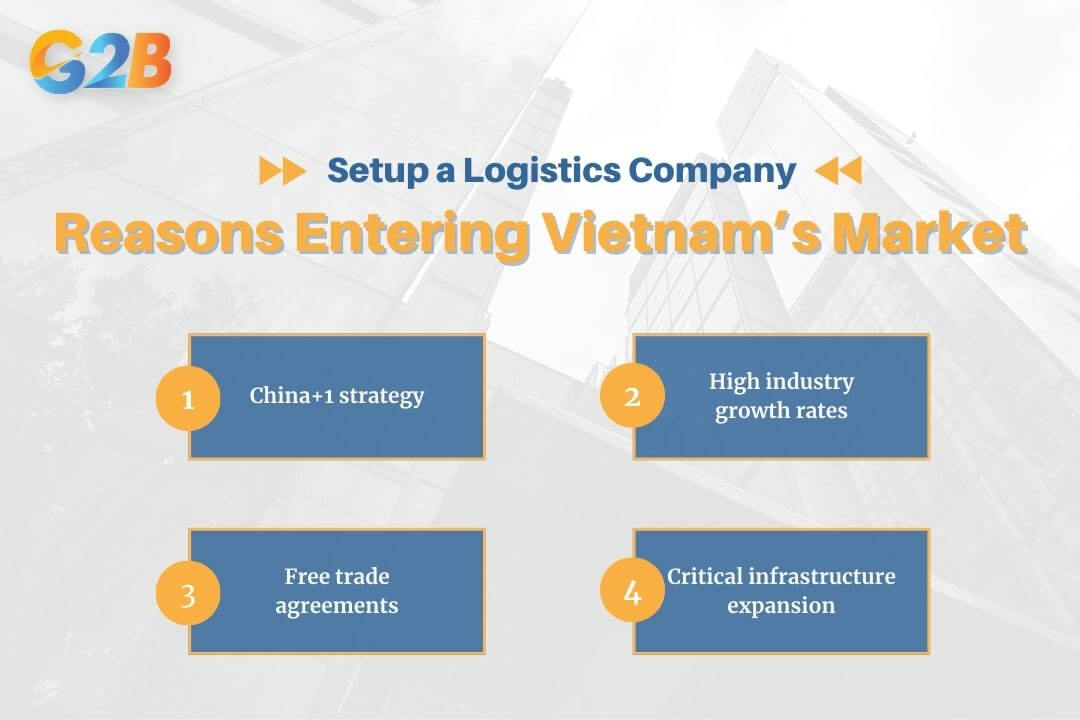
The decision to enter Vietnam’s market rests on 4 economic vectors
Understanding logistics services classification in Vietnam
To successfully setup a logistics company in Vietnam, investors must define their specific business lines. Decree No. 163/2017/ND-CP details the conditions for logistics services, implementing the Commercial Law 2005. Logistics services fall into three primary categories:
- Principal logistics services:
- Loading and unloading services (container handling).
- Warehousing and storage services (bonded warehouses, cold storage).
- Freight transport agency services (Freight Forwarding).
- Transportation services:
- Maritime cargo transport.
- Inland waterway transport.
- Rail and road freight transport.
- Air cargo transport.
- Related services:
- Cargo inspection and sampling.
- Customs brokerage (Customs clearance agents).
- Post and courier services (Last-mile delivery).
Note: The classification determines the Foreign Ownership Limit (FOL). Investors cannot register a generic "Logistics Company"; they must register specific CPC Codes (Central Product Classification) aligned with WTO commitments.
Conditions for foreign investors
Vietnam adheres to its WTO Accession Protocol. Foreign investors face distinct ownership caps depending on the specific sub-sector of logistics they intend to operate.
Sectors allowing 100% foreign ownership
Foreign investors establish 100% Foreign invested enterprises (FIE) in the following areas:
- Storage and warehousing services (CPC 742): Investors own and operate warehouses without a local partner.
- Freight transport agency services (CPC 748): This covers freight forwarding.
- Courier services (CPC 751): Express delivery services.
Sectors requiring Joint Ventures (JV)
Certain sectors classify as "conditional business lines", requiring a Joint Venture with a Vietnamese entity.
- Road freight transport (CPC 7123): Foreign capital contribution generally caps at 51%. The venture requires a local partner.
- Inland waterway transport (CPC 7221): Foreign ownership caps at 51%.
- Container handling services (CPC 7411): Foreign ownership caps at 51%.
Maritime transport specifics
For companies engaging in international maritime transport:
- Foreign ownership: Capped at 49%.
- Crew nationality: The Captain and First Officer must be Vietnamese citizens on Vietnamese-flagged vessels.
Requirements to setup a logistics company
Beyond ownership limits, investors must satisfy capital, location, and personnel requirements.
1. Capital requirements
Vietnam’s Enterprise Law does not stipulate a minimum "Legal capital" for most logistics business lines (unlike Banking or Insurance). However, investors must declare Charter capital.
- Financial capacity: The Department of Planning and Investment (DPI) assesses whether the capital matches the scale of the project.
- Recommendation: A minimum Charter Capital of $100,000 to $200,000 USD for a standard freight forwarding setup to ensure smooth licensing and cover initial operational costs (office rental, deposits, staff). For asset-heavy setups (fleets, warehouses), capital must reflect the asset value.
2. Physical location
A virtual office generally suffices for Freight Forwarding registration, but a physical office facilitates better banking relations and tax inspections.
- Warehousing: If the business model includes storage, the location must be in a designated zone.
- Industrial zones: Pre-approved for warehousing, simplifying fire safety and environmental licensing.
- Commercial centers: Suitable for administrative offices but strictly prohibited for goods storage.
3. Personnel requirements
For general logistics, no specific certification is required for the General Director. However, specific sub-licenses impose strict personnel conditions:
- Customs brokerage: The staff directly processing customs declarations must hold a Customs Practice Certificate issued by the General Department of Customs.
Step-by-step guide to setting up a logistics company in Vietnam
The incorporation process for foreign investors involves 4 stages, with 2 primary stages: Investment Registration and Enterprise Registration.
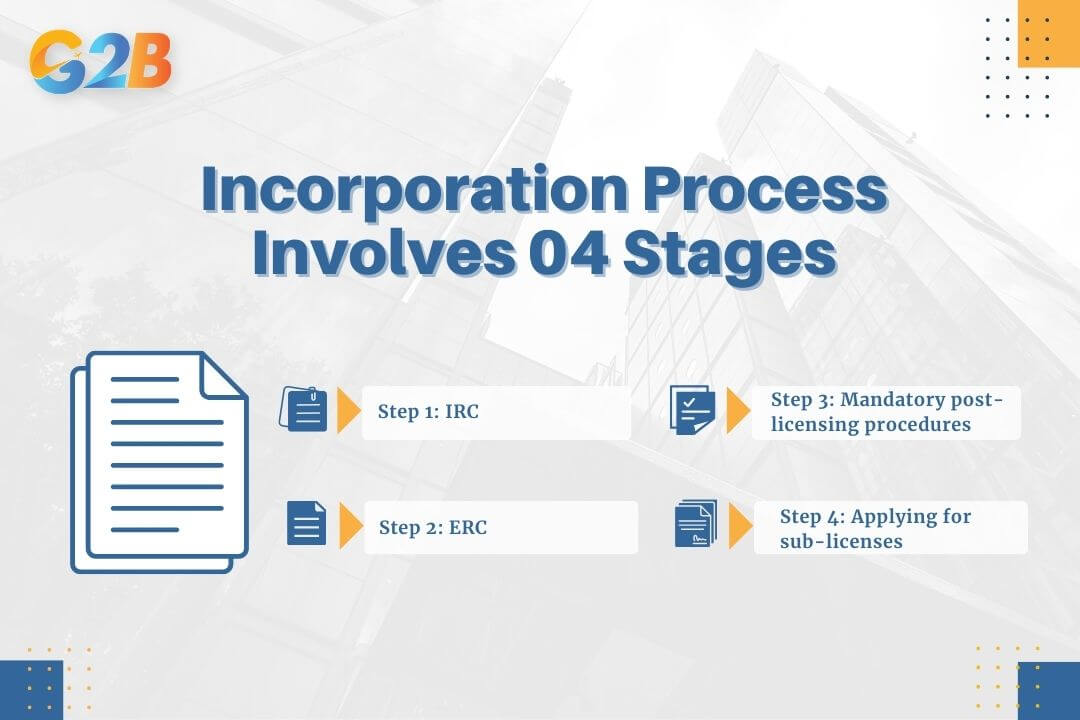
The incorporation process for foreign investors involves 4 stages
Step 1: Investment Registration Certificate (IRC)
- Authority: Department of Planning and Investment (DPI).
- Procedure: Investors submit a dossier proving financial capacity (bank statements), legal status (consularized documents from the home country), and a project proposal.
- Duration: 15 to 45 working days.
- Outcome: Issuance of the Investment Registration Certificate. This document grants the right to invest foreign currency in Vietnam.
Step 2: Enterprise Registration Certificate (ERC)
- Authority: Business Registration Office (under DPI).
- Procedure: Upon receiving the IRC, the investor registers the specific company entity (LLC is the most common structure).
- Duration: 3 to 7 working days.
- Outcome: Issuance of the Enterprise Registration Certificate. This document contains the Tax Identification Number.
Step 3: Mandatory post-licensing procedures
Before operations commence, the company completes these administrative tasks:
- Seal carving: Create the corporate seal.
- Public announcement: Publish company formation details on the National Business Registration Portal.
- Bank accounts: Open two types of accounts:
- Direct investment capital account (DICA): Used exclusively for receiving capital injection and repatriating profits.
- Current account: Used for daily transactions.
- Tax token: Purchase a Digital Signature (Token) for e-tax filing.
Step 4: Applying for sub-licenses
Holding an ERC does not automatically authorize all logistics activities. Specific operations require sub-licenses.
A. Multimodal transport license
Required for companies issuing their own House Bill of Lading (HBL) and acting as a Multimodal Transport Operator (MTO).
- International license: Requires asset proof or insurance liability coverage (minimum 80,000 SDR). Issued by the Ministry of Transport.
- Domestic license: Issued by the Department of Transport.
B. Trucking license
Required if the company owns and operates a truck fleet.
- Condition: Vehicles must fit GPS tracking; the company must have a transport safety plan.
C. Customs broker license
Required to sign customs declarations on behalf of clients.
- Condition: At least one staff member must pass the General Department of Customs exam.
Tax obligations and incentives for logistics companies
Logistics entities in Vietnam operate under the standard corporate tax regime, though location-based incentives exist.
Standard tax rates
- Corporate income tax (CIT): Standard rate is 20% on net profits.
- Value-added tax (VAT): Generally 10%.
- Note on Exported services: International transportation services often qualify for 0% VAT, allowing the company to claim input VAT refunds.
- Business license tax: An annual fixed fee (approx. $80 - $130 USD) based on charter capital.
- Foreign contractor tax (FCT): Applies when the Vietnamese entity pays a foreign overseas partner (e.g., paying an agent fee to a forwarder in the US). The Vietnamese company must withhold tax before payment.
Investment incentives
Investors setting up large-scale logistics centers in Economic zones or areas with difficult socio-economic conditions benefit from:
- Tax holidays: 2 to 4 years of CIT exemption.
- Tax reductions: 50% reduction of CIT for subsequent years (4 to 9 years).
- Import duty exemption: On fixed assets (machinery, specialized trucks) imported to form the enterprise.
Challenges and solutions for new logistics firms
Entering Vietnam’s logistics sector presents significant opportunities, but new firms must navigate regulatory complexity, infrastructure constraints, and intense market competition.
1. Infrastructure bottlenecks
Road congestion, particularly around Cat Lai Port and key industrial zones, leads to delivery delays.
- Solution: Utilize Technology Management Systems (TMS) to optimize routing. Diversify port usage (e.g., utilizing Cai Mep for long-haul cargo to bypass city congestion).
2. Bureaucratic procedures
Customs clearance procedures, though improving via the VNACCS/VCIS system, remain complex with frequent regulatory updates.
- Solution: Employ specialized customs staff or outsource to established brokers initially. Retain a legal consultant to monitor Decree changes.
3. Intense competition
The market is fragmented with thousands of local forwarders offering low rates.
- Solution: Focus on information gain and value-added services (e.g., Cold Chain, specialized project cargo, or integrated 3PL) rather than competing solely on ocean freight rates.
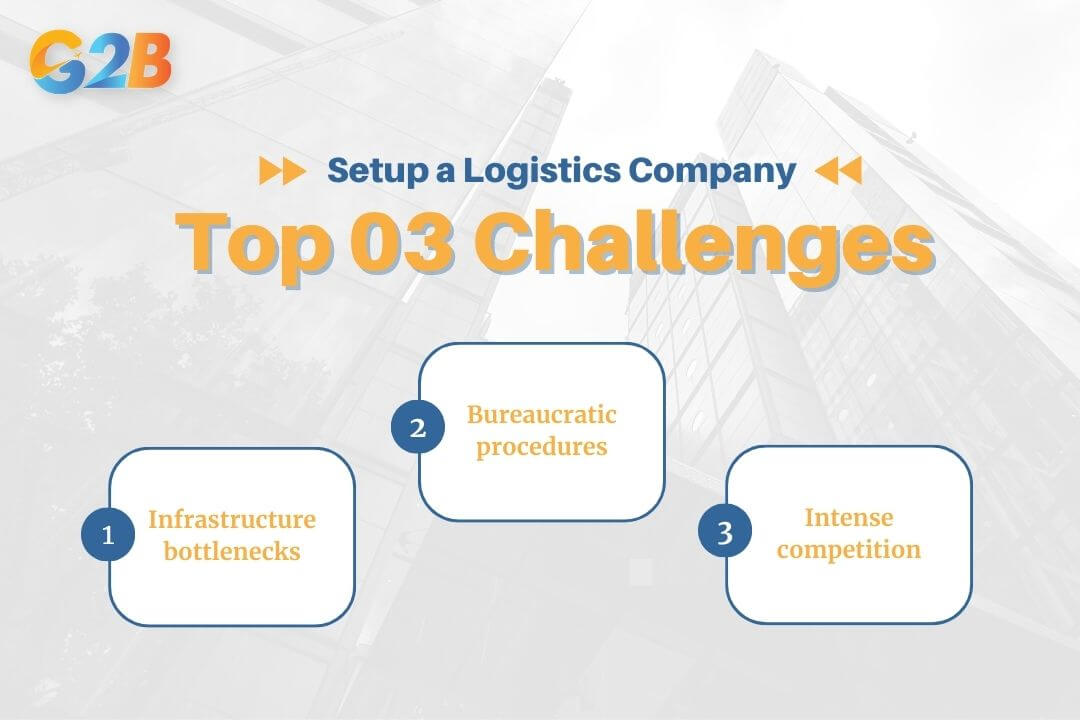
There are 3 challenges to consider when starting logistics firms
Frequently asked questions (FAQs)
To help investors and operators better navigate the setup process, this section addresses the most frequently asked questions about establishing a logistics company in Vietnam.
Can a foreigner own 100% of a logistics company in Vietnam?
Yes. Foreigners own 100% of companies providing Freight Transport Agency services (freight forwarding), Warehousing/Storage services, and Courier services. However, Road Transport and Inland Waterway transport require a Joint Venture with a Vietnamese partner.
What is the HS code for logistics services setup?
Service setups do not use HS Codes. Instead, they use CPC codes (Central Product Classification) and VSIC codes (Vietnam Standard Industrial Classification). For example, Freight Transport Agency is CPC 748 and VSIC 5229.
Do I need a multimodal transport license immediately?
No. A standard logistics company operates as a freight forwarder immediately after obtaining the ERC. The Multimodal Transport License is only necessary if the company acts as an MTO (Multimodal Transport Operator) and issues its own Bill of Lading carrying liability for the entire journey across different modes of transport.
What is the difference between FDI and local logistics setup?
A local logistics company (100% Vietnamese owned) bypasses the Investment Registration Certificate (IRC) stage, allowing for a setup time of just 5-7 days. An FDI (Foreign Direct Investment) company requires both IRC and ERC, taking 1-2 months.
The window of opportunity to setup a logistics company in Vietnam is wide open, driven by global trade shifts and massive infrastructure spending. However, the legal distinction between a Freight Forwarder, a Warehouse Operator, and a Transporter dictates strictly different entry strategies.
Establishing a logistics company in Vietnam requires a comprehensive understanding of the applicable investment framework, fulfilment of sector-specific licensing conditions, and careful alignment with operational and compliance requirements. A well-structured approach that integrates legal, regulatory, and strategic considerations will support sustainable market entry and long-term competitiveness in Vietnam’s rapidly expanding logistics sector.
Ready to start your journey in Vietnam? Contact G2B today for a consultation on how to establish a company in Vietnam and to follow annual compliance requirements during operations. Let us handle the bureaucracy so you can focus on your business.
