




 Delaware (USA)
  Vietnam
  Singapore
  Hong Kong
  United Kingdom
 Conditional business lines refer to economic sectors in which investment and business activities are subject to statutory conditions imposed for reasons of national defense, security, public order, social ethics, or public health. For businesses such as logistics, pharmaceuticals, or education, it is critical to assess whether the proposed activities fall within the list of conditional sectors prescribed under the Law on Investment 2020.
What are conditional business investment sectors?
To operate legally in Vietnam, investors must distinguish between "freedom of business" and "regulated business”. According to Clause 1, Article 7 of the Law on Investment 2020, conditional business lines are those where business investment must satisfy certain conditions for reasons of:
- National defense and security
- Social order and safety
- Social ethics
- Public health
If your industry falls into this category, you cannot simply register a company and start operating. You must satisfy the prescribed business investment conditions before conducting commercial activities.
Distinction between prohibited and conditional sectors
It is crucial not to confuse "Conditional" with "Prohibited”.
- Prohibited sectors: You cannot invest in these under any circumstances (e.g., trading in narcotics, prostitution, or debt collection services).
- Conditional sectors: You can invest, provided you meet the specific regulatory standards (e.g., trading in pharmaceuticals requires a Certificate of Eligibility for Pharmacy Business).
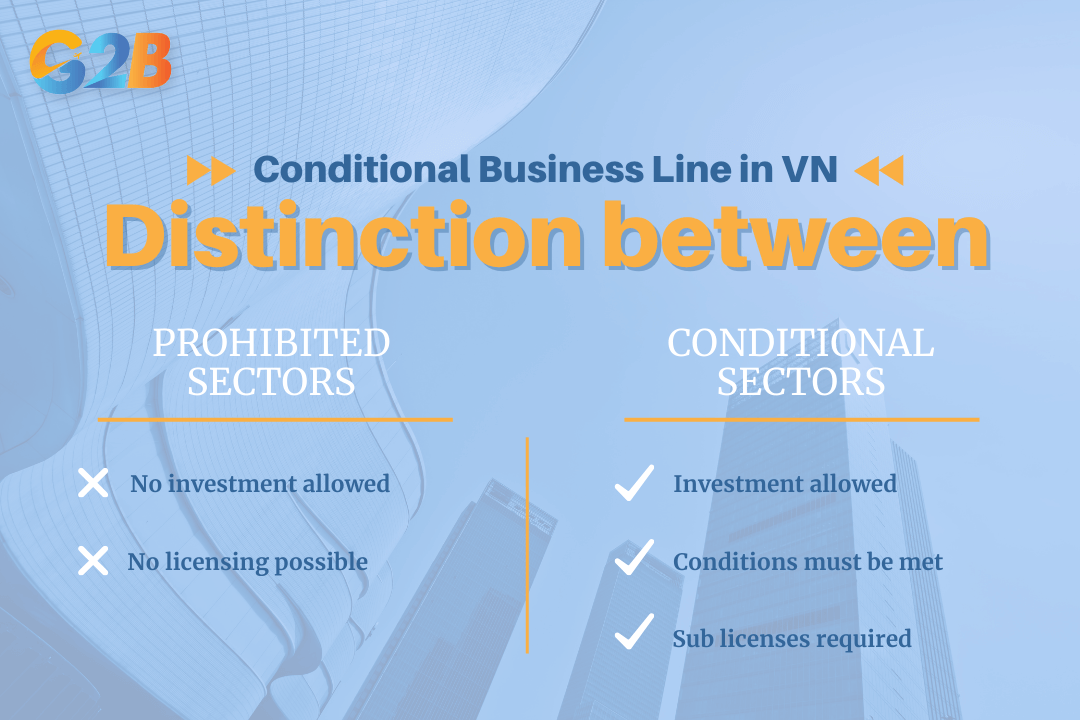
Understanding the difference between prohibited and conditional business lines
Legal framework governing conditional business investment sectors
The Vietnamese government maintains a strict hierarchy of laws to ensure that business conditions are transparent and not arbitrarily created by local authorities.
- Law on investment No. 61/2020/QH14: This is the supreme legal document regarding foreign investment. Appendix IV of this Law provides an exhaustive list of the over 220 conditional sectors.
- Decree No. 31/2021/ND-CP: Provides detailed regulations on the implementation of the Law on Investment.
- Specialized laws: Each specific sector (e.g., Banking, Aviation, Education) is governed by its own set of laws (e.g., Law on Credit Institutions, Law on Civil Aviation) which detail the exact conditions required.
Crucial legal principle: Business investment conditions can only be prescribed by Acts of the National Assembly, Resolutions of the National Assembly, Ordinances of the Standing Committee of the National Assembly, Resolutions of the Standing Committee of the National Assembly, and Decrees of the Government, as well as international treaties to which Vietnam is a party. Ministries, ministerial-level agencies, People’s Councils, and People’s Committees cannot promulgate regulations issuing business investment conditions. This principle protects investors from arbitrary administrative barriers.
Consolidated list of over 220 conditional business sectors grouped by sector
The Law on Investment 2020 lists over 220 specific sectors. For ease of reference and better user experience (UX), we have categorized these sectors into functional industry groups below.
National defence, security, and public order
- Weapons & combat gear: Manufacturing of stamps, Combat gear trading, Trading of paintball guns, Trading of military equipment/supplies for armed forces.
- Explosives & pyrotechnics: Trading of firecrackers (excluding explosive types), Trading of industrial explosive materials and explosive precursors, Blasting services.
- Surveillance & security: Security guard services, Trading of camouflage audio/video recording or positioning equipment, Trading of signal-emitting devices for priority vehicles.
- Public order services: Pawning service business, Massage service business.
Finance, banking, insurance and audit
- Banking & credit: Operations of commercial banks, non-bank credit institutions, cooperative banks, Payment intermediary services, Credit information services, Forex services.
- Securities: Securities business, Securities registration, depository, clearing, and settlement.
- Insurance: Insurance business, Reinsurance, Insurance brokerage, Insurance auxiliary services, Insurance agents.
- Accounting & tax: Accounting services, Auditing services, Tax agent services, Customs agent services.
- Other financial services: Lottery business, Casino business, Betting business, Debt trading, Prize-winning electronic games for foreigners, Voluntary pension fund management, Price appraisal, Credit rating services.
Legal and professional services
- Legal practice: Law practice, Notarial practice, Bailiff practice.
- Expertise & auction: Practicing judicial expertise (finance, construction, copyright), Property auction practice, Management and liquidation of assets (bankruptcy proceedings).
- Intellectual property: IP assessment services, IP representation services (industrial property, plant variety rights).
Transportation, logistics and aviation
- Road: Road transport business, Auto manufacturing/assembling, Auto driving training, Motor vehicle registry, Transport safety assessment, Driver testing services.
- Aviation: Aviation transport, Airport/aerodrome business, Air navigation services, Aircraft design/manufacture/maintenance, Aviation training, Unmanned aerial vehicles (drones) trading/import.
- Maritime & waterway: Water transport, Maritime transport, Seaport operation, Shipbuilding (inland and seagoing), Crew training, Towage services, Maritime safety.
- Rail & pipeline: Rail transport business, Railway infrastructure operation, Urban rail transit, Pipeline transport.
- Logistics support: Multimodal transport, Transport of dangerous goods, Container freight stations, Bonded warehouse operations.
Construction, real estate and architecture
- Real estate: Real estate business (development, trading), Condominium operation management.
- Construction: Construction service business, Architecture services, Construction survey, Construction supervision, Project management consultancy, Building inspection, Construction cost management.
- Materials: Trading of serpentine chrysotile products.
Education and training
- Institutions: Preschools, General education institutions, Higher education institutions, Continuing education institutions, Specialized education institutions.
- Vocational: Vocational education, Vocational skill assessment, Occupational safety training.
- International: Foreign-invested education institutions, Study abroad consultancy services, Foreign education alliances.
Information technology, media and post
- Telecom & internet: Telecommunications services, Internet content services, Domain name registration, Data center services, Mobile phone jammers trading.
- Cyber security: Cyber security products and services, Civil cryptographic products, Digital signature authentication, Electronic identification (eID).
- Media & publishing: Press publishing, Printing services (excluding packaging), Pay radio/TV services, Social networking services, Online game services (G1, G2, G3, G4).
Healthcare, pharmaceutical, and social services
- Medical services: Healthcare service business (Hospitals, Clinics), Cosmetic surgery, Radiography services.
- Pharmaceuticals: Pharmaceutical business (Manufacturing, wholesaling, retailing, import), Production of cosmetics, Trading of medical equipment.
- Chemicals & hygiene: Insecticides/germicides for medical use, Voluntary drug detoxification services, HIV/AIDS treatment services.
- Social work: Care for the elderly, people with disabilities, and children.
Industry trade and energy
- Energy: Electricity generation, transmission, distribution, wholesaling, retailing, Oil and gas business, Mineral mining/exploration, Coal trading.
- Trade: Multi-level marketing (MLM), Duty-free goods trading, Operation of Commodity Exchanges, Logistics for foreign service suppliers, Rice export, Temporary import/re-export (frozen food, excise tax goods).
- Chemicals: Trading of industrial chemicals (except banned ones), Industrial precursors, Alcohol business, Tobacco trading.
Agriculture, forestry, and fishery
- Fishery: Fishery business, Fishing vessel building/registration, Aquafeeds, Aquatic breeds.
- Veterinary: Veterinary medicine services, Trading of veterinary drugs/vaccines, Animal farming, Slaughtering business.
- Plants & forestry: Fertilizer business, Pesticide trading, Plant protection services, Trading of wild plants/animals (CITES list), Timber and forest product processing.
- Food safety: Trading of food under specialized management of the Ministry of Industry and Trade (MOIT) or Ministry of Agriculture (MARD).
Culture, tourism and sports
- Tourism: Travel services (Inbound/Outbound), Accommodation services (Hotels, Homestays).
- Culture: Film dissemination, Karaoke and dance hall services, Art performance services, Museum services, Relic/antique trading.
- Sports: Professional sports businesses, Sports clubs (Golf, swimming, gym, etc.).
Environment and science
- Environment: Environmental observation services, Hazardous waste transport/disposal, Scrap import, Clean water (tap water) business.
- Science: Measurement and calibration services, Atomic energy application services, Technology evaluation services.
Common forms of business investment conditions
Knowing your sector is conditional is step one. Step two is understanding what those conditions actually look like. In practice, business conditions usually manifest in four specific requirements.
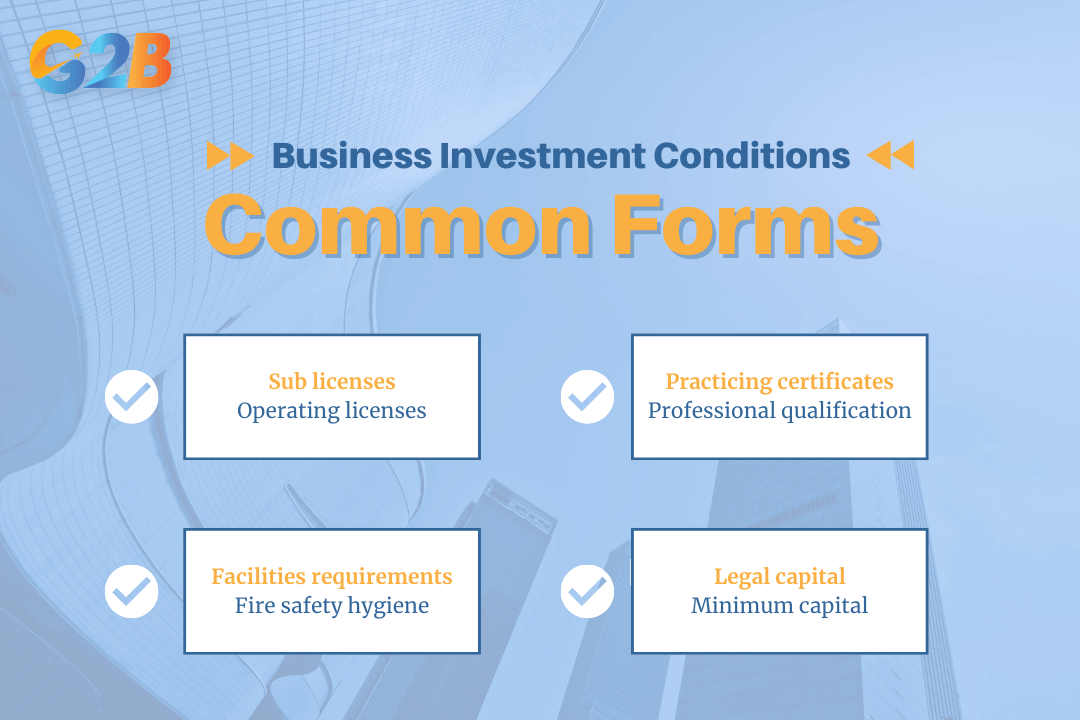
Business conditions go beyond company registration
Sub licenses and operating licenses
This is the most common form. After obtaining your Enterprise Registration Certificate (ERC), you must apply for a specific license from a ministry.
- Example: A logistics company needs a Postal operation license or a Multimodal transport license.
- Example: A restaurant selling alcohol needs a Liquor retail license.
Practicing certificates
Certain sectors require the business owner or the manager to hold a professional certification.
- Example: To open a law firm, the owner must have a Lawyer practicing certificate.
- Example: A pharmacy requires a Chief Pharmacist with a valid Pharmacy practice certificate.
Facilities and infrastructure requirements
The law may mandate physical standards regarding safety, hygiene, or equipment.
- Example: A manufacturing plant must have a Fire prevention and fighting certificate.
- Example: A food processing factory must meet Food safety and hygiene standards.
Legal capital and minimum capital requirements
While most businesses in Vietnam do not have a minimum capital requirement, conditional sectors often do.
- Example: Air transport businesses require significant legal capital (hundreds of billions of VND) depending on the number of aircraft.
- Example: Debt trading services require a minimum charter capital of 100 billion VND.
Procedures for registering conditional business lines
Navigating the registration process for conditional sectors requires a strategic sequence of steps.
Enterprise establishment registration ERC
You submit your application to the Department of Planning and Investment (DPI).
- Code selection: You must select the correct VSIC (Vietnam Standard Industrial Classification) codes.
- Registration: The DPI will issue the Enterprise Registration Certificate (ERC).
- Note: At this stage, your business lines are registered, but you are not yet allowed to operate them.
Fulfilling business conditions
Once the company is formed, you must prepare the conditions required by the specialized law (e.g., hiring certified staff, setting up the warehouse, depositing capital).
Application for sub-licenses
Submit the application to the relevant Ministry or Department (e.g., Ministry of Health for pharma, Ministry of Transport for logistics).
- Timeframe: This can take anywhere from 15 days to several months, depending on the complexity.
Official business operation
Only after obtaining the sub-license or approval can you legally commence business activities and issue VAT invoices for those specific services.
Special notes for foreign investors
Foreign investors face an additional layer of complexity: Market access conditions.
Restricted market access list
Under Decree 31/2021/ND-CP, the government maintains two separate lists for foreign investors: a prohibition list (25 sectors) and a conditional market‑access list (59 sectors).
- Sectors not yet allowed: Foreigners cannot invest (e.g., Judicial administration services).
- Conditional access: Foreigners can invest but must meet equity caps (e.g., Foreign ownership in banks is generally capped at 30%, in telecommunications, it varies by network type).
Investment registration certificate IRC
Before establishing a company in VN, foreign investors must first obtain an Investment Registration Certificate (IRC). During this phase, the licensing authority will strictly vet whether the investor meets the conditions for the conditional business sectors listed in their project proposal.
Legal consequences of non-compliance
Operating a conditional business without meeting the requirements is a serious violation. The consequences, outlined in various decrees on administrative penalties, include:
- Administrative fines: Monetary penalties ranging from tens to hundreds of millions of VND depending on the sector.
- Disgorgement of profits: Authorities may confiscate all illicit profits earned during the period of unauthorized operation.
- Suspension of operations: The business may be forced to shut down for a specific period (1–6 months).
- Revocation of licenses: In severe cases, the Enterprise Registration Certificate (ERC) or Investment Registration Certificate (IRC) may be revoked, effectively dissolving the company.
Frequently asked questions
Q1: How many conditional business sectors are there in Vietnam?
As of the latest update in the Law on Investment 2020, there are exactly over 220 conditional business investment sectors. This is a reduction from the previous 267 sectors under the 2014 Law, aimed at simplifying the business environment.
Q2: Can I start operating immediately after getting my Enterprise Registration Certificate (ERC)?
No. For conditional business lines, the ERC only records the business scope. You are legally prohibited from generating revenue in that sector until you have obtained the necessary sub-licenses or met the specific operating conditions (e.g., Fire Safety license, Food Hygiene certificate).
Q3: Is the "Pawnshop business" a conditional sector?
Yes. Pawning service business is listed as a conditional sector. It falls under the category of sectors affecting "social order and safety." Operators must obtain a Certificate of Satisfaction of Security and Order Conditions from the police department.
Q4: Where can I check the specific conditions for my industry?
You can search for conditions on the National Business Registration Portal. However, the regulations are often spread across multiple Decrees and Circulars. For a precise assessment, it is recommended to consult with legal experts.
The list of over 220 conditional business lines reflects Vietnam’s commitment to balancing economic growth with national security and public safety. For investors, this list represents a roadmap: while the path involves more checkpoints than standard sectors, the regulatory clarity provides a secure environment for long-term growth.
