




 Delaware (USA)
  Vietnam
  Singapore
  Hong Kong
  United Kingdom
 The Vietnam port system serves as the critical backbone for the country's rising status as a global manufacturing hub and the primary beneficiary of the "China+1" supply chain diversification strategy. This strategic shift has driven record levels of Foreign Direct Investment (FDI) into Vietnam's industrial zones. For businesses looking to enter or expand within Southeast Asia, understanding the nuances of this system is essential. This article analyzes the current classification, regional clusters that aim to position Vietnam as a maritime powerhouse rivaling traditional hubs like Singapore and Hong Kong.
This article highlights the key aspects of the Vietnam port system to help businesses and investors gain a clearer understanding of port infrastructure, capacity, and logistics connectivity in Vietnam. We specialize in company formation in Vietnam and do not provide logistics, shipping, or maritime advisory services. For detailed port operations, shipping, or logistics matters, please consult qualified maritime professionals.
Overview of Vietnam’s port system
Vietnam boasts a coastline stretching over 3,260 kilometers, strategically located along one of the busiest shipping lanes in the world. The development of the port system has been prioritized by the Ministry of Transport (MoT) and the Vietnam Maritime Administration (Vinamarine) to support an economy where trade turnover frequently exceeds 200% of GDP.
Current statistics underscore the scale and operational density of the maritime sector. The system is no longer just about capacity; it is about efficiency, connectivity, and the ability to handle ultra-large container vessels.
Operational snapshot (2024-2025 data context)
| Metric | Statistic | Context |
|---|---|---|
| Total Seaports | 296 ports/wharves | Distributed across 34 coastal provinces. |
| Cargo Throughput | ~800+ million tons | Includes container, liquid bulk, and dry bulk. |
| Container Volume | 29–30 million TEUs | Consistently growing at ~10-12% annually. |
| Global Ranking | 3 Ports in Top 100 | Hai Phong, Ho Chi Minh City, and Cai Mep. |
| Wharf Length | ~107 km | Total length of wharfage nationwide. |
The symbiotic relationship between port infrastructure and economic growth is undeniable. With an import-export turnover surpassing $700 billion, the port system must seamlessly execute customs clearance, cargo handling, and intermodal transport.
However, the distribution is not uniform. The system is characterized by a "bipolar" concentration of volume, heavily weighted towards the Northern (Red River Delta) and Southern (Southeast Region) clusters, leaving the Central coast with untapped potential.
Classification of seaports in Vietnam
To manage development and investment effectively, the Vietnamese government categorizes seaports based on their scope of influence, vessel capacity, and strategic importance to the national economy. Understanding these classifications is vital for logistics managers planning supply chain diversification.
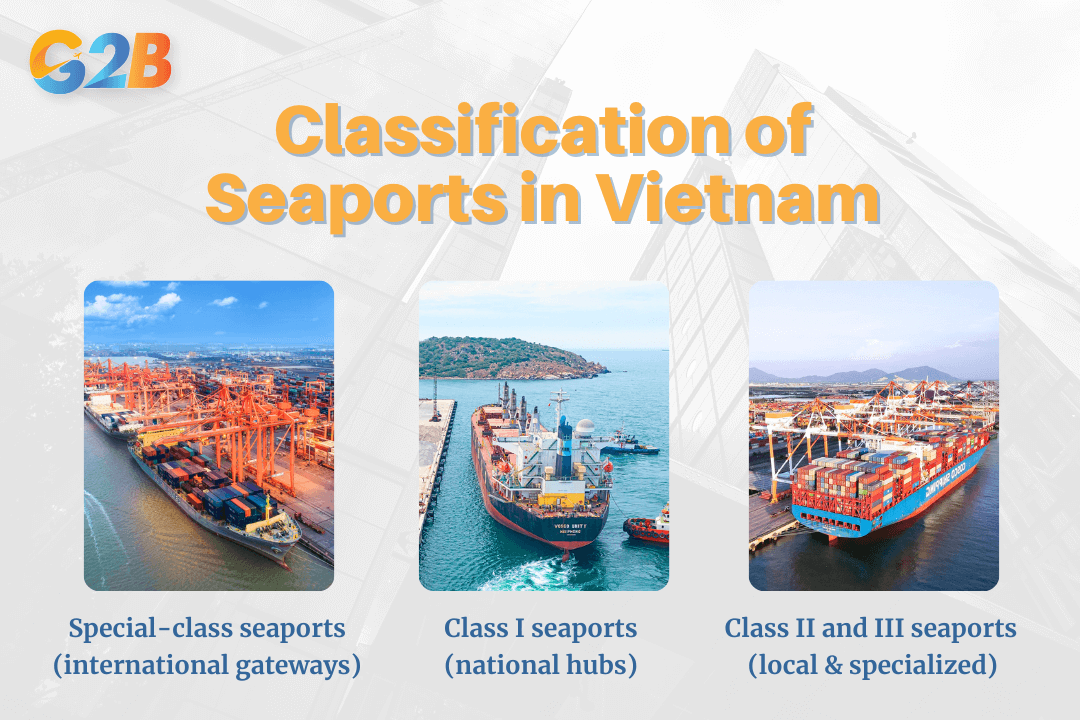
Understanding classifications is vital for logistics managers planning supply chain diversification
1. Special-class seaports (international gateways)
These are the crown jewels of the Vietnam port system, designed to handle long-haul, ocean-going vessels without the need for transshipment via intermediate hubs like Singapore or Tanjung Pelepas.
- Lach Huyen (Hai Phong): The deep-water gateway for Northern Vietnam. It accommodates vessels up to 100,000 DWT (Deadweight tonnage), connecting the electronics manufacturing hubs of Hanoi, Bac Ninh, and Thai Nguyen directly to North America and Europe.
- Cai Mep – Thi Vai (Ba Ria – Vung Tau): The premier deep-water cluster in the South. It receives mother vessels exceeding 200,000 DWT (18,000+ TEU), offering direct services to the US West Coast and Europe.
2. Class I seaports (national hubs)
These ports serve as regional hubs, playing a crucial role in the country’s socio-economic development and national defense. They handle a mix of containerized cargo, bulk, and liquid cargo.
- Da Nang port: The primary hub for the Central region and the endpoint of the East-west Economic Corridor.
- Quy Nhon port: A critical gateway for the Central Highlands and trade flows from Laos and Cambodia.
- Ho Chi Minh City port (Cat Lai): While technically part of a broader cluster, individual terminals here function as high-volume national hubs.
- Quang Ninh port: Focuses on bulk cargo (coal, clinker) and agricultural products.
3. Class II and III seaports (local & specialized)
- Class II: Integrated ports serving local socio-economic development (e.g., Nghe An, Ha Tinh).
- Class III: Offshore oil and gas terminals or specialized ports serving specific industrial zones (e.g., dedicated thermal power plant ports).
Key regional port clusters (geographic analysis)
Geography dictates logistics strategy in Vietnam. The long, slender shape of the country necessitates distinct port clusters, each serving a specific hinterland and industry vertical.
The Northern cluster (group 1)
- Hinterland: Hanoi, Hai Phong, Bac Ninh, Hai Duong.
- Primary Cargo: Electronics (Samsung, LG), Automotive parts, Garments.
- Key ports: Lach Huyen, Hai Phong, Dinh Vu.
- Characteristics: This cluster is defined by its proximity to the Chinese border, facilitating raw material imports. The shift from river ports (Hoang Dieu) to deep-sea terminals (Lach Huyen) marks a modernization trend to reduce logistics costs.
The Central cluster (group 2 & 3)
- Hinterland: Da Nang, Quang Nam, Dung Quat Economic Zone.
- Primary Cargo: Wood chips, Cement, Oil & Gas, General cargo.
- Key ports: Da Nang, Quy Nhon, Dung Quat.
- Characteristics: Serving the East-West Economic Corridor, this cluster is vital for cross-border logistics involving Laos and Thailand.
The Southern cluster (group 4)
- Hinterland: Ho Chi Minh City, Binh Duong, Dong Nai, Long An.
- Primary Cargo: Furniture, Footwear, Agriculture, FMCG.
- Key ports: Cat Lai, Cai Mep – Thi Vai, Hiep Phuoc.
- Characteristics: The economic engine of Vietnam. This cluster handles over 60% of the country’s total container volume. To maintain efficiency at this scale, companies must achieve economies of scale in their logistics and supply chain operations. The dynamic here is a struggle between extreme efficiency and chronic congestion, necessitating precise logistics planning.
Logistics insight: If your manufacturing base is in Binh Duong, utilizing Cai Mep instead of Cat Lai can reduce trucking time and bypass urban congestion, provided your volume warrants direct deep-sea booking.
"Big three" ports in Vietnam
Three specific port areas define the global competitiveness of the Vietnam port system.
1. Tan Cang - Cat Lai (Ho Chi Minh City)
"The Behemoth of Connectivity" Operated by Saigon Newport Corporation, Cat Lai is consistently ranked among the top 30 container ports globally.
- Dominance: Handles nearly 40% of Vietnam's total import-export container volume.
- Strength: Unrivaled connectivity with barges and trucking networks. It is the preferred choice for intra-Asia routes.
- Constraint: Located on the Dong Nai River, draft limitations prevent large mother vessels from docking. It relies on feeder services.
2. Cai Mep - Thi Vai (Ba Ria - Vung Tau)
"The Deep-water gateway" This is Vietnam's answer to Singapore. It is one of only roughly 20 ports worldwide capable of accommodating the largest vessels currently in operation (e.g., OOCL Spain, MSC Irina).
- Capacity: Can handle vessels up to 214,000 DWT.
- Strategic advantage: Direct routes to the US and EU reduce transit time by 7-10 days and eliminate transshipment costs.
- Utilization: Historically underutilized, it has seen rapid growth (double-digit %) in recent years as shipping alliances shift services here.
3. Lach Huyen (Hai Phong)
"The Northern Star" Home to the Hai Phong International Container Terminal (HICT), this represents the modernization of Northern logistics.
- Technology: Features advanced Smart Port technology and automated clearance systems.
- Draft depth: Natural depth of roughly 14-16 meters allows direct docking of 14,000 TEU vessels.
- Impact: Before Lach Huyen, Northern exports had to transship via Hong Kong or Singapore. Now, direct export is the standard.
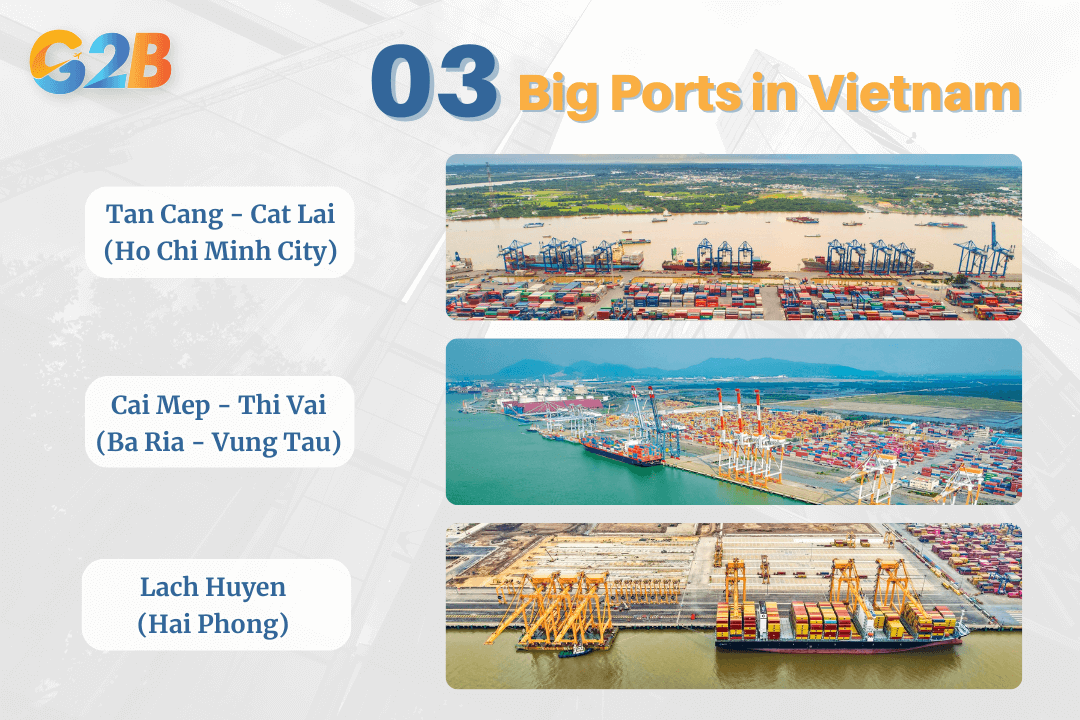
3 specific port areas define the global competitiveness of the Vietnam port system
Challenges facing the Vietnam port system
Despite the impressive statistics, the system faces structural and operational hurdles that logistics managers must mitigate.
1. Infrastructure imbalance & congestion
The "Super Port" of Cat Lai operates at or above maximum capacity, leading to road congestion on surrounding arteries like My Thuy roundabout. Meanwhile, ports in the Central region or smaller terminals in the Mekong Delta remain underutilized. This imbalance increases trucking costs, which can account for a disproportionate amount of the total logistics spend.
2. Logistics costs and hinterland connectivity
While port handling fees in Vietnam are competitive (lower than Thailand and Singapore), the cost of connecting the factory to the port is high.
- Road reliance: Over 75% of port connectivity relies on trucking.
- Rail/Waterway: Rail connectivity to ports is virtually non-existent (except for specific lines in the North), and inland waterway potential in the South is hampered by low bridge clearance.
3. Draft limitations and siltation
Many river ports (like those in Hai Phong city center or HCMC) require constant dredging to maintain depth. Rapid alluvial sedimentation can unpredictably alter draft limits, forcing carriers to reduce load factors.
4. Technology and digitalization gaps
While major ports use Electronic Delivery Orders (eDO) and the Vietnam Automated Cargo Clearance System (VNACCS), many Tier 2 ports still rely on manual paperwork. For these ports, digitizing documents like the Bill of Lading and electronic manifests is a critical step toward modernization. The push for a unified "National Single Window" is ongoing but requires deeper integration.
Master plan 2030 & vision 2050
The future of the Vietnam port system is codified in Decision 1579/QD-TTg, approved by the Prime Minister. This Master Plan outlines a vision where maritime infrastructure drives the nation toward becoming a developed, high-income country.
Strategic goals
- Throughput: Reach 1.14 – 1.42 billion tons by 2030.
- Container capacity: Handle 38 – 47 million TEUs.
- Green logistics: Implementation of Green Port criteria, focusing on emission reduction, shore power (cold ironing), and renewable energy usage at terminals. This shift aligns with the global trend of investing in green tech to ensure sustainable maritime development
Key mega-projects
Can Gio international transhipment port
This is the most ambitious project in the pipeline. Located at the mouth of the Cai Mep river system, Can Gio is envisioned to:
- Compete directly with Singapore for international transhipment cargo.
- Attract an investment of nearly $6 billion.
- Create a capacity of 15-18 million TEUs, effectively doubling the South's capacity.
Lien Chieu port (Da Nang)
Designed to alleviate pressure on the existing Tien Sa port (which causes traffic in Da Nang city), Lien Chieu will become the primary deep-water logistics gate for the Central region, integrated with the railway system.
Green port transformation
The Vietnam Maritime Administration is enforcing stricter environmental standards. Future port tenders will require operators to demonstrate capabilities in waste treatment, energy efficiency, and the ability to bunker cleaner fuels like LNG and eventually green methanol.
The Vietnam port system has evolved from a regional feeder network into an increasingly important global maritime hub, supporting the country’s rapid integration into international trade flows. With the strategic deep-water advantages of Cai Mep and Lach Huyen enabling direct intercontinental routes, alongside the high-throughput capacity of Cat Lai handling substantial cargo volumes, Vietnam offers robust, flexible, and scalable port options for global supply chains.
Ready to leverage Vietnam's maritime advantages? Before moving your cargo, ensure your business has the right foundation with our company setup process and requirements in Vietnam guide.
