




 Delaware (USA)
  Vietnam
  Singapore
  Hong Kong
  United Kingdom
 A visa run to Thailand or Singapore is a short trip where foreigners temporarily exit Vietnam and re-enter to activate a new visa. Foreigners use this process to extend their legal stay inside Vietnam. Thailand and Singapore operate as the primary destinations for these trips due to geographical proximity. Vietnam immigration authorities closely monitor repeated border crossings.
What does a visa run mean for foreigners in Vietnam?
A visa run means a foreigner leaves Vietnam and immediately returns to activate a new entry stamp. This process allows individuals to reset their legal stay duration inside the country. Temporary departure and re-entry create a new immigration record. Foreigners travel to a neighboring country, clear foreign immigration, and board a return flight to Vietnam. The new entry stamp grants a fresh period of stay.
A visa renewal differs from a visa extension. An extension happens inside Vietnam without leaving the country. A renewal requires the foreigner to exit Vietnam, secure a new visa approval, and re-enter. Vietnam currently limits internal visa extensions for tourists, making visa runs mandatory for many visitors. Foreigners perform visa runs for immigration compliance purposes. Staying beyond the approved visa date violates Vietnamese law. Exiting the country on time keeps the foreigner’s immigration record clean.
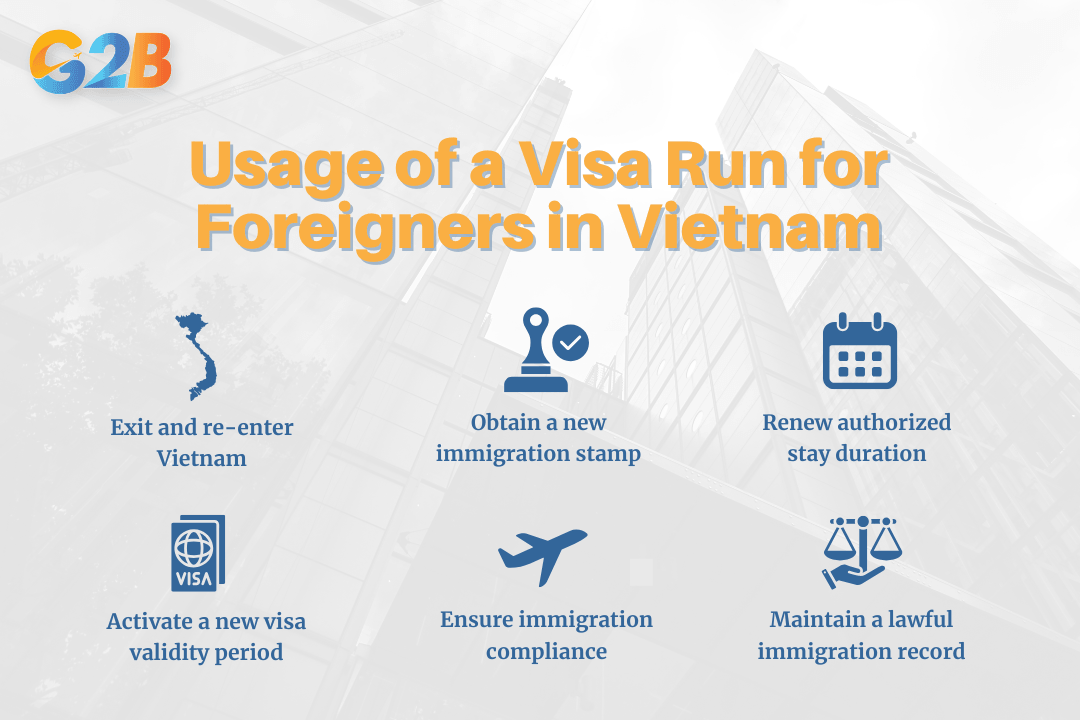
Usage of a visa run for foreigners in Vietnam
What common visa types connect to visa runs?
Common visa types connected to visa runs include tourist visas, eVisas, business visas, and visa exemption entries. Foreigners use these categories for short-term stays in Vietnam.
- Tourist visa: Vietnam issues tourist visas for holiday purposes. Visitors exit the country when the tourist visa period ends.
- eVisa: The Vietnam Immigration Department issues single or multiple-entry 90-day electronic visas. Foreigners apply online, leave Vietnam, and re-enter using the new eVisa.
- Business visa: Companies sponsor business visas for foreign partners. Business travelers exit and re-enter to activate new business sponsorships.
- Visa exemption entry: Citizens of specific countries receive 15-day or 45-day visa exemptions. Tourists fly out and return to claim a new exemption stamp.
Which foreign workers typically use visa runs?
English teachers, freelancers, remote workers, and startup employees typically use visa runs to stay in Vietnam. These groups often lack long-term residency documents.
- English teachers: Teachers wait for their schools to process official work permits. They complete visa runs to remain legal during the paperwork process.
- Freelancers: Independent contractors work for foreign clients online. Freelancers use eVisas and perform visa runs to live in Vietnam.
- Remote workers: Digital nomads operate location-independent businesses. They fly to Thailand or Singapore every 90 days to renew their tourist status.
- Startup employees: New company founders travel on business visas. They execute visa runs while their companies finalize local registration documents.
Why are Thailand and Singapore popular visa run destinations?
Thailand and Singapore attract visa runners because they offer fast flights and easy entry rules. Travelers complete the exit and re-entry process within a few days using these nearby hubs.
What is Thailand’s role in short-term Vietnam visa runs?
Thailand serves as a primary hub for short-term Vietnam visa runs due to cheap travel costs. Travelers prefer Thailand for its budget-friendly options and proximity. Bangkok acts as a central transit hub for Southeast Asia. Suvarnabhumi Airport and Don Mueang International Airport process thousands of daily passengers. Travelers easily book direct flights from Ho Chi Minh City, Hanoi, and Da Nang.
Low-cost airlines dominate the Vietnam-Thailand routes. Airlines offer cheap round-trip tickets, making frequent trips affordable. Thailand offers flexible accommodation options for travelers. Visitors book budget hostels, mid-range hotels, or premium apartments based on their daily budget.
What is Singapore’s role in professional visa processing?
Singapore provides a highly organized environment for professional visa processing. Business travelers choose Singapore for its speed and reliability. Singapore features highly efficient immigration systems. Changi Airport uses automated immigration gates for many nationalities. Travelers clear border checks in minutes.
The reliable airport infrastructure supports productive travel. Changi Airport offers fast Wi-Fi, business lounges, and quiet workspaces. Remote workers continue their daily tasks while waiting for Vietnam eVisa approvals. Fast turnaround trips define the Singapore visa run. Travelers often fly into Singapore, stay one night, and return to Vietnam the next morning.
How do costs compare between Thailand and Singapore visa runs?
Costs in Thailand remain lower for budget travelers, while Singapore requires premium spending. Foreigners calculate these expenses before choosing a destination.
| Factor | Thailand | Singapore |
|---|---|---|
| Flight price | Lower | Higher |
| Hotel rates | Lower | Higher |
| Processing convenience | Moderate | High |
| Typical trip duration | 2–4 days | 1–2 days |
| Daily expenses | Budget-friendly | Premium |
What documents are required before leaving Vietnam?
Travelers require valid passports and approved destination visas before leaving Vietnam. Missing documents cause airline boarding denials and travel delays.
What are the passport validity and immigration requirements?
Passports must possess at least six months of validity beyond the re-entry date. Immigration officers reject travelers holding nearly expired passports. The six-month validity rule applies internationally. Airlines check the passport expiration date during the check-in process. Travelers must renew their passports in their home countries if validity falls below six months.
Blank passport pages remain mandatory for entry stamps. Vietnam, Thailand, and Singapore border officers require empty pages to stamp entry and exit dates. Airlines conduct passport condition checks. Gate agents inspect passports for water damage, torn pages, or broken covers. Damaged passports lead to travel bans.
What essential Vietnam visa documents do foreigners need?
Foreigners need their current visa copy and the new eVisa approval before traveling. These documents prove legal status during the trip.
- Current visa copy: Travelers present their current visa stamp or eVisa paper at the Vietnam exit counter.
- eVisa approval: Foreigners print the new eVisa approval letter. Airlines request this document before boarding the return flight to Vietnam.
- Work permit documents: Legal workers carry their original work permit cards. This proves local employment during re-entry questioning.
- Sponsorship paperwork: Business travelers carry company invitation letters. Officers verify the corporate connection at the border.
What are the entry requirements for Thailand and Singapore?
Thailand and Singapore require arrival forms, hotel reservations, and return tickets. Border authorities verify these documents upon arrival.
- Submit arrival forms: Singapore requires the SG Arrival Card. Travelers submit this electronic form within three days before arriving.
- Show return ticket proof: Foreigners provide a confirmed outbound ticket. Thailand and Singapore immigration demand proof that the traveler will leave the country.
- Provide hotel reservation details: Travelers present booked accommodation receipts. Border officers verify the specific address where the foreigner will sleep.
How do foreigners apply for a new Vietnam visa during a visa run?
Foreigners apply for a new Vietnam eVisa through the official government portal. The process takes several days and requires digital document submission.
How do you apply for a Vietnam eVisa outside Vietnam?
You apply for a Vietnam eVisa outside Vietnam by submitting digital photos and passport scans to the National Web Portal on Immigration. Applicants pay a processing fee online. The official application portal operates directly under the Vietnam Immigration Department. Foreigners must avoid fake or unofficial agency websites.
Applicants upload specific requirements to the system. The portal requests a clear passport data page scan and a recent portrait photo without glasses. The processing workflow moves from submission to payment to review. The system generates a registration code. Applicants use this code to track the approval status online.
What are the processing timelines for a Vietnam eVisa?
Vietnam eVisa processing timelines take three to five working days. Delays occur during weekends and national holidays. Standard processing periods officially last three full working days. However, high application volumes often extend the timeline to five days. Travelers plan their visa run duration based on this waiting period.
Public holiday delays disrupt visa runs heavily. The Immigration Department closes during Tet (Lunar New Year) and National Day. eVisas submitted during these periods remain unapproved until offices reopen. Urgent processing services exist through specialized travel agencies. Agents expedite the application for an extra fee, reducing the wait time to one or two days.
What are common Vietnam eVisa application errors?
Common Vietnam eVisa application errors include incorrect passport details, wrong entry ports, and invalid photos. These mistakes cause application rejections.
- Enter incorrect passport details: Applicants misspell their names or type the wrong passport number. The system rejects mismatched information.
- Select the wrong entry port: Foreigners choose the wrong arrival airport on the form. eVisas only allow entry through the specific port listed on the document.
- Upload invalid portrait photos: Applicants submit photos wearing glasses or hats. The portal requires a clear, forward-facing photo with a white background.
What are the Vietnam re-entry procedures after a visa run?
Vietnam re-entry procedures involve border queueing, passport verification, and officer questioning. Immigration officials control all foreign arrivals at the airport.
How does the Vietnam airport immigration inspection process work?
The Vietnam airport immigration inspection process involves queuing at the foreign passport desk and presenting documents to an officer. The officer verifies the data and issues an entry stamp. The arrival queue separates foreign passport holders from Vietnamese citizens. Travelers wait in line to reach the designated border control booths.
Passport verification occurs electronically. The officer scans the passport and checks the immigration database. The system displays the traveler's past entry and exit records. Entry stamp issuance finalizes the process. The officer stamps the passport and writes the permitted stay duration. Officer questioning happens if the system flags the traveler. Officers ask about travel purposes, hotel addresses, and job status.
Which documents do immigration officers commonly request?
Immigration officers commonly request valid visa approvals, accommodation addresses, employer details, and onward tickets. Travelers must hand these documents to the officer upon request:
- Show valid visa approval: Travelers submit the printed A4 eVisa page. Digital copies on mobile phones are not accepted at the booth.
- Provide accommodation address: Officers ask for the exact hotel or apartment address. Foreigners must know where they will stay in Vietnam.
- Explain employer details: Business visa holders state their sponsor company name. Officers cross-check the company inside the database.
- Present return or onward ticket: Officers demand proof of an outbound flight. Travelers must show they plan to leave Vietnam before the new visa expires.
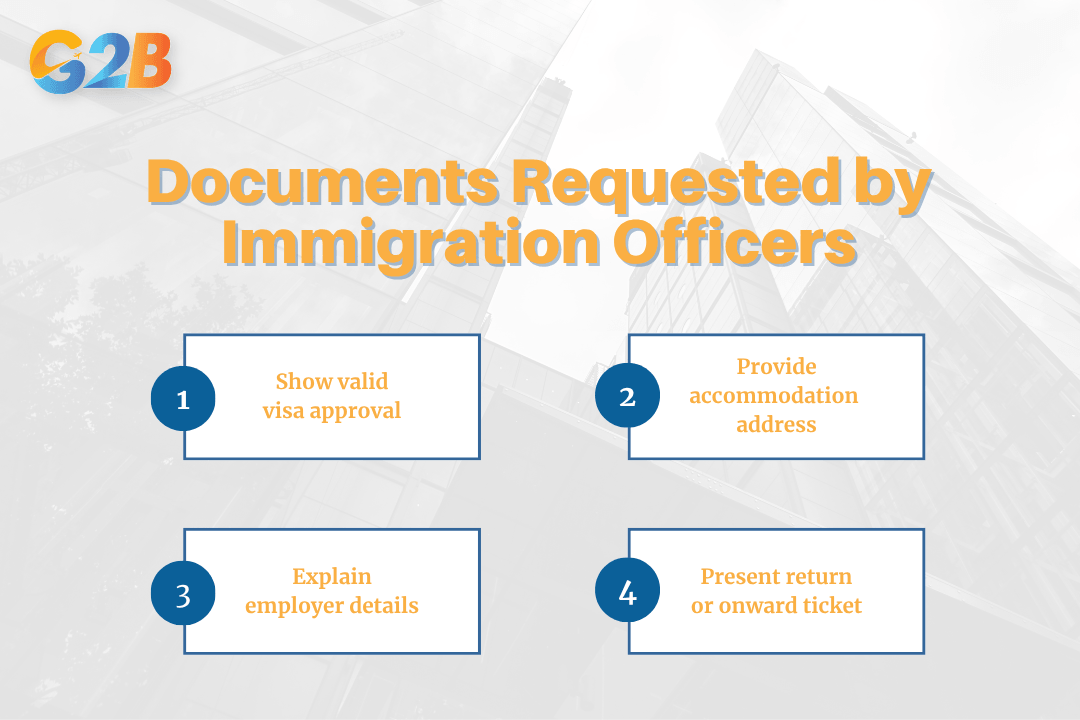
Documents commonly requested by immigration officers
Why do some foreigners face re-entry refusal?
Some foreigners face re-entry refusal because they lack work permits, hold previous overstays, or perform frequent visa runs. Officers possess the authority to deny entry. Frequent visa runs trigger system alerts. Officers suspect illegal employment if a foreigner stays in Vietnam for 12 months using consecutive tourist visas.
Previous overstays damage a foreigner's immigration record. The system records past late departures. Officers deny entry to individuals who repeatedly violate visa dates. Missing work permits cause entry denials for suspected workers. Officers refuse foreigners who claim to live and work in Vietnam but only present a tourist eVisa. Inconsistent travel records confuse border control. Travelers who switch frequently between different sponsor companies face heavy scrutiny.
How can foreigners improve re-entry approval chances?
Foreigners improve re-entry approval chances by maintaining legal employment status and keeping accurate accommodation registration. Legal compliance removes border risks.
- Maintain legal employment status: Foreigners obtain proper work permits. Legal workers transition to Temporary Residence Cards to avoid border questioning.
- Keep accurate accommodation registration: Landlords register foreign tenants with the local police. Immigration officers check this police registration during border control.
- Avoid overstays and immigration violations: Travelers exit the country one day before the visa expires. Clean records ensure smooth future entries.
What are the costs associated with Vietnam visa runs?
The costs associated with Vietnam visa runs include airfare, accommodation, transport, and document fees. Foreigners must budget specifically for their chosen destination.
What are typical Thailand visa run expenses?
Typical Thailand visa run expenses involve low-cost airfare, affordable hotels, local transport, and budget food costs. Thailand offers a highly economical trip. Airfare prices range from $100 to $200 for round-trip tickets from Ho Chi Minh City to Bangkok. Prices fluctuate based on airline sales and booking dates.
Hotels cost between $20 and $50 per night. Travelers find clean, budget-friendly rooms near the BTS Skytrain network in Bangkok. Local transport relies on public trains and cheap taxis. The Airport Rail Link provides fast, inexpensive transit from Suvarnabhumi Airport to central Bangkok. Food costs remain very low. Street food and local restaurants allow travelers to eat for under $15 per day.
What are typical Singapore visa run expenses?
Typical Singapore visa run expenses feature premium flight pricing, expensive accommodation, and higher daily spending expectations. Singapore requires a larger budget. Flight pricing averages between $150 and $300 for a round-trip ticket. Travelers pay more for prime morning flight slots.
Accommodation costs form the largest expense. Basic hotels in Singapore start at $100 per night. Budget hostels exist but lack privacy. Airport transportation utilizes the MRT system or standard taxis. Taxis apply airport surcharges, increasing the overall travel cost. Daily spending expectations run high. Restaurant meals and cafe visits cost significantly more in Singapore than in Vietnam or Thailand.
What additional expenses do foreigners often overlook?
Foreigners often overlook urgent visa fees, airline baggage charges, printing costs, and flight modification penalties. These hidden costs increase the total trip budget.
- Pay urgent visa fees: Travelers pay agency fees up to $100 to speed up delayed eVisas.
- Cover airline baggage fees: Low-cost airlines charge extra for check-in luggage. Visa runners travel with only a small backpack to avoid this cost.
- Find immigration printing services: Travelers pay hotel business centers to print the approved eVisa paper before heading to the airport.
- Accept flight modification charges: Travelers pay change fees if the eVisa does not arrive on time and they must delay the return flight.
What are the risks and common problems during visa runs?
Risks and common problems during visa runs include delayed visa approvals, airline boarding refusals, and overstay consequences. Poor planning causes expensive disruptions.
Why do delayed Vietnam eVisa approvals happen?
Delayed Vietnam eVisa approvals happen due to system bottlenecks, public holiday closures, and last-minute application submissions. The Immigration portal processes thousands of daily requests. Processing bottlenecks occur during peak tourist seasons. The high volume of applications slows down the standard three-day turnaround time.
Public holiday disruptions freeze the system completely. Government workers do not process eVisas during national holidays, leaving applicants stranded abroad. Last-minute application risks cause severe travel stress. Foreigners who apply the day before their departure often fail to receive approval on time.
What scenarios cause airline boarding refusals?
Airline boarding refusals happen when travelers lack a printed eVisa approval or hold invalid passports. Airlines enforce border rules strictly to avoid fines. Missing eVisa approval letters stop travelers at the check-in desk. Check-in staff refuse to issue a boarding pass if the foreigner cannot show the new entry document.
Passport validity issues trigger immediate denial. Airlines deny boarding if the passport expires in less than six months. Incorrect visa information leads to boarding refusal. Staff check the passport number against the eVisa paper. Any mismatch prevents the traveler from flying.
What are the overstay penalties and immigration consequences?
Overstay penalties include administrative fines, entry refusal risks, and permanent immigration history monitoring. Vietnam strictly penalizes foreigners who ignore visa dates. Administrative fines can reach up to 40 million VND (Decree 59/2026/ND-CP, effective April 1, 2026) based on the length of the overstay. Short overstays cost millions of Vietnamese Dong. Long overstays result in mandatory deportation.
Entry refusal risks apply to future trips. Officers deny new eVisas to individuals who previously broke immigration rules. Immigration history monitoring tracks non-compliant foreigners. The database flags returning travelers, leading to intense questioning every time they enter Vietnam.
What are long-term alternatives to frequent visa runs?
Long-term alternatives to frequent visa runs include Temporary Residence Cards and formal investor visas. Securing legal residency removes the stress of crossing borders every 90 days.
What are temporary residence card options for foreign workers?
Temporary Residence Card (TRC) options for foreign workers provide two years or longer of uninterrupted stay. The TRC replaces the need for tourist visas. Work permit linkage defines the TRC process. The government issues the TRC only after the foreigner secures a valid labor contract and work permit.
Validity periods match the work permit duration. Most TRCs for workers remain valid for a maximum of two years. Employer sponsorship acts as the foundation for the TRC. The local Vietnamese company submits the legal application on behalf of the foreign employee.
What are the business and investor visa pathways?
Business and investor visa pathways grant legal status to company founders and corporate employees. These pathways provide stable residency solutions.
- Apply for DN visas: Companies sponsor foreign employees for DN (Business) visas. These allow short-term legal work and business meetings.
- Obtain DT investor visas: Foreign business owners receive DT visas. The duration of the visa depends on the amount of capital invested in the Vietnamese company.
- Secure sponsorship requirements: Companies must maintain active tax codes and clean business records to sponsor foreign investors legally.
How do foreigners ensure legal employment compliance in Vietnam?
Foreigners ensure legal employment compliance by securing work permits, signing valid labor contracts, and following employer responsibilities. Compliance protects foreigners from deportation. Work permit obligations require foreigners to submit university degrees and criminal background checks. The local Department of Labor issues the final work permit.
Labor contract requirements force companies to formalize the employment. The foreigner signs a localized contract reflecting legal salary and tax obligations. Employer responsibilities include paying social insurance and registering the worker with local authorities. Companies face severe penalties for hiring foreigners illegally.
What are the best routes and airports for visa runs?
The best routes and airports for visa runs utilize direct flights connecting major Vietnamese cities to Bangkok and Singapore. Travelers choose routes based on geographic proximity.
Which major Vietnam airports facilitate visa runs?
Tan Son Nhat, Noi Bai, and Da Nang International Airports facilitate the vast majority of visa runs. These hubs offer the most international connections.
- Tan Son Nhat International Airport (SGN): Located in Ho Chi Minh City, SGN provides the highest volume of daily flights to Singapore and Thailand.
- Noi Bai International Airport (HAN): Located in Hanoi, HAN serves Northern Vietnam. Travelers fly direct to Bangkok from this hub.
- Da Nang International Airport (DAD): Located in Central Vietnam, DAD offers convenient regional flights, eliminating the need to travel to Hanoi or HCMC first.
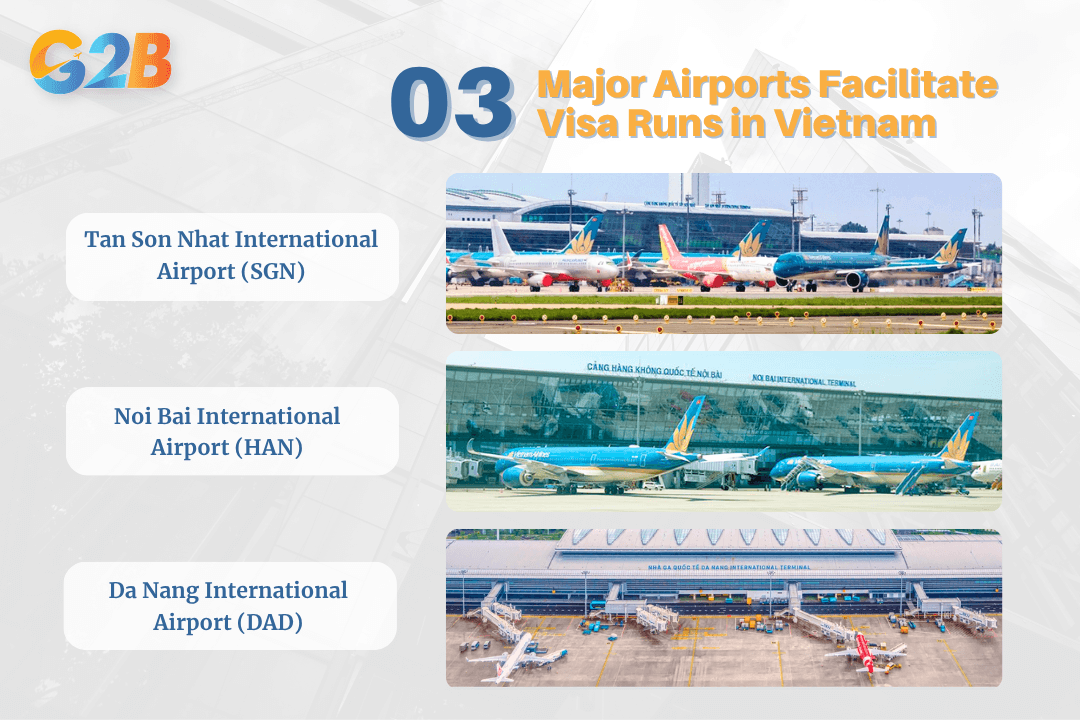
Major airports facilitate visa runs in Vietnam
What are the popular Thailand visa run routes?
Popular Thailand visa run routes connect Vietnam's three main cities directly to Bangkok. These short flights take less than two hours. Ho Chi Minh City to Bangkok serves as the busiest route. Multiple airlines fly between SGN and BKK or DMK daily. Hanoi to Bangkok provides a direct link for Northern expats. The flight time lasts approximately two hours. Da Nang to Bangkok connects Central Vietnam to Thailand. This route saves expats from taking domestic flights prior to exiting the country.
What are the popular Singapore visa run routes?
Popular Singapore visa run routes link Vietnamese tech and business hubs directly to Changi Airport. Business travelers use these routes frequently. Ho Chi Minh City to Singapore takes roughly two hours. Daily morning flights allow travelers to arrive in Singapore by lunchtime. Hanoi to Singapore requires a slightly longer flight of over three hours. Premium airlines service this route daily. Da Nang to Singapore provides a fast exit for digital nomads living in the coastal city. Direct flights operate several times a week.
Which airlines frequently operate Vietnam visa runs?
VietJet Air, Vietnam Airlines, Scoot, AirAsia, and Singapore Airlines frequently operate Vietnam visa runs. Travelers select airlines based on luggage needs and budget.
- Book VietJet Air: VietJet offers the cheapest flights to both Bangkok and Singapore. They do not include free checked baggage.
- Fly Vietnam Airlines: The national carrier provides full-service flights with baggage and meals included.
- Choose Scoot: Scoot operates budget flights directly to Singapore Changi Airport.
- Select AirAsia: AirAsia connects Vietnam to Bangkok Don Mueang (DMK) with multiple daily low-cost flights.
- Travel Singapore Airlines: Corporate travelers use this premium airline for comfortable, reliable trips to Singapore.
What are important Vietnam immigration trends?
Important Vietnam immigration trends focus on restricting illegal foreign employment and modernizing the visa system. Authorities regularly update policies to control foreign residency.
What are recent Vietnam immigration policy changes?
- Recent Vietnam immigration policy changes introduced a 90-day eVisa and increased border scrutiny. These changes impact how long foreigners stay.
- Increased scrutiny on repeated entries targets illegal workers. Officers stop foreigners who have stayed in Vietnam for over a year using consecutive tourist visas.
- Expanded eVisa availability allows citizens of all countries to apply online. The government extended the maximum stay from 30 days to 90 days.
- Work permit enforcement actions target language centers and foreign-owned businesses. Police conduct random inspections to catch foreigners working without proper documents.
Which immigration compliance trends affect foreigners?
- Immigration compliance trends affect foreigners who work remotely or abuse tourist visas. The government expects foreigners to hold visas that match their actual activities.
- Digital nomad concerns drive policy discussions. Vietnam does not offer a specific digital nomad visa, forcing remote workers into gray areas using tourist visas.
- Tourist visa employment restrictions remain strictly enforced. Foreigners caught generating income inside Vietnam on a tourist visa face deportation.
- Border officer discretion plays a major role in entries. Officers hold the final authority to deny entry even if the foreigner holds a valid eVisa approval.
Where are the official sources for Vietnam visa updates?
Official sources for Vietnam visa updates include the Immigration Department portal and Vietnamese embassies. Travelers must avoid unofficial blogs for legal updates.
- Consult the Vietnam Immigration Department: The official government website publishes the latest entry rules and eVisa portal links.
- Contact Vietnamese embassies: Embassies abroad provide accurate guidelines on business visas and specialized entry permits.
- Read airline travel advisories: Airlines update their check-in requirements based on real-time immigration bulletins.
Frequently asked questions about Vietnam visa runs
Travelers frequently ask questions about the legality and logistics of visa runs. Accurate answers prevent expensive travel mistakes.
Can foreigners return to Vietnam on the same day after a visa run?
Foreigners can return to Vietnam on the same day if they hold a pre-approved eVisa. Travelers fly out, clear foreign immigration, and board a return flight hours later.
Is Thailand or Singapore better for a Vietnam visa run?
Thailand is better for budget travelers seeking cheap flights and low daily expenses. Singapore is better for business professionals requiring fast, highly efficient immigration processing.
How many visa runs are considered risky?
Completing more than three consecutive visa runs is considered risky. Immigration officers heavily question foreigners who attempt to live in Vietnam permanently on tourist visas.
Can foreigners work in Vietnam on an eVisa?
Foreigners cannot legally work in Vietnam on an eVisa. The government strictly prohibits local employment without a valid work permit and a sponsored business visa.
Does Vietnam track repeated border exits and entries?
Vietnam tracks all repeated border exits and entries electronically. The passport control database highlights foreigners who perform back-to-back visa runs.
What is the safest long-term visa option for foreign workers?
The safest long-term visa option for foreign workers is the Temporary Residence Card. This card requires formal employer sponsorship and a government-issued work permit.
Can a company sponsor a foreign worker’s legal stay?
A legally registered Vietnamese company can sponsor a foreign worker’s legal stay. The company must prove the foreigner's expertise and pay local taxes.
What happens if a Vietnam visa expires before departure?
If a Vietnam visa expires before departure, the foreigner must pay a daily overstay fine at the immigration office. Serious overstays result in forced exit and future entry bans.
Securing legal residency in Vietnam requires careful planning and a deep understanding of local immigration laws. Visa runs provide a temporary solution for tourists, but foreign professionals must eventually transition to formal sponsorship. Travelers must ensure their passports remain valid, book onward flights, and secure proper eVisa approvals before exiting the country. By following official government procedures and maintaining clean travel records, foreigners prevent costly border denials. Transitioning to a Temporary Residence Card eliminates the stress of border runs entirely. Partnering with professional business consultants ensures your documents meet all legal compliance standards for a secure long-term stay. For streamlined support in work permit / TRC / visa services, contact G2B for professional guidance and reliable assistance throughout every step of the application process.
