




 Delaware (USA)
  Vietnam
  Singapore
  Hong Kong
  United Kingdom
 For foreign professionals planning to work in Vietnam, obtaining the appropriate work visa is one of the most important legal requirements before starting employment. Vietnam work visa allows expatriates to legally enter the country, work for registered employers, and stay in Vietnam for an approved period of time. Depending on the nature of employment, applicants may also need to prepare supporting documents such as a work permit, health certificate, and sponsorship papers from their employer. Understanding the visa process, required documents, and applicable regulations can help foreign employees and businesses ensure full compliance with Vietnamese immigration and labor laws.
What is a Vietnam work visa?
A Vietnam work visa is an official immigration document that allows foreign nationals to enter the country specifically for employment purposes. The Immigration Department issues the entry approval letter; embassies or border gates place the actual visa stamp, while work permits are issued by the provincial Department of Labor, War Invalids and Social Affairs (DOLISA).
The government uses specific visa symbols to categorize foreign workers. The LD1 visa is issued to foreign nationals who have an official certificate confirming they are not required to obtain a work permit. The LD2 visa is issued to foreign nationals who must hold a valid Vietnamese work permit. These visa categories ensure that foreign employees meet legal employment authorization standards before they cross the border.
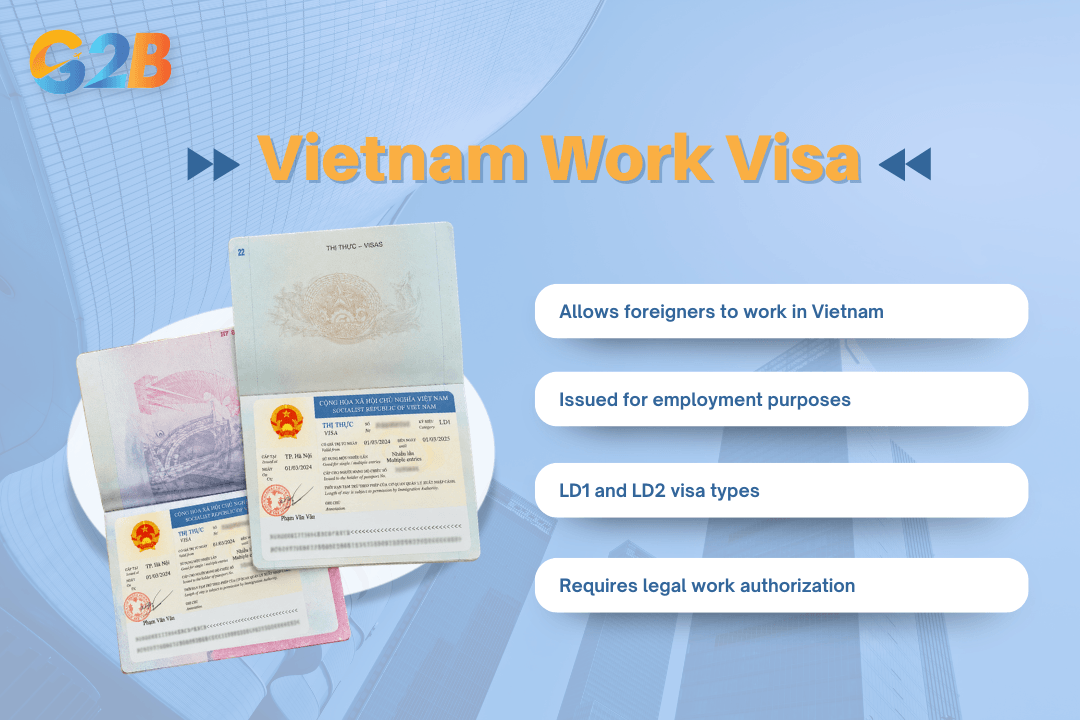
Work visa allows foreigners to enter Vietnam specifically for employment purposes
Who needs a work visa in Vietnam?
Foreign individuals who intend to perform paid work for an organization inside Vietnam need a work visa. The law requires any non-citizen earning an income from a Vietnamese entity to hold proper immigration status. Specific roles requiring work visas include:
- Direct company operations as corporate executives
- Manage business departments as senior managers
- Execute specialized tasks as technical specialists
- Deliver educational content as foreign language teachers
What is the difference between a work visa and a work permit?
A work visa grants permission to enter and stay in the country, while a work permit grants permission to perform legal labor. Foreigners need both documents to work and reside legally in Vietnam.
| Feature | Work visa | Work permit |
|---|---|---|
| Purpose | Entry and stay | Employment authorization |
| Issuing authority | Immigration Department | Department of Labor |
| Validity | Short to medium term | Up to 2 years |
| Requirement | Entry approval | Job qualification approval |
Can foreigners work in Vietnam without a work visa?
Foreigners cannot work legally in Vietnam without a work visa, except in specific short-term exemption cases. The government enforces strict penalties for unauthorized employment, including immediate deportation and financial fines. Exemption categories apply to foreign experts working fewer than 30 days per entry and no more than 3 times per year. All other professionals must maintain visa compliance. Companies must verify immigration status before signing formal labor agreements.
Who is eligible for a Vietnam work visa?
Foreign nationals become eligible for a Vietnam work visa when a registered Vietnamese employer sponsors their employment. Eligibility depends on the applicant's professional background, health status, and criminal record clearance.
What qualifications must foreign workers have?
Foreign workers must possess relevant educational degrees and demonstrate specific professional experience to qualify for a work visa. The labor authority evaluates these qualifications to ensure the applicant fills a skilled position. Foreigners must meet these minimum standards:
- Hold a bachelor's degree or higher in a relevant field
- Prove at least three years of professional work experience
- Provide verification letters from previous employers
- Submit technical training certificates for specialized trades
Which employers can sponsor work visas?
Legally registered organizations operating in Vietnam can sponsor foreign work visas. The sponsoring entity must demonstrate the business need to hire international workers instead of local citizens. Eligible sponsoring entities include:
- Operate as domestic Vietnamese companies
- Function as foreign-owned enterprises (FOEs)
- Serve as representative offices of foreign corporations
- Act as international non-governmental organizations (NGOs)
What industries commonly hire foreign workers?
Industries requiring highly specialized technical skills or foreign language proficiency commonly hire international workers in Vietnam. The government approves work visas for sectors facing domestic talent shortages. Common sectors include:
- Teach foreign languages in the education sector
- Oversee factory operations in the manufacturing industry
- Develop software in the information technology sector
- Manage engineering projects in the construction industry
- Direct hotel operations in the hospitality sector
Are there age or health requirements?
Foreign applicants must be at least 18 years old and pass a comprehensive medical examination to qualify for a work visa. The government mandates health checks to prevent the spread of infectious diseases. Applicants must fulfill these conditions:
- Complete a health check at an approved Vietnamese hospital
- Maintain a valid passport with at least six months of remaining validity
- Provide a clean criminal background certificate
- Demonstrate physical fitness for the specific job role
What types of work visas exist in Vietnam?
Vietnam issues different visa categories for foreign workers based on their work permit status and employment purpose. The Immigration Department assigns specific codes like LD1, LD2, and DN to classify the traveler's exact intent.
What is the LD1 visa?
The LD1 visa is a work visa issued to foreign nationals who possess a formal work permit exemption certificate. This category applies to specific international transfers and recognized treaty participants. The government issues the LD1 visa when workers:
- Enter Vietnam to implement international treaties
- Work as internal corporate transfers in specific service sectors
- Marry a Vietnamese citizen and obtain a work permit exemption
- Serve as managers for international non-governmental organizations
What is the LD2 visa?
The LD2 visa is the standard employment visa issued to foreign nationals who hold a mandatory Vietnamese work permit. This is the most common visa for expatriates hired by local businesses. Workers use the LD2 visa to:
- Enter Vietnam after the employer secures work permit approval
- Sign a formal labor contract with a local company
- Earn a registered salary subject to personal income tax
- Apply for a subsequent temporary residence card
What is the DN visa and how does it differ?
The DN visa is a business visa designed for meetings and negotiations, whereas the LD visa authorizes formal, paid employment. Foreigners use DN visas for short commercial visits, not for signing local labor contracts. The DN visa carries specific employment limitations:
- Attend corporate meetings with local partners
- Sign commercial contracts on behalf of a foreign entity
- Conduct market research for future investments
- Prohibit receiving direct salary payments from a Vietnamese company
Can investors use work visas?
Foreign investors use DT (investor) visas rather than LD (work) visas to manage their businesses in Vietnam. The immigration system separates corporate ownership from standard employment. Differences include:
- DT visas require proof of capital contribution in a local company
- LD visas require a formal labor contract and work permit
- DT visas offer validity periods up to 5 years based on investment size
- LD visas limit validity to a maximum of 2 years
What documents are required for a Vietnam work visa?
Applicants must prepare personal identification, employment records, health certificates, and police clearances to apply for a Vietnam work visa. The government requires precise documentation to verify the identity and qualifications of foreign laborers.
Which personal documents must applicants provide?
Applicants must provide their original passport, standardized photographs, and official entry forms to initiate the visa request. These documents verify the individual's identity at the border. Required personal items include:
- Present a valid passport with two blank pages
- Provide two recent 4x6cm passport-sized photos
- Complete the official NA5 visa application form
- Submit the pre-approved entry letter from the Immigration Department
Which employment documents are required?
The applicant must submit the original work permit and a valid sponsorship letter from the Vietnamese employer. These documents prove the foreigner has legal authorization to earn an income. Required employment files include:
- Submit the official work permit approval document
- Provide a signed employment contract or job offer
- Present the employer's business registration certificate
- Attach the official corporate sponsorship forms
Is a criminal background check required?
Yes, applicants must provide a clean police clearance certificate issued within the last six months. This document proves the foreign national has no criminal record that threatens national security. Background check rules include:
- Obtain Police Check No. 1 from the Vietnamese Department of Justice (if residing in Vietnam)
- Procure a foreign police check from the home country (if newly arriving)
- Translate foreign criminal records into Vietnamese
- Legalize foreign documents through the local Vietnamese embassy
Are medical examinations mandatory?
Foreign workers must complete a mandatory health examination at a medical facility approved by the Ministry of Health. The medical certificate confirms the applicant carries no contagious diseases. Medical requirements include:
- Secure a health certificate valid for 12 months
- Complete blood tests, urine tests, and chest X-rays
- Visit designated hospitals recognized by the Vietnamese government
- Submit the original medical results with the visa dossier
Do foreign documents require legalization?
All documents issued outside of Vietnam must undergo consular legalization to become valid for the visa application. The government rejects unverified foreign diplomas and background checks. The legalization process requires applicants to:
- Notarize the original document in the issuing country
- Certify the document at the home country's Ministry of Foreign Affairs
- Legalize the document at the Vietnamese Embassy or Consulate
- Translate the final document into Vietnamese using a certified service
How to apply for a work visa in Vietnam
The application process requires the employer to secure labor approval before the foreigner submits the visa dossier to the immigration authority. Successful applications depend on accurate document sequencing and employer compliance.
What is the work visa?
The process begins with employer sponsorship and ends with the foreigner receiving the physical visa stamp. Follow these required steps:
- Request foreign labor usage approval from DOLISA
- Prepare the applicant's legalized personal and professional documents
- Submit the work permit application to the labor authority
- Apply for the entry approval letter at the Immigration Department
- Receive the visa stamp at the Vietnamese embassy or international airport
- Enter Vietnam legally using the approved work visa
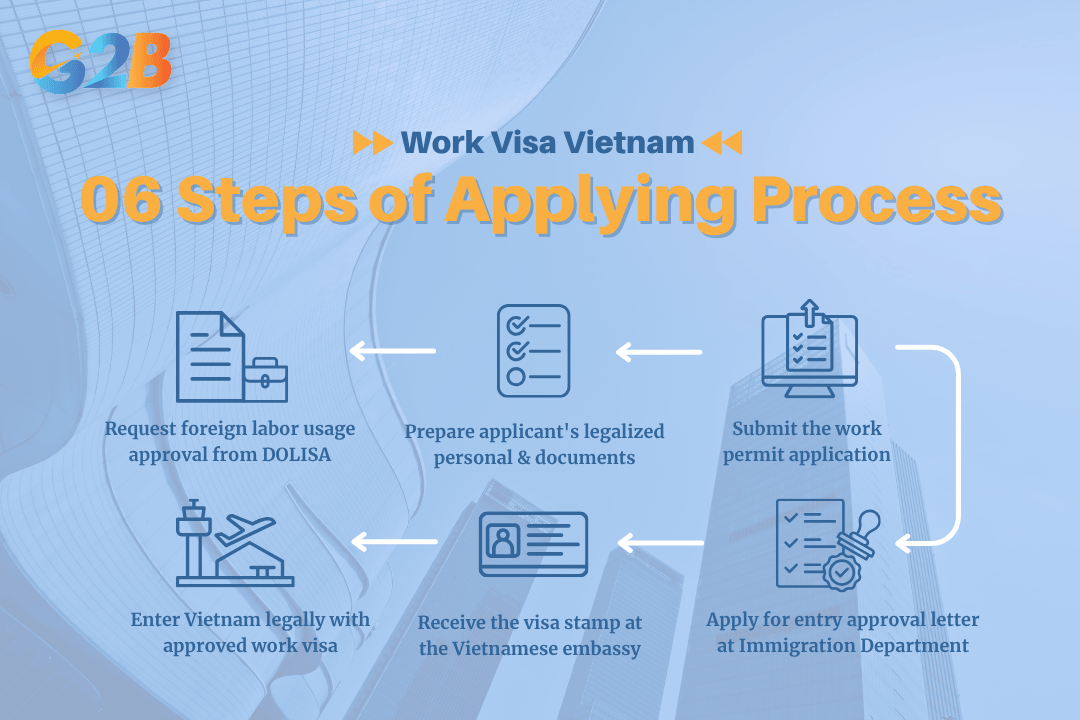
The work visa process requires many steps
Where can applicants apply for the visa?
Applicants can claim their physical work visa at a Vietnamese embassy, a consulate, or an international airport upon arrival. The employer determines the pickup location when applying for the entry letter. Pickup locations include:
- Visit a designated Vietnamese embassy abroad
- Claim the visa at an international border gate or airport
- Update immigration status at the provincial immigration office inside Vietnam
How long does processing take?
The standard processing time for a complete Vietnam work visa application takes 5 to 7 working days. This timeframe applies only after the employer successfully secures the work permit, which takes several weeks. Timeline factors include:
- Allow 3 to 4 weeks for initial work permit approval
- Wait 5 working days for the immigration entry letter
- Experience delays if documents lack proper consular legalization
- Request urgent processing through specialized visa agencies for an additional fee
What fees apply for Vietnam work visas?
The Vietnamese government charges standard consular fees based on the visa's validity length and entry frequency. Applicants pay these stamping fees directly to the immigration officer or embassy.
| Visa type | Typical validity | Government fee range |
|---|---|---|
| Single-entry visa | 1-3 months | $25 USD |
| Multiple-entry visa | 3-6 months | $50 USD |
| Long-term multiple-entry | 6-12 months | $135 USD |
What is a Vietnam work permit?
A Vietnam work permit is a legal certification issued by the Department of Labor that authorizes a foreigner to hold a specific job. While the visa handles border entry, the work permit regulates domestic labor law compliance.
Why is a work permit important?
The work permit proves that a foreign national legally occupies a job position that local workers cannot fill. The government uses this document to protect the local workforce and enforce taxation. Permit requirements help the government:
- Enforce corporate labor law compliance
- Track foreign income for personal income tax collection
- Authorize the issuance of long-term temporary residence cards
- Prevent exploitation of undocumented migrant workers
Who needs a work permit?
Any foreign national executing a paid employment contract with a Vietnam-based entity must hold a work permit. This rule applies across all industries and organizational structures. Target groups include:
- Sign formal labor contracts as foreign employees
- Operate specialized machinery as technical workers
- Lead corporate departments as managers and executives
- Instruct students as foreign educators
Who is exempt from work permits?
The government exempts specific foreigners, including large capital investors and individuals married to Vietnamese citizens, from holding a traditional work permit. These individuals must still apply for a formal exemption certificate. Exempted categories include:
- Own a company with a capital contribution of at least 3 billion VND
- Enter Vietnam for fewer than 30 days as a technical expert
- Transfer internally within specific service sectors outlined by the WTO
- Marry a Vietnamese citizen and reside locally
How long is a work permit valid?
A standard Vietnam work permit remains valid for a maximum of two years. Employers must align the employment contract duration with the work permit validity period. Rules for validity include:
- Issue initial permits for a maximum of 24 months
- Allow one single renewal for an additional 2 years
- Require a completely new application after the renewal expires
- Cancel the permit if the foreigner changes employers or job titles
Can foreigners convert a tourist visa into a work visa in Vietnam?
Foreigners generally cannot convert a tourist (DL) visa into a work (LD) visa without leaving the country. Immigration laws require individuals to enter Vietnam under the correct visa category that matches their true purpose.
Does Vietnam allow tourist-to-work visa conversion?
Current immigration policies prohibit the direct conversion of a tourist visa into an employment visa from inside the country. Foreigners usually must execute a "border run" to re-enter with the correct sponsorship. The government enforces strict entry purpose regulations. The immigration database tracks the initial visa symbol. Changing the core purpose of a visit requires a new entry approval letter.
What conditions allow visa conversion?
Vietnam may allow domestic visa conversion only in exceptional cases, such as when the foreigner holds a valid work permit or an official exemption certificate and obtains prior approval from the Immigration Department. Standard employees cannot bypass the exit requirement. Approved conversion conditions require applicants to:
- Hold formal employer sponsorship before the current visa expires
- Secure a valid work permit from the labor department
- Submit conversion requests directly to the central Immigration Department
- Prove an unavoidable reason preventing international travel
What risks exist when working on a tourist visa?
Working on a tourist visa constitutes illegal employment and subjects the foreigner to immediate administrative penalties. Authorities actively monitor workplaces for undocumented expatriates. Risks include:
- Face administrative fines ranging from 15 to 25 million VND
- Suffer forced deportation and removal from the country
- Receive a multi-year entry ban on the applicant's passport
- Cause severe financial and operational sanctions against the hiring employer
How long can foreigners stay in Vietnam with a work visa?
Foreigners can stay in Vietnam for the exact duration printed on their LD work visa, which typically lasts up to 12 months. To stay longer, workers transition their visa into a Temporary Residence Card (TRC).
What is the validity period of Vietnam work visas?
The Immigration Department issues work visas with a validity matching the work permit, up to a maximum of two years. If the work permit has a shorter duration, the visa duration decreases accordingly. Validity rules include:
- Issue single-entry visas for short-term probationary contracts (1-3 months)
- Issue multiple-entry visas for longer employment terms (up to 12 months)
- Base the final visa validity strictly on the employer's request letter
Can work visas be extended?
Employers can extend a foreigner's work visa by submitting a renewal application before the current visa expires. The extension requires an active, valid work permit. The renewal process requires the employer to:
- Prove ongoing legal employment
- Submit the passport and current visa to the immigration office
- Guarantee the foreigner's compliance with local laws
- Pay the corresponding extension processing fees
Can work visa holders obtain temporary residence cards?
Work visa holders who possess a work permit valid for at least 12 months can apply for a Temporary Residence Card (TRC). The TRC replaces the visa and provides long-term stability. Residence card benefits include:
- Allow unlimited border crossings without requesting new visas
- Grant stay permission for up to 2 years for employees, or up to 5 years for investors
- Eliminate the need for frequent immigration renewals
- Facilitate the sponsorship of dependent family members
What benefits does a Vietnam work visa provide?
A work visa guarantees the foreign worker full protection under Vietnamese labor laws and provides access to local social services. It separates legal expatriates from undocumented transient workers.
Does a work visa allow legal employment?
The primary benefit of a work visa is the authorization to receive legal salary payments from a registered company. It ensures the worker's income complies with local tax authorities. Legal employment benefits include:
- Enforce employment contract protections through labor courts
- Allow tax-deductible salary expenses for the hiring company
- Enable the legal transfer of earned funds to overseas bank accounts
- Guarantee compliance with occupational safety and health laws
Does a work visa support long-term residence?
A valid work visa acts as the direct legal pathway to obtaining a multi-year Temporary Residence Card. The government designed the LD visa as the first step toward long-term expatriate settlement. Workers transition to long-term residence to bypass annual visa renewals.
Can dependents accompany work visa holders?
Foreign workers holding an LD visa or TRC can sponsor their spouse and children for a dependent (TT) visa. The government recognizes the importance of keeping expatriate families together. Dependent sponsorship options allow workers to:
- Secure TT visas for legally married spouses
- Sponsor biological or legally adopted children under 18 years old
- Grant dependents a stay duration matching the primary worker's visa
- Allow children to enroll in local international schools
Does a work visa support banking and housing access?
A valid work visa allows foreigners to sign long-term residential leases and open full-service domestic bank accounts. Undocumented tourists cannot access these essential financial and civic services. Visa holders use their legal status to:
- Open local currency and foreign currency bank accounts
- Sign legitimate apartment rental agreements
- Register utilities and internet services in their own name
- Obtain local driving licenses and purchase motorbikes
Common reasons Vietnam work visa applications are rejected
The Immigration Department rejects work visa applications when documents contain errors, employers fail compliance checks, or applicants violate immigration rules. Proper preparation prevents costly processing delays.
Do incomplete documents cause rejection?
Missing signatures, expired passports, or incorrectly formatted application forms trigger immediate visa application rejections. The immigration portal uses strict verification protocols. Common document errors include:
- Submit a passport with less than six months of validity
- Fail to legalize foreign university degrees and police checks
- Provide inconsistent personal details on the NA5 form
- Forget to attach the original work permit approval letter
Can employers fail sponsorship requirements?
The government denies visas if the sponsoring employer owes back taxes, operates without a valid business license, or exceeds foreign labor quotas. The company must remain in good standing. Employer failures include:
- Operate a business with suspended tax codes
- Fail to submit mandatory foreign labor reports to DOLISA
- Hire foreigners without completing the 30-day domestic job posting requirement
- Register an invalid or fake corporate headquarters address
Does criminal history affect approval?
Applicants with a documented criminal history in Vietnam or their home country face automatic visa denial. The immigration authority cross-references applicant data with international security databases. Security concerns involve:
- Possess prior convictions for fraud, violence, or drug offenses
- Trigger Interpol red notices or international warrants
- Commit previous administrative violations inside Vietnam
Can immigration violations create problems?
Foreigners who previously overstayed their Vietnamese visas or worked illegally lose their eligibility for future work visas. Immigration officers maintain permanent records of border violations. Past violations create problems such as:
- Suffer automatic rejections due to unpaid overstay fines
- Face enhanced scrutiny for conducting previous "border runs"
- Receive denials for making false declarations on past arrival forms
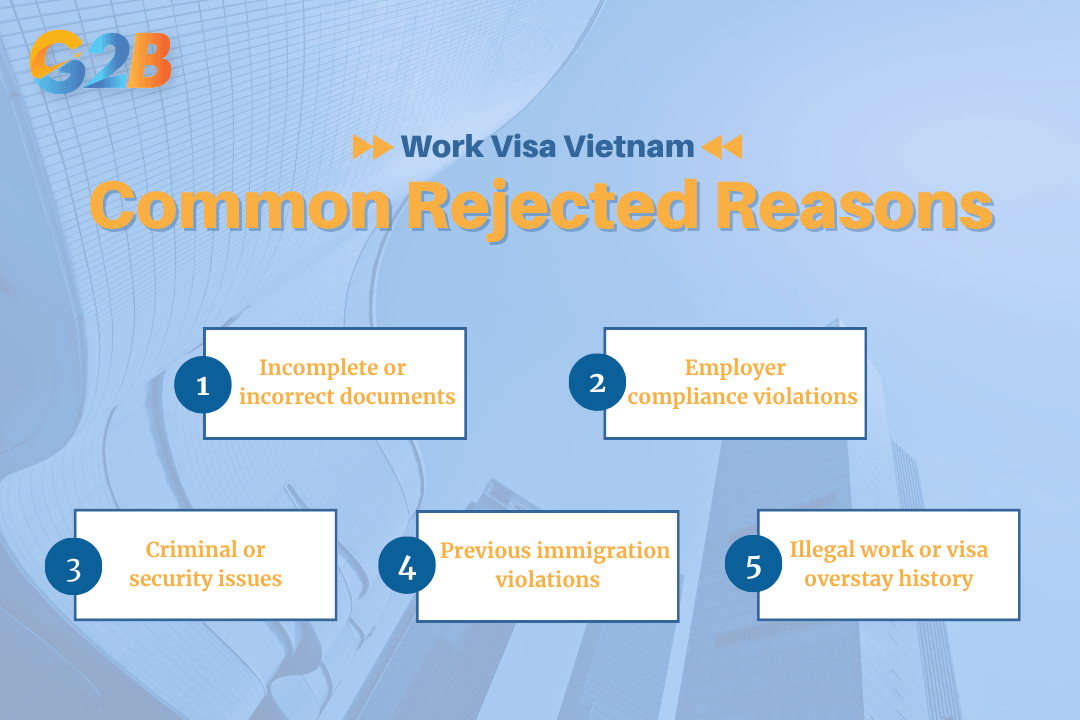
Common reasons Vietnam work visa applications are rejected
What are the penalties for illegal employment in Vietnam?
Vietnam penalizes illegal employment with heavy financial fines, immediate deportation, and long-term entry bans for the foreign national. The government enforces these rules strictly to protect the domestic economy.
What happens if foreigners work without a permit?
Foreigners caught working without an LD visa and valid work permit face administrative fines ranging from 15,000,000 to 25,000,000 VND. The police also execute mandatory deportation procedures. The authorities apply these penalties:
- Issue immediate monetary fines
- Invalidate current tourist or business visas
- Deport the individual back to their home country
- Place a multi-year ban on the foreigner's passport
What penalties apply to employers?
Companies that hire illegal foreign workers face financial fines up to 75,000,000 VND and risk severe business disruptions. The labor department holds the employer fully responsible for immigration compliance. Employer penalties include:
- Pay fines scaling with the number of illegal foreign workers
- Face suspension of operational business licenses for up to 3 months
- Lose the legal right to sponsor future foreign laborers
- Undergo strict audits by the provincial tax authority
How does Vietnam monitor foreign employment?
The government monitors foreign employment through unannounced labor inspections and integrated immigration database checks. Landlords and employers must report the presence of foreign nationals to local police. Monitoring methods include:
- Conduct random workplace inspections by DOLISA officials
- Require online temporary residence declarations from local landlords
- Cross-reference personal income tax filings with immigration records
- Enforce mandatory bi-annual foreign labor usage reports from companies
Frequently asked questions about Vietnam work visas
The following part answers some frequently asked questions about Vietnam work visas. These questions provide additional information to help foreigners better understand the work visa process and related immigration requirements in Vietnam.
How long does it take to get a Vietnam work visa?
Securing a complete work visa takes approximately 4 to 6 weeks. This timeline includes obtaining the work permit approval from the labor department and processing the visa entry letter with the immigration office.
Can freelancers apply for a Vietnam work visa?
No, freelancers cannot apply for a Vietnam work visa because the law requires an established local corporate sponsor. Digital nomads and independent contractors must either incorporate their own local business or use alternative visa routes.
Can remote workers use a tourist visa in Vietnam?
Remote workers technically violate local laws if they work on a tourist visa, as tourist visas strictly prohibit any form of employment. However, Vietnam does not currently possess a specific digital nomad visa category.
Can work visa holders change employers?
Work visa holders cannot transfer their visa to a new employer without completing a new application process. The foreigner must return the current work permit, cancel the residence card, and re-apply under the new company's sponsorship.
Can spouses and children stay in Vietnam?
Yes, work visa holders can sponsor their legal spouses and children under 18 for a dependent visa (TT). The dependents receive a visa validity that matches the principal applicant's work visa or temporary residence card.
What happens if a work permit expires?
When a work permit expires, the associated work visa or residence card becomes invalid. The employer must either process a formal renewal before the expiration date or the foreign worker must exit the country.
Can a work visa lead to permanent residence?
A work visa does not directly lead to permanent residence in Vietnam. Permanent residence status remains highly restricted and generally applies only to foreigners who meet specific statutory conditions on long-term legal residence, contribution to the state, and family ties.
Foreign professionals navigating the complex Vietnamese immigration system must prioritize strict adherence to legal regulations. Securing a Vietnam work visa requires careful coordination between the employer, the labor department, and the immigration authorities. By preparing accurate documentation, verifying health and criminal backgrounds, and obtaining the correct employment authorization, expatriates ensure a secure and legal stay. Companies must consistently monitor visa expiration dates and permit renewals to avoid administrative penalties.
