




 Delaware (USA)
  Vietnam
  Singapore
  Hong Kong
  United Kingdom
 A TRC for workers is a legal residence permit that allows foreign employees to live and work in a host country for a defined period under an employment contract, directly linking immigration status to work authorization while serving as official proof of lawful residence for local authorities. Issued by government immigration departments and typically sponsored by the employer on behalf of foreign staff, the TRC plays a central role in regulatory compliance. This article outlines the key rules, requirements, and processing timelines for obtaining a TRC for workers.
What is a TRC for workers?
A TRC for workers (Temporary Residence Card) is a government-issued identity document that permits a foreign national to reside in a country legally for work purposes. Immigration authorities issue this card after approving a work permit. The physical card usually contains a microchip. This microchip stores biometric data. The card displays the worker's full name, nationality, date of birth, and passport number. It also lists the sponsoring employer's name and the card's expiration date. Police officers and government officials scan this card to check the worker's legal status in the national database.
A TRC replaces the standard paper visa. Foreign workers carry this card in their wallets. They show the TRC at airports, banks, and government offices. The TRC proves that the worker entered the country legally and holds a valid job.
Why do workers need a temporary residence card?
Workers need a TRC to obtain a legal stay and employment rights. Authorities require this card to regulate foreign labor, ensure tax compliance, and track residency status. Governments use the TRC system to manage the labor market. Without a TRC, a foreign worker is an illegal immigrant. Police deport illegal workers. Employers face heavy fines if they hire workers without a valid TRC.
Key functions of the TRC include:
- Grant legal residence based on active employment.
- Enable access to local payroll and taxation systems.
- Validate the official employer-employee relationship.
- Provide a local identification number for daily tasks.
- Allow the worker to open a local bank account.
- Permit the worker to sign a housing lease agreement.
Who is eligible for a TRC for workers?
Eligibility for a TRC depends on employment status, employer sponsorship, and legal compliance with immigration laws. Applicants must hold a valid job offer to start the process. Immigration departments check both the worker and the employer. The employer must be a legally registered company. The company must pay local taxes. The worker must possess the right skills for the job. Governments often prioritize skilled workers, managers, and technical experts.
Common eligibility requirements include:
- Hold a valid passport with at least two blank pages.
- Possess a signed work contract from a local company.
- Meet specific skill, education, or salary thresholds.
- Pass local health checks and medical tests.
- Provide a clean criminal background check from the home country.
- Hold a valid work permit from the Ministry of Labor.
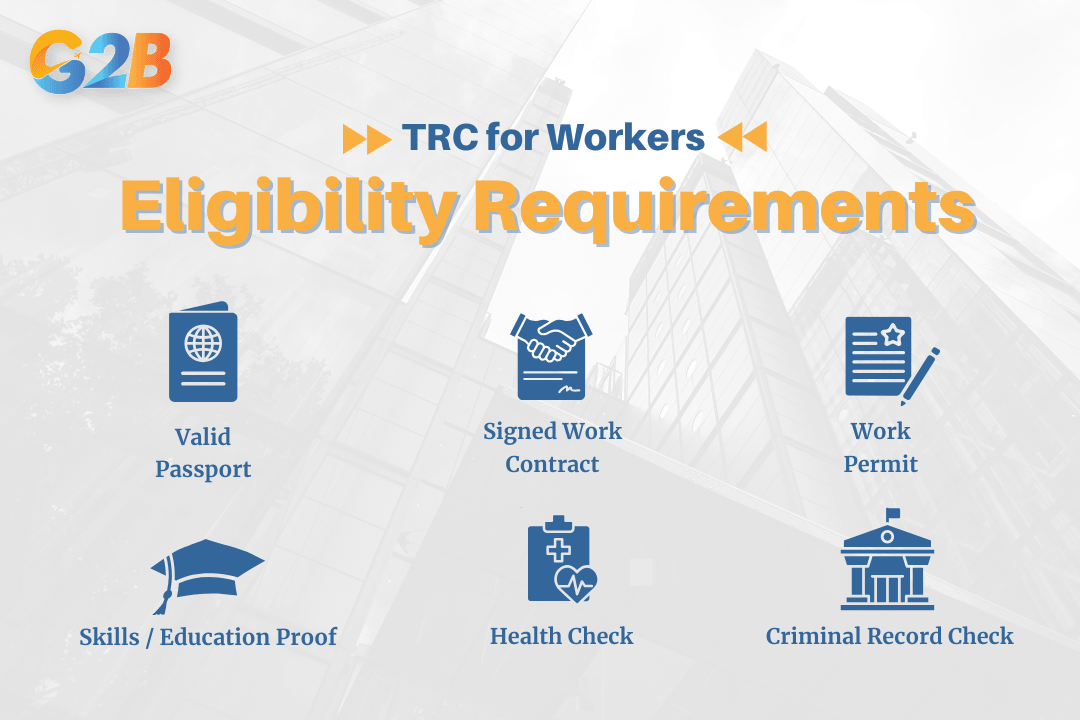
Foreign workers must meet legal requirements to get a TRC in Vietnam
What documents are required for a TRC application?
A TRC application requires identity, employment, and compliance documents. Authorities verify these documents to check authenticity and completeness. Workers and employers must collect the correct papers. Many governments require applicants to translate foreign documents into the local language. Applicants must also notarize these translations. Some documents require an apostille from the worker's home embassy.
Core documents include:
- Submit a valid passport (validity ≥ 6 - 12 months).
- Provide the original employment contract or job offer letter.
- Show the original work permit (WP) approval document issued by MoLISA or DOLISA.
- Provide confirmation of temporary residence registration (not housing lease).
- Provide a valid health insurance policy.
- Attach 4 passport-sized photos (4x6 cm, white background, taken within 6 months).
- Submit the official company registration certificate of the employer.
- Provide a criminal record certificate from the home country (issued within 6 months).
How to apply for a TRC for a worker?
Applicants apply through local immigration offices or online government portals. The process includes document submission, background verification, and biometric registration. The employer usually starts the process. The worker arrives in the host country on a working visa. Then, the worker converts the visa into a TRC.
Step-by-step process:
- Gather all personal and company documents.
- Translate and notarize foreign certificates.
- Submit the application form with documents to the immigration department.
- Pay the official application and processing fees.
- Attend a biometric appointment to provide fingerprints and a photo.
- Wait for the government to process the application.
- Collect the physical TRC card from the government office.
Read more: How to Convert a Tourist Visa to a Business Visa in Vietnam
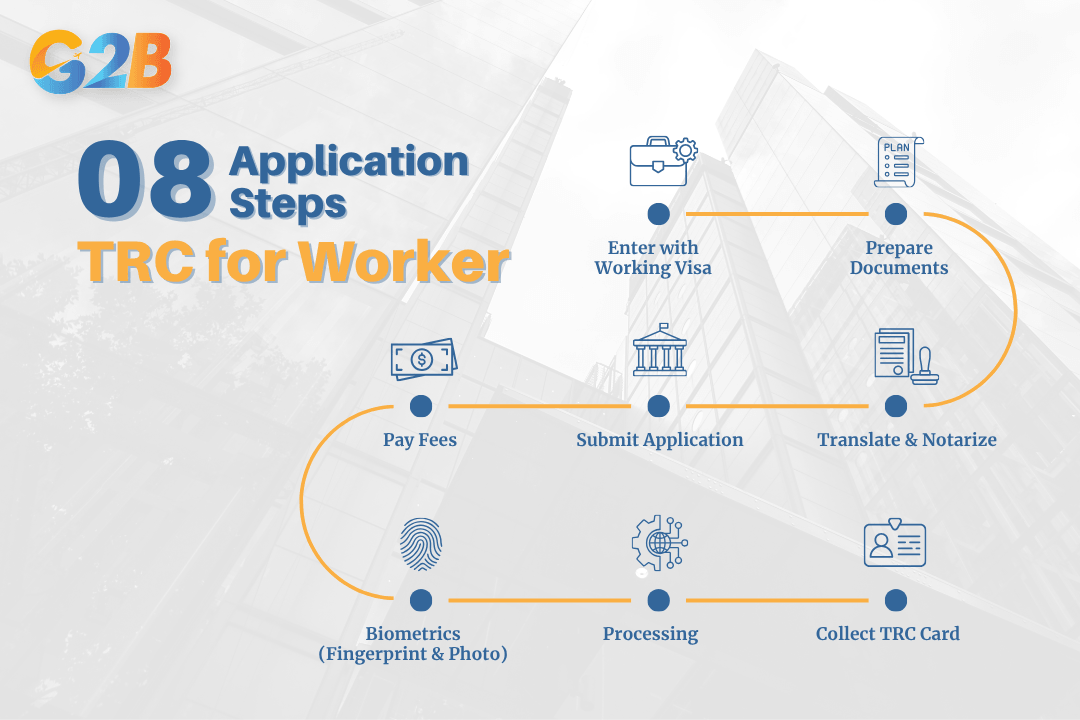
Workers follow a structured process to obtain a TRC in Vietnam
How long does it take to get a TRC?
Processing time ranges from 2 to 12 weeks, depending on the country, government workload, and application completeness. Missing documents delay the process significantly. Immigration officers review the files carefully. They check the police database. They verify the company's tax records. If the officer finds a mistake, they return the application. The worker must fix the mistake and apply again. This adds weeks to the waiting time.
Standard TRC processing times:
| Application Phase | Average Time | Action Required |
|---|---|---|
| Document Preparation | 1–3 weeks | Translate and notarize papers. |
| Work Permit Approval | 15 working days | Submit labor requests to the Ministry. |
| TRC Submission | 1 week | Book an appointment and submit files. |
| Government Review | 7–10 working days | Wait for immigration database checks. |
| Card Printing | 1 week | Collect the physical card. |
How long is a TRC for workers valid?
TRC validity typically aligns with the employment contract duration. Immigration authorities usually issue the card for a period of 2 years. The government does not issue a TRC that lasts longer than the worker's passport validity. If a worker signs a one-year contract, the TRC lasts for one year. If the worker signs an unlimited contract, the government usually caps the TRC at two years. After this period, the worker must renew the card.
What rights does a TRC holder have?
A TRC holder gains legal residence and work rights tied to a specific employer and job role. The card allows the worker to live safely and legally in the host country. The TRC provides many local benefits. It acts as the worker's primary ID card. Workers show the TRC to hospitals, schools, and utility companies.
Rights include:
- Live legally in the host country during the card's validity.
- Work-authorised jobs with the sponsoring employer.
- Access basic public services, such as government healthcare.
- Travel in and out of the host country without a separate visa.
- Sign contracts for mobile phones, internet, and electricity.
- Sponsor dependent visas for family members.
Read more: TRC for Family (Spouses and Children) – Temporary Residence Card Guide
What are the restrictions of a TRC for a worker?
A TRC imposes conditions that limit mobility and employment flexibility. Foreign workers must follow these rules to maintain their legal immigration status. The TRC belongs to the government. The government ties the card to one specific company. The worker does not have the freedom to work anywhere. If the worker breaks these rules, the government cancels the card.
Common restrictions include:
- Limit employment strictly to the sponsoring employer.
- Prohibit part-time work or freelance work for other companies.
- Require a permit update to change job titles or promotions.
- Restrict the total number of days spent outside the host country.
- Require the worker to report any change of home address to the police.
How to renew or extend a TRC for workers?
Renewal requires continued employment and updated documentation before the current card expires. Workers must submit renewal applications to the immigration office early. Workers should not wait until the last minute. If a TRC expires, the worker becomes illegal immediately. Governments charge heavy fines for overstaying. The renewal process is similar to the first application.
Renewal steps include:
- Submit the renewal application 30 to 60 days before expiration.
- Provide an updated work contract signed by the employer.
- Show recent salary slips to prove active employment.
- Pay the official government renewal fees.
- Update the local police registration for accommodation.
- Provide a new passport if the old passport has expired.
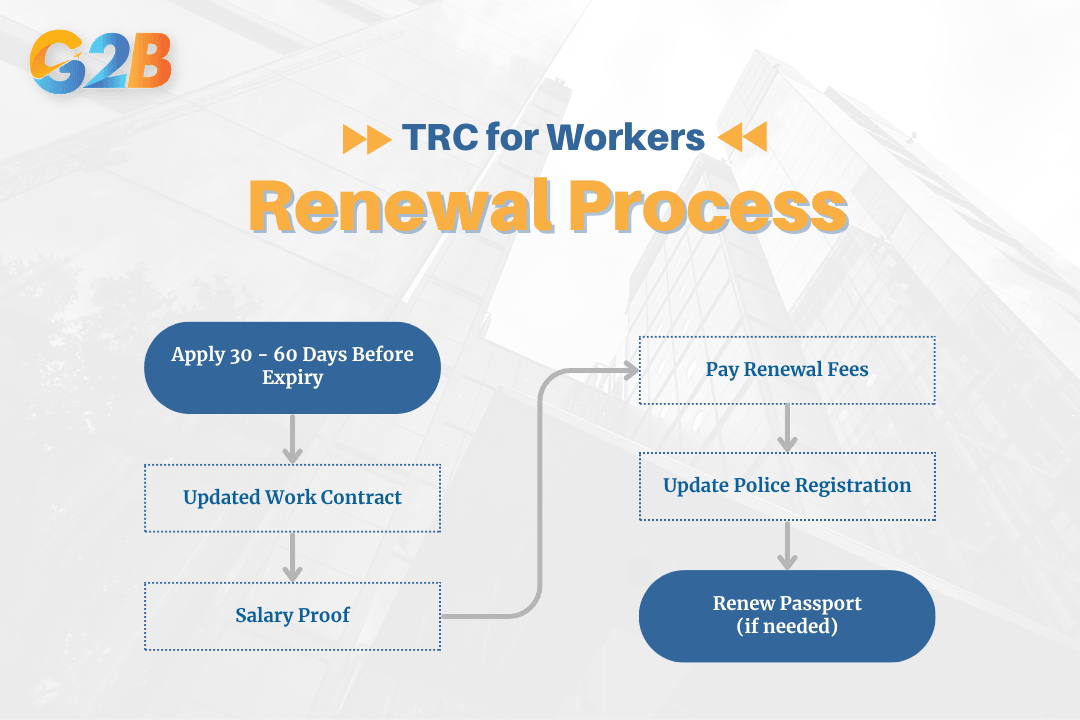
Workers must complete required updates and documents to renew TRCs
Who issues the TRC for workers?
National immigration departments issue the TRC for workers. These departments work together with the Ministry of Labor and local police forces to approve applications. The Ministry of Labor first approves the work permit. They confirm that the company needs a foreign worker. Next, the immigration department checks the worker's background. Finally, the immigration office prints and issues the physical card. Embassies do not issue TRCs. Embassies only issue entry visas. The worker must travel to the host country to get the actual TRC.
What happens if a worker loses their job?
If a worker loses their job, the TRC becomes invalid. The employer must inform the immigration office to cancel the residence permit immediately. The TRC depends entirely on the employment contract. When the contract ends, the worker loses the right to live in the country. Some countries give the worker a grace period. A grace period is a short time (usually 30 to 90 days) to find a new job. If the worker finds a new job, the new employer applies for a new TRC. If the worker does not find a job, they must leave the country.
Why do TRC applications get rejected?
Immigration authorities reject TRC applications due to non-compliance, incomplete data, or security concerns. Applicants must provide accurate and legal information to avoid denial. Rejections waste time and money. The government does not refund application fees for rejected files. Employers must ensure the company has no tax debts. Workers must ensure their passports are valid and their diplomas are real.
Common rejection reasons include:
- Submit missing, expired, or fake documents.
- Fail to meet the legal minimum salary requirements.
- Apply with an employer who has unpaid government taxes.
- Have a criminal record in the home country or host country.
- Fail the mandatory blood test or chest x-ray.
- Hold the wrong type of entry visa.
How much does a TRC for a worker cost?
TRC costs depend on the country's government fees, processing speed, and document preparation expenses. The total cost includes medical tests, translations, and application fees. Usually, the employer pays for the TRC. Labor laws in many countries require the company to cover immigration costs for its foreign staff. However, the worker usually pays for documents from their home country, such as the police clearance certificate.
Common cost components include:
- Pay the government application fee for the physical card.
- Pay for the mandatory hospital health check.
- Pay translation and notary offices for document processing.
- Pay fees for passport photos and biometric scans.
- Pay consulting or legal fees if using an agency.
How do immigration offices verify TRC documents?
Immigration offices verify documents by cross-checking government databases and contacting issuing authorities. They use advanced technology to detect fake passports and fake diplomas. The government checks the employer's status in the national business registry. They verify that the company pays corporate taxes. They also check the worker's passport against Interpol databases. Sometimes, immigration officers call the company to confirm the job offer. If officers suspect fraud, they reject the application and ban the worker from entering the country again.
What are the employer's responsibilities for a TRC?
Employers must sponsor the TRC, pay related taxes, and report any changes in employment status to the government. The company acts as the legal guarantor for the foreign worker. The employer takes legal responsibility for the worker's actions during working hours. If the worker runs away or breaks the law, the police contact the employer first.
Employer responsibilities include:
- Provide a valid, legal employment contract.
- Pay the foreign worker's monthly salary through a local bank.
- Pay mandatory health and social security taxes.
- Report contract terminations to the immigration office within a few days.
- Cancel the TRC when the worker resigns or leaves the country.
- Ensure the worker's job duties match the approved work permit.
How to replace a lost or stolen TRC?
Workers must report a lost or stolen TRC to the local police immediately and apply for a replacement card. Driving or working without the physical card is illegal. The worker needs a police report to prove the card was stolen or lost. The immigration office uses this police report to cancel the old microchip. This stops criminals from using the lost card for identity theft.
Replacement steps include:
- Visit the nearest police station to file a loss report.
- Obtain the official stamped police report document.
- Submit a replacement application to the immigration office.
- Provide a copy of the lost TRC or passport.
- Pay the government card re-printing fee.
- Wait for the government to issue the new physical card.
Can a worker hold two TRCs at the same time?
No, a worker cannot hold two active TRCs from different employers in the same country. The immigration system only links one foreign resident to one primary employer. If a worker finds a second part-time job, they usually cannot get a second TRC. The original employer must grant permission, and the government must approve a special secondary work permit. The TRC system ensures the government knows exactly who the worker's main sponsor is.
Frequently asked questions about TRC for workers
What is the difference between a TRC and a work permit?
A TRC grants legal residence rights, while a work permit authorizes employment. Many countries require the worker to hold both documents. The labor department issues the work permit. The immigration department issues the TRC.
Can a TRC holder change jobs?
Yes, a TRC holder can change jobs, but authorities require a permit modification or a completely new application. Workers cannot switch employers without government approval. The old employer must cancel the current TRC first.
Can family members join a TRC holder?
Yes, dependent visas allow family reunification in many countries. The TRC holder must prove they have enough income and a large enough apartment to support their spouse and children.
Does a TRC lead to permanent residency?
Yes, holding a TRC for multiple consecutive years often leads to permanent residency. Most countries require the worker to live and work legally for 5 to 7 years before applying for a permanent residence card.
Can a worker travel with an expired TRC?
No, a worker cannot travel internationally with an expired TRC. Border police will stop the worker at the airport. The worker must renew the TRC before leaving the host country to ensure safe re-entry.
Do I need to carry my TRC every day?
Yes, foreign workers must carry their physical TRC card at all times. Police officers have the right to stop foreigners and ask for legal identification. The TRC serves as the official proof of legal stay.
A TRC for workers is one of the most critical documents for foreign employees living abroad. It enables access to essential services while ensuring employers remain compliant with labor and tax regulations. However, strict adherence to documentation requirements and renewal timelines is essential, as non-compliance may lead to rejections or legal penalties. A clear understanding of the TRC framework helps maintain a stable and lawful working environment. For tailored support in navigating these procedures, G2B provides professional services for work permit / TRC / visa applications, ensuring a compliant and efficient process for employers and foreign employees.
