




 Delaware (USA)
  Vietnam
  Singapore
  Hong Kong
  United Kingdom
 APEC Card in Vietnam allows eligible business travelers to enter participating APEC economies without applying for separate visas for short-term business trips. Vietnam participates in the APEC Business Travel Card (ABTC) scheme to facilitate international business mobility. The program serves businesspeople in Vietnam by reducing administrative travel barriers. Qualified applicants obtain the card to conduct market research, attend conferences, and negotiate international trade agreements. The Vietnamese government actively promotes the ABTC program to support domestic enterprises in expanding their operations across the Asia-Pacific region.
What is the APEC business travel card in Vietnam?
The APEC Business Travel Card (ABTC) is a physical or digital travel document that allows pre-cleared business travelers to visit participating APEC economies for short-term business activities. The Asia-Pacific Economic Cooperation (APEC) created this initiative to improve regional trade. The card replaces traditional visas for short-term business visits. Cardholders present the ABTC alongside their valid Vietnamese passport at immigration checkpoints. The system stores applicant data centrally, and each member economy pre-approves the traveler before the home economy issues the final card.
What does the APEC card allow Vietnamese business travelers to do?
The APEC card allows Vietnamese business travelers to enter participating APEC economies for business purposes, use fast-track immigration lanes, reduce visa procedures, and stay for short visits. The document eliminates the need to apply for individual business visas before every trip. Travelers save time during airport arrivals and departures. Permitted activities include:
- Enter participating APEC economies for business purposes
- Use fast-track immigration lanes at designated international airports
- Reduce visa application procedures and associated legal fees
- Permitted activities include short-term business visits, with maximum stay length determined by each destination economy (varies by economy, e.g., 60 or 90 days depending on the member).
Which authority issues the APEC card in Vietnam?
The APEC card in Vietnam is issued by the Immigration Department under the Ministry of Public Security (Department of Immigration, Ministry of Public Security), with initial verification of business need typically provided by the applicant’s provincial People's Committee (local authorities) or other competent ministries as required.
The issuance process requires coordination between multiple government bodies. The local authorities first verify the applicant's business need. After provincial approval, the federal immigration authorities handle the final card generation. The involved authorities include:
- Ministry of Public Security: Manages the national immigration database and security checks
- Ministry of Industry and Trade: Evaluates state-owned enterprises and specific trade organizations
- Immigration Department of Vietnam: Prints and distributes the physical or digital ABTC
Is the APEC card a visa?
No, the APEC card is not a visa, nor is it a substitute for a valid passport. It acts as a multiple-entry business clearance for specific participating economies. The ABTC provides visa-equivalent entry permissions for full APEC members. The cardholder must always carry their primary passport. The card only grants entry to economies that have pre-cleared the specific applicant. Transitional members, such as the United States and Canada, do not offer visa-free entry through the ABTC. Travelers to transitional economies must still obtain standard visas but can use fast-track immigration lanes.
What are the benefits of an APEC card for Vietnamese businesspeople?
The primary benefits include visa-free entry to 19 economies, dedicated fast-track airport lanes, and reduced long-term travel costs for regular business trips. The APEC card provides significant strategic advantages for international enterprises. It transforms how executives manage urgent business trips. Companies reduce their overall administrative workload related to foreign travel.
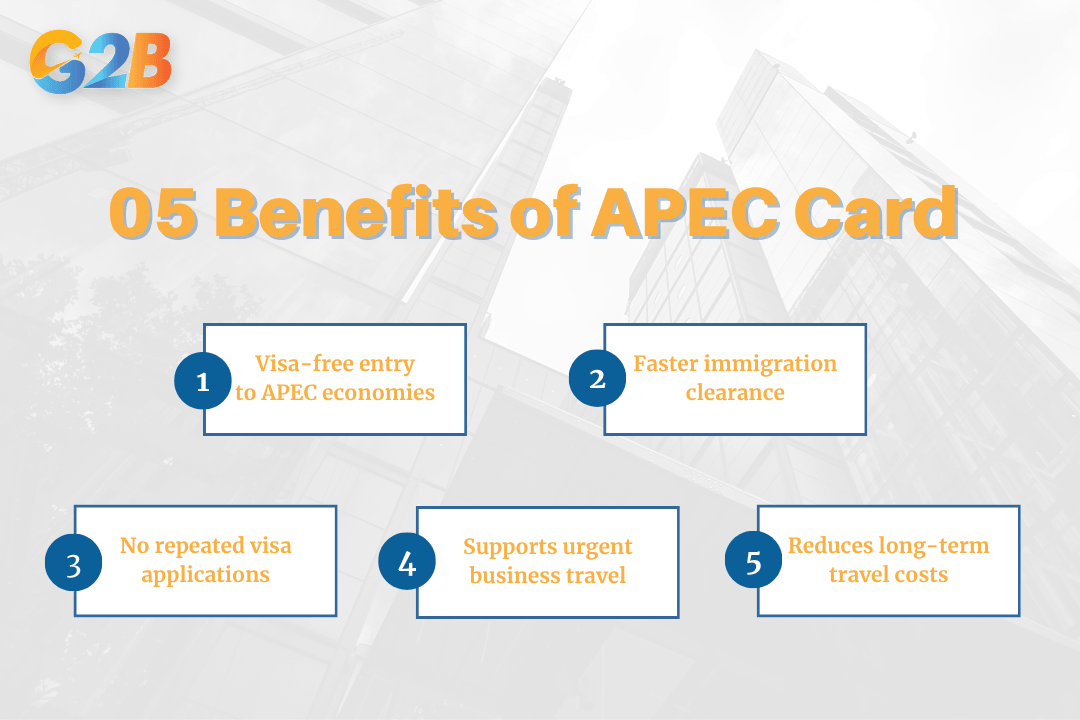
The benefits of an APEC card for Vietnamese businesspeople
How does the APEC card simplify business travel?
The APEC card simplifies travel by eliminating repeated visa applications, speeding up immigration clearance, and supporting regional trade mobility for urgent business needs. Frequent travelers face significant delays when applying for single-entry visas. The ABTC solves these administrative bottlenecks. The card simplifies travel because it:
- Eliminates repeated visa applications for every new business trip
- Speeds up immigration clearance through dedicated APEC lanes
- Supports regional trade mobility by allowing immediate travel for urgent meetings
What countries accept the APEC business travel card?
APEC Business Travel Card (ABTC) is accepted by 19 APEC member economies, including:
| Australia | Brunei | Chile |
|---|---|---|
| China | Hong Kong | Indonesia |
| Japan | South Korea | Malaysia |
| Mexico | New Zealand | Papua New Guinea |
| Peru | Philippines | Russia |
| Singapore | Taiwan | Thailand |
| Vietnam |
ABTC holders may enjoy visa-free short-term entry for business purposes and access to priority immigration lanes at many international airports. The United States and Canada currently participate as transitional members, meaning the ABTC cannot replace a visa for entry; however, cardholders may still use priority lanes at selected airports. The permitted length of stay and applicable conditions may vary depending on each country’s regulations.
Which business sectors benefit most from the ABTC?
Import-export companies, manufacturing firms, logistics businesses, international investors, and trade promotion organizations benefit the most from the APEC Business Travel Card. These sectors require constant international mobility. Executives in these industries frequently visit foreign factories, attend trade shows, and meet global clients. The main beneficiaries include:
- Import-export companies: Negotiate cross-border commodity agreements
- Manufacturing firms: Inspect foreign supply chains and machinery
- Logistics businesses: Manage international shipping and freight routes
- International investors: Evaluate foreign markets and joint ventures
- Trade promotion organizations: Facilitate bilateral trade events
Who can apply for an APEC card in Vietnam?
Vietnamese citizens who hold managerial positions in qualifying businesses and conduct regular trade activities with APEC economies can apply for the card. The Vietnamese government sets strict eligibility criteria to prevent program misuse. Applicants must prove their genuine need for frequent regional travel. The business entity sponsoring the applicant must also meet specific financial and legal standards.
What are the eligibility requirements for Vietnamese citizens?
Eligible Vietnamese citizens must hold a valid passport, conduct regular business in APEC economies, hold managerial positions, and have no immigration violations. Individual applicants undergo strict background checks. The government verifies personal records and professional statuses. The individual requirements include:
- Must hold a valid Vietnamese passport with at least three years of remaining validity
- Must conduct regular and documented business in APEC economies
- Must not violate domestic or international immigration laws
- Must hold specific managerial or business-related positions within their company
Which positions qualify for an ABTC in Vietnam?
Eligible applicants are typically employees sponsored by a legally registered enterprise who hold positions with demonstrable decision-making or international business responsibilities (titles such as director, general manager, department head, or export-import executive are common examples). The applicant must possess decision-making authority within their organization. Junior staff members generally do not qualify for the ABTC program. Qualifying positions include:
- Company directors: Including CEO, CFO, and Board Members
- General managers: Overseeing corporate branches or main operations
- Department heads: Leading key divisions like sales, procurement, or finance
- Export-import executives: Managing international trade operations directly
- Investors and enterprise owners: Holding significant shares in the registered business
Which companies qualify employees for ABTC sponsorship?
Legally registered Vietnamese enterprises with documented international trade activities, tax compliance records, and business relations in APEC economies qualify to sponsor employees. Not all businesses can sponsor an ABTC application. The government requires the sponsoring enterprise to demonstrate financial stability and active international operations. Qualifying enterprises include:
- Legally registered Vietnamese enterprises: Holding valid business registration certificates
- Businesses with international trade activities: Showing direct revenue from foreign markets
- Companies with tax compliance records: Fulfilling all state financial obligations without debt
- Enterprises with documented business relations: Providing active contracts in APEC economies
What documents are required for an APEC card application in Vietnam?
Applicants must submit personal identification documents, corporate legal certificates, employment verification, and formal proof of international business activities with APEC partners. The documentation process requires precision. Incomplete dossiers cause immediate rejections. The application requires both personal files and company-level evidence to prove the business relationship.
Which personal documents must applicants submit?
Applicants must submit a valid passport copy, citizen identification, official portrait photographs, and the completed APEC card application form. Personal documents verify the identity and travel history of the businessperson. The authorities check these documents against national security databases. Required personal documents include:
- Provide a notarized passport copy showing previous travel history
- Submit a valid ID card or citizen identification document
- Attach recent portrait photographs meeting standard passport criteria
- Complete the official APEC application form with accurate personal details
Which company documents are required?
The sponsoring company must submit its business registration certificate, tax code certificate, employment confirmation, appointment decisions, and proof of APEC business activities. Company documents prove the legal and financial health of the sponsor. The government uses these files to confirm the enterprise contributes to the national economy. Required company documents include:
- Submit the certified business registration certificate
- Provide the official tax code certificate and recent tax clearance
- Attach the employment confirmation and social insurance records
- Include the formal decision appointing the applicant’s specific managerial position
- Prepare documents proving recent and active APEC business activities
What proof of business activities strengthens approval?
Contracts with foreign partners, customs declarations, import-export invoices, business travel schedules, and active trade agreements strengthen the APEC card approval chances. The immigration authorities require undeniable proof that the enterprise trades with APEC economies. A single email exchange does not suffice. Strong evidence includes:
- Submit signed commercial contracts with foreign partners in APEC countries
- Provide official customs declarations showing cross-border goods movement
- Attach recent import-export invoices demonstrating transaction volumes
- Include detailed business travel schedules outlining future APEC visits
- Present formal trade agreements or memorandums of understanding (MOUs)
How to apply for an APEC card in Vietnam
Applicants must prepare required documents, obtain provincial approval, submit the dossier to the Immigration Department, and wait for multinational pre-clearance. The application is a multi-phase procedure. The applicant must pass domestic verification before foreign economies review the request. This systematic approach ensures only qualified businesspeople enter the APEC mobility system.
What is the step-by-step ABTC application process?
The process involves preparing documents, getting local authority approval, submitting files to immigration, passing background checks, waiting for international clearance, and receiving the card. Each step requires specific processing times. Missing a step will halt the entire application. Follow this ordered list to apply:
- Prepare all required personal and company documents
- Obtain provincial approval from the local People's Committee or relevant ministry
- Submit the complete application to the competent immigration authorities
- Complete the national background verification process
- Wait for participating APEC economies to issue pre-clearance approvals
- Receive the printed or digital APEC card from the Immigration Department
Where can applicants submit the ABTC application?
Applicants can submit their ABTC applications at provincial authorities for the initial phase, and then at regional Immigration offices or online public service portals. The submission location depends on the specific phase of the application. The provincial phase requires local submission. Submission locations include:
- Provincial authorities: For the initial business necessity approval
- Immigration offices: Specifically the central departments in Hanoi, Da Nang, or Ho Chi Minh City
- Online public service portals: Where available, for uploading digital copies of the application dossier
How long does the APEC card process take in Vietnam?
The APEC card process in Vietnam typically takes 4 to 6 months, including domestic approval timelines and multinational pre-clearance stages. The process is lengthy because 19 different governments must review the applicant's data.
- The domestic approval timeline usually takes 1 to 2 months. Provincial authorities verify the company's tax and insurance records
- The multinational pre-clearance stage takes 2 to 4 months. Each APEC economy independently checks the applicant's immigration history
- Processing times vary among APEC economies. Some economies approve requests within weeks, while others require several months
How much does an APEC card cost in Vietnam?
Official government fees for the ABTC administration vary and should be confirmed with the Immigration Department or current Ministry of Finance circulars; the commonly cited fee is approximately 1,200,000 VND, with additional costs possible for renewals or replacements and optional consultancy fees.
What are the official government fees?
The official government fees cover the initial issuance, standard renewals, and replacement costs for lost or damaged cards as regulated by the Ministry of Finance. These fees only cover the administrative printing and processing by the state.
| Fee type | Estimated cost |
|---|---|
| Initial issuance | Government-regulated fee (approx. 1,200,000 VND) |
| Renewal | Government-regulated fee (approx. 1,200,000 VND) |
| Replacement for lost card | Additional fee (approx. 1,200,000 VND) |
Why do service providers charge different prices?
Service providers charge different prices based on consultancy support, document preparation, expedited administrative handling, and translation services. Many businesses lack the internal resources to compile a flawless dossier. They hire business mobility experts to handle the complex requirements. Price variations depend on:
- Consultancy support: Advising on company eligibility and legal compliance
- Document preparation: Organizing, formatting, and verifying corporate dossiers
- Expedited administrative handling: Managing internal logistics to submit files promptly
- Translation and notarization support: Converting Vietnamese business documents into required formats
How long is the APEC card valid?
The standard APEC Business Travel Card in Vietnam is valid for five years from the date of issuance, or until the passport expires. The validity period allows businesspeople to plan long-term corporate strategies. The 5-year duration significantly reduces the administrative burden of frequent visa renewals.
What is the validity period of the Vietnam ABTC?
The Vietnam ABTC has a standard validity duration of five years, but its validity remains strictly linked to the expiration date of the applicant’s passport. The government grants a maximum 5-year term. However, passport-linked validity limitations apply. If the applicant's passport expires in three years, the issued ABTC will also expire in three years. Applicants should ensure their passport has at least three years of validity before applying.
When should cardholders renew the APEC card?
Cardholders should renew the APEC card at least six months before expiration to account for delays caused by foreign economy approvals. Renewing an ABTC takes almost as long as the initial application. The home economy must send the data back to all APEC members for updated pre-clearance.
- Recommend renewing before expiration to maintain uninterrupted travel access
- Explain delays caused by economy approvals, which can leave travelers without coverage if they apply too late
What happens if the passport expires first?
If the passport expires first, the APEC card becomes invalid, and the cardholder must request a replacement card linked to the new passport details. The ABTC number connects directly to the passport number. A new passport requires a new card.
- The ABTC linkage to passport validity means travelers cannot use an old card with a new passport.
- Replacement requirements involve submitting the new passport details and paying a replacement fee to update the physical or digital card.
Can family members use an APEC card?
No, family members cannot use an APEC card because the scheme strictly requires individual eligibility based on business purposes and managerial positions. The ABTC program facilitates trade, not family tourism or relocation. The authorities evaluate every individual based on their professional contribution.
Does the ABTC cover spouses or children?
The ABTC does not cover spouses or children, as it limits privileges exclusively to the approved businessperson for specific commercial purposes. Family members must apply for their own appropriate visas if they wish to accompany the cardholder.
- Individual eligibility requirements mean dependents cannot share the main applicant's benefits
- The business-purpose limitation strictly prohibits using the card for non-commercial family vacations
Can dependents travel using the cardholder’s privileges?
Dependents cannot travel using the cardholder’s privileges and must hold separate visas to enter the destination economy. The fast-track lanes and visa exemptions only apply to the person pictured on the card.
- Family members require separate visa applications for entry
- Dependents must use standard immigration lanes unless the destination airport specifically allows them to accompany the ABTC holder at the counter
Which countries participate in the APEC business travel card scheme?
Twenty-one APEC economies participate in the scheme, divided into 19 full members offering visa-free entry and 2 transitional members offering fast-track processing. The scheme connects the fastest-growing economic region in the world. Cardholders gain unprecedented mobility across these borders.
Full list of participating APEC economies
The participating economies include major trade hubs like Australia, Japan, China, Singapore, the United States, and Canada. The following table categorizes the primary participants and their membership status.
| Economy | Full Member | Transitional Member |
|---|---|---|
| Vietnam | Yes | No |
| Australia | Yes | No |
| China | Yes | No |
| Japan | Yes | No |
| United States | No | Yes |
| Canada | No | Yes |
What is the difference between full and transitional members?
Full members grant visa-free entry and fast-track clearance to approved cardholders, while transitional members provide fast-track immigration lanes only. The membership tier dictates the travel benefits.
- Full members grant visa-free entry: Travelers can enter without any additional embassy visits
- Transitional members provide fast-track lanes only: Travelers to the US and Canada must still obtain standard B1/B2 or business visas but can bypass regular immigration queues at the airport
What are common reasons for APEC card rejection in Vietnam?
Common reasons for rejection include incomplete documents, insufficient business proof, past immigration violations, tax non-compliance, and incorrect company information. The government scrutinizes every application. A minor administrative error can trigger an automatic refusal from the provincial or federal authorities.
Why do some ABTC applications fail?
Applications fail when businesses cannot prove adequate APEC trade, owe state taxes, or when the applicant has a history of overstaying foreign visas. Authorities prioritize compliance and security. Applications usually fail due to:
- Incomplete documents: Missing signatures, stamps, or specific official forms.
- Insufficient business proof: Failing to meet minimum required contract values with foreign partners.
- Immigration violations: Possessing a history of deportations or visa overstays.
- Tax non-compliance: Showing outstanding corporate tax debts or social insurance arrears.
- Incorrect company information: Submitting inconsistent corporate registration details.
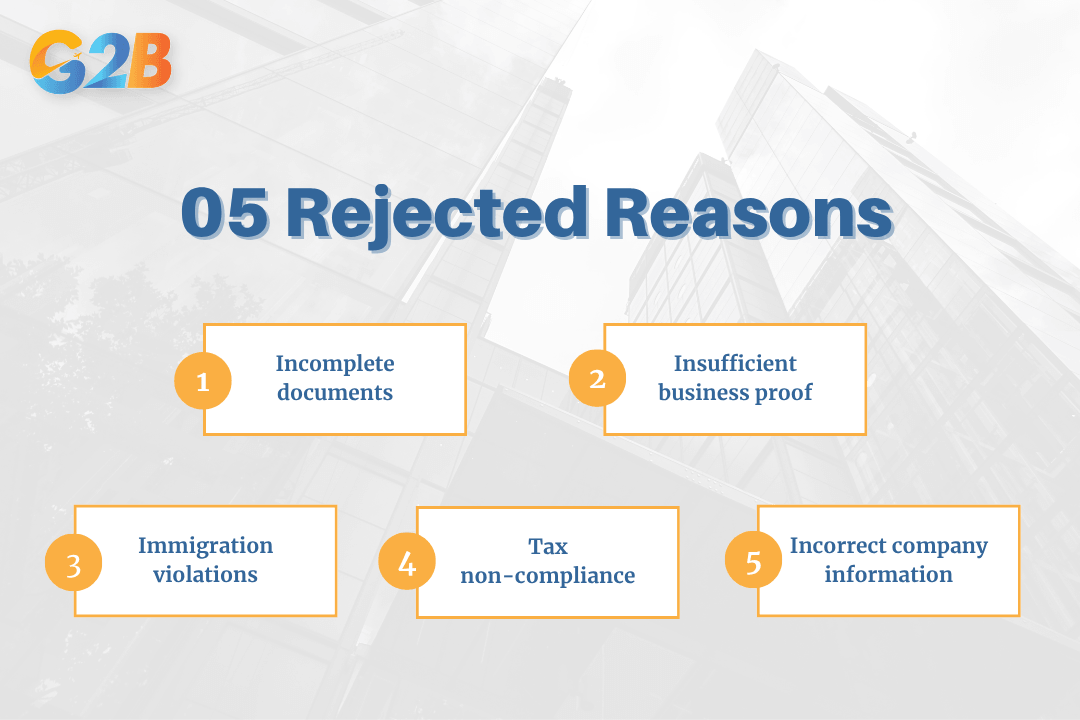
Reasons APEC cards are rejected
How can applicants improve approval chances?
Applicants improve approval chances by maintaining accurate financial records, submitting verified business evidence, ensuring long passport validity, and using updated official forms. Preparation defines the success of the application. To secure approval, applicants must:
- Maintain accurate corporate tax and social insurance records
- Submit verified and high-value business evidence, such as signed commercial contracts
- Use updated application forms provided by the Immigration Department
- Ensure passport validity exceeds three years before applying
How to renew or replace an APEC card in Vietnam
Cardholders renew or replace an APEC card by submitting their existing card, an updated passport, updated company verification documents, and a formal replacement request. The renewal process functions similarly to the initial application. The government must re-verify the continuing business need for the cardholder.
What documents are required for renewal?
Renewal requires the existing ABTC, an updated passport, company verification documents, and the official renewal application form. Cardholders must prove they still hold a qualifying position within an active enterprise. Required renewal documents include:
- Submit the existing ABTC (or a copy if it remains active during the process)
- Provide the updated passport copy
- Attach recent company verification documents showing ongoing APEC trade
- Complete the updated renewal application form
What should cardholders do if the ABTC is lost?
If the ABTC is lost, cardholders must immediately report the loss to authorities, request replacement documentation from their company, and submit a replacement application. A lost card poses a security risk. Prompt reporting is mandatory. Follow this ordered list to replace a lost card:
- Report the loss to the local police and the Immigration Department immediately
- Request internal replacement documentation and confirmation from the sponsoring company
- Submit the formal replacement application alongside the police report
- Pay the regulated replacement fee to the government office
APEC card Vietnam FAQs
The APEC Business Travel Card raises common questions regarding freelancer eligibility, startup approvals, tourism usage, tracking statuses, and foreign applicant rules in Vietnam. Clear answers help businesses decide if they should invest time into the ABTC application process.
Can freelancers apply for an APEC card in Vietnam?
No, freelancers cannot apply for an APEC card in Vietnam because the scheme strictly requires sponsorship from a legally registered, tax-compliant enterprise. Freelancers lack the required corporate structure. The government mandates that a recognized corporate entity takes responsibility for the applicant's business activities.
Can startup founders qualify for ABTC approval?
Yes, startup founders can qualify for ABTC approval if their registered enterprise demonstrates tax compliance and proven international trade activities with APEC economies. Age of the company matters less than actual trade volume. However, newly registered startups without established import-export contracts will fail the provincial approval phase.
Does the ABTC allow tourism travel?
No, the ABTC does not allow tourism travel; it exclusively permits short-term business visits, and using it for vacations violates the scheme’s regulations. Immigration officers at the destination economy can question the traveler. If the traveler admits to tourism, the officer can cancel the ABTC and deny entry.
Can applicants track the ABTC application status?
Yes, applicants can track the ABTC application status online through the APEC Business Travel Card pre-clearance tracking system using their application number. The central APEC website provides a public tracker. Applicants input their specific file number to see which economies have granted pre-clearance and which are still pending.
Is an interview required for the Vietnam APEC card?
No, a formal interview is not required for the Vietnam APEC card; authorities process the application entirely based on the submitted physical or digital documents. Unlike traditional US or European business visas, the ABTC process relies on documentary evidence rather than in-person consular interviews.
Can foreigners in Vietnam apply for an ABTC?
Foreigners in Vietnam cannot apply for a Vietnamese ABTC; they must apply through the competent authorities in their home economy using their home passport. Vietnam only issues the card to Vietnamese citizens. A foreign businessperson working in Vietnam must contact their own national immigration department to secure the card.
Does the ABTC guarantee entry into every APEC economy?
No, the ABTC does not guarantee entry into every APEC economy; destination immigration officers retain the final authority to deny entry based on local laws. The card provides pre-clearance, but it is not an absolute right of entry. Security alerts, health protocols, or suspicious behavior at the border can lead to entry refusal.
How many times can ABTC holders enter participating economies?
ABTC holders can enter participating economies an unlimited number of times during the card’s 5-year validity, provided each stay complies with the maximum duration limits. The multi-entry nature of the card is its greatest benefit. Businesspeople can travel back and forth multiple times a month without administrative restrictions.
What is the difference between an APEC card and a business visa?
An APEC card offers multi-year, multi-economy access with fast-track immigration privileges, whereas a traditional business visa usually provides single-country access through standard immigration lanes. The ABTC consolidates regional travel permissions into one document. Standard business visas require repetitive paperwork and embassy visits.
| Feature | APEC card | Business visa |
|---|---|---|
| Validity | Multi-year (up to 5 years) | Country-specific (often short-term) |
| Application Frequency | One application for 19 economies | Repeated applications per trip |
| Immigration Access | Fast-track lanes at airports | Standard immigration lanes |
| Coverage | Multiple participating economies | Single specific country |
What recent updates affect APEC card applications in Vietnam?
Recent updates involve shifts toward digital public service portals, stricter administrative verification, and increased demand driven by regional trade expansion within ASEAN. The Vietnamese government continuously modernizes its immigration infrastructure. These changes impact how businesses prepare and submit their ABTC dossiers.
Have Vietnam’s ABTC regulations changed recently?
Yes, Vietnam’s ABTC regulations have modernized recently by integrating digital public service portals and updating administrative procedures for corporate tax verification. The state aims to reduce paper waste and improve processing speeds.
- Administrative updates require companies to maintain flawless electronic tax records
- Digital public service developments allow companies to submit initial applications through government web portals
- Evolving immigration procedures mandate stricter verification of actual business contracts to prevent program fraud
How do regional trade trends affect ABTC demand?
Regional trade trends increase ABTC demand by expanding supply chains, boosting ASEAN cross-border investments, and requiring higher executive mobility across the Asia-Pacific region. As Vietnam's economy integrates further into global supply networks, local companies need rapid access to foreign markets.
- Growth in ASEAN trade forces local managers to travel frequently to Singapore, Malaysia, and Thailand
- Expansion of supply chain operations requires constant physical inspections of foreign manufacturing sites
- Increased executive mobility drives the need for visa-free, fast-track travel solutions like the ABTC
The APEC Business Travel Card continues to play an important role in supporting Vietnamese enterprises engaged in international trade. By understanding the strict eligibility requirements, preparing comprehensive corporate dossiers, and navigating the multi-phase application process, businesspeople secure unparalleled travel mobility. Companies utilizing expert consulting services ensure their applications meet all governmental standards, avoiding costly delays. Ultimately, the ABTC empowers executives to bypass bureaucratic visa hurdles, focus on global expansion, and actively participate in the rapid economic growth of the Asia-Pacific region. For streamlined support in work permit / TRC / visa services, contact G2B for professional guidance and reliable assistance throughout every step of the application process.
