




 Delaware (USA)
  Vietnam
  Singapore
  Hong Kong
  United Kingdom
 Birth certificate legalization for dependent visas in Vietnam is the mandatory process of verifying a foreign civil document for use by Vietnamese immigration authorities. Vietnam requires official proof of family relationships before issuing dependent visas. A birth certificate directly proves the parent-child relationship. Vietnamese authorities review legalized civil documents to confirm authenticity. Immigration officials evaluate these documents before they issue a dependent visa or a Temporary Residence Card (TRC) to the foreign child.
What is birth certificate legalization for a Vietnam dependent visa?
Birth certificate legalization for a Vietnam dependent visa is the authentication of a foreign public document for formal recognition by Vietnamese state authorities.
Why Vietnam requires legalized birth certificates
Vietnam requires legalized birth certificates to verify family relationships, confirm document authenticity, and prevent fraud in visa sponsorship applications. Vietnamese officials cannot directly verify the signatures of foreign government officials without this formal authentication chain.
Legalization vs translation vs notarization
Legalization confirms the validity of a foreign document, translation converts the text into the Vietnamese language, and notarization certifies the translated copy for official use.
| Process stage | Primary purpose | Responsible authority |
|---|---|---|
| Legalization | Verifies foreign government signatures | Ministry of Foreign Affairs / Embassy |
| Translation | Converts document language to Vietnamese | Certified Translation Company |
| Notarization | Certifies the translated document matches the original | Vietnamese Notary Public or Justice Department |
When do you need a legalized birth certificate for a Vietnam dependent visa?
Foreign parents need a legalized birth certificate when they apply for child dependent visas, secure Temporary Residence Cards, sponsor foreign children, or convert existing visa statuses.
Applying for a child dependent visa
A child dependent visa (TT visa) requires a legalized birth certificate to establish the child's biological or legal relationship to the foreign worker or investor parent living in Vietnam. The immigration office rejects applications lacking this proof.
Applying for a temporary residence card for a child
Parents apply for a child's Temporary Residence Card (TRC) by submitting the legalized birth certificate, the child's passport, and the parent's work permit and TRC. The TRC allows the child to stay long-term in Vietnam.
Sponsoring a foreign child to stay in Vietnam
Expatriates sponsor a foreign child by providing a legalized birth certificate to the Vietnam Immigration Department. This authenticated document legally links the sponsoring parent to the dependent child for the duration of the stay.
Is birth certificate legalization required for children born in Vietnam?
Children born in Vietnam generally do not need foreign legalization if they receive a Vietnamese birth certificate, but rules change depending on the child's registered nationality and passport.
Child born in Vietnam to foreign parents
A child born in Vietnam to foreign parents receives a Vietnamese-issued birth certificate. This document requires no foreign legalization. Parents use this local certificate directly for immigration registration steps. Required registration steps include:
- Register the birth at the local District People's Committee.
- Apply for the child's foreign passport at their home country embassy.
- Submit the local birth certificate to the Vietnam Immigration Department for the visa.
Child born in Vietnam but using foreign nationality
A child born in Vietnam assumes a foreign nationality by applying for a passport at the parents' home country embassy. Parents submit the Vietnamese birth certificate to the embassy to secure this foreign passport. The passport application unlocks the visa application requirements.
Cases where additional embassy documents may be needed
Parents need additional embassy documents when the home country issues a consular report of birth abroad instead of a standard local certificate. The Vietnamese immigration office sometimes requests a consular translation or certification for these specific documents.
Which birth certificates need legalization for Vietnam?
Vietnam requires legalization for original birth certificates issued outside the country, official certified copies, and multilingual birth certificates lacking specific treaty exemptions.
Birth certificates issued outside Vietnam
Birth certificates issued outside Vietnam always need consular legalization to be valid for local administrative procedures. Vietnamese authorities reject foreign public documents lacking the proper embassy stamps and authentication seals.
Reissued or certified copies
Reissued or certified copies of birth certificates require the exact same legalization process as original documents. The issuing government must officially certify the copy before the document enters the consular legalization chain.
Multilingual birth certificates
Multilingual birth certificates still require consular legalization even if they include English or Vietnamese text. After legalization, the documents may still require formal translation and local notarization depending on the specific immigration office's policies.
Apostilled documents and Vietnam recognition
Vietnam does not recognize apostilled birth certificates because Vietnam is not a member of the Hague Apostille Convention. Apostilled documents still require full embassy legalization unless a specific bilateral treaty exists between Vietnam and the issuing country. Current treaty exceptions include:
- Treaty countries: Nations with specific bilateral agreements with Vietnam (e.g., Russia, France) bypass some legalization steps.
- Non-treaty countries: Countries without agreements must complete the full consular legalization process, regardless of existing apostille stamps.
How to legalize a birth certificate for a Vietnam dependent visa
Parents legalize a birth certificate for a Vietnam dependent visa by obtaining the official document, authenticating it in the home country, securing Vietnamese embassy stamps, translating it, and notarizing the final copy.
Step 1: Obtain the official birth certificate
Step 1 requires parents to obtain the original birth certificate or a government-certified copy from the issuing authority. Hospital birth records are not public documents and cannot proceed through the legalization process.
Step 2: Authenticate in issuing country
Step 2 involves local authority verification in the issuing country. The foreign affairs department or state department of the issuing country verifies the local registrar's signature and attaches an official authentication certificate.
Step 3: Legalize at Vietnamese embassy or consulate
Step 3 requires submitting the authenticated document to the Vietnamese Embassy or Consulate in the issuing country. The consular officers verify the foreign affairs stamp and apply the final Vietnamese legalization sticker and seal.
Step 4: Translate into Vietnamese
Step 4 requires parents to bring the fully legalized birth certificate to a certified translation service in Vietnam. The translator converts all foreign text, including the legalization stamps, into the Vietnamese language.
Step 5: Notarize the Vietnamese translation
Step 5 involves taking the translated document to a State Notary Public or District Justice Department in Vietnam. The notary verifies the translator's credentials and binds the translation to a copy of the legalized certificate.
Documents required for birth certificate legalization
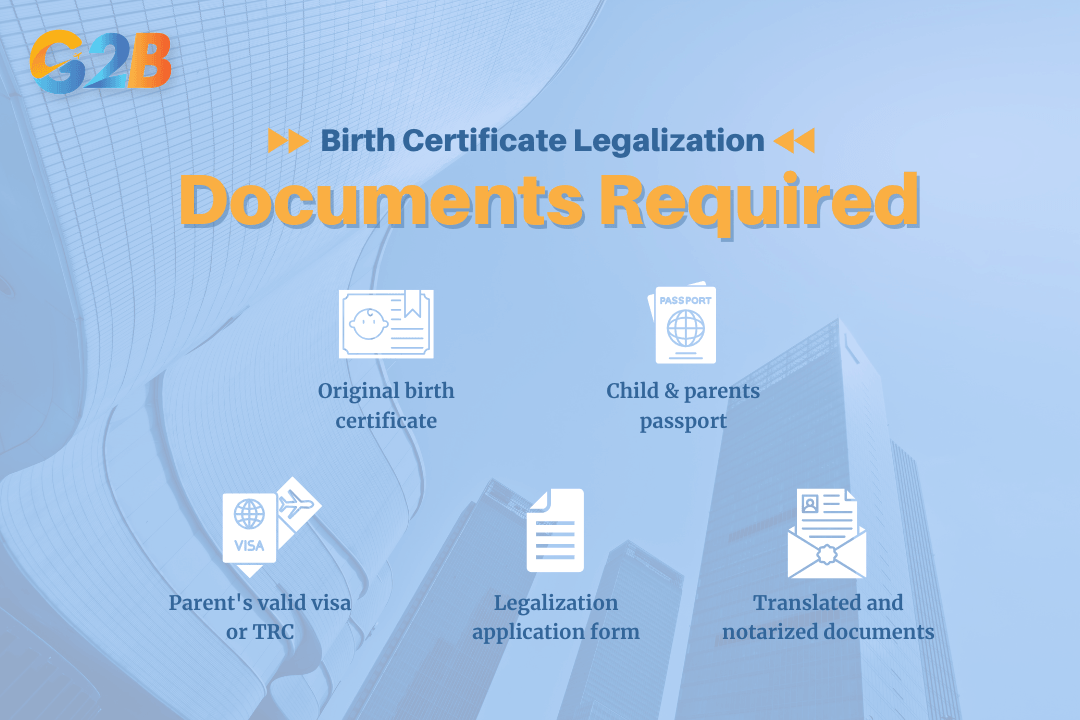
Applicants require the original birth certificate, valid passports of both the child and parents, and proper application forms to complete the full legalization and visa process.
Documents required for birth certificate legalization
General checklist
The general checklist for document legalization includes the primary civil documents and the parent's current immigration paperwork. Required documents include:
- Submit the child’s original foreign birth certificate.
- Provide the passport of the child.
- Provide the passports of both parents.
- Include the valid visa or Temporary Residence Card of the sponsoring parent.
Embassy legalization documents
Embassy legalization requires the authenticated birth certificate, a completed legalization application form, copies of identity documents, and the consular fee receipt. Parents mail these documents to the embassy or submit them in person.
Translation and notarization documents
Translation and notarization require the fully legalized original birth certificate and copies of the parent's passport. The local notary office retains one copy of the translated document for government record-keeping purposes.
Birth certificate legalization for a child born in Vietnam
Parents handle birth certificates for children born in Vietnam by registering the birth locally, applying for a foreign passport, obtaining a local visa, and registering the child's temporary residence.
Registering birth with Vietnamese authorities
Parents register a birth with Vietnamese authorities by submitting the hospital birth notification and parents' passports to the District People's Committee. The committee issues a formal Vietnamese birth certificate within a few working days.
Applying for a passport through the embassy
Parents apply for a passport through their home country's embassy by submitting the Vietnamese birth certificate and marriage certificate. The embassy registers the citizen abroad and issues the physical passport document for the child.
Obtaining a Vietnam visa for the child
Families obtain a Vietnam visa for the child by submitting the new foreign passport, the Vietnamese birth certificate, and the sponsor's immigration documents to the Vietnam Immigration Department. The department issues the dependent visa.
Temporary residence registration after birth
Temporary residence registration works by submitting the child's passport and visa details to the local ward police. The landlord or parents log into the online police portal to register the infant's legal presence at the residential address.
How long does birth certificate legalization take?
Birth certificate legalization takes between 10 and 30 days depending on home country processing speeds, embassy appointment availability, and local Vietnamese translation timelines.
Processing time in home country
Processing time in the home country ranges from 3 to 14 days. Government departments require this time to verify local signatures, process the paperwork, and attach the official authentication certificate.
Vietnamese embassy legalization timeline
The timeline for Vietnamese Embassy legalization generally takes 3 to 7 working days. Processing times increase during Vietnamese public holidays or when embassies experience high volumes of mail-in applications.
Translation and notary timeline
Translation and notarization take 1 to 3 working days in Vietnam. Certified translation companies complete the translation quickly, and the State Notary Public processes the final stamps within 24 hours of submission.
Common problems during birth certificate legalization
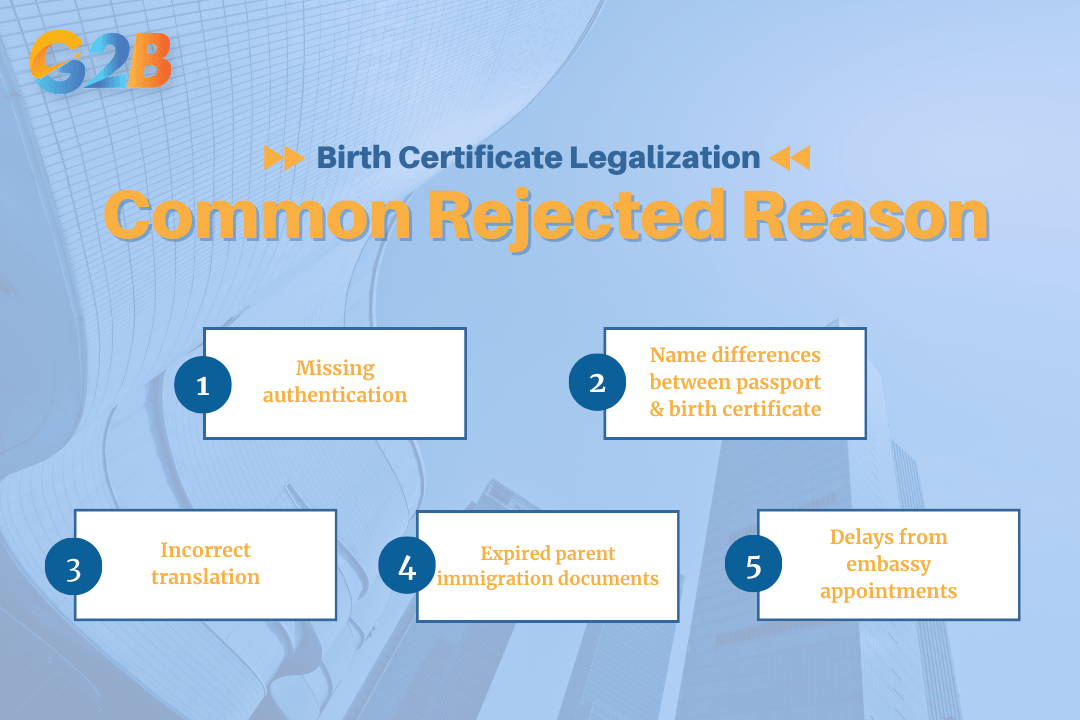
Common problems during birth certificate legalization include missing authentication stamps, mismatched names on passports, incorrect translations, expired parent visas, and delays in securing embassy appointments.
Common problems during birth certificate legalization
Missing authentication
Missing authentication stops the legalization process immediately. The Vietnamese Embassy rejects birth certificates that do not have the preliminary verification stamp from the home country's Ministry of Foreign Affairs.
Name differences between passport and birth certificate
Names differing between passports and birth certificates cause the Vietnam Immigration Department to reject the dependent visa application. Parents must provide official name change documents or affidavits to bridge any naming discrepancies.
Incorrect translation
Incorrect translations cause visa rejections because immigration officers rely on exact legal phrasing. If a translator misspells a parent's name or mistranslates a date of birth, the notary public and the immigration office invalidate the document.
Expired parent immigration documents
Expired parent immigration documents block applications because the dependent child's visa duration directly ties to the sponsor's visa. The immigration office cannot issue a child dependent visa if the sponsoring parent lacks a valid work permit or TRC.
Delays from embassy appointments
Delays from embassy appointments force families to extend their child's tourist visas to avoid overstay penalties. Long waiting times at the home country embassy slow down the entire legalization timeline.
Can parents apply through an immigration or visa agency?
Parents can apply through an immigration or visa agency to streamline document legalization, coordinate with foreign embassies, and file dependent visa applications accurately with the Vietnam Immigration Department.
Benefits of agency support
Agency support prevents document rejections and saves families valuable time. Agencies verify all paperwork before submission, ensuring documents meet exact legal requirements.
Embassy coordination
Agencies coordinate with embassies by managing courier deliveries, paying consular fees directly, and tracking document processing statuses. This coordination prevents documents from getting lost in international mail systems.
Common mistakes families make
Families make several common administrative mistakes that delay child dependent visa approvals in Vietnam. Avoiding these errors ensures a smooth immigration process. Common mistakes include:
- Submit untranslated foreign documents to the immigration department.
- Use uncertified photocopies instead of original government-issued documents.
- Forget the mandatory embassy legalization step in the home country.
- Apply with mismatched names across passports and civil records.
- Delay the child's local immigration registration after a birth in Vietnam.
Securing a Vietnam dependent visa requires careful preparation of civil documents. Parents must follow the exact procedural steps to authenticate and legalize foreign birth certificates. The overall process demands home country verification, Vietnamese embassy legalization, and local translation. Missing administrative stamps or incorrect document translations cause immediate immigration delays. Families must verify that all names match exactly across passports and birth certificates.
