




 Delaware (USA)
  Vietnam
  Singapore
  Hong Kong
  United Kingdom
 A Vietnam entry approval letter is an official immigration pre-authorization used to enter Vietnam in specific visa cases. Most travelers now use the Vietnam eVisa for regular tourism. This electronic system often removes the need for an approval letter. You need an approval letter mainly when entering under sponsored, urgent, business, or special visa procedures. This guide explains the exact steps to obtain this immigration document, specific visa categories, standard processing times, and the best ways to avoid application rejection.
What is a Vietnam entry approval letter?
A Vietnam entry approval letter is a legal document from the Vietnam Immigration Department confirming that a foreign traveler may receive a visa upon arrival or enter under an approved status. This document serves as proof of pre-clearance from immigration authorities. It allows airlines to let you board your flight to Vietnam. It also allows immigration officers at the airport to issue your physical visa sticker. The entry approval letter usually includes:
- State the full applicant name
- Display the exact passport number
- Indicate the approved entry date
- Indicate the approved exit date
- Specify the exact visa category
- Designate the permitted entry checkpoint
- List the sponsor or inviting entity details
An approval letter is not the same as a visa sticker. You do not place it in your passport before you travel. It is also not a temporary residence card. You print this document on standard paper and carry it with your travel documents.
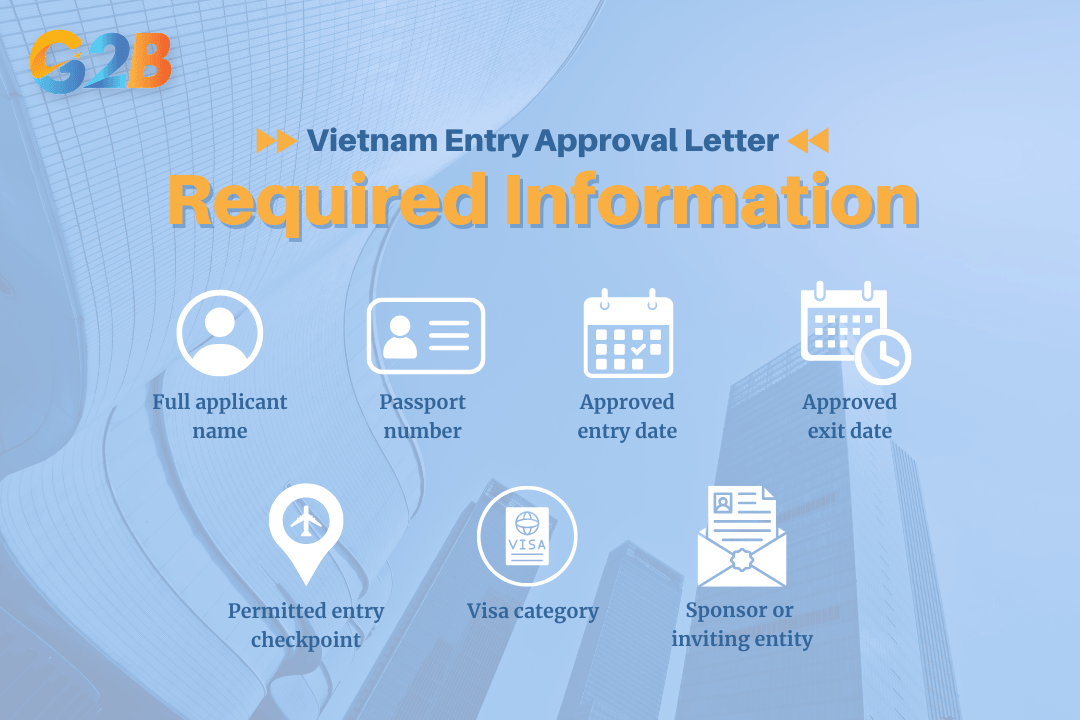
Information required in the entry approval letter
Which government authority issues the Vietnam entry approval letter?
The Vietnam Immigration Department under the Ministry of Public Security issues the Vietnam entry approval letter to qualified sponsors and applicants. This department manages all entry and exit records for foreign citizens. Sponsors submit all applications directly to this central authority. Immigration officers review the legal status of the sponsor first. They then check the background of the foreign applicant. Upon successful verification, the department releases the official letter to the sponsor. The sponsor then forwards this digital letter to the foreign traveler.
When do you need a Vietnam entry approval letter?
You need a Vietnam entry approval letter when a company sponsors your visit, when you require an urgent airport visa, or when your travel purpose falls outside the standard eVisa system. Foreigners face many different entry situations. The standard tourist visa covers basic holidays. However, work and business require different administrative paths.
How do you apply through a sponsor?
A legal entity in Vietnam submits an application to the Immigration Department to sponsor your visit and request your entry approval letter. Many foreign visitors enter Vietnam for specific professional or personal reasons. These visits require a local party to take responsibility for the foreigner during their stay. Common sponsored situations include:
- Travel for corporate business meetings
- Enter the country for long-term employment
- Visit family members living in Vietnam
- Arrive to manage investment projects
In these cases, the sponsor prepares the paperwork. The foreigner cannot apply for this specific letter directly without local support.
Why do urgent visas require an approval letter?
Urgent airport visa services use pre-approved immigration letters to allow foreigners to board flights and receive a visa upon arrival in emergencies. Travel plans change rapidly. Standard eVisas take several working days to process. When time runs out, travelers need a faster solution. Typical urgent use cases include:
- Book last-minute business flights
- Miss the standard eVisa application deadline
- Face emergency family or medical travel
Agencies process urgent approval letters quickly. This fast-track service connects directly with the immigration system to secure rapid boarding clearance.
Which visa types are not covered by the eVisa?
Long-stay visas, work-related visas, investor visas, and certain family visas often require prior approval instead of a standard eVisa. The Vietnam eVisa system covers many nationalities and simple purposes. It works well for 90-day tourist trips. However, the system does not cover every complex scenario. If you plan to apply for a temporary residence card later, you must enter the country with the correct visa category. The correct category usually requires an approval letter first.
How does the legacy visa-on-arrival process work today?
The legacy visa-on-arrival process allows foreigners to obtain a visa stamp at a Vietnamese airport by presenting a pre-approved entry letter. Vietnam previously used this visa-on-arrival approval letter system widely for all tourists. Today, this specific route is much more limited. Immigration policy now directs regular tourists to the eVisa portal. You must always verify current immigration rules with your sponsor before you book your flight.
When do travelers not need a Vietnam entry approval letter?
You do not need a Vietnam entry approval letter if you qualify for visa exemption, hold a valid residence card, or enter with an approved eVisa. The government offers several simpler entry methods for eligible travelers. You bypass the pre-approval letter process if you meet specific conditions. You usually bypass the letter when you:
- Qualify for a bilateral or unilateral visa exemption.
- Hold a valid temporary residence card (TRC).
- Enter with an approved Vietnam eVisa.
- Possess a valid visa sticker already stamped in your passport.
- Carry a valid APEC Business Travel Card (ABTC).
What are the differences between an approval letter and a Vietnam eVisa?
An approval letter provides pre-authorization for a visa stamp at the airport, while an eVisa is a direct electronic visa that allows immediate entry. Many travelers confuse these two documents. They are different papers with different rules. The eVisa is the final visa. The approval letter is a permission slip to get the final visa.
| Feature | Vietnam entry approval letter | Vietnam eVisa |
|---|---|---|
| Primary purpose | Pre-approval for the visa and entry process | Direct electronic visa for immediate entry |
| Issued before travel | Yes | Yes |
| Passport stamp needed | Often yes (requires stopping at the visa counter) | Usually on arrival validation only (go straight to passport control) |
| Local sponsor needed | Often required | Usually no sponsor required |
| Best travel use case | Special cases, work, business, and urgent entry | Tourism and standard short personal stays |
How do you apply for a Vietnam entry approval letter?
You apply for a Vietnam entry approval letter by sending your passport details and travel plans to a Vietnamese sponsor, who then submits the request to the Immigration Department. Foreign citizens cannot register for an approval letter on their own. The process requires action from a local entity in Vietnam. You usually obtain the letter through:
- Contact a Vietnamese company sponsor
- Hire a licensed visa service provider
- Ask a family sponsor living in Vietnam
- Follow an immigration-supported application route
What documents do you need for the application?
You need to provide a clear passport copy, confirmed travel dates, your entry checkpoint details, and documents proving the purpose of your visit. The immigration department requires accurate data to process the clearance. The sponsor collects these items from the traveler. Required application steps include:
- Scan a clear copy of your valid passport data page
- Submit your intended travel dates
- Select the entry airport or border gate
- Provide sponsor business registration documents (handled by the local company)
- Explain the purpose of the visit clearly
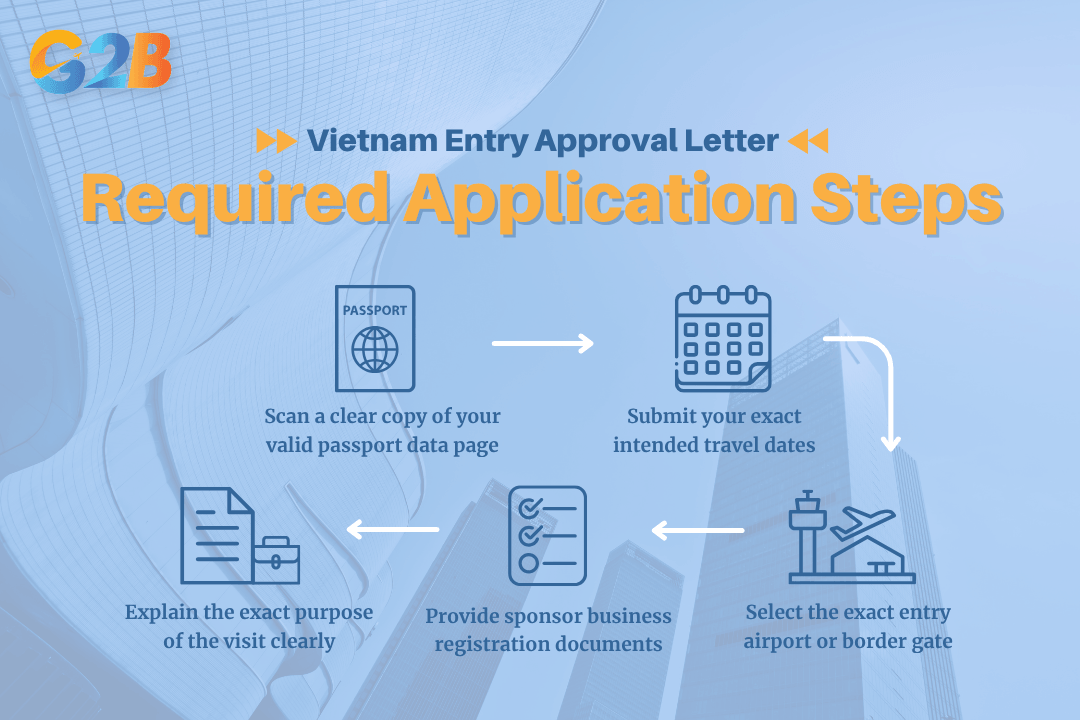
Required steps when applying for a Vietnam entry approval letter
Which entry ports accept the Vietnam entry approval letter?
Major international airports in Vietnam accept the entry approval letter for the visa-on-arrival stamping process. You cannot use an approval letter at every border crossing. Land borders usually require a physical visa in advance or an eVisa. The approval letter works best for air travel.
| Airport name | City location | Region |
|---|---|---|
| Noi Bai International Airport | Hanoi | Northern Vietnam |
| Tan Son Nhat International Airport | Ho Chi Minh City | Southern Vietnam |
| Da Nang International Airport | Da Nang | Central Vietnam |
| Cam Ranh International Airport | Nha Trang | Central Vietnam |
| Phu Quoc International Airport | Phu Quoc Island | Southern Vietnam |
How long does it take to process the Vietnam entry approval letter?
The standard processing time for a Vietnam entry approval letter ranges from three to seven business days, depending on the visa category and immigration workload. Processing times vary greatly depending on the type of sponsor and the urgency of the case. Business visas take longer to verify than urgent tourist entries. Typical processing ranges include:
- Wait 3 to 7 business days for standard processing.
- Wait 1 to 2 business days for urgent processing.
- Wait less than 24 hours for emergency same-day processing.
Government holidays delay approval times. The Immigration Department closes on weekends. They also close during national holidays like Tet (Lunar New Year). You must add these closed days to your wait time.
What common mistakes cause rejection of the Vietnam entry approval letter?
Common mistakes that cause rejection include submitting an expiring passport, entering wrong passport numbers, providing incorrect travel dates, and missing required sponsor documents. Immigration officers reject incomplete or inaccurate applications immediately. A small typo ruins the entire process and wastes your application fee. Common issues to avoid include:
- Submit a passport that expires in less than six months from your intended entry date
- Enter the wrong passport number on the application form
- Provide an incorrect entry date or exit date
- Request the wrong visa category for your actual travel purpose
- Fail to submit the proper sponsor registration papers
- Give an unclear or suspicious travel purpose
What happens at the Vietnam airport with an approval letter?
At the Vietnam airport, you present your approval letter, passport, photos, application form, and stamping fee to the immigration officer to receive your visa sticker. When you land in Vietnam, you do not go directly to the normal passport control line. You must complete the stamping procedure first. Follow these steps upon arrival:
- Locate the Landing Visa or Visa Upon Arrival counter.
- Submit your printed approval letter and original passport.
- Provide two 4x6 cm passport-sized photos (white background, taken within 6 months).
- Hand in the completed NA1 visa application form.
- Pay the mandatory state stamping fee in crisp US dollars.
- Wait for the officer to call your name and return your stamped passport.
After you receive the passport with the new visa sticker, you proceed to the standard immigration line for your final entry stamp.
What is the best option for entering Vietnam in 2026?
For most tourists in 2026, the best option is the Vietnam eVisa because it offers a simpler, direct, and fully online application process. The government continuously updates its digital immigration platforms. The eVisa provides up to 90 days of stay and allows multiple entries for most nationalities. It is the cheapest and fastest method for pure tourism. However, approval letters remain highly useful and necessary for business trips, urgent travel, or sponsored work programs.
Should you apply for the approval letter before booking flights?
Yes, you must apply for and receive your Vietnam entry approval letter before you book non-refundable flights to avoid financial loss if immigration delays your application. Your entire trip depends on immigration approval. Airlines check your entry documents at the check-in counter in your home country. They deny boarding if you lack a valid visa, an eVisa, or a printed approval letter. Securing the letter first reduces airline boarding risk and protects your travel schedule.
How do corporate sponsors handle the Vietnam entry approval letter process?
Corporate sponsors submit specific legal forms, such as the NA2 form, along with their company business license to the Vietnam Immigration Department to request entry for foreign workers. The process requires strict legal compliance. Companies must prove they operate legally in Vietnam. They must explain why they need to invite a foreign professional.
What are the specific visa categories that use approval letters?
Business visas, work visas, investor visas, and family visit visas are the most common specific visa categories that require a pre-approved entry letter from a sponsor. The Vietnam immigration system uses specific symbols for different travel purposes. Your approval letter prints this exact symbol.
| Visa symbol | Target applicant | Purpose of travel |
|---|---|---|
| DN1 / DN2 | Foreign business professionals | Attend meetings, sign contracts, and work with local enterprises. |
| LD1 / LD2 | Foreign employees | Work legally under a Vietnam work permit or work permit exemption. |
| DT1 to DT4 | Foreign investors | Invest capital in a Vietnamese company or set up a new business. |
| TT / VR | Foreign family members | Visit relatives who hold valid Vietnamese residence cards or citizenship. |
| DH | Foreign students | Study at universities or recognized educational institutions in Vietnam. |
You cannot change your visa category easily after you enter the country. Your sponsor must request the correct category on your initial approval letter.
How do you decide between the approval letter and other visa options?
You evaluate your travel purpose, your nationality, and your timeframe to decide whether to use an eVisa or apply for an entry approval letter. Use this quick decision guide before you start any application:
- Check eVisa eligibility first if you hold a tourist passport and want a simple holiday.
- Pursue the sponsor route and approval letter if you plan a business trip or intend to work.
- Use fast-track approval letter services if you face urgent travel and cannot wait for the standard eVisa.
- Rely on visa-free passport rules if your nationality qualifies for an exemption and your trip is short.
Navigating the Vietnam immigration process requires careful attention to current rules and document requirements. You need a Vietnam entry approval letter when your visa class requires immigration pre-approval, when you rely on sponsor support, when you need urgent processing, or when you use a non-standard entry route. Most standard tourists now rely on the eVisa system for basic travel. However, corporate workers, investors, and family members still depend heavily on the approval letter system to secure their specific visa types. Understanding the exact state fees, the mandatory application documents, and the airport stamping process ensures you cross the border without delays or penalties. For streamlined support, G2B provides work permit / TRC / visa services, ensuring an efficient and fully compliant process for foreign investors.
