




 Delaware (USA)
  Vietnam
  Singapore
  Hong Kong
  United Kingdom
 A permanent residence card in Vietnam is an official identification document issued by the Vietnam Immigration Department under the Ministry of Public Security. It grants foreign nationals the right to live indefinitely in the country without needing a visa. Unlike temporary residence cards (TRC), which expire after 1 - 10 years, a permanent residence card (PRC) offers indefinite immigration status. Foreigners seek permanent residence in Vietnam to gain administrative stability, eliminate frequent visa renewals, and simplify long-term family and business planning.
What is a permanent residence card in Vietnam?
A permanent residence card in Vietnam is a legal document granting foreign citizens the right to stay in the country indefinitely. Immigration authorities issue this card to replace traditional visas and temporary residence permits. The permanent residence status removes the need for regular immigration renewals. Cardholders enjoy long-term lawful stay rights under the supervision of the Ministry of Public Security. The Vietnamese government provides this document to acknowledge a foreigner’s long-term commitment and legal integration into the country.
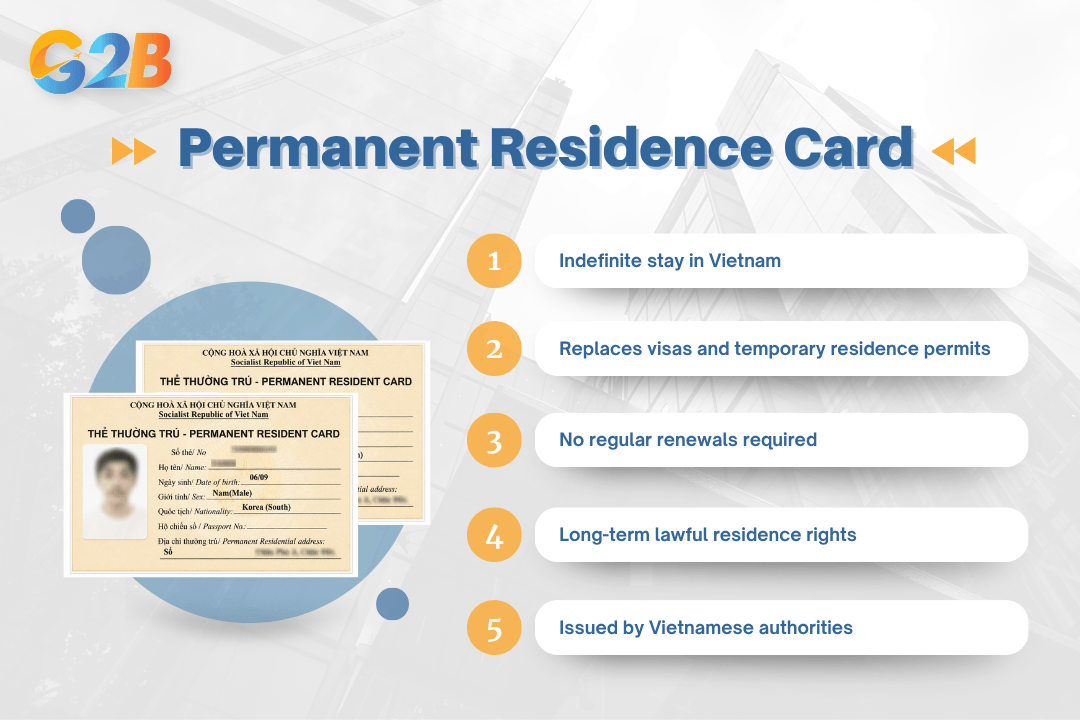
A permanent residence card allows foreign citizens to stay in a country indefinitely
Who can receive a permanent residence card in Vietnam?
Vietnam limits permanent residence to specific foreign nationals who demonstrate significant ties or contributions to the country. The Ministry of Public Security evaluates applications based on strict legal criteria. Eligible applicants include:
- Foreign scientists and experts who are formally recommended by a Minister or the head of a ministerial-level agency
- Spouses, parents, or children of Vietnamese citizens residing locally
- Stateless persons residing lawfully in Vietnam continuously since before the year 2000
- Foreign individuals who receive national medals for their contributions to Vietnam
What rights does a permanent residence card provide?
A permanent residence card provides long-term residence rights, visa exemptions, and simplified domestic travel procedures. Cardholders receive significant administrative advantages within the country. The benefits include:
- Reside in Vietnam indefinitely without renewing visas
- Enter and exit the country freely using the residence card and passport
- Access local administrative services, banking, and public utilities easily
- Sponsor eligible family members for immigration purposes
What restrictions still apply to permanent residents in Vietnam?
Permanent residents in Vietnam still face restrictions regarding voting rights, land ownership, and specific employment sectors. They do not hold the same constitutional rights as Vietnamese citizens. Permanent residents must observe the following limitations:
- Accept voting restrictions, as foreigners cannot participate in national elections
- Observe land ownership limitations, as outright freehold land ownership remains restricted
- Avoid employment in national security and defense sectors
- Comply strictly with all local immigration reporting rules
Who is eligible for permanent residence in Vietnam?
Foreign nationals become eligible for permanent residence if they meet the strict legal conditions set by the Law on Foreigners' Entry into, Exit from, Transit through and Residence in Vietnam. The government categorizes applicants into four main groups.
Can foreign investors apply for permanent residence in Vietnam?
Foreign investors do not qualify for permanent residence solely based on capital contribution. Vietnam currently issues temporary residence cards (DT1 to DT4 visas) to investors. To stay long-term, investors use temporary residence cards valid for up to 10 years. An investor can only obtain permanent residence if they qualify under another category, such as marrying a Vietnamese citizen or receiving a national medal for exceptional economic contributions.
Can spouses or children of Vietnamese citizens qualify for permanent residence?
Spouses, parents, and children of Vietnamese citizens qualify for permanent residence if they meet continuous residency requirements. Family sponsorship represents the most common pathway to permanent status. Applicants must fulfill specific conditions:
- Provide legal proof of the family relationship, such as a marriage or birth certificate
- Reside in Vietnam continuously for at least three consecutive years on a temporary residence card
- Demonstrate a stable lawful residence and income in Vietnam
Can highly skilled professionals obtain permanent residence in Vietnam?
Highly skilled professionals, experts, and scientists can obtain permanent residence if they receive a ministerial recommendation. The applicant must demonstrate significant professional value to the country. The requirements include:
- Hold recognized expert or scientist status under Vietnamese regulations
- Receive official proposals from Ministers or heads of ministerial-level agencies
- Prove a legitimate residence and decent living conditions in Vietnam
Can stateless individuals apply for permanent residence in Vietnam?
Stateless individuals can apply for permanent residence under humanitarian and historical eligibility rules. Vietnam allows specific long-term stateless residents to regularize their immigration status. Applicants must prove:
- Maintain continuous temporary residence in Vietnam since the year 2000 or earlier
- Hold no recognized citizenship from any other country
- Comply with local laws during their entire stay in the country
What are the general eligibility conditions for permanent residence?
All applicants must maintain a clean criminal background, secure a stable residence, and comply fully with Vietnamese laws. The immigration authority rejects applications failing these core conditions. General conditions include:
- Hold a valid passport or legal equivalent
- Demonstrate a clean criminal record both internationally and locally
- Prove a stable registered residential address in Vietnam
- Show adequate financial means to support themselves
What documents are required for a permanent residence card in Vietnam?
Applicants must submit identity documents, civil status records, proof of residence, and sponsorship forms to the immigration authority. A complete application dossier prevents processing delays.
Which identity documents must applicants submit for permanent residence?
Applicants must submit valid passports, existing visas, temporary residence cards, and standardized photographs. These documents verify the applicant's current lawful status in Vietnam. Required items include:
- Submit certified copies of the applicant's valid passport
- Provide the current temporary residence card (TRC)
- Include recent passport-sized photographs matching government specifications
- Attach the official application form for permanent residence
What civil status documents are required for the application?
Applicants need to submit marriage certificates, birth certificates, or family relationship proof to validate family sponsorship claims. These documents establish the legal connection between the applicant and the sponsor. Applicants must provide:
- Submit a valid marriage certificate for spousal applications
- Provide birth certificates for parent-child sponsorship
- Present the Vietnamese sponsor's identity card and household registration document
What financial or employment documents may be requested?
Immigration authorities request employment contracts, bank statements, or business licenses to verify the applicant's financial stability. The government requires proof of a decent living standard. Common financial documents include:
- Provide a valid employment contract or labor agreement
- Submit recent bank statements or savings account confirmations
- Include business licenses or investment certificates if applicable
- Show tax compliance records to prove legal income reporting
Do foreign documents require consular legalization in Vietnam?
Yes, foreign documents require consular legalization and a notarized Vietnamese translation before submission in Vietnam. The government does not accept foreign documents directly. The process involves:
- Obtain the original document from the issuing country
- Authenticate the document at the foreign affairs department of the issuing country
- Legalize the document at the Vietnamese Embassy or Consulate
- Translate the legalized document into Vietnamese and notarize it locally
- Note: Vietnam is not a member of the Apostille Convention, so standard consular legalization remains mandatory
What additional supporting documents strengthen a permanent residence application?
Police clearance certificates, residence confirmation letters, and official recommendation letters strengthen the application. These documents prove good character and legal compliance. Additional documents include:
- Provide a police clearance certificate from the home country and Vietnam
- Obtain a residence confirmation letter stamped by the local ward police
- Submit ministerial recommendation letters for experts and scientists
How can foreigners apply for a permanent residence card in Vietnam?
Foreigners apply for a permanent residence card by submitting a verified dossier to the Vietnam Immigration Department. The multi-step process requires strict adherence to administrative procedures.
Where do applicants submit the permanent residence application?
Applicants submit their permanent residence dossier to the Vietnam Immigration Department or the Provincial Immigration Office. The specific office depends on the applicant's registered residential address. Submission locations include:
- Vietnam Immigration Department offices in Hanoi, Da Nang, or Ho Chi Minh City
- Provincial Police Immigration Divisions covering the applicant's local residence area
What is the application process for permanent residence?
The process involves document preparation, legalization, formal submission, and final card collection. Following the exact order ensures a smooth administrative experience. Required steps include:
- Prepare all required identity, civil, and financial documents
- Translate and legalize all foreign-issued documents
- Submit the complete application dossier to the immigration authority
- Attend a verification interview with immigration officers if requested
- Receive the approval decision from the Ministry of Public Security
- Collect the physical permanent residence card and pay the final fee
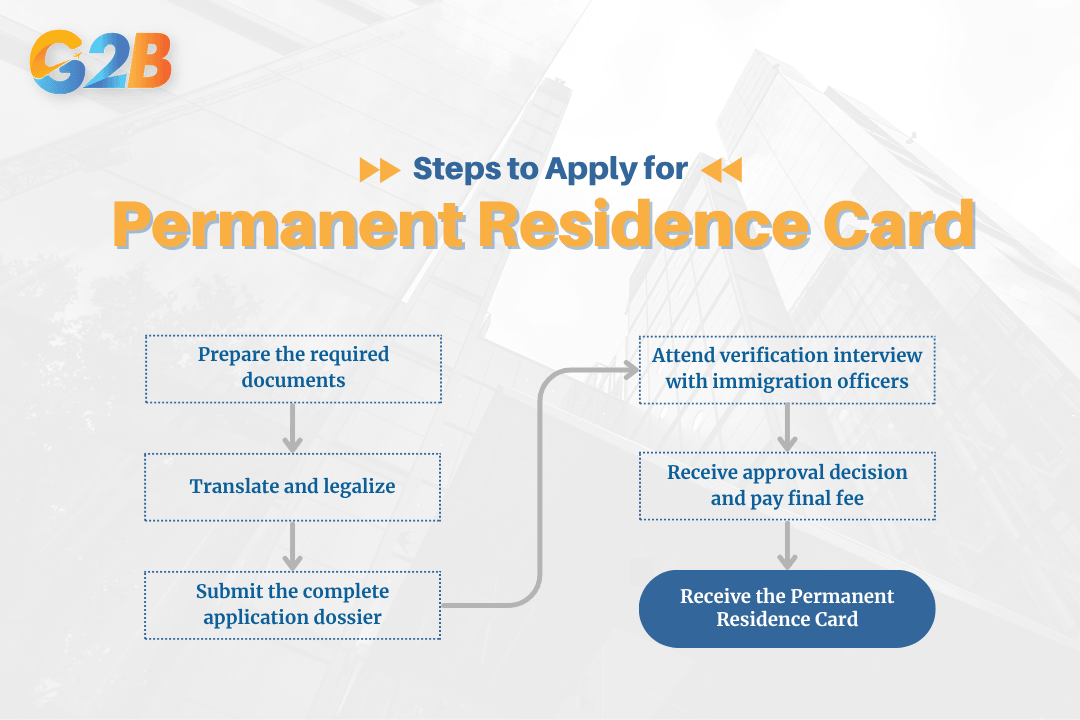
The application process for permanent residence involves many steps
How long does the permanent residence approval process take?
The permanent residence approval process takes approximately four to six months under standard conditions. The Ministry of Public Security requires this time to conduct thorough background checks. The Immigration Department examines the dossier within four months. If the authorities need additional verification, the process extends further. Upon final approval, the immigration office issues the physical card within five working days.
Can Vietnam permanent residence applications be rejected?
Immigration authorities reject applications due to incomplete documentation, criminal history, or national security concerns. False declarations also result in immediate denial. Rejection reasons include:
- Submit incomplete, expired, or incorrectly formatted documents
- Hold a domestic or international criminal record
- Make false declarations during the application process
- Pose a potential risk to Vietnamese national security or public order
What is the difference between temporary and permanent residence cards in Vietnam?
A temporary residence card has a fixed expiration date, whereas a permanent residence card grants indefinite stay rights. Permanent status offers stronger security and fewer renewal requirements.
How long is a temporary residence card valid?
A temporary residence card in Vietnam remains valid for one to ten years, depending on the visa category. Foreign investors, workers, and students typically use this document. Validity periods include:
- Hold a 1-to-2-year card for standard employment sponsorships
- Hold a 3-year card for family reunification (TT visa)
- Hold up to a 10-year card for major foreign investors (DT1 visa)
Does permanent residence status expire in Vietnam?
Permanent residence status does not expire, but the physical card requires periodic replacement. The legal immigration status remains indefinite. Cardholders maintain their long-term settlement rights automatically. They only interact with immigration authorities to update physical documents or report administrative changes.
Which card offers stronger immigration benefits?
The permanent residence card offers stronger immigration benefits, including broader visa exemptions and long-term stability. Temporary cards require frequent renewals and strict conditional sponsorships.
| Feature | Temporary Residence Card (TRC) | Permanent Residence Card (PRC) |
|---|---|---|
| Visa exemption | Limited to the card's duration | Continuous and indefinite |
| Validity | Fixed term (1 - 10 years) | Indefinite immigration status |
| Renewal frequency | High (Requires full dossier updates) | Low (Physical card replacement only) |
| Employment | Conditional (Tied to sponsor/company) | Stable (Less reliance on employers) |
| Security | Moderate (Cancellable upon job loss) | High (Long-term legal protection) |
How long does a permanent residence card remain valid in Vietnam?
The permanent residence status in Vietnam remains valid indefinitely, but the physical card requires renewal every 10 years. This rule ensures the government holds updated photographs and identity data.
Does Vietnam issue permanent residence indefinitely?
Yes, Vietnam issues permanent residence status indefinitely for approved applicants. Once granted by the Ministry of Public Security, the right to live in the country does not expire. Unlike temporary visas, this status does not rely on an ongoing employment contract or temporary investment project. The cardholder becomes a recognized long-term resident of the state.
When must permanent residence cards be renewed or reissued?
Cardholders must replace their permanent residence cards every 10 years or when the card becomes lost or damaged. Administrative updates also trigger a replacement request. Foreigners must apply for a new physical card to:
- Replace the card strictly every 10 years to update photos and security features
- Reissue damaged, destroyed, or lost cards immediately
- Update personal data if the cardholder receives a new passport number
Can permanent residence status be revoked in Vietnam?
Vietnamese authorities revoke permanent residence status if the cardholder commits serious crimes or violates immigration laws. Extended undocumented absences or fraud also lead to cancellation. Revocation occurs when residents:
- Commit severe criminal offenses under the Vietnamese Penal Code
- Provide fraudulent documents during the initial application
- Threaten national security or disrupt public order
- Leave Vietnam to resettle permanently in another country
What benefits does permanent residence offer in Vietnam?
Permanent residence offers significant benefits, including visa-free border entry, administrative stability, and family settlement security. It transforms a foreigner's daily life by removing short-term immigration pressures.
Does permanent residence simplify immigration procedures?
Permanent residence simplifies immigration procedures by eliminating the need for visa runs, extensions, and work-based TRC renewals. Cardholders experience frictionless border control. The immigration advantages include:
- Enter Vietnam freely using the PRC at any international checkpoint
- Avoid paying regular visa issuance or TRC extension fees
- Maintain lawful stay rights regardless of employment status changes
Does permanent residence improve business operations?
Permanent residence improves business operations by providing legal stability and simplifying local licensing procedures. Resident investors enjoy smoother interactions with local authorities. Business benefits include:
- Manage companies without worrying about sudden visa cancellations
- Open corporate and personal bank accounts with fewer restrictions
- Sign long-term commercial leases and business contracts confidently
Does permanent residence support family stability?
Permanent residence supports family stability by allowing foreigners to plan long-term schooling, housing, and integration. It removes the uncertainty of short-term immigration limits. Family advantages include:
- Enroll children in local or international schools easily
- Sponsor dependents under simpler family reunification rules
- Build a permanent life without the threat of unexpected relocation
Does permanent residence help with employment opportunities?
Permanent residence helps with employment opportunities by reducing a foreigner's dependence on employer-sponsored visas. Companies face lower administrative burdens when hiring permanent residents. Employment advantages include:
- Change employers freely without canceling residence status
- Reduce corporate costs, as employers do not need to fund TRC applications
- Streamline human resource compliance procedures for local companies
What obligations do permanent residents have in Vietnam?
Permanent residents must register their local address, obey tax laws, and notify authorities of passport changes. Long-term status requires strict adherence to civic duties.
Must permanent residents register their address in Vietnam?
Permanent residents must register their residential address with the local ward police immediately upon settling. The government mandates accurate residence tracking for all citizens and foreigners. Compliance requires residents to:
- Register the current living address on the national population database
- Report any change of address to the local police department promptly
- Maintain a valid housing lease or ownership document
Are permanent residents subject to Vietnamese tax laws?
Permanent residents are subject to Vietnamese tax laws and must declare global income if they qualify as tax residents. Living long-term in Vietnam triggers standard personal income tax obligations. Tax obligations include:
- Register for a personal tax identification number
- File annual personal income tax returns with the local tax department
- Pay taxes on worldwide income generated during the tax year
Can permanent residents leave Vietnam for extended periods?
Permanent residents can leave Vietnam, but they must inform authorities if they relocate to another country permanently. An extended, unnotified absence may risk residency cancellation. To protect their status, cardholders should:
- Maintain a valid registered address within Vietnam
- Keep their physical PRC and passport active
- Avoid abandoning their Vietnamese residency without official notification
Must permanent residents comply with reporting requirements?
Permanent residents must comply with reporting requirements by updating the immigration department whenever their passport information changes. Failure to update documents results in administrative fines. Reporting duties include:
- Notify the police when receiving a newly issued passport
- Report the loss of the physical permanent residence card immediately
- Follow all local municipal rules and administrative decrees
What are the common reasons permanent residence applications are delayed or denied?
Immigration authorities delay or deny applications due to missing translations, minor criminal records, or visa overstay histories. Strict scrutiny applies to all submitted files.
Do incomplete documents cause application rejection?
Incomplete documents cause immediate application rejection or severe processing delays at the immigration office. Officers strictly enforce formatting and legal guidelines. Common document errors include:
- Submit foreign documents without proper consular legalization
- Provide poorly translated documents lacking official notarization
- Use expired passports or invalid temporary residence cards
Can immigration violations affect permanent residence approval?
Past immigration violations heavily affect permanent residence approval and often lead to outright denial. The government demands a flawless immigration history for permanent status. Negative factors include:
- Hold a record of previous visa overstays or late renewals
- Reside at an unregistered address without notifying local police
- Possess prior deportation or forced exit records from Vietnam
Does criminal history affect permanent residence eligibility?
Any criminal history affects permanent residence eligibility and results in mandatory application refusal. Applicants must prove excellent moral character. Background checks reveal:
- Domestic criminal convictions under Vietnamese law
- Foreign criminal records reported via international police clearance certificates
- Active involvement in civil or commercial litigation preventing exit
Can inconsistent information create application problems?
Inconsistent information creates severe application problems, triggering extra verification interviews and long delays. The Ministry of Public Security cross-checks all submitted data. Discrepancies include:
- Show conflicting name spellings between passports and birth certificates
- Declare employment history that contradicts local tax records
- Provide conflicting family relationship dates on sponsorship forms
What is the complete Vietnam permanent residence card checklist?
A complete checklist helps applicants organize their identity papers, legalizations, and compliance steps efficiently. Proper organization guarantees a successful submission to the Vietnam Immigration Department.
What is the document preparation checklist?
Applicants must gather all required paperwork before visiting the immigration office:
- Valid passport (Certified copy)
- Current temporary residence card (Original and copy)
- Standard passport photos (Recent, white background)
- Proof of eligibility (Marriage certificate, birth certificate, or ministerial recommendation)
- Police clearance certificates (From Vietnam and home country)
- Consular legalized translations (For all foreign-issued documents)
- Proof of residence (Police registration confirmation)
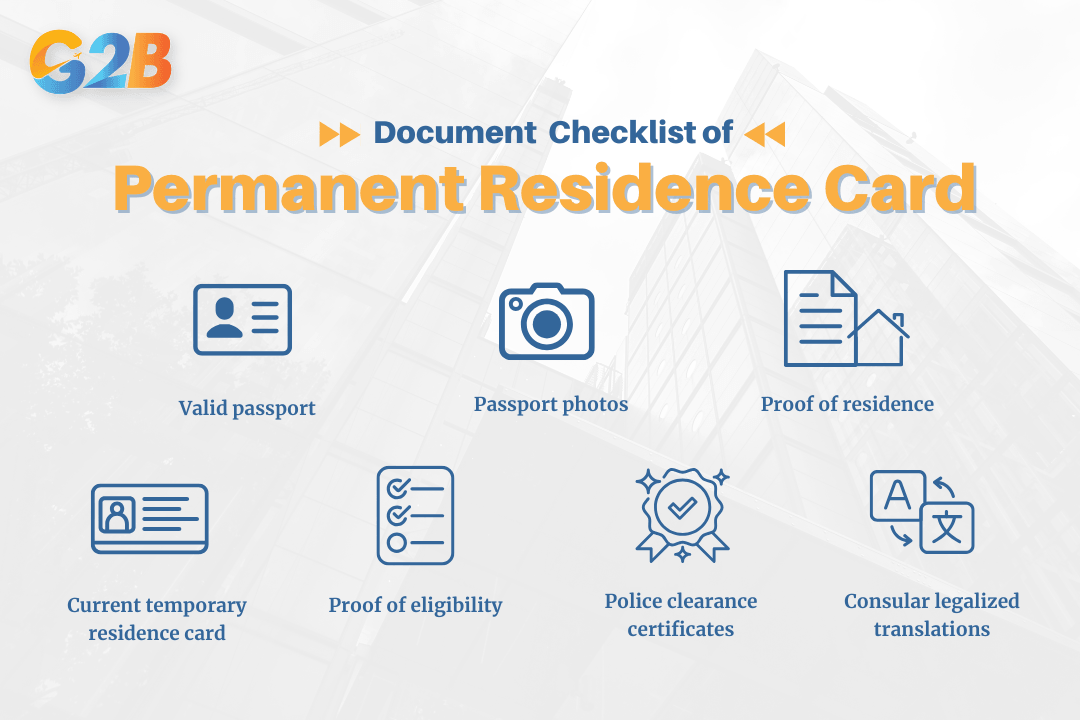
Complete checklist helps applicants prepare full and error-free documents
What is the application process checklist?
Foreigners must follow these exact administrative steps:
- Verify eligibility under Vietnam Immigration Law
- Prepare notarized and legalized translations
- Submit the complete application to the Immigration Department
- Pay the required government application fees
- Track processing status over the four-to-six-month review period
- Receive the physical permanent residence card
What is the compliance checklist after approval?
Cardholders must observe ongoing legal rules to protect their status:
- Register the current local address with the ward police
- Update the immigration office when receiving a new passport
- Follow Vietnamese personal income tax rules
- Maintain lawful conduct to prevent status revocation
- Renew the physical card strictly every 10 years
Frequently asked questions about permanent residence cards in Vietnam
The following part provides answers to some frequently asked questions about permanent residence cards in Vietnam. These questions may help foreigners better understand the relevant regulations and practical considerations related to permanent residence status.
How many years must foreigners live in Vietnam before applying?
Foreigners applying via family sponsorship must live continuously in Vietnam for at least three consecutive years on a temporary residence card before submitting a permanent residence application.
Can permanent residents buy property in Vietnam?
Permanent residents can buy apartments in specific commercial housing projects, but they cannot own freehold land. Foreign property ownership in Vietnam remains limited to 50-year leaseholds for apartments.
Can permanent residence lead to Vietnamese citizenship?
Permanent residence can lead to Vietnamese citizenship if the applicant lives in Vietnam for five years, speaks Vietnamese fluently, and agrees to renounce their original nationality, subject to Presidential approval.
Can dependents receive permanent residence?
Dependents cannot automatically receive permanent residence. They must apply individually through family sponsorship rules, requiring the Vietnamese citizen to sponsor each family member separately.
Is Vietnamese language proficiency required?
Vietnamese language proficiency is not legally required to obtain a permanent residence card. However, applicants need language skills if they later decide to apply for full Vietnamese citizenship.
Can retired foreigners apply for permanent residence?
Retired foreigners cannot apply for permanent residence unless they are married to a Vietnamese citizen or have previously contributed exceptionally to the country. Vietnam does not offer a specific retirement visa.
What happens if a permanent residence card is lost?
If a permanent residence card is lost, the cardholder must immediately report the loss to the local police and apply for a card reissuance at the Provincial Immigration Office.
Can permanent residents work without a work permit?
Permanent residents married to Vietnamese citizens qualify for a work permit exemption. Other permanent residents must still secure a work permit or exemption certificate to work legally in Vietnam.
Securing a permanent residence card in Vietnam transforms a foreigner’s living experience by offering unmatched legal stability and administrative freedom. While the eligibility criteria remain strict and the document preparation demands precision, the long-term benefits easily outweigh the initial effort. By carefully following the guidelines, utilizing proper legal pathways, and ensuring strict compliance with local regulations, eligible expatriates can successfully establish their permanent home in Vietnam. For streamlined support in work permit / TRC / visa services, contact G2B for professional guidance and reliable assistance throughout every step of the application process.
