




 Delaware (USA)
  Vietnam
  Singapore
  Hong Kong
  United Kingdom
 What are the benefits of a DT visa for foreign investors in Vietnam is a primary question for business owners entering the Southeast Asian market. A DT visa grants legal residence, investment security, and business access in Vietnam. Vietnam issues DT visas (DT1 - DT4) based on investment capital. The visa supports long-term stay, corporate control, and market entry in a fast-growing ASEAN economy.
The Vietnam Immigration Department regulates the issuance of these investor visas. The Law on Investment 2020 defines the rights and obligations of foreign business owners. Foreigners use the DT visa to establish legal operations, hire local staff, and open corporate bank accounts. This visa type replaces short-term tourist or business visas, providing a stable foundation for corporate expansion. The process requires official documents, such as the Enterprise Registration Certificate (ERC) and the Investment Registration Certificate (IRC). This article explains the requirements, rights, financial access, and compliance rules associated with the DT visa in Vietnam.
What is a DT visa in Vietnam?
The DT visa is an official document issued by the Vietnam Immigration Department to foreign investors. The government also issues this visa to foreign investors contributing capital to Vietnamese enterprises, not foreign lawyers (who use LN visa) who practice legally in Vietnam. The letters "DT" stand for "Dau Tu," which translates to "Investment" in English. The government created this visa category to categorize foreigners based on their exact purpose of entry. Law No. 51/2019/QH14 updated the immigration rules and divided the DT visa into four specific sub-categories. The state bases these sub-categories on the total amount of capital the foreigner contributes to a Vietnamese company. Foreign individuals apply for the DT visa at Vietnamese embassies abroad or at international borders upon arrival. The visa appears as a sticker inside the foreigner's passport. This sticker contains the visa type, the validity dates, and the passport details of the holder.
How does the DT visa support long-term residence in Vietnam?
A DT visa enables an extended legal stay without frequent renewals. Duration depends directly on the registered investment capital. Investors reduce visa runs and stabilize long-term residency planning. The Vietnam Immigration Department uses a tiered system to determine the length of the visa. Higher capital investments receive longer residency rights. This system encourages foreigners to bring larger financial investments into the Vietnamese economy.
| Visa Type | Investment Capital (VND) | Investment Capital (USD Estimate) | Maximum Validity |
|---|---|---|---|
| DT1 | ≥ 100 billion | ≥ 4.1 million | Up to 10 years |
| DT2 | 50 billion – 100 billion | 2.05 million – 4.1 million | Up to 5 years |
| DT3 | 3 billion – under 50 billion | 123,000 – 2.05 million | Up to 3 years |
| DT4 | < 3 billion | < 125,000 | Up to 12 months |
Holders of DT1, DT2, and DT3 visas have the right to apply for a Temporary Residence Card (TRC). A TRC replaces the visa sticker in the passport. The TRC acts as a long-term identity card for foreigners inside Vietnam. DT4 visa holders cannot apply for a TRC. DT4 holders receive a maximum 12-month visa and must renew it annually. To secure long-term residence, investors must follow these steps:
- Prepare the legal investment certificates.
- Submit the visa application dossier to the immigration office.
- Receive the initial DT visa sticker.
- Apply to convert the valid visa into a TRC.
- Register the residential address with the local police station.
How does the DT visa improve business ownership rights?
A DT visa allows foreign investors to establish, manage, and control companies in Vietnam legally. The visa links directly to the ownership of limited liability companies and shareholding in joint-stock companies. Vietnam’s Law on Investment 2020 protects investor rights and defines market access conditions. The state recognizes the DT visa holder as a legal business entity operator. A valid DT visa or TRC is mandatory for foreigners to register as Legal Representative with the Department of Planning and Investment (DPI). The Legal Representative signs official state documents, labor contracts, and commercial agreements on behalf of the Vietnamese company. The DT visa supports different types of corporate structures. The table below shows how the visa interacts with business types:
| Business Structure | Role of the DT Visa Holder | Legal Rights Granted |
|---|---|---|
| Single-Member Limited Liability Company (LLC) | Sole Owner / Legal Representative | Total control over business decisions and profits. |
| Multi-Member Limited Liability Company (LLC) | Capital Contributor / Member of Members' Council | Voting rights based on the percentage of capital contributed. |
| Joint-Stock Company (JSC) | Shareholder / Board Member | Rights to receive dividends and vote at shareholder meetings. |
Business owners with a DT visa perform daily corporate operations legally. They sign property leases for office spaces and factories. They hire both local Vietnamese workers and foreign experts. The visa secures the foundation for standard corporate activities.
What is the difference between a DT visa and a DN visa in Vietnam?
A DT visa is for foreign investors who own capital in a Vietnamese company, while a DN visa is for foreigners who visit Vietnam to work with a local company. The Vietnam Immigration Department issues both visas for business purposes. The DN visa (Doanh Nghiep) is a standard business visa. Foreign employees, consultants, or partners use the DN visa to attend meetings, sign contracts, or perform short-term tasks. The DN visa does not require the foreigner to own shares or contribute capital to the host company. DN visas usually have a shorter validity period, often ranging from 1 - 3 months. The DT visa requires proof of ownership. The applicant must show their name on the Enterprise Registration Certificate (ERC) or the Investment Registration Certificate (IRC). The DT visa grants stronger residency rights and longer validity periods than the DN visa.
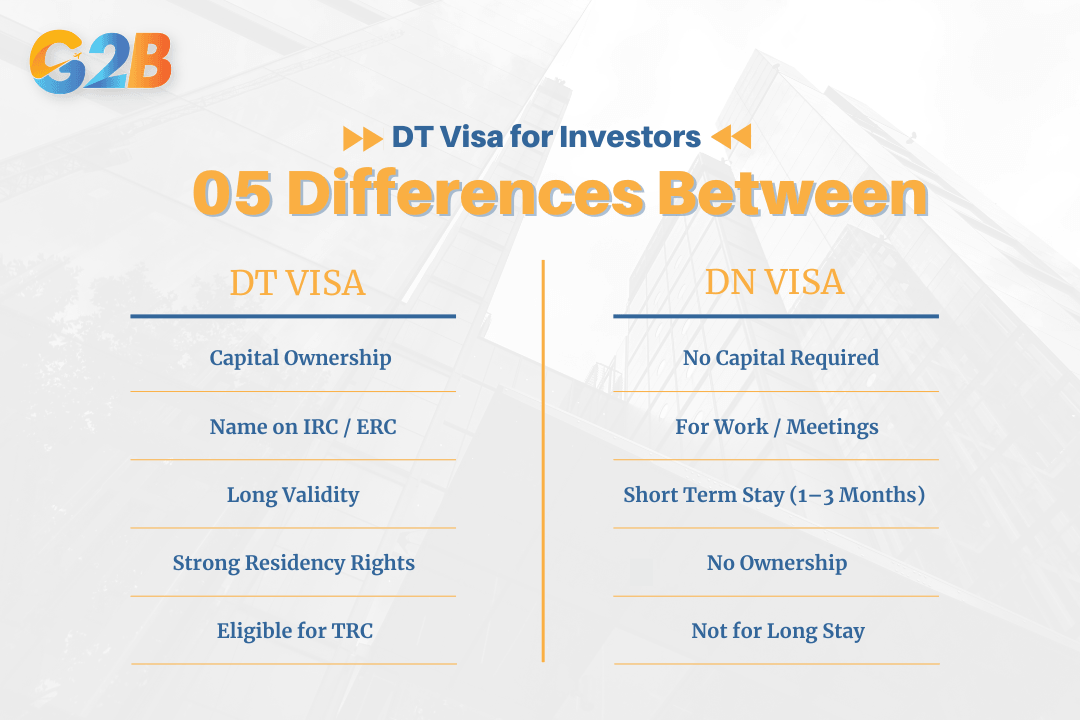
DT visas for investors with ownership while DN visas for short-term business activities
Does the DT visa enable easier travel in and out of Vietnam?
Yes, a DT visa allows multiple entries and exits during its entire validity period. Investors enter and exit Vietnam without reapplying for new documents or paying extra entry fees. Foreign business owners travel frequently to manage supply chains, meet international clients, and attend trade shows. The DT visa supports seamless international travel. Border police at international airports, such as Tan Son Nhat in Ho Chi Minh City and Noi Bai in Hanoi, process DT visa holders quickly.
The multiple-entry feature provides specific travel advantages:
- Bypass regular tourist or short-term business visa applications.
- Maintain continuous business operations during personal travel.
- Attend regional ASEAN meetings efficiently.
- Save money on repeated single-entry visa stamping fees.
- Avoid delays at embassy consulates abroad.
Can family members benefit from a DT visa?
Yes, a DT visa allows dependent sponsorship for immediate family members. Eligible dependents include the investor's legal spouse and biological or legally adopted children under 18 years old. The Vietnam Immigration Department issues a TT visa (Thi Thuc) to the family members of DT visa holders. The TT visa links directly to the primary investor's DT visa. If the investor holds a three-year DT3 visa, the family members receive a three-year TT visa. Families maintain legal residence together during the investor’s stay in Vietnam. Applicants must prove their family relationship to the immigration authorities. The authorities require official documents.
Required family documents include:
- Provide a legalized marriage certificate for the spouse.
- Provide a legalized birth certificate for the children.
- Translate all foreign documents into the Vietnamese language.
- Notarize the translated documents at a recognized state notary public.
- Submit the family documents along with the investor's corporate documents.
The TT visa allows children to enroll in international schools in Vietnam. It allows the spouse to live legally in the country, though the spouse must apply for a separate work permit if they wish to seek local employment.
Read more: TRC for Family in Vietnam
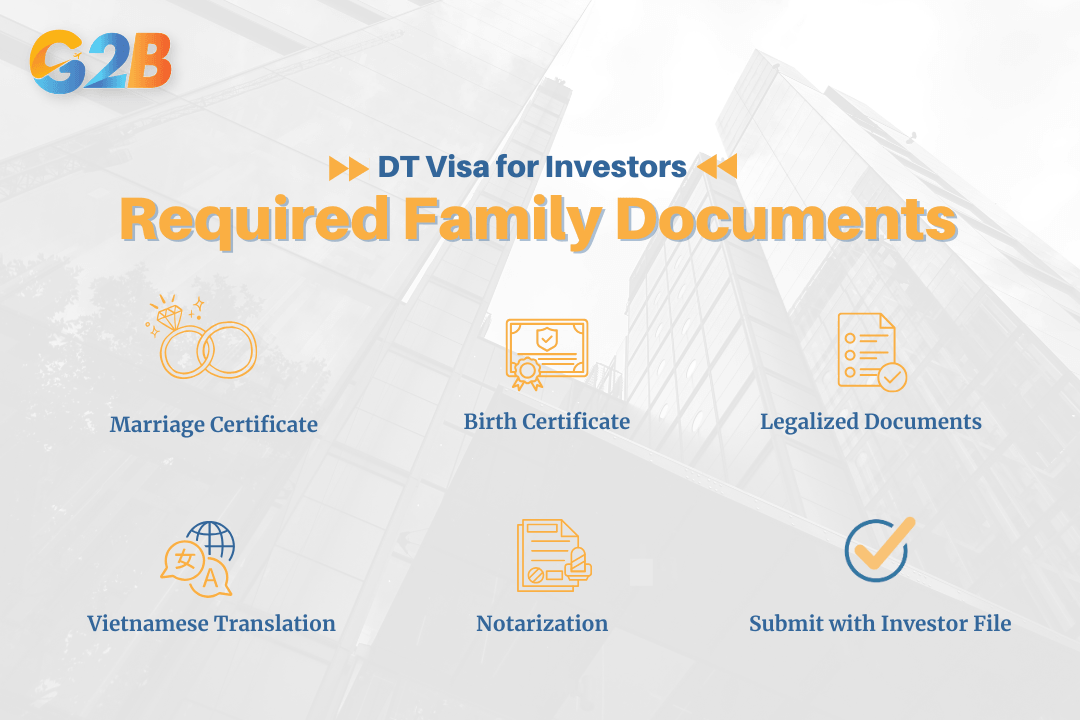
Family members need to provide legalized and translated documents
How does the DT visa reduce administrative burden?
A DT visa reduces repeated visa applications, extension fees, and complex paperwork. Investors avoid short-term visa renewals, access long-term temporary residence cards, and simplify compliance with immigration rules. Foreigners using short-term tourist or business visas must perform "visa runs." A visa run involves leaving Vietnam, flying to a neighboring country, and returning immediately to obtain a new visa stamp. This process consumes time, money, and focus. The DT visa stops this cycle. Administrative efficiency lowers operational friction and allows business owners to focus on growth. Investors reduce administrative tasks by following these actions:
- Organize corporate certificates immediately after the company setup.
- Apply for the correct DT category based on the exact capital amount.
- Monitor visa and passport expiration dates using corporate calendars.
Does the DT visa improve access to financial systems?
Yes, a DT visa supports foreign investors in opening corporate bank accounts and personal bank accounts in Vietnam. Banks require legal residency proof, and the DT visa satisfies this strict requirement. The State Bank of Vietnam regulates all financial transactions involving foreign currency. To operate a business, a foreign investor must open a Direct Investment Capital Account (DICA). The DICA is a specialized bank account used solely to receive the initial investment capital from abroad. After transferring the capital into the DICA, the investor uses the funds for business operations.
Banks such as Vietcombank, BIDV, and foreign branches like HSBC Vietnam require the director to show a valid DT visa or TRC. Without this document, the bank refuses to open the DICA or standard current accounts. A DT visa allows investors to perform the following financial actions:
- Open local currency corporate accounts in Vietnamese Dong (VND).
- Open foreign currency accounts in United States Dollars (USD) or Euros (EUR).
- Transfer legal business profits and dividends back to their home country.
- Pay local employees, suppliers, and state taxes legally.
- Access personal banking services and credit cards in Vietnam.
How does the DT visa support market entry in Vietnam?
A DT visa enables direct participation in a high-growth economy. Investors gain early positioning in expanding sectors across manufacturing, technology, and export trading. Vietnam shows a stable Gross Domestic Product (GDP) growth rate, typically ranging from 5% to 7% annually based on World Bank data. The country receives strong Foreign Direct Investment (FDI) inflows. Global companies move supply chains to Vietnam to access young labor pools and strategic shipping routes.
The DT visa grants the investor the physical presence needed to oversee market entry. Managing a factory or a trading company from abroad is difficult. The visa allows the investor to be on the ground. Vietnam participates in major strategic trade agreements. These include the Comprehensive and Progressive Agreement for Trans-Pacific Partnership (CPTPP) and the European Union-Vietnam Free Trade Agreement (EVFTA). Investors with a local Vietnamese company use these agreements to export goods at lower tariff rates. The DT visa provides the necessary legal residency to manage these export operations directly.
What documents are required for a DT visa application?
The Vietnam Immigration Department requires specific corporate and personal documents for a DT visa application. Applicants submit investment certificates, passport copies, and official guarantee forms to the immigration office. The local Vietnamese company acts as the sponsor for the foreign investor. The company must prepare a dossier to prove the business is active and legally registered. The authorities review these documents to verify the foreigner's identity and investment status. The standard DT visa application dossier includes:
| Document Name | Description and Purpose |
|---|---|
| Form NA16 | Registration form for the seal and signature of the legal representative. |
| Form NA5 / NA2 | Visa application form or approval letter request form. |
| Original Passport | Must have at least 6 months of validity remaining and two blank pages. |
| Enterprise Registration Certificate (ERC) | Certified copy proving the company exists and the investor is listed. |
| Investment Registration Certificate (IRC) | Certified copy proving the state approved the foreign investment project. |
| Certificate of Seal Specimen | Document showing the official red stamp of the Vietnamese company. |
| Proof of Capital Contribution | Bank statements showing the investor transferred the required funds into the DICA. |
How much does a DT visa cost in Vietnam?
The cost of a DT visa depends on the validity period and the issuance location. The government charges standard state fees ranging from 25 USD to 145 USD for the visa sticker or TRC. The Ministry of Finance sets the state fees for immigration documents. Foreigners pay these fees in cash at the immigration department or at the international airport upon arrival. These state fees do not include consulting fees, document translation costs, or notarization charges. The current state fee structure includes:
- Pay 25 USD for a single-entry visa valid for up to 3 months.
- Pay 50 USD for a multiple-entry visa valid for up to 3 months.
- Pay 95 USD for a multiple-entry visa valid from 3 months to 6 months.
- Pay 135 USD for a multiple-entry visa valid from 6 months to 12 months.
- Pay 145 USD for a Temporary Residence Card (TRC) valid for 1 to 2 years.
- Pay 155 USD for a Temporary Residence Card (TRC) valid for 2 to 5 years.
What happens if an investor changes their investment capital?
- If an investor changes their investment capital, they must update their legal documents and apply for a new DT visa category. The Ministry of Planning and Investment (MPI) requires companies to report any changes to the registered capital.
- If an investor increases their capital from 2 billion VND to 4 billion VND, their status changes from DT4 to DT3. The investor must update the Enterprise Registration Certificate (ERC) first. After receiving the new ERC, the investor submits the new documents to the immigration department. The immigration department cancels the old DT4 visa and issues a new DT3 visa. The investor then gains the right to apply for a TRC.
- If an investor decreases their capital below the threshold of their current visa, the immigration department downgrades the visa upon the next renewal. Financial accuracy is a strict requirement for maintaining visa validity.
What risks or limitations should investors consider for a DT visa?
A DT visa requires strict capital thresholds and ongoing regulatory compliance. Investors must maintain registered investment capital, comply with sector restrictions, and renew documentation before expiration. The Law on Enterprise and the Law on Investment mandate exact timelines for capital contribution. When a foreigner sets up a new company, they have 90 days from the issuance date of the Enterprise Registration Certificate (ERC) to transfer the money. The investor must send the exact registered amount from their foreign bank account into the Vietnamese DICA.
Failure to meet these financial conditions creates severe risks. The Department of Planning and Investment (DPI) issues financial penalties for late contributions. Furthermore, the immigration department rejects DT visa renewals if the investor fails to prove the capital transfer. Investors must take specific actions to prevent visa risks:
- Transfer the registered investment capital strictly within the 90-day legal window.
- Maintain correct tax records and submit annual audited financial reports.
- Renew personal passports and visa documentation months before the expiration date.
- Comply with all foreign ownership limits in restricted business sectors.
- Report any changes in the business structure or legal address to state authorities immediately.
Understanding these compliance rules strengthens the long-term benefits of the DT visa. Accurate financial management ensures the foreigner retains their legal right to live and operate a business in Vietnam.
A DT visa provides foreign investors with legal stability, long-term residence, and complete business ownership rights in Vietnam. The government structured the DT1, DT2, DT3, and DT4 visa categories to reward capital investment with corresponding residency lengths. Foreign owners use this visa to establish local companies, access state banking systems, sponsor family members, and manage trade operations directly within the ASEAN region. Fulfilling capital contribution requirements and submitting accurate documents ensures continuous legal standing. The DT visa remains the primary legal tool for foreigners seeking to build and expand permanent corporate footprints in the Vietnamese economy. For tailored support in navigating these procedures, G2B provides professional services for work permit / TRC / visa applications, ensuring a compliant and efficient process for employers and foreign employees.
