




 Delaware (USA)
  Vietnam
  Singapore
  Hong Kong
  United Kingdom
 The visa procedure at Vietnam airports dictates how foreign travelers clear border control and enter the country legally. The Vietnam Immigration Department manages this system across all international entry points. Foreigners must complete document verification, face matching, and entry stamp issuance upon arrival. Understanding the specific checkpoint locations, required documents, and officer questions ensures a smooth arrival experience for tourists, business professionals, and foreign workers.
What is the Vietnam airport entry system overview?
The Vietnam airport entry system is a structured border control process managed by the Vietnam Immigration Department. This system verifies passenger identities, inspects travel authorizations, and clears customs declarations.
Where are the Vietnam immigration checkpoints at international airports?
Vietnam immigration checkpoints operate immediately after the international arrival gates inside the airport terminal. Travelers pass through these secure zones before reaching the baggage claim and public arrival halls. The checkpoint area consists of several designated zones. Travelers must follow airport signage to reach the correct processing location.
- Approach immigration counters: Officers sit at glass booths to inspect passports and issue entry stamps.
- Visit visa verification areas: The landing visa counters process visa-on-arrival applications for travelers lacking pre-approved eVisas.
- Complete arrival screening procedures: Health and security personnel monitor arriving passengers for infectious diseases or security threats.
- Pass customs inspection flow: Travelers scan their luggage through X-ray machines to declare taxable goods or restricted items.
Which main international airports handle foreign arrivals?
Four main international airports handle the vast majority of foreign arrivals in Vietnam. These aviation hubs connect major Vietnamese cities to global destinations.
- Tan Son Nhat International Airport (SGN): Ho Chi Minh City operates the busiest airport in Vietnam, serving the southern economic region.
- Noi Bai International Airport (HAN): Hanoi manages the northern gateway, processing government officials, tourists, and business travelers.
- Da Nang International Airport (DAD): Da Nang handles central Vietnam arrivals, catering heavily to tourists and digital nomads.
- Cam Ranh International Airport (CXR): Nha Trang operates this coastal airport, receiving many international charter flights and vacationers.
| Airport Name | Location | Region | Airport Code |
|---|---|---|---|
| Tan Son Nhat | Ho Chi Minh City | South | SGN |
| Noi Bai | Hanoi | North | HAN |
| Da Nang | Da Nang | Central | DAD |
| Cam Ranh | Nha Trang | South Central | CXR |
Which foreign traveler categories enter Vietnam?
Tourists, business professionals, foreign workers, investors, and family visit travelers form the primary categories of foreigners entering Vietnam. Immigration officers classify entries based on the approved visa type.
- Process tourists: Visitors enter on tourist eVisas or visa exemptions for sightseeing and holidays.
- Screen business travelers: Professionals enter on DN visas for short-term meetings and corporate events.
- Verify foreign workers: Employees enter using work visas sponsored by local Vietnamese companies.
- Identify investors: Business owners enter using DT investor visas linked to their capital contributions.
- Register family visit travelers: Spouses and children of Vietnamese citizens enter using TT family visas or 5-year visa exemption certificates.
What are the Vietnam visa types used at airports?
Vietnam uses electronic visas, visa exemptions, and visa-on-arrival letters to process foreign entries at airports. Each travel authorization requires a distinct verification process.
How does the Vietnam eVisa entry process work?
The Vietnam eVisa entry process allows travelers to present a printed digital approval directly at the immigration counter. The officer scans the document and issues the entry stamp without extra fees. The pre-approved online visa grants up to 90 days of stay. Foreigners apply through the National Web Portal on Immigration before flying to Vietnam.
The system creates a passport-linked authorization. The eVisa approval contains a specific QR code connected to the traveler's passport data. Entry checkpoint verification takes only a few minutes. Travelers hand the printed eVisa and their passport to the officer for immediate processing.
What are the visa exemption entry categories?
Visa exemption entry categories allow citizens of specific countries to enter Vietnam without applying for a prior visa. Travelers simply present their passports to receive an entry stamp. Eligible nationalities include citizens of 25 countries, such as ASEAN countries, the United Kingdom, France, Germany, South Korea, Japan , India, and others listed officially. The Vietnam Immigration Department maintains the official list of exempt countries.
Exemption duration limits vary by nationality. ASEAN citizens generally receive 30 days, while citizens of certain European and Asian nations receive 45 days. Return ticket requirements apply strictly to visa-exempt travelers. Immigration officers and airline staff demand proof of an outbound flight before granting the exemption.
What is the visa-on-arrival approval letter procedure?
The visa-on-arrival approval letter procedure requires travelers to obtain an agency-sponsored letter before flying, and then collect the physical visa sticker at the airport. This method predates the eVisa system.
- Show the pre-arranged approval letter: Travelers present a letter issued by the Vietnam Immigration Department through a local travel agency.
- Complete the landing visa counter process: Travelers submit the letter, two portrait photos, and an application form at the "Visa upon Arrival" desk.
- Process the stamping fee payment: The airport cashier collects a mandatory USD cash fee before printing and applying the visa sticker into the passport.
What are the business visa and work-related entry procedures?
Business visa and work-related entry procedures require officers to cross-check the traveler's sponsoring company in the national database. Foreigners enter using DN business visas or LD labor visas. DN visa verification confirms the corporate purpose of the trip. Officers verify that the traveler intends to work with the specific company listed on the visa approval.
Sponsorship checks prevent illegal employment. Immigration officials ensure the local Vietnamese company possesses an active tax code and legal status. Employer documentation review sometimes occurs at the border. Officers ask business travelers for physical invitation letters or local company contact details.
What documents are required at Vietnam airports?
Foreigners must present a valid passport and the correct travel authorization documents at Vietnam airports. Missing documents lead to immediate entry refusal and deportation.
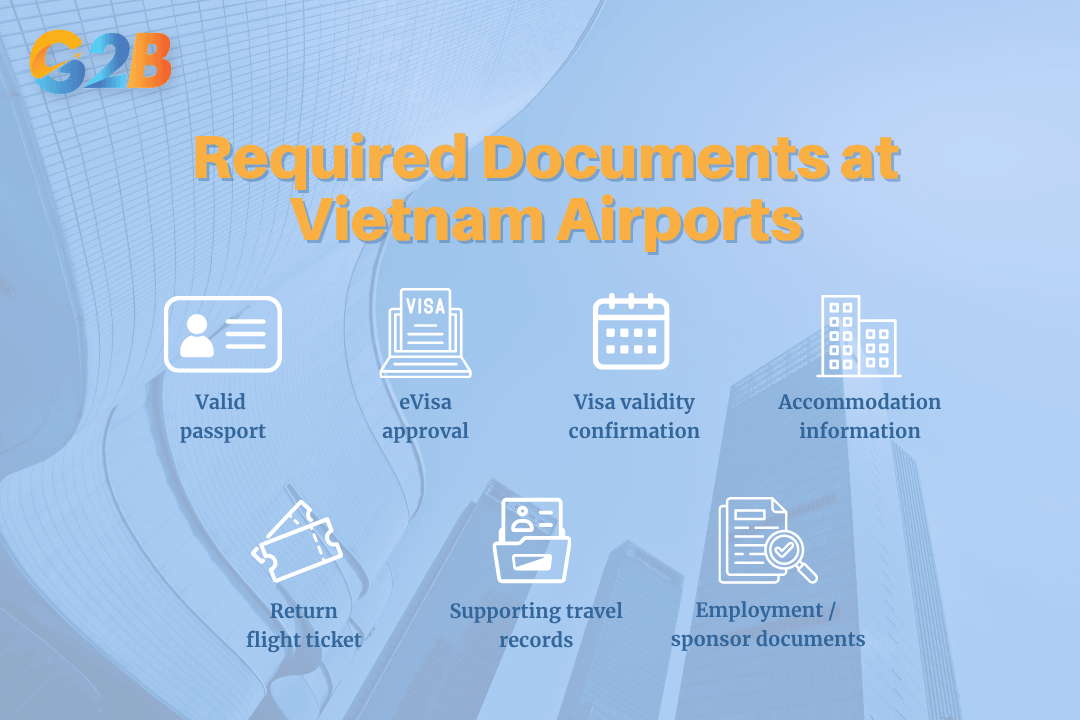
Required documents at Vietnam airports
What are the mandatory passport requirements?
Passports must possess at least six months of validity beyond the date of arrival in Vietnam. Border officers reject travelers holding passports with insufficient validity. The six-month validity rule aligns with international aviation standards. Airlines check the passport expiration date at the departure airport and deny boarding for non-compliance.
Blank page requirements mandate at least two empty visa pages. The immigration officer needs space to affix the entry stamp or the full-page visa sticker. Passport condition standards strictly forbid damaged documents. Officers refuse entry to individuals holding passports with water damage, torn pages, or loose binding.
Which essential visa and immigration documents do foreigners need?
Foreigners need a printed eVisa approval page or a valid visa approval letter to enter the country. Digital copies displayed on mobile phones cause delays.
- Provide the printed eVisa approval: Travelers must hand over a physical A4 printout of the eVisa document.
- Present the visa approval letter: Visa-on-arrival users must submit the multi-page approval document provided by their sponsor.
- Confirm entry and exit dates: Travelers must check that their arrival date matches the validity period printed on the visa.
- Supply accommodation details: Foreigners must know the exact address of their hotel or apartment in Vietnam.
Which supporting travel documents may immigration officers request?
Immigration officers may request a return ticket, hotel reservation, and work permit copy during border inspection. Travelers must keep these documents accessible.
- Show the return ticket: Officers verify the traveler will exit Vietnam before the visa expires.
- Provide the hotel reservation: Officers request booking confirmations to verify the stated accommodation address.
- Present the work permit copy: Legal foreign workers show their work permit to prove their employment status.
- Supply employer contact information: Business travelers provide business cards or corporate phone numbers for sponsorship verification.
What is the Vietnam airport arrival procedure step by step?
The Vietnam airport arrival procedure moves travelers from the aircraft gate through immigration, baggage claim, and customs inspection. Following the correct steps ensures a fast exit from the terminal.
How does the arrival and disembarkation process work?
The arrival and disembarkation process begins when travelers exit the aircraft and enter the terminal building. Passengers follow designated pathways toward passport control. Arrival gate procedures involve walking through the airbridge or taking an airport bus to the terminal entrance. Airport staff direct passenger flow.
Airport direction signage guides travelers in English and Vietnamese. Passengers follow the signs labeled "Immigration" or "Passport Control." Immigration queue routing separates passengers into different lines. Airports maintain distinct queues for foreign passports, Vietnamese passports, and diplomatic personnel.
What is the immigration counter verification process?
The immigration counter verification process involves a direct interaction with a border officer. The officer confirms the traveler’s identity and legality.
- Submit to passport inspection: The officer scans the passport data page into the national immigration database.
- Complete face matching checks: Travelers remove hats and masks. The officer compares the traveler's face to the passport photo.
- Wait for visa validation: The system checks the eVisa QR code or exemption status for validity.
- Receive the entry stamp issuance: The officer stamps the passport, writes the permitted stay duration, and returns the documents.
What are the visa-on-arrival counter procedures?
The visa-on-arrival counter procedures require travelers to submit paperwork and pay fees before entering the main immigration queue. This counter sits adjacent to the passport control area.
Approval letter submission initiates the process. The traveler hands the passport, completed entry form, and sponsor letter to the receiving officer. Photo requirements mandate two 4x6 cm passport-sized portraits. The officer attaches one photo to the entry form.
Stamping fee payment happens when the officer calls the traveler's name. Travelers pay the fee in cash. Visa sticker issuance concludes the process. The officer returns the passport containing the new Vietnam visa sticker. The traveler then proceeds to the standard immigration line.
How does baggage claim and customs inspection work?
Baggage claim and customs inspection occur after travelers clear passport control. Passengers collect their luggage and declare taxable items before exiting into the public hall. Luggage collection happens at the designated baggage carousels. Electronic screens display the flight number corresponding to each carousel.
Customs declaration lanes separate passengers. Travelers with nothing to declare use the Green Channel. Travelers carrying taxable goods or more than $5,000 USD in cash use the Red Channel. Restricted item screening requires all baggage to pass through an X-ray scanner before the final exit doors. Customs officers monitor screens for prohibited agricultural products, weapons, or illegal substances.
What immigration questions do foreigners commonly receive?
Immigration officers commonly ask foreigners questions about their travel purpose, hotel address, and employment status. Answering directly and honestly prevents secondary inspections.
How do officers verify the purpose of visit?
Officers verify the purpose of visit by asking travelers why they came to Vietnam. The stated purpose must match the approved visa type.
- Question tourism: Officers ask tourists about their travel itinerary and planned destinations inside Vietnam.
- Examine business activities: Officers ask business visa holders about the nature of their meetings and the name of their local partner.
- Verify employment: Officers ask foreign workers about their job title and the location of their office.
- Confirm family visits: Officers ask TT visa holders about the name and relationship of their Vietnamese spouse or relative.
How do officers confirm accommodation and address details?
Officers confirm accommodation and address details by requesting the specific name of the hotel or building. Vietnam requires foreigners to register their temporary residence. Hotel details satisfy short-term tourist requirements. Travelers provide the name of the hotel and the city.
Apartment registration applies to long-term renters. Officers expect foreign workers and digital nomads to know their exact street address and district. Temporary residence information links to local police databases. Officers use the stated address to ensure local landlords comply with reporting laws.
What employment and sponsorship questions do officers ask?
Officers ask employment and sponsorship questions to verify that business travelers possess legal authorization. Border control actively screens for illegal workers. Employer identification requires the foreigner to state the exact registered name of the sponsoring company. Nicknames or brand names sometimes cause confusion.
Work permit status questions occur if a foreigner stays long-term. Officers ask if the worker possesses a valid plastic work permit card. Business sponsor verification involves cross-referencing the company in the system. If a traveler claims to work for a company but holds a tourist visa, the officer will likely deny entry.
What are common problems during Vietnam airport immigration?
Common problems during Vietnam airport immigration include incorrect visa data, damaged passports, and missing paperwork. These issues lead to severe delays and denied entries.
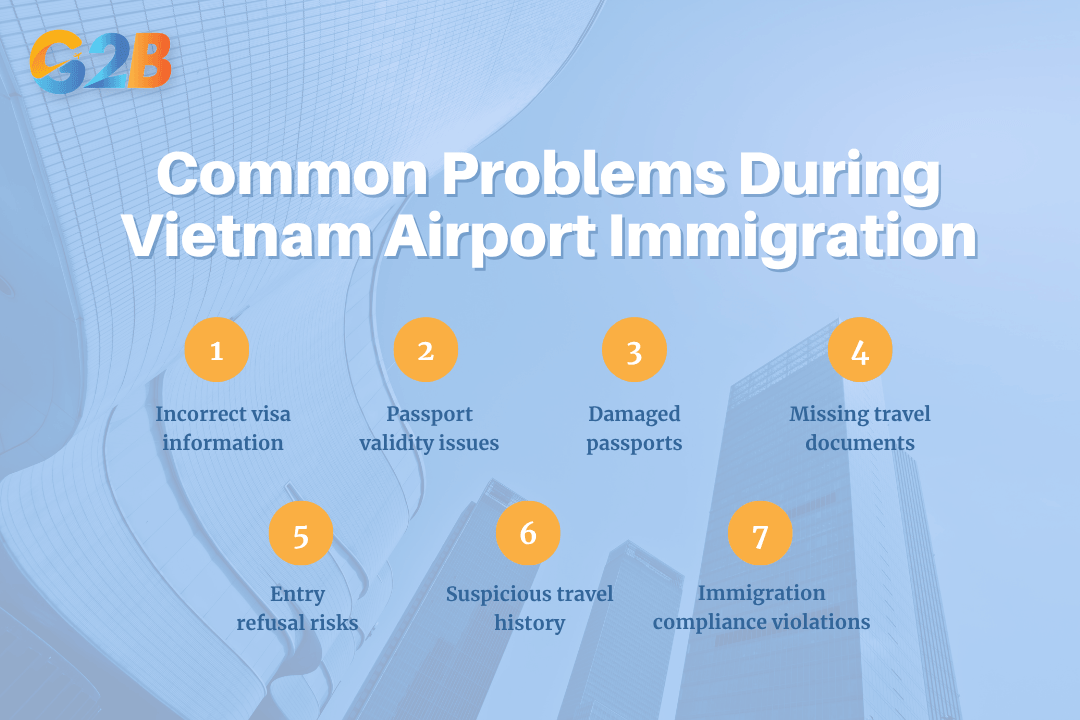
Common problems during Vietnam airport immigration
How do incorrect visa information issues occur?
Incorrect visa information issues occur when applicants misspell their names or type the wrong passport details into the eVisa portal. The system generates an approval containing the typo. Wrong passport numbers instantly invalidate the eVisa. The immigration system rejects the document because it does not match the physical passport scan.
Incorrect entry port selections cause boarding denials. If a traveler selects Hanoi Noi Bai Airport on the eVisa but flies into Ho Chi Minh City Tan Son Nhat Airport, the officer will refuse entry. Name formatting mismatches happen when travelers confuse first names and surnames. The name on the eVisa must exactly match the machine-readable zone of the passport.
What are the passport validity and damage problems?
Passport validity and damage problems prompt officers to reject travelers at the counter. Border control enforces strict physical document standards. Expired passports or passports with less than six months of validity trigger automatic system rejections. Officers possess no authority to override this rule.
Torn passport pages invalidate the document. If the data page or any visa pages contain rips, the officer classifies the passport as mutilated. Water damage concerns lead to intense scrutiny. Smeared ink or warped pages prevent the passport scanner from reading the security chip.
How do missing documents cause delays?
Missing documents cause delays because officers pause the inspection to demand proof of travel plans. Travelers without printed documents hold up the immigration queue. No printed visa copy forces the traveler to leave the queue, find a printing station, and return to the back of the line.
Missing return tickets cause suspicion. If a visa-exempt traveler cannot prove they hold an outbound flight, the officer denies the exemption stamp. Incomplete sponsorship documents delay business travelers. The officer will hold the traveler at the desk until they can call their local Vietnamese company to verify the visit.
What causes immigration refusal and denied entry risks?
Immigration refusal and denied entry risks stem from previous immigration violations or suspicious travel patterns. The Immigration Department reserves the right to reject any foreigner.
- Detect previous overstays: The database flags foreigners who previously overstayed their Vietnam visa without paying fines.
- Spot frequent visa runs: Officers question travelers who continuously exit and re-enter Vietnam on tourist visas to live in the country illegally.
- Flag suspicious travel history: Individuals with Interpol alerts or criminal records face immediate deportation.
- Notice inconsistent statements: Travelers who claim tourism but carry commercial goods or tools face entry refusal for lying to a border officer.
What are the Vietnam airport procedures for foreign workers?
Vietnam airport procedures for foreign workers involve verifying employer sponsorship and checking Temporary Residence Cards. Long-term expats follow slightly different arrival rules than tourists.
How do officers verify work permits and business visas?
Officers verify work permits and business visas by matching the traveler's company name against the national tax database. The border system tracks corporate sponsorships. Employer sponsorship review confirms that the Vietnamese company remains active and legally compliant. Bankrupt or suspended companies cannot sponsor entries. Labor contract references apply to new foreign employees. Officers may ask to see the signed labor agreement if the foreigner enters on a fresh LD visa.
What are the temporary residence registration obligations?
Temporary residence registration obligations require foreign workers to declare their local address immediately after leaving the airport. Vietnam law mandates police registration. Police registration requirements force landlords to register foreign tenants on the national online portal within 24 hours of arrival.
Hotel reporting obligations require hotel receptionists to submit the foreigner's passport details to the local ward police every night. Apartment lease documentation serves as proof of residence. Foreign workers use their lease agreements to apply for long-term Temporary Residence Cards.
What are the re-entry procedures for existing foreign residents?
Re-entry procedures for existing foreign residents require presenting a Temporary Residence Card (TRC) alongside the passport. Residents bypass standard visa checks. Temporary Residence Card checks replace the eVisa process. The officer scans the TRC card to verify the resident's active status.
Multi-entry visa verification applies to workers holding long-term visa stickers instead of plastic cards. The officer checks the expiration date on the sticker. Immigration history review happens automatically. The system logs every exit and entry, tracking the resident's total time spent inside and outside Vietnam.
What are the transit and connecting flight procedures in Vietnam?
Transit and connecting flight procedures in Vietnam depend on whether the onward flight is domestic or international. Travelers must plan their layovers accordingly.
How does international transit work without immigration clearance?
International transit without immigration clearance allows travelers to stay inside the secure terminal zone without entering Vietnam legally. This process avoids visa requirements entirely. The airside transit process keeps passengers in the international departure hall. Travelers simply walk to their next departure gate.
Baggage transfer rules apply to single-ticket itineraries. If the traveler booked the entire journey on one ticket, the airline transfers the luggage automatically. Airline transfer policies differ for low-cost carriers. Passengers flying on separate tickets with budget airlines must clear immigration, collect bags, and check in again.
What are the domestic connecting flight procedures after international arrival?
Domestic connecting flight procedures after international arrival require travelers to clear immigration and customs at the first point of entry. Vietnam does not process domestic connections airside.
- Complete immigration first: Travelers must use their eVisa to enter Vietnam at the arrival airport (e.g., Ho Chi Minh City).
- Perform customs clearance: Travelers must collect all checked baggage and walk through the customs X-ray scanners.
- Execute the domestic terminal transfer: Travelers exit the international building, walk or take a shuttle to the domestic terminal, and re-check their luggage for the onward flight.
What are the airport transfer timing recommendations?
Airport transfer timing recommendations suggest booking a minimum layover of three hours for domestic connections. Immigration delays easily consume short layovers. Minimum layover guidance advises against booking flights closer than 150 minutes apart. Travelers need time to clear borders and change terminals.
Immigration queue delays occur when multiple wide-body aircraft land simultaneously. Lines frequently exceed 45 minutes during busy periods. Peak travel hour considerations include late evenings and early mornings. Airports experience heavy congestion during major holidays like Tet (Lunar New Year).
What are the tips for faster immigration clearance in Vietnam?
Tips for faster immigration clearance in Vietnam involve preparing physical documents, booking optimal flight times, and communicating clearly with officers. Organization prevents desk delays.
How do you prepare documents before landing?
You prepare documents before landing by printing all visa approvals and organizing your hotel addresses. Having paperwork ready speeds up the counter interaction. Printed visa copies eliminate phone-related issues. Officers despise waiting for travelers to find digital documents or connect to the airport wifi.
Completed arrival information includes knowing the exact hotel address and outbound flight number. Memorize or write down these details. Accessible passport storage keeps documents safe. Travelers place their passports and printed eVisas in a dedicated folder for quick retrieval.
How do you choose efficient arrival times?
You choose efficient arrival times by selecting flights that land outside peak airport operational windows. Timing impacts queue length significantly. Early morning arrivals generally experience shorter lines. Flights landing before 8:00 AM bypass the heavy afternoon congestion.
Avoiding holiday congestion saves hours of waiting. Travelers should avoid arriving a few days before the Tet Lunar New Year, as airports flood with returning overseas citizens. Airline scheduling considerations matter. Avoid landing exactly at midnight, as numerous international flights arrive simultaneously in Ho Chi Minh City and Hanoi.
How should you behave and communicate at immigration counters?
You should behave respectfully and communicate directly at immigration counters. Professionalism ensures the officer processes the passport quickly.
- Provide direct responses: Answer the officer's questions with short, factual statements.
- Maintain consistent travel information: Ensure your spoken answers match the details printed on your visa and hotel bookings.
- Use a professional communication style: Remove sunglasses, take off headphones, and avoid using mobile phones while standing at the booth.
What are the recent Vietnam immigration policy changes?
Recent Vietnam immigration policy changes expanded eVisa availability and tightened internal compliance checks. The government continually modernizes the border system.
What are the expanded Vietnam eVisa policies?
The expanded Vietnam eVisa policies grant access to citizens of all countries and increase the maximum stay duration. The government implemented these changes in August 2023. Additional eligible countries expanded the system globally. Previously, only 80 nationalities could use the eVisa portal.
Extended visa validity periods allow a 90-day stay. This replaces the old 30-day eVisa limit. Multi-entry availability represents a major upgrade. Foreigners now select multiple-entry eVisas online, allowing them to travel in and out of Vietnam freely for 90 days.
How do authorities perform increased immigration compliance checks?
Authorities perform increased immigration compliance checks by monitoring digital entry records and verifying local company data. The government targets illegal employment. Work authorization verification happens at the border and inland. Police conduct surprise inspections at language centers to check foreign teachers' passports.
Frequent entry monitoring tracks foreigners performing visa runs. Officers question tourists who repeatedly stay for 90 days, leave for a day, and return. Digital record systems link immigration data to police residence registrations. If a foreigner enters but fails to register a local address, the system flags the discrepancy.
Where are the official sources for Vietnam visa updates?
Official sources for Vietnam visa updates include government websites and national embassies. Travelers must avoid outdated blogs when checking border rules.
- Check the Vietnam Immigration Department: The National Web Portal on Immigration publishes all official eVisa rules and systemic updates.
- Consult Vietnamese embassies: Embassies provide accurate information regarding complex business visas and diplomatic entries.
- Review airline travel advisories: Airlines update their check-in requirements based on real-time bulletins issued by the Vietnamese government.
Frequently asked questions about Vietnam airport visa procedures
Foreign travelers frequently ask questions regarding document formats, processing times, and border rules. Accurate knowledge prevents expensive flight denials.
Can foreigners enter Vietnam with only an eVisa printout?
Yes, foreigners can enter Vietnam using only a valid passport and the printed A4 eVisa approval. No other physical visa stickers are required for eVisa holders.
Is visa on arrival still available in Vietnam?
Yes, visa on arrival remains available for travelers holding a pre-approved agency sponsor letter. However, the eVisa system has largely replaced this method for standard tourism.
How long does Vietnam airport immigration usually take?
Vietnam airport immigration usually takes between 30 and 60 minutes. Wait times stretch up to two hours during major national holidays or simultaneous flight arrivals.
Can immigration officers ask for proof of accommodation?
Yes, immigration officers frequently ask for proof of accommodation. Travelers must provide the specific name and street address of their hotel or registered apartment.
What happens if a visa contains incorrect information?
If a visa contains incorrect information, the immigration officer denies entry. Travelers must apply for a new eVisa containing the exact passport details before flying.
Can foreigners enter Vietnam with a one-way ticket?
Foreigners holding an eVisa or business visa can sometimes enter with a one-way ticket, but visa-exempt travelers absolutely require a return ticket. Airlines heavily enforce the return ticket rule.
Which airport is fastest for immigration clearance in Vietnam?
Da Nang International Airport is generally the fastest for immigration clearance. The smaller terminal size and lower flight volume allow for rapid passport processing.
Do foreign workers need additional documents at immigration?
Yes, foreign workers must carry their Temporary Residence Card or original work permit. Officers check these documents to confirm legal employment status.
Can travelers use digital copies instead of printed visa documents?
No, travelers cannot use digital copies on their mobile phones. Immigration officers strictly require physical paper printouts for eVisas and approval letters.
Navigating the visa procedure at Vietnam airports requires an understanding of immigration rules, required documents, and arrival workflows. Preparing your printed eVisa, maintaining a valid passport, and knowing your accommodation details ensure a seamless border crossing. Foreigners must choose the correct entry method, whether utilizing the 90-day eVisa, a visa exemption, or a corporate-sponsored business visa. Understanding transit rules and layover timing prevents missed connections at major hubs like Tan Son Nhat and Noi Bai.
For business travelers and foreign workers, maintaining strict legal compliance with local sponsorship laws is mandatory. Partnering with professional consultants simplifies this process. Securing the proper documents prior to your flight guarantees a safe, fast, and legal entry into Vietnam. For streamlined support in work permit / TRC / visa services, contact G2B for professional guidance and reliable assistance throughout every step of the application process.
