




 Delaware (USA)
  Vietnam
  Singapore
  Hong Kong
  United Kingdom
 The Vietnam immigration blacklist is a government database that restricts foreign nationals from entering, exiting, or obtaining a visa for Vietnam. The Vietnam Immigration Department maintains these records to control border security and enforce the Law on Entry, Exit, Transit, and Residence of Foreigners in Vietnam. This article explains the primary causes of immigration bans, such as visa overstays, employment violations, and legal disputes. Understanding these immigration rules helps travelers, investors, and expatriates maintain legal status and prevent travel disruptions in Vietnam.
What is the Vietnam immigration blacklist?
The Vietnam immigration blacklist is a government administrative record that restricts a person from entering, leaving, or getting a visa for Vietnam. The government applies these bans to individuals who violate immigration, civil, or criminal laws.
This record functions as an entry, exit, or visa restriction list. Authorities use the system to manage national security and monitor foreign visitors. The restriction applies as a temporary ban or a long-term prohibition. A temporary ban usually happens when a traveler overstays a visa or forgets to pay an administrative fine. A long-term or permanent ban occurs for serious criminal offenses or severe immigration fraud. The system categorizes these restrictions into administrative holds and legal prohibitions. An administrative hold pauses visa processing until the person pays a fine or submits missing documents. A legal prohibition blocks the person from crossing the border due to court orders or national security risks.
Which authority controls blacklist records in Vietnam?
The Department of Immigration Vietnam controls the primary blacklist records. Several other government agencies update the database and enforce these immigration restrictions at international borders and airports. Different government bodies manage and update the immigration database. These authorities share information to secure the national borders and enforce local laws. Authorities involved in the process include:
- Manage the central database at the Department of Immigration Vietnam.
- Enforce national security policies through the Ministry of Public Security.
- Control passport checks through border control authorities at airports and land crossings.
- Issue legal travel bans through relevant courts or civil enforcement agencies.
- Report tax or labor violations through provincial labor departments and tax offices.
Is the blacklist status public or private?
The Vietnam immigration blacklist status is a private government record. The general public cannot access or search this database on the internet to find restricted individuals. The government secures personal data under Decree 13/2023/ND-CP on Personal Data Protection. Privacy rules prevent the public disclosure of administrative records. Authorities do not publish a list of banned foreigners on any public website. Travelers cannot type their name into a portal to see if they have an entry ban. The system requires strict identity verification. A person must prove their identity by presenting their original passport and valid residence documents to request their own immigration record, usually through an official written request or in person at an Immigration office.
Why would someone be blacklisted in Vietnam?
A person receives a blacklist status in Vietnam for violating local laws. Common reasons include visa overstays, illegal employment, unpaid fines, criminal actions, and deportation orders. Foreigners must follow all Vietnamese regulations during their stay. The government monitors compliance through visa renewals, tax filings, and local police registrations.
Can visa overstay cause blacklist status?
Yes, a visa overstay typically results in an administrative penalty and possible forced exit. Extended or repeated overstays may lead to an entry ban for a specified period, depending on the case and applicable decrees.
An overstay represents the most common reason for an entry ban. The government applies Decree 144/2021/ND-CP to calculate immigration penalties. Overstaying invalidates the foreigner's legal status. The government issues overstay fines starting from 500,000 VND for a few days to over 20,000,000 VND for long periods. Repeat overstays increase the risk of a long-term ban. Immigration officers flag repeat offenders automatically because multiple overstays demonstrate a disregard for the law. Duration-based penalties calculate the exact number of illegal days in the country. A one-month overstay causes a temporary hold, while a one-year overstay leads to immediate deportation and a multi-year entry ban.
Can unpaid fines or legal disputes trigger a blacklist?
Yes, unpaid fines and ongoing legal disputes trigger an exit ban or entry ban in Vietnam. The government restricts travel privileges until the foreigner resolves their financial or legal obligations. Financial debts to the state or local businesses cause administrative holds. Foreigners must clear these issues to restore their travel rights. Common triggers for these bans include:
- Fail to pay traffic fines after police issue a formal ticket.
- Evade tax obligations for Personal Income Tax (PIT) or Corporate Income Tax (CIT).
- Ignore civil judgments from a Vietnamese court regarding business disputes.
- Avoid administrative immigration penalties related to lost passports or late registrations.
- Breach commercial contracts resulting in a formal police investigation.
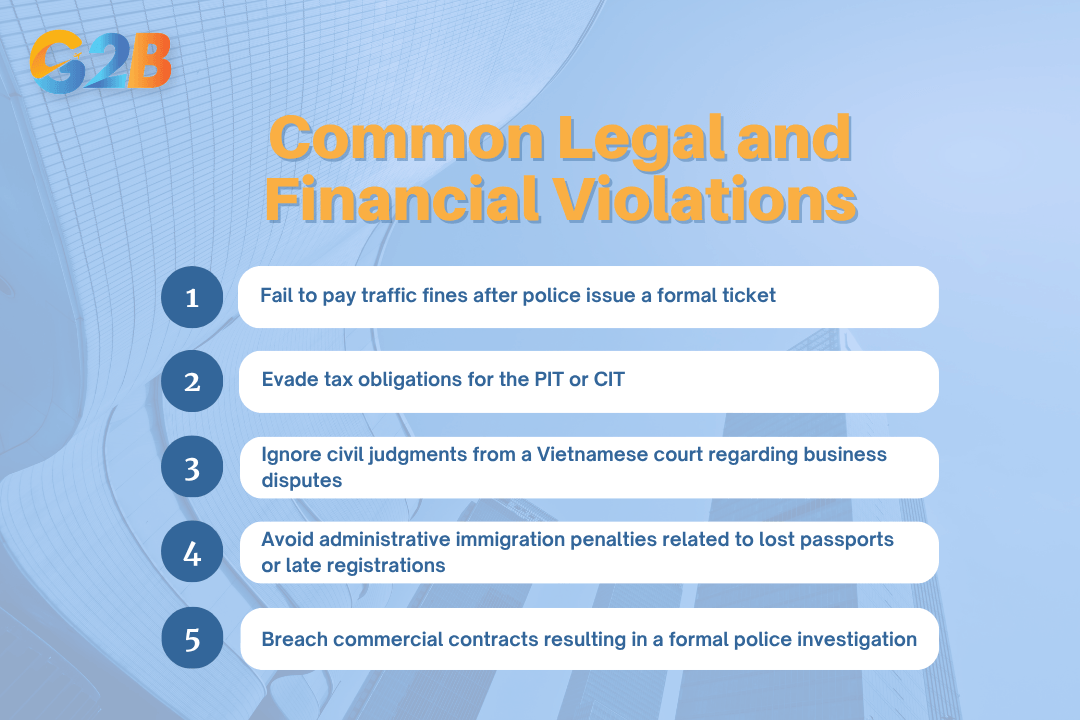
Common legal and financial violations may trigger Vietnam immigration blacklist restrictions
Can criminal cases lead to immigration bans?
Yes, criminal cases lead directly to severe immigration bans in Vietnam. The Ministry of Public Security may blacklists individuals involved in crimes to protect national safety and order.
Criminal cases involve serious breaches of the Vietnamese Penal Code. Local police report suspects to the border control forces. Ongoing investigations trigger a temporary exit ban. Authorities prevent the suspect from escaping the jurisdiction before the trial. Convictions result in fixed-term or permanent bans. The court decides the length of the ban based on the crime severity. Security-related concerns also cause blacklisting. The Ministry of Public Security denies entry to individuals threatening national sovereignty, including those with Interpol notices or international arrest warrants.
Can employment violations cause a blacklist?
Yes, employment violations cause a blacklist status when a foreigner works illegally in Vietnam. The Department of Labor, Invalids, and Social Affairs reports these violations to immigration authorities.
Vietnam enforces Decree 152/2020/ND-CP governing foreign labor. Expatriates must possess valid work permits and correct visa types. Working without a permit causes immediate corporate fines and foreign travel bans. The police perform random checks on companies to find illegal workers. Wrong visa category use violates immigration rules. Foreigners holding a Tourist Visa (DL) or eVisa (EV) cannot perform paid work. Employer compliance breaches impact the worker. Companies failing to register foreign staff face heavy fines, and the immigration office holds both the employer and employee legally responsible.
Can deportation result in re-entry bans?
Yes, deportation is commonly accompanied by an entry ban for a specified period, though the length and permanence depend on the official decision and case severity.
A deportation history creates a permanent record in the national immigration system. Fixed-term re-entry bans start from the date of physical removal. A minor immigration violation results in a 1 to 3-year ban. Serious crimes lead to 5-year bans. National security threats cause lifetime permanent bans. The foreigner must wait for the exact ban period to expire before applying for a new visa.
How do you know if you are blacklisted in Vietnam?
You know you are blacklisted in Vietnam when authorities deny your visa application or refuse your entry at the border. The government does not send proactive notifications about blacklist records. Many travelers only discover their restricted status when they attempt to travel. Recognizing the warning signs helps foreigners address the problem quickly.
What are common blacklist warning signs?
Common blacklist warning signs include visa rejections, boarding refusals, and border control stops. The National Web Portal on Immigration automatically flags the restricted passport number during the travel process. Foreigners experience specific issues when their name appears on the restriction list. Common warning signs include:
- Receive a visa denial from the Vietnamese embassy abroad.
- Experience an eVisa rejection with a generic error message.
- Face boarding refusal by airline staff during the check-in process.
- Suffer detention at the arrival airport during passport scanning.
- Encounter exit delays when the border agent stops you from leaving.
Can you check blacklist status online?
No, you cannot check your Vietnam immigration blacklist status online. The Vietnamese government does not provide a universal public blacklist checker on the internet. Scammers often create fake websites claiming to check immigration status instantly. These unofficial websites cannot access the secure national police database. Travelers must use official case-specific inquiry channels. The Immigration Department protects the database from public internet access to ensure data privacy.
How can you verify your status legally?
You can verify your immigration status legally by contacting the Vietnam Immigration Department directly. You must submit a formal request with your passport details to receive an official answer. Verifying your status requires direct communication with government offices. To check your status legally:
- Contact the Vietnam Immigration Department headquarters in Hanoi or the branch in Ho Chi Minh City
- Request assistance from the Vietnamese embassy or consulate in your home country
- Hire a licensed immigration lawyer to represent you in Vietnam
- Grant a Power of Attorney (POA) to a legal representative to check the official records
How to remove your name from the Vietnam immigration blacklist?
You remove your name from the Vietnam immigration blacklist by resolving the original violation and submitting a clearance request. The process requires paying fines and providing legal documents to the authorities. The removal process demands exact compliance with Vietnamese administrative procedures.
Can blacklist status be removed?
Yes, a blacklist status can be removed in many cases. The removal depends on the exact reason for the restriction and the specific government authority that issued the ban. Not all bans are permanent. Temporary bans expire without extra effort once the time limit passes. However, unresolved violations require active legal action. An unpaid fine keeps the ban active forever. The foreigner must initiate the resolution process. A permanent ban for a severe crime is generally impossible to remove.
What documents help remove a blacklist?
Documents that help remove a blacklist include your passport copy, penalty receipts, and legal clearance papers. You must provide evidence to the government that you fixed the legal violation. Authorities demand notarized and legalized documents. Missing documents delay the removal process. Required documents include:
- Submit a notarized passport copy valid for at least six months.
- Provide previous visa records, temporary residence cards (TRC), and entry stamps.
- Attach official fine payment receipts stamped by the State Treasury of Vietnam.
- Present a written explanation letter detailing the violation and corrective actions.
- Include employer support letters or sponsorship forms from a Vietnamese company.
- Deliver court clearance certificates proving the resolution of civil or criminal cases.
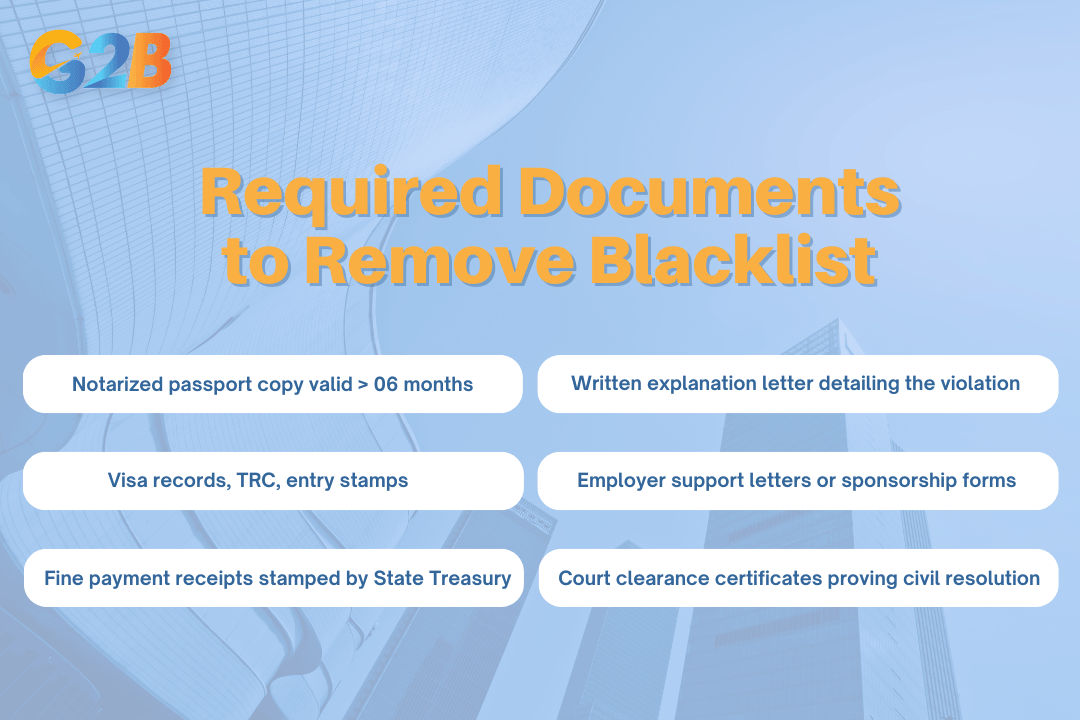
Required documents to remove a blacklist
What is the appeal or resolution process?
The resolution process involves identifying the ban reason, paying the required penalties, and applying for an official review. The Immigration Department evaluates the submitted case file before removing the restriction. Following the correct steps ensures a faster resolution. The process requires the applicant to:
- Identify the exact reason for the immigration restriction through an official inquiry
- Resolve the legal or financial issue by paying the State Treasury
- Draft the explanation letter and translate foreign documents into Vietnamese
- Submit the complete application dossier to the Immigration Department
- Request a formal review of the restricted status
- Await the official written decision from the government authority
The Vietnam immigration blacklist enforces strict border security and legal compliance across the country. Foreigners face travel restrictions for visa overstays, illegal employment, unpaid fines, and criminal actions. Resolving an entry ban requires direct communication with authorities, payment of outstanding fines, and submission of legalized documents. Temporary bans expire naturally, but unresolved administrative holds require proactive legal steps. For streamlined support in work permit / TRC / visa services, contact G2B for professional guidance and reliable assistance throughout every step of the application process.
