





 Delaware (USA)
  Vietnam
  Singapore
  Hong Kong
  United Kingdom
 Opening a recruitment agency in Vietnam is classified as establishing a conditional business entity subject to specific statutory frameworks under domestic labor regulations. The establishment process mandates foreign investors to secure structural approvals and specialized operational permits to legally supply workforce solutions. This article details the legal conditions, the mandatory escrow requirement, and the rigid licensing process enforced for foreign investors.
What is a recruitment agency under Vietnamese law?
Under the Law on Employment and Decree 23/2021/ND-CP, a recruitment agency is classified as an enterprise authorized to provide employment services, including job consulting, job placement, and labor supply. The enterprise performs specific statutory functions, such as analyzing domestic labor market conditions, sourcing candidate profiles, providing workforce integration counseling, and mediating employment contracts between job seekers and registered employers.
The core operational mandate of a recruitment agency involves matching human capital with corporate demand in exchange for an authorized service fee. The legal entity operates strictly as an intermediary. The recruited employee signs a direct labor contract with the hiring company, and the recruitment agency bears no legal responsibility for the ongoing employment relationship, payroll tax, or compulsory social insurance contributions.
A critical legal distinction exists between Employment services (headhunting) and Labor subleasing (staffing). Employment Services requires the agency to find candidates for a one-time placement fee and operates under an Employment service license. Conversely, labor subleasing refers to a business model where the agency legally hires the employees, pays their salaries, and leases them to a third-party client. Labor Subleasing is governed by entirely different legal mandates, requiring a Labor subleasing license and a significantly higher financial threshold. Mixing these two distinct models without the corresponding permits results in immediate operational suspension and severe administrative fines under Vietnamese enterprise regulations.
Statutory conditions for opening a recruitment company in Vietnam
Establishing a legal entity in the employment placement sector requires strict adherence to predefined infrastructural, financial, and administrative parameters. Vietnam allows the establishment of a 100% foreign-owned recruitment agency. To successfully register the company in Vietnam, foreign investors must independently satisfy three mandatory statutory conditions.
1. Escrow deposit requirement
The escrow deposit requirement is defined as a mandatory financial safeguard utilized by the state to protect laborers against potential corporate default. Investors must deposit 300,000,000 VND (approximately $12,500 USD) into an active, blocked escrow account held at a legally recognized commercial bank operating within Vietnam.
The funds placed in this restricted account are completely frozen and remain inaccessible for daily business operations. The deposit secures various operational liabilities, such as unpaid candidate reimbursements, unfulfilled state administrative penalties, and labor dispute resolution costs. The designated commercial bank issues an official Escrow Deposit Certificate, which serves as a non-negotiable prerequisite document within the Sub-license application dossier. The enterprise earns standard demand deposit interest on this blocked amount, and the principal remains fully refundable upon the legal dissolution of the enterprise or the official termination of its employment service activities.
2. Qualifications of the legal representative/manager
The qualifications of the agency's executive management are strictly regulated to ensure high-level competence in workforce administration. The registered Legal Representative, or the designated individual directly managing the employment service operations, must possess a specialized academic background and verifiable professional tenure.
The manager must hold a bachelor's degree or higher issued by a recognized academic institution. Furthermore, the individual must prove an accumulation of at least 3 years (36 months) of direct managerial experience in specific authorized fields, such as human resources, recruitment, labor administration, or enterprise management. If the appointed manager is a foreign national, all academic degrees and foreign employment records must undergo consular legalization, professional translation into Vietnamese, and domestic notarization before submission to the labor authorities.
3. Registered office and facilities
The registered office is the fixed, physical headquarters where the agency conducts formal business, executes contracts, and hosts labor market participants. Vietnamese law mandates the possession of a stable, commercially viable facility accompanied by verified property documentation.
Investors must secure legitimate commercial premises utilizing verifiable property documents, such as long-term commercial lease agreements, notarized building ownership certificates, and local ward commercial zoning approvals. Note: Lease contract must be for at least 36 months from the application date. The law specifically demands a physical location to accommodate job seekers and regulatory inspections. The utilization of a virtual office or a purely residential apartment without commercial zoning for a recruitment agency is strictly prohibited. The licensing authority conducts a mandatory physical site inspection prior to issuing the sub-license, automatically rejecting applications utilizing shared workspaces, unregistered physical addresses, or properties lacking standardized fire safety clearances.
The 3-step process: IRC, ERC, and recruitment agency license
Foreign investors entering the Vietnamese labor market must navigate a rigid, chronological corporate formation sequence. The regulatory framework separates foreign investment approval from corporate establishment and subsequent operational licensing.
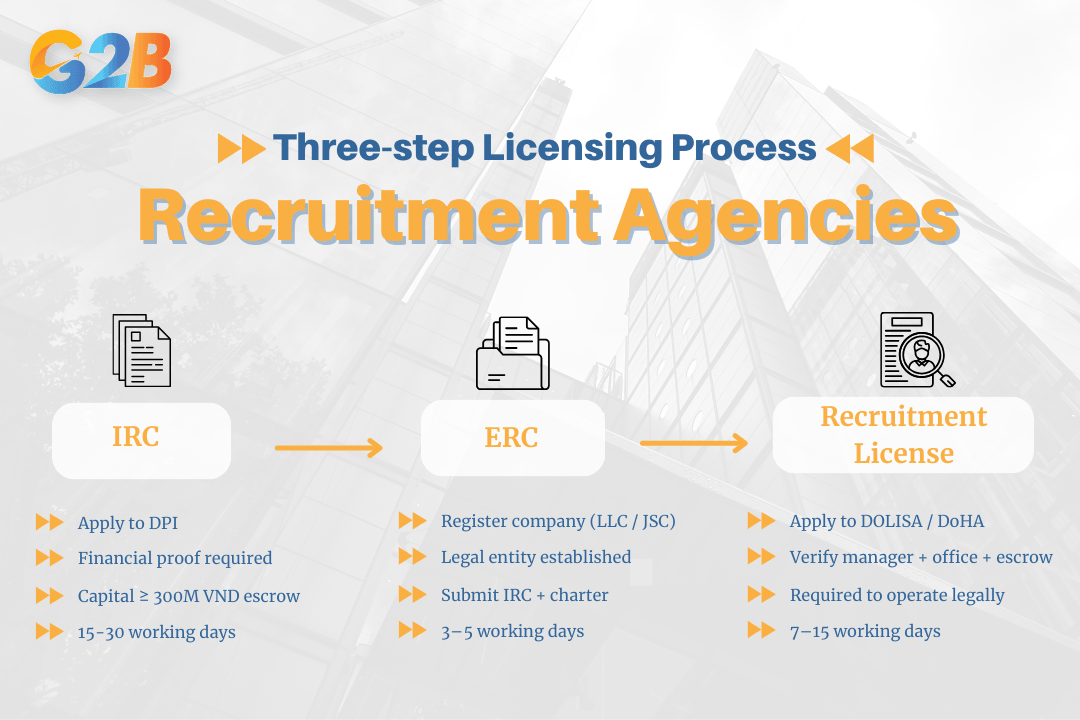
Three-step licensing process for recruitment agencies
Step 1: Applying for the Investment Registration Certificate (IRC)
The Investment Registration Certificate (IRC) refers to the primary authorization document granted to foreign direct investment (FDI) projects by the Vietnamese government. Investors submit a comprehensive investment dossier to the provincial Department of Planning and Investment (DPI) where the headquarters will be located.
During the IRC phase, the DPI evaluates the financial feasibility and socioeconomic impact of the proposed recruitment agency. Foreign investors must submit comprehensive financial proofs, such as audited corporate bank statements, parent company tax returns, and formalized equity funding commitments. The financial documentation must explicitly demonstrate that the investor possesses sufficient capital to cover both the operational business expenses and the mandatory 300,000,000 VND escrow requirement.
The statutory timeline dictates a 15-day evaluation period upon the receipt of a valid dossier, though inter-departmental consultations regarding labor market saturation often extend the practical approval timeline to approximately 25 to 30 working days.
Step 2: Obtaining the Enterprise Registration Certificate (ERC)
The Enterprise Registration Certificate (ERC) is defined by the creation of the formal legal entity under the Law on Enterprises. Following the issuance of the IRC, the investor registers the company structure, typically forming a Limited Liability Company (LLC) or a Joint Stock Company (JSC).
The enterprise registration establishes corporate rights, such as the ability to issue legally binding invoices, the capacity to hire domestic staff, and the right to execute commercial vendor contracts. The application is processed through the National Business Registration Portal and evaluated by the Business Registration Office of the DPI. This procedure requires the submission of the approved IRC, the formal company charter, and the authenticated passports or corporate records of the founding members. The standard processing timeframe for the ERC is 3 to 5 working days.
Step 3: Applying for the recruitment agency license (Sub-license)
The Recruitment Agency License is classified as the operational permit granting the registered legal entity the authority to commence headhunting and job placement activities. The ERC alone does not permit the company to conduct employment services. Operating without this sub-license constitutes an illegal business practice resulting in severe punitive actions.
The enterprise submits the sub-license dossier to the Department of Labor, Invalids and Social Affairs (DOLISA) in provinces or the Department of Home Affairs (DoHA) in Ho Chi Minh City in the province/city of the registered headquarters. The provincial DOLISA scrutinizes the academic credentials of the manager, verifying the legitimacy of the escrow deposit, and deploying inspectors to audit the physical premises. The statutory processing time for the Recruitment Agency License is 7 to 15 working days after the submission of a fully compliant and verified dossier.
Mandatory compliance and post-licensing procedures
Acquiring the recruitment agency sub-license triggers an immediate set of corporate compliance obligations governed by the General Department of Taxation and regional labor departments. Failing to fulfill these post-licensing duties triggers enterprise status suspension.
The newly licensed enterprise must fulfill immediate administrative duties, such as registering with the local tax branch, purchasing a designated digital signature token, and initiating an electronic invoicing system. The enterprise must also open a standard corporate payment account (distinct from the locked escrow account) to receive client fees, pay employee salaries, and disburse state tax obligations. Furthermore, the company must execute formal labor contracts with its internal staff, register them with the Vietnam Social Security system, and declare their Personal Income Tax (PIT) codes.
The most critical ongoing regulatory requirement for a recruitment agency is the mandatory labor reporting protocol. The company must submit periodic statutory reports to DOLISA detailing its job placement statistics, total candidate consultations, and successful workforce supply metrics. These reports are strictly mandated every 6 months (before June 20th) and annually (before December 20th). Failure to submit these operational transparency reports results in administrative fines and provides DOLISA with the legal authority to permanently revoke the agency's sub-license.
Common mistakes when opening a recruitment agency in Vietnam
Foreign investors frequently encounter structural and procedural failures by misunderstanding the strict enforcement parameters of the Vietnamese enterprise registry. Navigating this conditional sector without specialized oversight leads to critical application rejections.
- Confusing license types: Investors consistently confuse "Employment Services" with "Labor Subleasing". Employment Services strictly requires the standard 300,000,000 VND deposit. Labor Subleasing requires a massive 2 billion VND (approximately $83,000 USD) deposit alongside vastly more complex capitalization requirements. Applying for the incorrect license leads to the immediate dismissal of the entire investment project.
- Using a virtual office: Investors commonly attempt to reduce initial overhead by registering the corporate headquarters at a virtual office address. Virtual offices lead to automatic rejection because DOLISA inspectors physically verify the premises. The location must possess dedicated space to consult with walk-in job seekers, visibly display the approved corporate signboard, and present independent fire safety compliance certificates.
- Invalid experience proof: Applicants frequently submit insufficient experience records, such as uncertified resumes, self-drafted recommendation letters, and unverified digital professional profiles. DOLISA outright rejects standard CVs. Authorities absolutely require legally binding proofs, including old labor contracts explicitly stating managerial titles, verified social insurance contribution books, or official confirmation letters formally stamped by previous corporate employers or government tax departments.

Common mistakes when opening a recruitment agency in Vietnam
Frequently asked questions (FAQs) about recruitment licenses
Obtaining a recruitment license is a crucial step when establishing a recruitment agency in Vietnam. The following FAQs address common questions investors often have about licensing requirements and procedures.
Can a foreigner own 100% of a recruitment agency in Vietnam?
Yes. Vietnamese law imposes no foreign investor limit on this specific commercial sector. A foreigner can own 100% of the capital and operate as the sole legal representative of the recruitment entity.
How long does it take to get a recruitment agency license?
The total setup time takes approximately 45 to 60 working days. This structural timeline definitively covers the acquisition of the Investment Registration Certificate (IRC), the Enterprise Registration Certificate (ERC), and the final DOLISA operational sub-license.
Is the 300 million VND deposit locked?
Yes. The 300,000,000 VND is completely frozen in a specialized escrow account during the entire period of the enterprise's operation. These funds can only be officially withdrawn upon the formal termination of the employment service activities or the full dissolution of the company under the supervision of the tax and labor authorities.
Establishing structural legitimacy in the Vietnamese employment sector demands precise adherence to financial minimums, flawless document authentication, and absolute transparency in corporate structuring. Any deviation from the rigid mandates outlined in Decree 23/2021/ND-CP results in capital lockups and prolonged bureaucratic delays. By maintaining meticulous corporate compliance and securing the appropriate localized headquarters, foreign enterprises can rapidly capitalize on Vietnam's expanding labor market.
