




 Delaware (USA)
  Vietnam
  Singapore
  Hong Kong
  United Kingdom
 Labor Disputes in Vietnam represent a significant challenge for businesses operating within its dynamic economy. The complexities of a rapidly growing market, coupled with a legal framework that strongly protects employee rights, make it crucial for employers to understand the landscape of workplace conflicts. Understanding the nuances of the labor law in Vietnam is the first step toward fostering a stable and productive work environment.
This article highlights the key aspects of labor disputes in Vietnam to help businesses better understand. We specialize in Vietnam Incorporation Service and do not provide legal representation or labor litigation advisory services. For complex labor dispute cases, businesses should consult a qualified labor lawyer or legal professional.
What constitutes a labor dispute?
According to Vietnam's Labor Code 2019, a labor dispute is defined as a conflict concerning the rights, obligations, and interests that arise between parties within an employment relationship. This definition is broad, covering disagreements between an individual employee and their employer, as well as collective disputes involving employee representative organizations. The disputes can emerge at any stage of the employment lifecycle - from establishment and execution to the termination of the working relationship.
The rise of labor disputes in a growing economy
Vietnam's rapid industrialization and sustained economic growth have transformed its labor market, making it more complex and, consequently, more prone to disputes. This economic expansion has led to a heightened awareness of labor rights and obligations among the workforce.
A significant feature of Vietnam's labor landscape is the prevalence of strikes, which have historically been common, particularly in foreign-invested enterprises (FIEs). While the number of strikes has seen a decline in recent years, the potential for collective work stoppages remains a key concern for employers. These disputes not only disrupt operations but can also lead to financial losses and damage a company's reputation.
Common causes and types of labor disputes
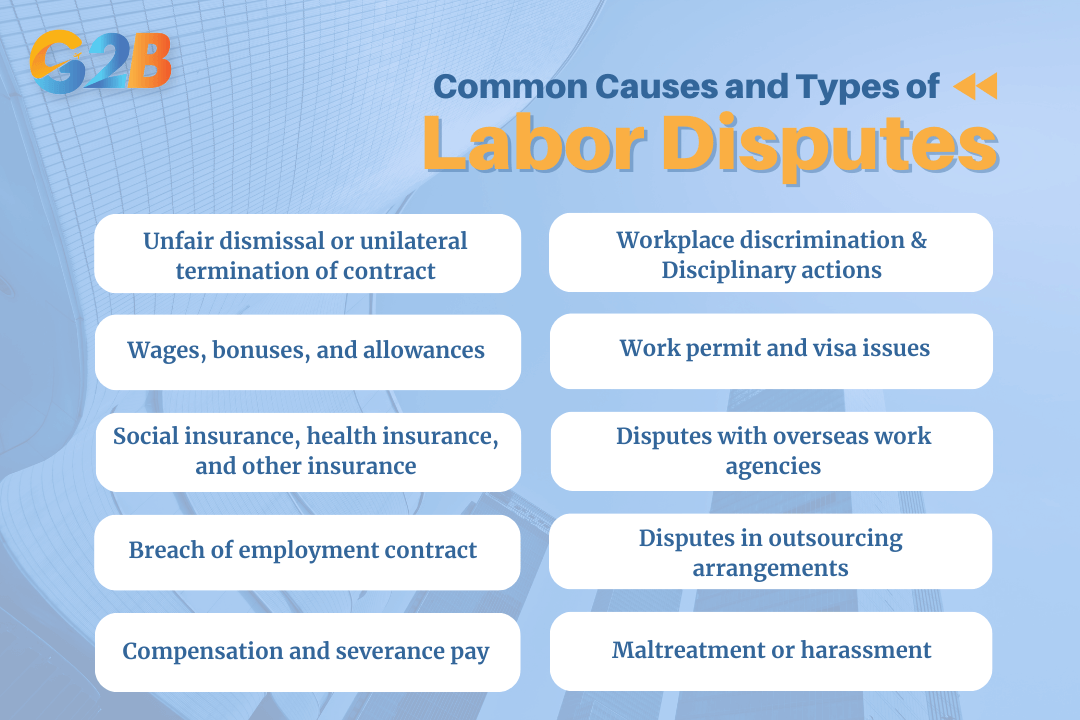
Workplace conflicts in Vietnam can be triggered by a variety of issues, often stemming from misinterpretations of the law or breaches of contractual agreements. Below are some of the most frequent causes and types of labor disputes.
Common causes and types of labor disputes
Unfair dismissal or unilateral termination of contract
An employer's failure to follow legal procedures when terminating employees in Vietnam is a primary source of conflict. Disputes related to an employer ending an employment contract without a valid legal reason or without following the correct legal procedures are a primary source of conflict. The Vietnamese Labor Code provides specific grounds for lawful termination, and any deviation can be challenged. An employer's failure to provide adequate advance notice is a common procedural error that leads to disputes. Notice periods are mandated by law and vary based on the contract type, such as 45 days for indefinite-term contracts and 30 days for fixed-term contracts.
Wages, bonuses, and allowances
Conflicts over compensation are one of the most frequent causes of labor disputes in Vietnam. These issues can include disagreements over the payment of salaries, overtime, bonuses, or other benefits stipulated in the employment agreement. Disputes often arise from ambiguous bonus policies where terms are not clearly defined, leading to unmet expectations. Late payment or the withholding of wages is another significant trigger for conflict.
To prevent disputes, wages must be calculated accurately based on the registered salary and never fall below Vietnam's minimum wage for the specific region
Social insurance, health insurance, and other insurance
Employers in Vietnam are required to make mandatory contributions to several insurance funds, such as social insurance, health insurance, and unemployment insurance. Disputes in this category often arise from disagreements over these contributions. This can involve failure to contribute the correct amount or failure to register employees for the required insurance schemes, impacting their long-term benefits.
Breach of employment contract
Conflicts frequently occur when either the employer or the employee fails to adhere to the terms and conditions agreed upon in the labor contract. For an employer, this could mean not providing the agreed-upon working conditions. For an employee, it might involve not fulfilling their job responsibilities. These breaches can lead to formal grievances and, if unresolved, legal action.
Compensation and severance pay
Disagreements regarding the amount of damages or allowances to be paid upon the termination of an employment contract are common. Severance pay is legally mandated in specific situations for employees who have worked for 12 months or more. The calculation, typically half a month's salary for each year of service, can be a point of contention if not handled transparently and in accordance with the law.
Workplace discrimination
Vietnamese law prohibits discrimination based on factors like gender, age, race, skin color, pregnancy, marital status, religion, or disability. Disputes can arise from unfair treatment in hiring, promotion, or daily work activities. For example, paying male and female employees different wages for the same work is a clear violation that can lead to a formal dispute.
Disciplinary actions
Conflicts often arise over the application of disciplinary measures, particularly dismissal. The Labor Code specifies the only permissible forms of disciplinary action, which are reprimand, deferral of a wage increase for up to six months, demotion, and dismissal. Dismissal is reserved for the most serious misconduct, such as theft, workplace violence, or disclosure of trade secrets. Employers must follow strict procedures, including holding a disciplinary hearing, to ensure the action is legally valid.
Work permit and visa issues (for foreign employees)
For foreign employees, disputes can emerge when employers misuse work permit or visa problems to unfairly terminate contracts or withhold wages. The law places the responsibility on the employer to assist with obtaining and renewing work permits, and failure to do so can be a source of conflict.
Employers must stay vigilant about the visa and employment permits of their foreign staff, including the timely application for a work permit in Vietnam
Disputes with overseas work agencies
Conflicts can also occur between an employee and the organization that sends them to work abroad under a contract. These disputes may involve issues related to the terms of the overseas assignment, payment, or working conditions.
Disputes in outsourcing arrangements
In outsourcing or labor leasing arrangements, disputes can arise between the outsourced worker and the client company they are performing work for. These issues are increasingly common as the business process outsourcing industry in Vietnam continues to expand.
Maltreatment or harassment
Disputes stemming from an employee being physically or verbally insulted, maltreated, or sexually harassed at the workplace are taken very seriously under Vietnamese law. The law defines the workplace broadly to include any location where the employee works, including work-related social events and communications. Such behavior can be grounds for an employee to immediately terminate their contract.
Best practices for employers to prevent and manage labor disputes
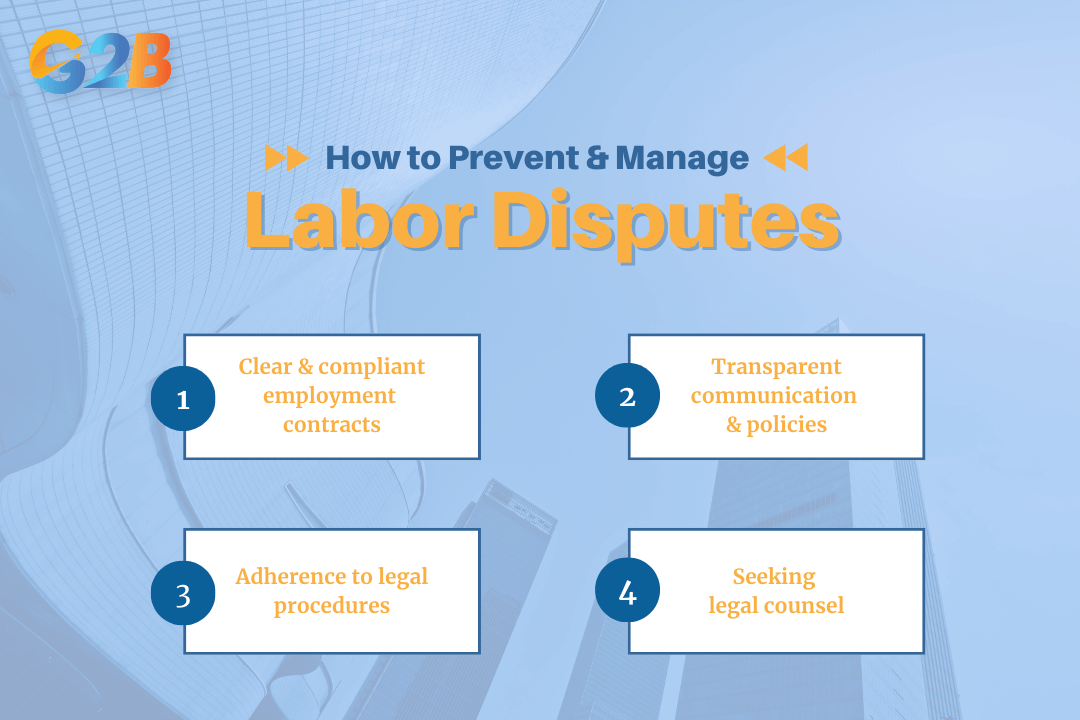
While disputes can arise, proactive and compliant human resource management can significantly mitigate the risks. Employers who prioritize fairness and transparency are better positioned to maintain a harmonious work environment.
Best practices for employers to prevent and manage labor disputes
Clear and compliant employment contracts
The most effective way to prevent disputes is to ensure all employment contracts are clear, comprehensive, and fully compliant with the latest Vietnamese Labor Code. A legally sound contract minimizes ambiguity, sets clear expectations for both parties, and serves as the foundational document for the employment relationship. It should clearly outline job responsibilities, salary, benefits, working hours, and conditions for termination.
Transparent communication and policies
Maintaining open and consistent dialogue with employees is fundamental to preventing misunderstandings. Employers should ensure that all company policies, especially those related to performance evaluation, disciplinary procedures, and bonuses, are transparent and easily accessible to all staff. Regularly conducting dialogue sessions with employees can help address concerns before they escalate into formal disputes.
Adherence to legal procedures
Strict adherence to the legal procedures outlined in the Labor Code is non-negotiable, particularly for termination and disciplinary actions. This includes providing the correct notice period, conducting disciplinary hearings with the participation of the employee's representative organization, and accurately calculating final payments. Meticulous documentation of all steps taken is crucial for demonstrating compliance if a dispute arises.
To ensure these processes are handled by experts, appointing a qualified chief accountant in Vietnam can help oversee payroll and compliance documentation, reducing the risk of administrative errors
Seeking legal counsel
Given the complexities of Vietnam's labor laws, consulting with labor law experts is a prudent investment. Legal counsel can help in drafting compliant contracts and policies, provide guidance on handling complex termination cases, and represent the company's interests during dispute resolution processes like mediation or court proceedings.
While Labor disputes in Vietnam are a common feature of its business landscape, they are often preventable. The primary causes frequently revolve around breaches of contract, disagreements over wages and benefits, and procedural failures during termination. By focusing on preventative measures such as creating clear and legally compliant employment contracts, fostering transparent communication, strictly adhering to legal procedures, and seeking expert legal advice when needed, employers can significantly reduce the risk of conflict.
Building a stable workforce starts with a solid foundation. Explore our guide on hiring employees in Vietnam to ensure your recruitment process is fully compliant from day one
