




 Delaware (USA)
  Vietnam
  Singapore
  Hong Kong
  United Kingdom
 Guarantee Company is a specific legal entity business structure primarily used by non-profit organizations, charities, and membership-based associations that do not intend to distribute profits to owners. Unlike traditional commercial entities, a private company limited by guarantee (CLG) does not have share capital or shareholders. Instead, it is owned by members who act as guarantors, pledging a nominal sum to cover the company's debts only in the event of insolvency. For social entrepreneurs and trustees, choosing the correct legal vehicle is the foundational step in organizational governance.
What is a guarantee company?
A Private Company Limited by Guarantee is a corporate structure designed for organizations pursuing social, charitable, or community-based objectives rather than profit maximization for investors. It possesses a separate legal personality, distinct from the individuals who manage or support it. The fundamental distinction lies in ownership. A standard "Company Limited by Shares" is owned by shareholders who invest capital in exchange for equity and dividends.
Conversely, a Guarantee Company is owned by Members. These members do not "own" a portion of the company in a financial sense; rather, they provide a guarantee to contribute a nominal amount towards debts if the company is wound up, thus holding limited liability instead of equity ownership. A Guarantee Company is often used by nonprofit organizations but is not strictly limited to them.
The "Non-profit" distribution logic is central to this structure. While the company can - and should - generate surplus revenue to ensure sustainability, this surplus is not distributed as dividends. Instead, any surplus is reinvested into the organization to further its mission and sustain its activities. This creates a secure environment for public funding and grants, as donors are assured that their contributions serve the cause, not private wallets.
Core attributes and characteristics
To understand why this structure is the global standard for the third sector, one must analyze its four specific legal attributes: the absence of share capital, the role of guarantors, the nominal liability limit, and its status as a legal person.
Absence of share capital and shareholders
A Guarantee Company strictly prohibits the issuance of shares. Consequently, there is no equity to buy, sell, or trade. This absence of share capital eliminates the pressure to generate returns for investors, allowing the organization to focus entirely on its social objects. Because there are no shareholders, there are no dividend payments. The removal of the profit motive changes the legal nature of the entity. It signals to stakeholders - such as government bodies, grant-making trusts, and the general public - that the organization operates for the public benefit. This structural trait is often a mandatory requirement for registering as a charity with a regulatory body like the Charity Commission.
The role of the "guarantor" (member)
In this structure, the owners are referred to as members or guarantors. While members perform a custodial role overseeing the organization’s mission, they also accept a limited financial liability in the event the company is wound up. Members are stewards of the organization’s mission. They do not possess a "stake" that increases in value if the company succeeds. Members exercise control through democratic governance. They are responsible for critical constitutional decisions, such as changing the Articles of Association, appointing or removing directors, and approving the annual accounts at the Annual General Meeting (AGM). While they hold the ultimate power, they do not have a claim on the company's assets during its operation or upon dissolution.
The guarantee mechanism: Nominal liability limits
The term "Limited by Guarantee" refers to the limited liability protection afforded to its members. Every member must sign a declaration, usually found in the Memorandum of Association, agreeing to contribute a specific amount to the company's assets if it is wound up. This amount is the "guarantee." It is a nominal sum, typically fixed at £1, $1, or $10, representing the maximum amount each member guarantees to contribute if the company is wound up. It is crucial to understand that this amount is not paid upfront. It is a contingent liability. The member pays this sum only if the company becomes insolvent and enters liquidation or winding up proceedings while they are a member, or within one year of them ceasing to be a member. This mechanism protects the personal assets of the trustees and social entrepreneurs, encouraging individuals to lead non-profits without fear of financial ruin.
Separate legal entity status
A Guarantee Company enjoys separate legal personality. Upon incorporation by Companies House (or the relevant registrar), the company becomes a "legal person" in the eyes of the law. This status empowers the organization to perform autonomous legal acts, including:
- Owning property and assets (land, equipment, intellectual property) in its own name, rather than in the names of the trustees.
- Entering into contracts with suppliers, landlords, and employees.
- Suing and being sued in courts of law.
This separation creates a "corporate veil" that shields the directors and members from the company's liabilities, provided they have acted within the scope of their fiduciary duty and not engaged in wrongful trading.
Governance and organizational structure
The governance of a Guarantee Company is defined by its constitutional documents and the relationship between its members and directors.
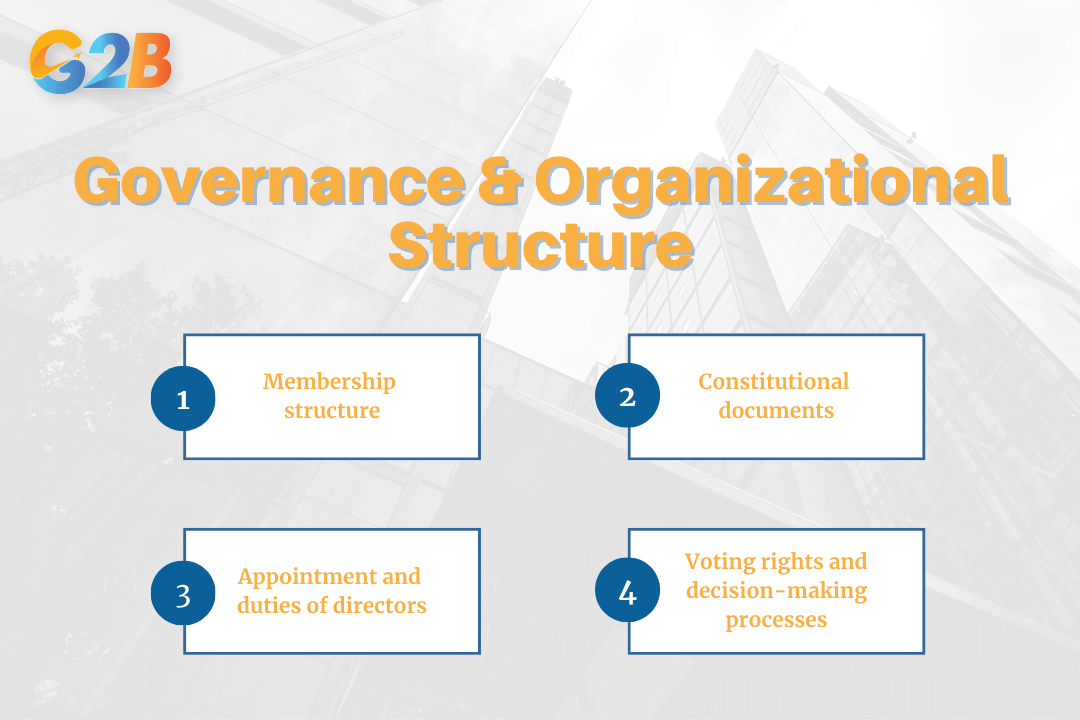
Governance and organizational structure
Membership structure
Membership in a Guarantee Company is personal, meaning it is non-transferable. A member cannot sell or gift their membership to another individual. Membership automatically terminates upon specific events, such as death, resignation, or expulsion in accordance with the company’s rules. The admission of new members is typically overseen by the Board of Directors. Organizations can structure their membership to be open (e.g., a community sports club) or closed (e.g., a small NGO where the members are the same individuals as the directors). The register of members must be kept up to date to ensure valid voting procedures.
Appointment and duties of directors
While members "own" the company, the Board of Directors (often called the Management Committee or Board of Trustees) manages it. Members appoint directors to oversee daily operations and strategic direction. Directors are subject to strict statutory obligations. They must adhere to fiduciary duties, including acting within their powers, promoting the success of the company, exercising independent judgment, and avoiding conflicts of interest. In many small non-profits, the list of members and the list of directors are identical. However, as the organization scales, it is common to separate these roles, having a large base of voting members who elect a smaller, specialized Board of Directors.
Voting rights and decision-making processes
Democracy is the hallmark of the Guarantee Company. The standard voting principle is "one member, one vote," regardless of how long an individual has been a member or how much they have donated. This prevents any single entity from buying influence, contrasting sharply with the "one share, one vote" system of commercial companies. Major decisions occur at General Meetings. The Annual General Meeting (AGM) is the primary forum where members review financial performance, hold directors accountable, and vote on special resolutions.
Constitutional documents
The Articles of Association serve as the internal rulebook. For a Guarantee Company, the Articles must be drafted with precision to reflect its non-profit nature. Key clauses include:
- The object clause: Defines the specific purpose of the organization (e.g., "to relieve poverty in region X").
- The bon-profit distribution clause: Prohibits the distribution of profits as dividends to members.
- The dissolution clause: Mandates that upon winding up, any remaining assets must be transferred to another non-profit entity with similar objects, rather than distributed to members.
Financial structure and funding
Without shares to sell, a Guarantee Company must rely on alternative financial strategies to sustain its operations.
Restrictions on profit distribution (the "non-profit" lock)
A key optional feature, often called the Asset Lock, this legal clause ensures that the company's assets and profits are permanently dedicated to its social purpose. The asset lock prevents the monetization of the company for private gain. Any surplus revenue generated from trading (e.g., selling tickets, merchandise, or training services) is retained as "reserves." These reserves provide financial stability and capital for future projects. This restriction is what makes the structure attractive to public funders, who require assurance that their grants will not leak out as profits.
Challenges in raising capital (inability to issue equity)
The primary disadvantage of this structure is the inability to raise equity financing. Since the company cannot issue shares, it cannot attract funding from Venture Capitalists (VCs) or Angel Investors, who require an ownership stake and an exit strategy (ROI). This limitation makes a Guarantee Company unsuitable for high-growth startups that require massive upfront capital investment to scale quickly. Founders looking for rapid expansion via investment rounds should consider a Company Limited by Shares with a social mission statement, or a specific hybrid model like the Community Interest Company (CIC) limited by shares (in the UK context).
Alternative funding sources
To overcome the lack of equity funding, Guarantee Companies utilize diverse revenue streams, such as:
- Government and institutional grants: Funds provided for specific projects with no repayment obligation. Organizations may qualify for various startup grants and incentives designed to support community development.
- Commercial loans: Bank financing based on the company's ability to service debt.
- Debentures: Long-term loans secured against the company's assets.
Because the company is a separate legal entity, it can borrow money in its own name. However, banks may require personal guarantees from directors if the company lacks sufficient assets to secure the loan.
Member subscriptions and membership fees
For associations and clubs, membership subscriptions (dues) form the financial backbone. These are recurring payments made by members to maintain their voting rights and access services. Unlike share capital, these payments are treated as revenue, not equity. This model provides a predictable cash flow, allowing for better financial planning and budget management.
Guarantee company vs. non-profit business types in Vietnam
It is imperative to understand that the Company Limited by Guarantee (CLG) is a concept rooted in Common Law.
The Vietnam reality: Civil law distinctions
Vietnam operates under a Civil Law system. The Law on Enterprise 2020 does not provide a direct equivalent to the "Company Limited by Guarantee." In Vietnam, all limited liability companies require a defined Charter Capital (capital contribution) and owners are liable up to their contributed capital, not a "nominal guarantee."
The Vietnamese alternative: Social enterprise
If you intend to operate a structure similar to a Guarantee Company in Vietnam - where the focus is mission over profit - the correct legal vehicle is a Limited Liability Company (LLC) registered specifically as a Social Enterprise.
Key differences:
- Capital: A Vietnamese Social Enterprise must have Charter Capital. There is no "zero capital" or "guarantee only" option. Members must contribute actual funds or assets during incorporation.
- Profit commitment: To qualify as a Social Enterprise, the company must commit to reinvesting at least 51% of its total profits back into its registered social or environmental goals. This serves a similar function to the "Asset Lock" in a CLG.
- Governance: The governance follows the standard LLC model (Member's Council), but the Charter (Articles) is customized to restrict profit distribution.
For foreign NGOs (INGOs), operating as a Representative Office or under a Project Permit is common, but these are not corporate entities. For those wanting a legal entity to invoice and employ staff locally, the Social Enterprise LLC is the optimal path.
Common use cases and business models
The flexibility of the Guarantee Company makes it the preferred vehicle for various sectors.
Charities and non-profit organizations (NGOs)
This is the standard structure for modern charities. It offers the best of both worlds: corporate status to sign contracts and limited liability to protect trustees. It allows the charity to operate professionally while adhering to strict regulatory standards regarding non-distribution of profit. In the United States, for example, such entities often seek 501(c)(3) organization status to ensure tax-exempt benefits for charitable, religious, or educational activities.
Property management companies (RTM)
In the property sector, Right to Manage (RTM) companies or residents' management companies are often formed as Guarantee Companies. Here, the members are the leaseholders of a building. The company exists solely to manage communal areas, insurance, and maintenance, collecting service charges to cover costs without seeking a profit.
Professional associations and trade unions
Industry bodies, such as Law Societies, Medical Associations, and Chambers of Commerce, utilize this structure. It allows the organization to act as a collective voice for its profession. The assets are held for the benefit of the profession, and the democratic voting structure ensures that the leadership represents the will of the membership.
Sports clubs and membership societies
From local tennis clubs to national sports federations, the Guarantee structure supports community ownership. It facilitates a culture where the club belongs to its supporters. Surplus revenue from ticket sales or merchandise is poured back into facilities, youth training academies, and coaching staff. For reference, social and recreational clubs in other jurisdictions often align with the 501(c)(7) social clubs model, which focuses on pleasure and recreation rather than profit.
Taxation and regulatory compliance
A common misconception is that a Company Limited by Guarantee is automatically tax-exempt. This is factually incorrect. Legal structure and tax status are separate issues.

Taxation and regulatory compliance
Corporate tax obligations for guarantee companies
By default, a Guarantee Company is a taxable entity. It is liable for Corporate Income Tax (CIT) on any trading profits, investment income, or capital gains. If a Guarantee Company engages in commercial trade not directly related to its charitable purpose (e.g., a charity selling branded t-shirts), those profits are taxable unless specific relief is applied.
VAT registration and exemptions
Guarantee Companies must register for Value Added Tax (VAT) if their taxable turnover exceeds the statutory threshold (e.g., £90,000 in the UK, or the relevant limit in other jurisdictions). However, many services provided by non-profits - such as education, welfare services, and cultural events - may be exempt from VAT, reducing the administrative burden.
Applying for charitable status and tax relief
To achieve tax exemption, the company must apply for Charitable Status after incorporation. This is a two-step process:
- Incorporation: Register the Guarantee Company with the business registrar (e.g., Companies House).
- Registration: Apply to the regulator (e.g., Charity Commission) and Tax Authority (e.g., HMRC) for recognition as a charity.
Once charitable status is granted, the company benefits from tax reliefs, such as exemption from CIT on primary purpose trading and relief on business rates (property tax).
Annual reporting and accounting requirements
Transparency is the price of limited liability. The company must file annual statutory documents, such as the confirmation statement, annual accounts, and tax returns. These documents are publicly available. For companies with Charitable Status, the reporting is dual-layered: accounts must be sent to both the Registrar of Companies and the Charity Commission. This high level of transparency builds trust with donors, beneficiaries, and the wider community, proving that funds are managed responsibly.
The Guarantee Company remains the gold standard for organizations dedicated to purpose rather than profit. Its unique blend of corporate protection, democratic governance, and asset locking provides a robust foundation for charities and social enterprises globally. However, translating this structure into the Vietnamese market requires careful legal engineering. For mission-driven founders seeking an emerging, high-impact environment, this is the right moment to register a company in Vietnam and build a sustainable organization aligned with both global best practices and Vietnam’s rapidly evolving legal landscape.
