




 Delaware (USA)
  Vietnam
  Singapore
  Hong Kong
  United Kingdom
 Greenfield investment in Vietnam offers one of the most dynamic and high-growth opportunities in the global market for companies looking to establish new operations from the ground up. As Vietnam continues its rapid economic ascent, understanding the nuances of its investment environment is crucial for success. This article will delve into what a greenfield investment entails in the Vietnamese context, why the country is such a compelling destination, and the core legal structures that govern these transformative projects.
Understanding greenfield investment in Vietnam
A greenfield investment is a form of foreign direct investment (FDI) where a foreign investor starts a new venture in a foreign country by constructing new operational facilities from the ground up. In contrast to mergers and acquisitions (M&A), a greenfield project gives the investor maximum control over its new enterprise, allowing for the precise implementation of its business model, technology, and corporate values. This approach is particularly favored by companies in the manufacturing and processing sectors that require specialized facilities tailored to their production needs.
In recent years, Vietnam has placed a significant emphasis on attracting high-quality, sustainable investments, especially in green tech. This strategic shift is formalized through its National Green Taxonomy, a classification system designed to channel capital towards environmentally friendly projects. To qualify for various incentives, such as green credit and green bonds (among others), projects must now meet specific environmental criteria.
On July 4, 2025, the government issued Decision No. 21/2025/QD-TTg, promulgated by the Prime Minister, which establishes the official environmental criteria and verification process for investment projects under this taxonomy. This framework is crucial for investors aiming to align with Vietnam's sustainable development goals. Projects in prioritized sectors that meet these standards can gain access to preferential financing and other government support, signaling a clear advantage for "green" greenfield investments.
The following table illustrates key sectors prioritized for green investment and the general requirements to become eligible for green financing mechanisms:
| Field | Green Credit | Green Bonds | Requirements |
|---|---|---|---|
| Renewable & Clean Energy | Eligible | Eligible | Projects must meet specified efficiency standards and use certified equipment for solar, wind, and biomass energy production. |
| Green Construction | Eligible | Eligible | Buildings must be certified by a recognized green building organization and comply with legal requirements on reducing emissions. |
| Sustainable Agriculture & Forestry | Eligible | Eligible | Projects must adhere to national or international standards like VietGAP or GlobalGAP and promote water conservation and sustainable land use. |
| Clean Transportation | Eligible | Eligible | Investment must be in low- or zero-emission vehicles powered by electricity or other green fuels. |
| Water Management & Wastewater Treatment | Eligible | Eligible | Projects must focus on water conservation, wastewater treatment, and improving water infrastructure. |
Why Vietnam is a prime destination for greenfield projects
With strong government support for foreign investment and a strategic position within Asia’s supply chain, Vietnam offers an ideal foundation for building new operations from the ground up.
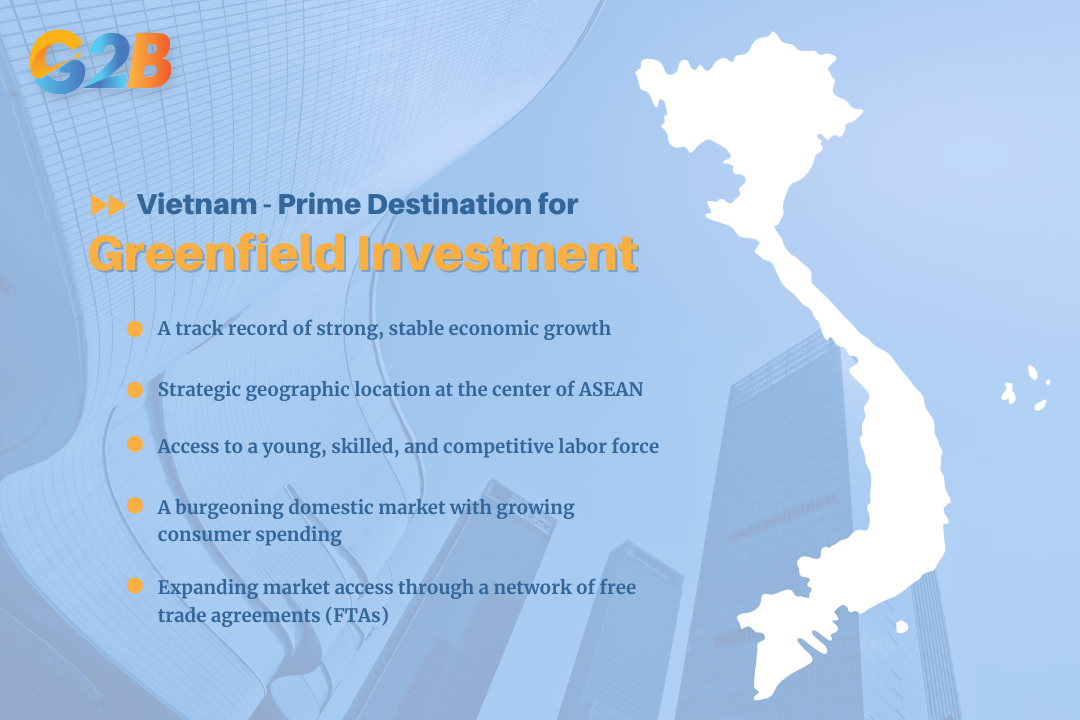
Vietnam is a prime destination for greenfield projects
A track record of strong, stable economic growth
Vietnam's economy has demonstrated remarkable resilience and consistent growth, even during periods of global economic instability. Its macroeconomic stability provides a secure and predictable environment, which is a critical factor for the long-term commitment required by greenfield investments. Reputable financial institutions have consistently forecast strong growth for the nation. For instance, the Asian Development Bank (ADB) projected Vietnam economic growth to be 6.7% in 2025 and 6.0% in 2026, underscoring its position as one of the fastest-growing economies in the region. This sustained economic performance is fueled by robust exports, strong domestic consumption, and significant foreign direct investment, creating a virtuous cycle of development.
Strategic geographic location at the center of ASEAN
Vietnam’s geographical position is a powerful logistical asset. With a long coastline featuring deep-water ports, it serves as a critical hub on major international shipping routes. Its proximity to China has made it an indispensable part of the "China+1" supply chain diversification strategy, allowing companies to mitigate risks by expanding production beyond a single country. Furthermore, its location in the heart of Southeast Asia provides businesses with a strategic gateway to the entire ASEAN market, a bloc of over 660 million consumers. This combination of global connectivity and regional access makes Vietnam an ideal base for manufacturing and export-oriented enterprises.
To capitalize on this location, investors should prepare a comprehensive business plan that outlines logistics strategies and market entry points. A well-structured plan is not only essential for operational success but also a requirement for obtaining investment licenses.
Access to a young, skilled, and competitive labor force
Vietnam's demographic profile offers a significant competitive advantage. The country boasts a large and youthful population, with a median age of approximately 33.4 years. This translates to a dynamic and adaptable labor force. As of early 2025, Vietnam's labor force was estimated to be around 53 million people. While labor costs remain competitive compared to other manufacturing hubs, the quality of the workforce is steadily increasing. The percentage of laborers with degrees or certificates has risen to 27.8%, indicating a growing pool of skilled talent capable of meeting the demands of high-tech and value-added industries.
Expanding market access through a network of free trade agreements (FTAs)
Vietnam is one of the most open economies in the world, thanks to its proactive engagement in international trade. It is a party to over 17 free trade agreements, which provide businesses operating within its borders with preferential access to a vast network of global markets. Key agreements include the Comprehensive and Progressive Agreement for Trans-Pacific Partnership (CPTPP), the EU-Vietnam Free Trade Agreement (EVFTA), and the Regional Comprehensive Economic Partnership (RCEP). These FTAs significantly reduce or eliminate tariffs on a wide range of goods, such as textiles, electronics, and agricultural products, giving Vietnam-based producers a distinct competitive edge when exporting to key markets like the European Union, Japan, and Australia.
A burgeoning domestic market with growing consumer spending
While Vietnam is a powerful export platform, its domestic market represents a compelling opportunity in its own right. With a population nearing 100 million people and a rapidly expanding middle class, domestic consumer spending is on a strong upward trajectory. In 2024, total retail sales of consumer goods and services saw a significant year-on-year increase, a trend that continued into 2025. This rising disposable income is fueling demand for a wide array of products and services, from consumer electronics and vehicles to high-quality food and modern retail experiences. For greenfield investors, this creates a dual opportunity: to manufacture for export and to sell directly to one of Southeast Asia’s most dynamic consumer markets.
Legal framework governing greenfield investments in Vietnam
The legal framework governing greenfield investments in Vietnam provides a structured pathway for foreign investors looking to establish new operations in the country.
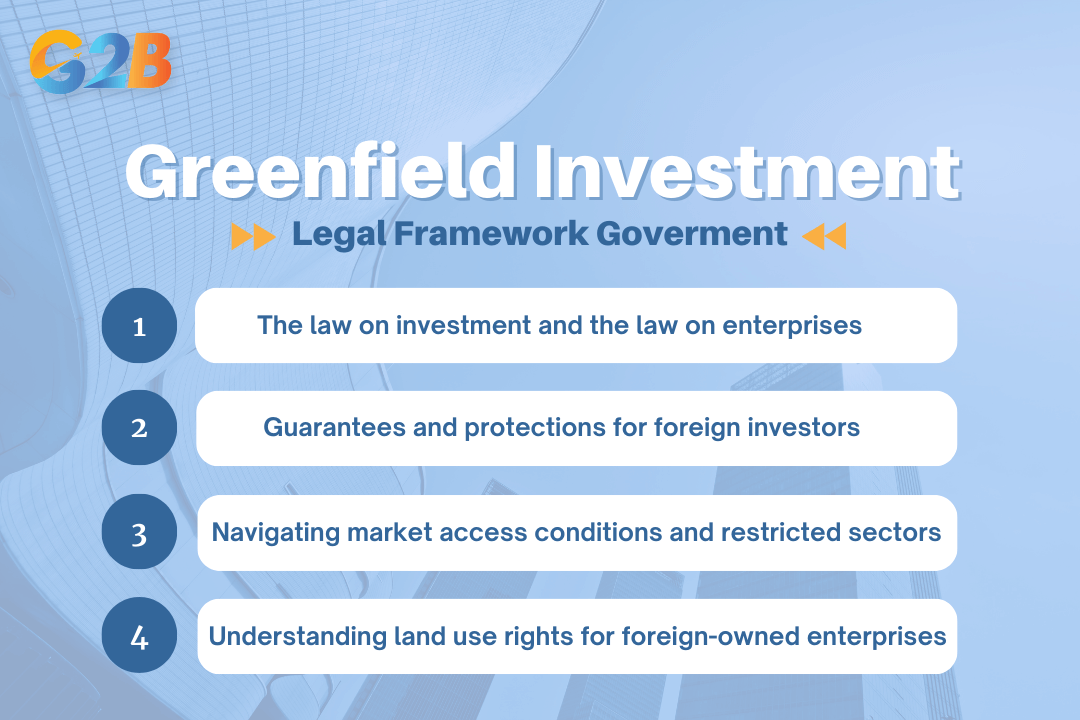
Legal framework governing greenfield investments provides a structured pathway
The law on investment and the law on enterprises
The legal bedrock for foreign investors in Vietnam is formed by two principal laws: the Law on Investment and the Law on Enterprises. The Law on Investment is the primary legislation that governs all investment activities. It outlines the sectors open to foreign investment, the conditions and procedures for establishing a project, and the incentives available to investors. A crucial step under this law is obtaining an Investment Registration Certificate (IRC), which officially recognizes the foreign investment project. Concurrently, the Law on Enterprises governs the establishment, organization, and operation of the business entity itself, such as a Limited Liability Company (LLC) or a Joint Stock Company. This law dictates the requirements for obtaining an Enterprise Registration Certificate (ERC), which formally creates the legal entity.
In some infrastructure projects, the legal framework also allows for public-private partnerships, such as the Build-Operate-Transfer (BOT) contract, which can be an alternative to traditional greenfield investment for large-scale developments.
Guarantees and protections for foreign investors
Vietnam's legal framework provides robust protections for foreign investors, creating a secure and transparent environment. The Law on Investment explicitly guarantees the protection of assets and ensures that foreign-owned capital will not be nationalized or expropriated through administrative measures without fair and adequate compensation. These domestic legal guarantees are further reinforced by a wide network of bilateral investment treaties and free trade agreements that Vietnam has signed. These international agreements provide an additional layer of security, offering provisions for fair and equitable treatment and access to international arbitration for resolving disputes.
Navigating market access conditions and restricted sectors
Vietnam has adopted a "negative list" approach to market access for foreign investors, a key reform introduced in the 2020 Law on Investment. This means that foreign investors are permitted to operate in any sector not explicitly prohibited or conditioned. This approach enhances transparency and simplifies the investment process.
The specifics are detailed in Decree 31/2021/ND-CP, which outlines the list of sectors with market access restrictions. This list includes:
- 25 prohibited business lines where foreign investment is not permitted, such as debt collection services and activities related to national security.
- 59 conditional business lines where foreign investment is allowed but subject to specific requirements.
Examples of such conditions include foreign ownership limits, which are capped in sectors like advertising services, or requirements to form a joint venture with a local partner, as is often the case in education services. For all other sectors not on this negative list, foreign investors receive the same treatment as domestic investors.
Understanding land use rights for foreign-owned enterprises
A fundamental principle of Vietnam's legal system is that the state holds ownership of all land. Foreign investors cannot own land directly; instead, they secure Land Use Rights (LURs), which act as a long-term lease from the state. These LURs grant the holder the right to use the land for a specific purpose and duration, typically 50 years for foreign investment projects, with the possibility of extension.
There are several common methods for a foreign-owned enterprise to secure these rights:
- Leasing land directly from the state: This involves an application process and a land lease agreement with the relevant provincial authorities.
- Subleasing land within an industrial park or economic zone: This is often the most straightforward method, as the industrial park developer has already cleared the land and obtained the master LUR from the state.
The new Land Law 2024, effective from August 2024, has introduced important changes favorable to foreign investors. Notably, it provides greater flexibility by allowing foreign-invested enterprises to receive transfers of LURs within industrial zones, a right previously not available under the old law. This reform is expected to create more favorable conditions for M&A activities and operational flexibility within these designated zones.
Greenfield investment in Vietnam presents a powerful opportunity for businesses aiming to build a strategic presence in one of the world's most promising markets. The country’s combination of a stable, high-growth economy, a strategic location at the nexus of global trade, a young and capable workforce, and an increasingly supportive and transparent legal framework creates an exceptionally favorable environment for building operations from the ground up.
The government's clear commitment to attracting sustainable, high-quality projects further aligns with the long-term goals of forward-thinking global companies. For investors ready to navigate this dynamic landscape, the potential for growth and success is immense. G2B will be your trusted partner, providing the essential guidance and in-depth knowledge needed to establish a company in Vietnam successfully.
