




 Delaware (USA)
  Vietnam
  Singapore
  Hong Kong
  United Kingdom
 Green tech is the application of science and technology to mitigate the negative human impact on the environment while maintaining economic viability. For modern business leaders and investors, it is no longer a niche vertical but a fundamental asset class and a critical lever for operational optimization.
This article explains the key concepts of green tech. We specialize in company formation in Vietnam and not in engineering or environmental technology consulting. For technical guidance on green technology development, please consult a qualified expert.
What is green tech?
Green tech, or green technology, encompasses a broad spectrum of innovations, processes, and business models designed to foster a sustainable relationship between industrial progress and the biosphere. It moves beyond simple pollution control to address the systemic inefficiencies of the traditional industrial economy. Green tech also focuses on environmental restoration and regenerative solutions that repair existing damage and promote ecosystem resilience.
The fundamental shift driving green tech adoption is the transition from a linear economy (take-make-waste) to a circular economy. In a linear model, raw materials are extracted, processed into goods, and eventually discarded as waste. Green tech disrupts this by introducing restorative and regenerative cycles, where waste from one process becomes the input for another. It supports sustainable product lifecycle management, emphasizing resource efficiency, product durability, and material reuse.
For corporations, green tech acts as a strategic sector for regulatory compliance and long-term profitability. Governments worldwide are implementing stricter Environmental, Social, and Governance (ESG) mandates. Consequently, companies integrating green technologies - such as carbon capture systems, energy-efficient algorithms, and biodegradable materials - protect themselves against transitional risks like carbon taxes and asset stranding. Green tech solutions span renewable energy, sustainable transportation, waste management, and energy efficiency, addressing the triple planetary crisis of climate change, biodiversity loss, and pollution. Furthermore, it includes sustainable business models and environmentally friendly manufacturing processes.
Key pillars of the green tech ecosystem
The green tech landscape is vast, composed of interconnected sectors that function as a cohesive industrial ecosystem. Understanding these pillars is essential for capital allocation and supply chain modernization.
Clean energy generation
Decarbonizing the power grid is the foundational step in the green transition. This pillar focuses on deploying renewable energy technologies that operate without emitting Green House Gases (GHGs).
- Solar photovoltaics (PV): Innovation in monocrystalline silicon cells, bifacial panels, and perovskite solar cells has drastically reduced the Levelized Cost of Energy (LCOE). Commercial installations now leverage smart inverters and AI-driven tracking systems to maximize irradiance capture and grid integration.
- Offshore wind: Unlike onshore counterparts, offshore wind farms utilize larger turbines and higher wind speeds to generate baseload-level power. Advancements in floating wind platforms allow deployment in deeper waters, expanding the potential for gigawatt-scale generation.
- Green hydrogen: Essential for decarbonizing "hard-to-abate" heavy industries like steel and shipping, green hydrogen is produced via electrolysis powered by renewable energy. It serves as a versatile energy carrier and feedstock, replacing grey hydrogen derived from fossil fuels.
Energy storage and battery technologies (BESS)
The intermittency of renewables necessitates robust Battery Energy Storage Systems (BESS) to ensure grid stability and dispatchability.
- Lithium-ion dominance: Currently the standard for Electric Vehicles (EVs) and short-duration grid storage, utilizing chemistries like Lithium Iron Phosphate (LFP) and Nickel Manganese Cobalt (NMC).
- Emerging architectures: Investors are funding solid-state batteries, which promise higher energy density and safety, and vanadium redox flow batteries, which offer superior scalability for long-duration utility storage.
- Grid services: Advanced storage systems provide essential grid services, including frequency regulation, voltage control, and peak shaving, allowing utilities to defer expensive infrastructure upgrades.
Sustainable mobility and transport
This pillar extends beyond the production of Electric Vehicles (EVs) to the entire ecosystem required to move people and goods with zero tailpipe emissions.
- Infrastructure: The rollout of Level 3 Direct Current (DC) fast chargers is critical for reducing range anxiety. Smart charging networks utilize vehicle-to-grid (V2G) technology, treating EVs as mobile battery units that can stabilize the grid during peak demand.
- Fleet electrification: Logistics companies are adopting electric delivery vans and heavy-duty e-trucks. Success relies on AI-driven fleet management software that optimizes route planning based on battery range, payload, and charging station availability.
- Alternative fuels: For aviation and maritime shipping, where electrification is difficult, the focus is on Sustainable Aviation Fuel (SAF) and green methanol, synthesized from biogenic waste or captured carbon.
Circular economy and waste management
Green tech transforms waste management from a logistical burden into a resource recovery opportunity.
- Waste-to-energy (WtE): Modern incineration plants use anaerobic digestion and gasification to convert organic waste into electricity, heat, or renewable natural gas (RNG), diverting mass from landfills.
- Advanced recycling: Unlike mechanical recycling, chemical recycling technologies (such as pyrolysis) break down plastics into their molecular building blocks (monomers). This allows for the creation of virgin-quality plastics from mixed, contaminated waste streams that were previously non-recyclable.
- Product lifecycle management: Digital passports and blockchain tracking enable transparent supply chain management for businesses, ensuring materials can be identified, recovered, and reused at the product's end-of-life.
Green building and smart city infrastructure
The built environment contributes significantly to global carbon emissions. Green tech mitigates this through energy efficiency and material innovation.
- Smart HVAC and IoT: Commercial buildings utilize Internet of Things (IoT) sensors and building management systems (BMS) to automate heating, cooling, and lighting based on real-time occupancy and weather data, significantly lowering OpEx.
- Low-carbon materials: Structural innovation focuses on Green Steel (produced using hydrogen) and low-carbon cement alternatives that utilize supplementary cementitious materials or carbon injection to reduce the embodied carbon of construction.
- District energy systems: Smart cities implement district heating and cooling networks that utilize waste heat from data centers or industrial processes to condition multiple buildings, maximizing thermal efficiency.
Agritech and sustainable food systems
Feeding a growing population while restoring soil health requires high-precision technology.
- Precision farming: Farmers employ drones, satellite imagery, and soil moisture sensors to apply water, fertilizers, and pesticides only where strictly necessary. This reduces runoff pollution and input costs.
- Alternative proteins: The sector includes plant-based formulations and cultivated meat (lab-grown) technologies. These methods drastically reduce the land use, water consumption, and methane emissions associated with traditional livestock farming.
- Vertical farming: Controlled Environment Agriculture (CEA) utilizes hydroponics and aeroponics stacked vertically in urban centers, reducing food miles and eliminating the need for arable land.
Carbon capture, utilization, and storage (CCUS)
To reach Net Zero, emissions reduction is not enough; active removal is required.
- Direct air capture (DAC): Industrial facilities filter CO2 directly from the atmosphere. While currently energy-intensive, scaling this technology is viewed as vital for offsetting unavoidable emissions.
- Carbon utilization: Captured carbon is not just stored but used as a feedstock to produce synthetic fuels, carbon-cured concrete, and industrial chemicals, creating a market value for CO2.
- Carbon accounting: Enterprise-grade SaaS platforms automate the tracking of Scope 1, 2, and 3 emissions, ensuring accurate reporting for investors and regulatory bodies.
Benefits of green tech
Adopting green tech offers a compelling B2B business case, moving beyond ethical considerations to tangible financial and strategic advantages.

There are 04 benefits of green tech
Operational efficiency and lower OpEx: Technologies such as LED lighting, variable speed drives, and automated energy management systems deliver immediate cost savings. Renewable energy installations lock in electricity prices, shielding businesses from the volatility of fossil fuel markets. Green tech also improves overall sustainability across supply chains and reduces lifecycle costs and climate-related financial risks.
Risk mitigation: Companies with high ESG scores and green tech integration are better positioned to navigate regulatory shifts, such as the EU’s Carbon Border Adjustment Mechanism (CBAM). Furthermore, they mitigate physical climate risks by adopting resilient infrastructure and diversified, local supply chains. Increasingly stringent ESG standards drive investor preference towards sustainable portfolios, enhancing capital access for green adopters.
Access to capital: Global finance is prioritizing sustainability. Businesses leveraging green tech have preferential access to business funding avenues like Green Bonds, sustainability-linked loans, and impact venture capital. Furthermore, many governments now offer specific business grant programs to subsidize the initial cost of adopting these technologies, effectively lowering the barrier to entry.
Brand equity and talent retention: Demonstrable commitment to green tech attracts top-tier talent, particularly among Gen Z and Millennials who prioritize purpose-driven employers. It also enhances brand value among B2B partners requiring sustainable supply chain certifications. Additionally, it fosters customer loyalty and strengthens corporate social responsibility commitments.
Challenges of green tech

There are 04 challenges of green tech
High capital expenditure (CapEx): Many green technologies, such as offshore wind farms or retrofitting factories for hydrogen, require massive upfront investment. While OpEx is often lower, the initial hurdle rate can be prohibitive for Small and Medium Enterprises (SMEs) without green financing.
The "green premium": In sectors like aviation (SAF) or construction (Green Cement), the sustainable option currently costs more than the carbon-heavy incumbent. Scaling production is required to drive these costs down to parity.
Infrastructure deficits: The rapid expansion of renewables and EVs is outpacing grid capacity. Grid congestion and the lack of transmission lines often delay the connection of new solar and wind projects, causing "curtailment" (wasted energy).
Regulatory uncertainty: While the long-term trend is clear, short-term policy fluctuations regarding subsidies, tax credits, and tariff structures can disrupt investment timelines and ROI calculations.
Opportunities when investing in green tech in Vietnam
Vietnam represents a high-potential growth industry for green tech investment, driven by strong government commitment and rapid industrialization.
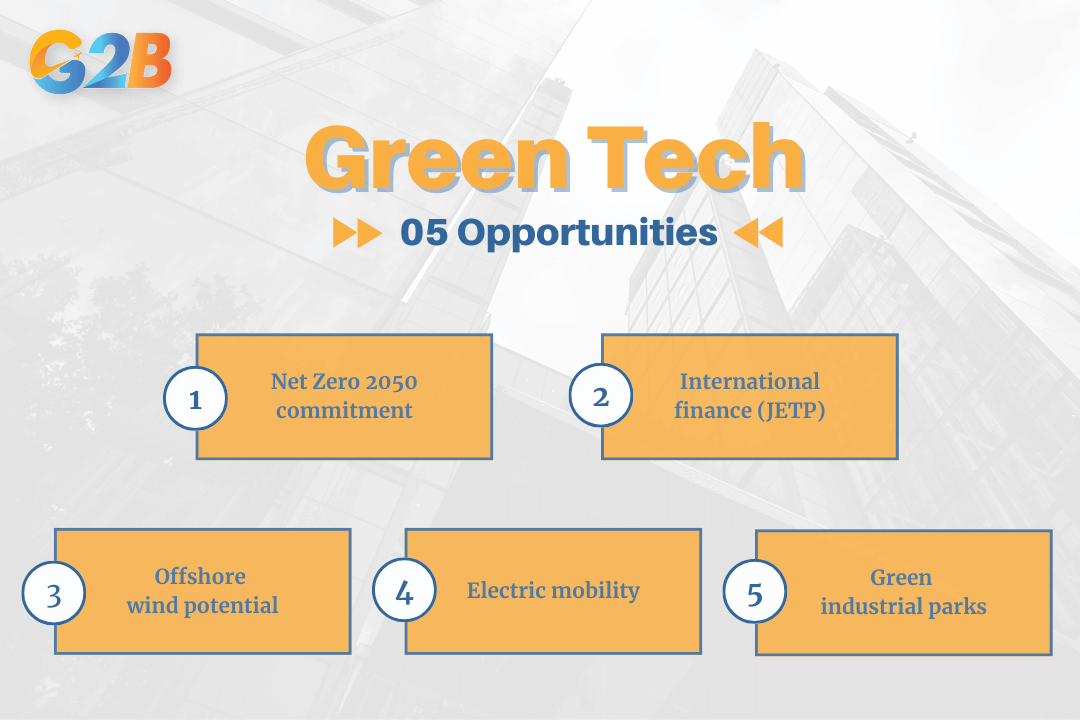
05 Opportunities when investing in green tech
- Net Zero 2050 commitment: At COP26, Vietnam pledged to reach Net Zero emissions by 2050. This political will is codified in the Power Development Plan 8 (PDP8), which prioritizes a transition away from coal toward renewable energy and gas-to-power projects.
- International finance (JETP): Vietnam is a partner in the Just Energy Transition Partnership (JETP), which mobilizes $15.5 billion in financing from G7 nations and private lenders to support the country's green transition. This influx of capital de-risks projects for foreign investors.
- Offshore wind potential: With a long coastline and high wind speeds, Vietnam has immense potential for offshore wind energy. Investors are eyeing this sector to not only supply domestic power but potentially export clean energy to neighboring ASEAN nations.
- Green industrial parks: To attract FDI from global conglomerates like Lego, Nike, and Samsung - all of whom have strict Net Zero targets - Vietnam is developing Green Industrial Parks. These zones benefit from green field investment policies in Vietnam, which offer incentives for projects built from scratch that meet sustainability criteria, prioritizing rooftop solar, wastewater recycling, and LEED-certified factory shells.
- Electric mobility: The rise of VinFast has accelerated the domestic EV ecosystem. Opportunities exist in developing charging station networks, battery recycling facilities, and electric two-wheeler manufacturing, serving a population heavily reliant on motorbikes.
FAQs about green tech
1. Is Green Tech the same as Clean Tech? No. While related, Clean Tech focuses broadly on improving efficiency and reducing waste across any industry, whereas Green Tech specifically implies technology that heals or preserves the environment (e.g., environmental remediation).
2. Is investing in Green Tech profitable for businesses in the short term? Yes. Many efficiency-based green technologies, such as LED retrofitting, smart thermostats, and waste reduction software, offer immediate ROI through reduced utility bills and operational costs.
3. Does Vietnam have a government commitment to reach Net Zero emissions? Yes. Vietnam committed to Net Zero by 2050 at COP26 and has approved the Power Development Plan 8 (PDP8) to guide the energy sector toward this goal.
4. Is nuclear energy considered part of Green Tech? Yes. In many taxonomies (including the EU Taxonomy), advanced nuclear energy is considered a green technology because it provides baseload power with zero direct carbon emissions, supporting the transition away from fossil fuels.
5. Can small businesses adopt Green Tech without massive investment? Yes. Small businesses can adopt cloud computing (reducing hardware waste), remote work policies, smart energy monitoring, and circular procurement strategies with minimal upfront capital.
Green tech is the defining industrial revolution of the 21st century. It represents a fundamental restructuring of global supply chains, energy grids, and production methods. For investors and business leaders, the transition offers a dual opportunity: to safeguard operations against climate risks and to capitalize on new, high-growth markets.
