





 Delaware (USA)
  Vietnam
  Singapore
  Hong Kong
  United Kingdom
 Setup of an IT company in Vietnam is a strategic move for foreign investors seeking access to a high-growth digital economy, a skilled demographic dividend, and one of the most attractive Corporate Income Tax (CIT) incentive schemes in Southeast Asia. Vietnam has rapidly evolved from a low-cost outsourcing destination into a sophisticated hub for software development, fintech innovation, and digital transformation. This guide details the technical requirements, legal frameworks, and procedural steps required to establish an Information Technology entity in Vietnam.
Why choose Vietnam to establish an IT company?
Foreign investors choose Vietnam due to a convergence of macroeconomic stability, cost efficiency, and human capital potential. The Vietnamese government actively encourages foreign direct investment (FDI) in high-tech sectors through specific legislative decrees and tax reforms.
The "China+1" strategy and cost efficiency
Investors adopting the "China+1" strategy find Vietnam to be the optimal alternative for diversifying supply chains and development centers. Operational costs in Vietnam remain significantly lower than in traditional hubs. Software engineer salaries in Vietnam are generally lower than those in many other major outsourcing hubs in Asia for comparable skill sets, while office rental costs in Grade B buildings in Ho Chi Minh City or Hanoi average USD 20–30 per square meter, drastically reducing overheads.
The golden population structure
Vietnam possesses a golden population structure, with a significant majority of the population under the age of 35. The country produces approximately 55,000 IT graduates annually from universities and vocational institutions. This creates a sustainable pipeline of developers, data scientists, and UI/UX designers capable of handling complex technologies such as AI, Blockchain, and Machine Learning.
Legal structures for foreign IT companies in Vietnam
Investors must select the appropriate legal entity type based on their operational scope and commercial objectives. The three primary vehicles for foreign entry are the 100% Foreign-owned enterprise, Joint Stock Company (JSC), Joint venture, and Representative office.
Comparison of legal entities
| Feature | 100% Foreign-owned LLC | Joint venture (JV) | Representative office (RO) |
|---|---|---|---|
| Ownership | 100% Foreign Investor | Shared (Foreign + Local) | Foreign Parent Company |
| Revenue generation | Permitted (Can issue invoices) | Permitted (Can issue invoices) | Prohibited (Cost center only) |
| Scope of activity | Full commercial rights (Dev, sales, consulting) | Defined by JV agreement | Market research, Liaison |
| Liability | Limited to contributed capital | Limited to contributed capital | Parent company is liable |
| Setup complexity | Moderate | High (Negotiations required) | Low |
| Tax incentives | Eligible (If conditions met) | Eligible | Not eligible |
For 90% of tech startups and outsourcing firms, the 100% Foreign-Owned Limited Liability Company (LLC) is the superior choice. It provides full operational control, allows for the repatriation of profits, and enables the company to sign contracts directly with clients globally and domestically.
Key business lines (VSIC Codes) for the IT sector
Correctly registering business lines determines the company's scope of work and eligibility for tax incentives. Vietnam utilizes the Vietnam Standard Industrial Classification (VSIC) system. Investors must map these to WTO Commitments (typically CPC Codes).
Essential VSIC codes for IT entities
- VSIC 6201 (Computer programming activities): This is the primary code for software development, coding, and application design. It corresponds to CPC 842.
- VSIC 6202 (Computer consultancy and computer facilities management activities): This covers IT consulting services, hardware planning, and systems integration.
- VSIC 6311 (Data processing, hosting and related activities): Required for companies offering SaaS (Software as a Service), cloud hosting, or data center services.
Software production vs. software services
Investors must understand that CIT incentives apply specifically to Software Production activities, not general IT services.
- Software production: Involves the creation of new software products. This is tax-privileged.
- Software services: Involves implementation, maintenance, or consulting. This is taxed at the standard rate (20%).
Requirements to set up an IT company in Vietnam
Setting up an IT company in Vietnam requires meeting several legal and operational conditions. Understanding these key requirements will help ensure a smooth and compliant market entry.
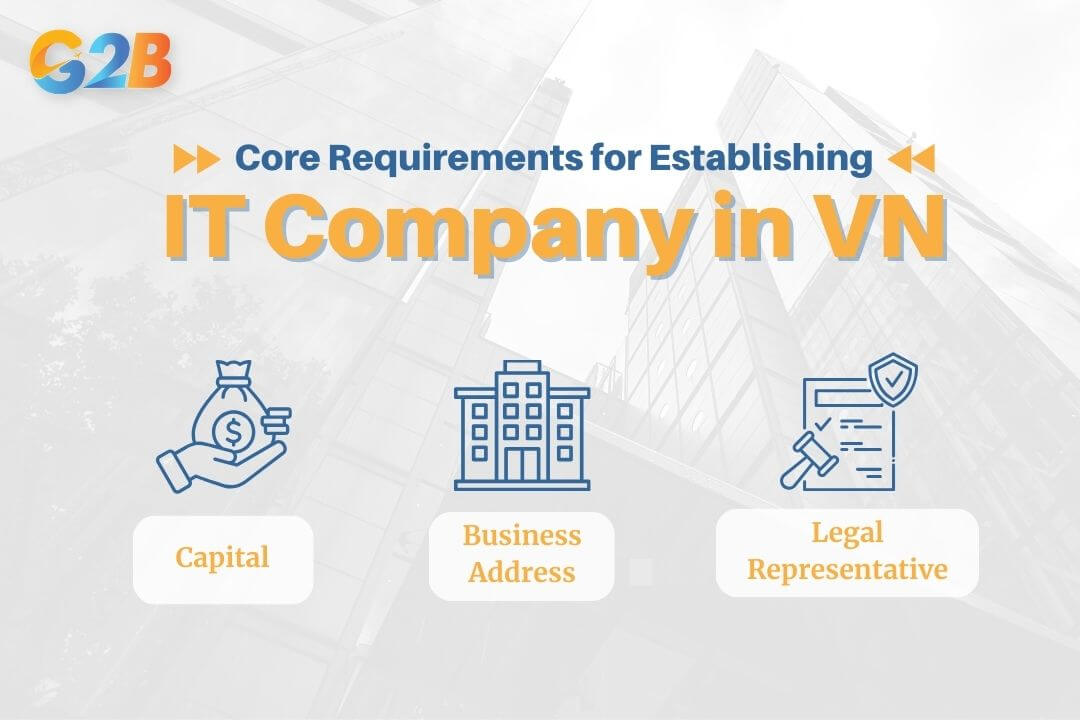
Core requirements for establishing an IT company in Vietnam
1. Minimum capital requirement
Vietnam's Enterprise Law does not stipulate a statutory minimum capital for IT companies. However, the Department of Planning and Investment (DPI) assesses the capital based on the scale of the project.
- Recommended capital: To ensure smooth approval of the Investment Registration Certificate (IRC), investors should commit a charter capital between USD 15,000 and USD 25,000.
- Payment timeline: Capital must be fully contributed within 90 days of receiving the Enterprise Registration Certificate (ERC).
2. Registered business address
- Virtual offices: Foreign investors can utilize Virtual offices for registration purposes, provided the premises are legally approved for business use (not a purely residential apartment), and the virtual office provider holds a valid, verifiable title or master lease.
- Restrictions: The address cannot be located in a residential apartment building or a collective living quarter. It must be a commercial property.
3. Resident legal representative
- Residency: In practice, at least one Legal Representative should reside in Vietnam or be regularly present to perform day-to-day management and work with authorities. At least one Legal Representative must reside in Vietnam. If the foreign director is not initially in Vietnam, they can appoint a local nominee director or obtain a work permit and residency card post-incorporation.
Step-by-step process to establish an IT company
The incorporation process for a foreign-owned IT company involves two main phases: obtaining the Investment Registration Certificate (IRC) and the Enterprise Registration Certificate (ERC).
Phase 1: Investment Registration Certificate (IRC)
Timeline: 15 – 20 working days. The investor submits an Investment Proposal to the Department of Planning and Investment (DPI). This document outlines the project's objectives, scale, and capital impact.
Required documents:
- Proof of financial capacity: Bank account balance statements (for individuals) or audited financial statements (for corporate investors) showing funds equal to the proposed capital.
- Passport/business license: Notarized and consularized copies of the investor's legal documents.
- Lease agreement: Signed contract for the Vietnam office location.
Phase 2: Enterprise Registration Certificate (ERC)
Timeline: 3 – 5 working days. Once the IRC is issued, the investor applies for the ERC. The ERC serves as the company's official incorporation document and includes the tax identification number. At this stage, the company legally exists.
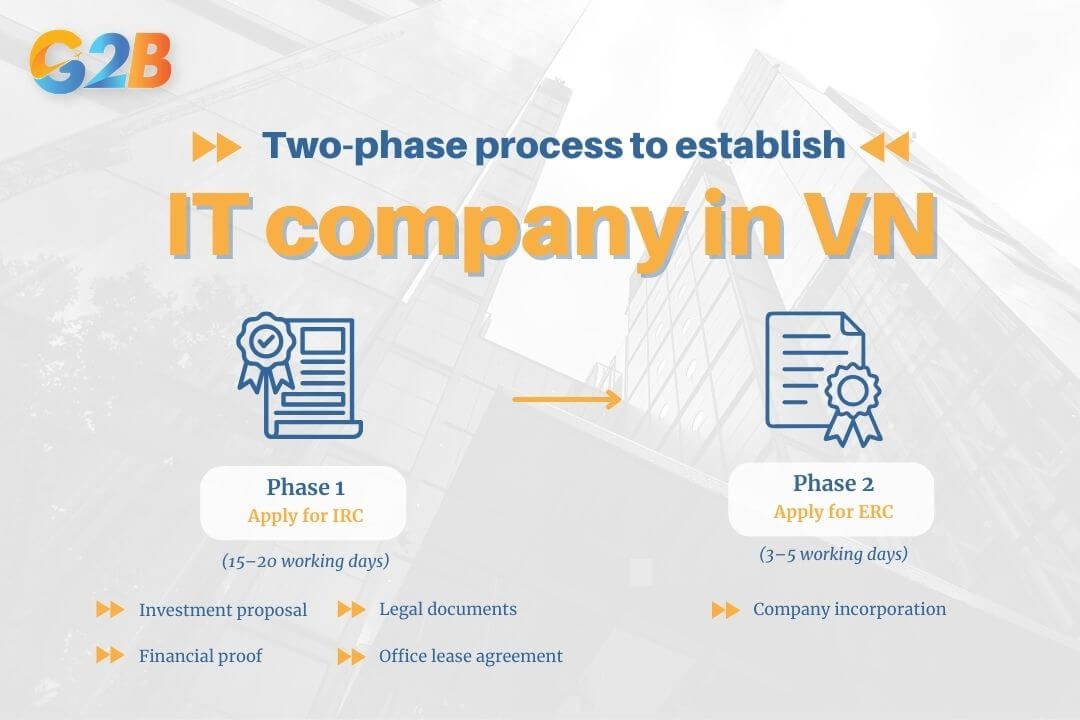
Two-phase process to establish a foreign-owned IT company in Vietnam
Mandatory post-licensing procedures
Obtaining the license is only the beginning. Investors must complete specific post-licensing compliance tasks to avoid heavy administrative penalties.
- Company seal carving: Produce the corporate seal and publish its sample on the National Business Registration Portal.
- Open bank accounts:
- Direct investment capital account (DICA): This is critical. All charter capital must be transferred into this specific account from the overseas investor's account. Using a normal current account for capital injection is a serious compliance issue that can complicate or block future profit repatriation and may trigger additional regulatory scrutiny.
- Current account: Used for daily transactions (payroll, revenue, expenses).
- Digital signature (token): Purchase a USB token for electronic tax filing and signing documents.
- Business license tax (BLT): Pay the annual BLT (approx. USD 85 – 130 depending on capital).
- Electronic invoice (E-invoice) registration: Register the company’s e-invoice template with the Tax Authority.
Corporate income tax (CIT) incentives for IT companies
The IT sector enjoys the most aggressive tax incentives in Vietnam, specifically for Software production.
The incentive formula
If an IT company qualifies as a Software Production enterprise, and meets the conditions on project location and scale under Vietnam’s tax and investment regulations, it may enjoy:
- Tax rate: 10% preferential CIT rate for 15 years (Standard rate is 20%).
- Tax holiday: Up to 4 years of tax exemption (0% tax) starting from the first profit-making year.
- Reduction period: 50% reduction (5% tax) for the subsequent 9 years.
Compliance requirements (Circular 13/2020/TT-BTTTT)
To qualify, the company must prove its activities adhere to the 7 Steps of software production defined by the Ministry of Information and Communications:
- Requirement definition
- Analysis and design
- Programming/Coding
- Testing
- Completion and packaging
- Installation and transfer
- Maintenance/Warranty
Important: The company must document these processes strictly. Revenue from "non-software" activities (e.g., hardware resale, pure data entry) is subject to the standard 20% CIT.
Recruitment and visas for foreign IT experts
Recruiting foreign IT experts in Vietnam involves both talent acquisition planning and compliance with immigration regulations. Employers must carefully manage recruitment processes alongside visa and Work permit requirements to ensure a lawful and efficient onboarding process.
Work permits for foreign employees
Foreign IT experts working in Vietnam for more than 30 days must obtain a Work Permit.
- Requirements: A university degree or equivalent and at least 3 years of suitable work experience related to the position, in line with current regulations on foreign experts.
- Process: Approval of demand for foreign labor -> Work Permit Application -> Issuance (Timeline: 4-6 weeks).
Temporary residence card (TRC)
Once the Work Permit is issued, or if the foreigner is an investor contributing capital (above a certain threshold), they are eligible for a Temporary Residence Card (TRC).
- Validity: 2 to 5 years.
- Benefit: Allows visa-free entry and exit during the validity period.
Common challenges when opening an IT company in Vietnam
Opening an IT company in Vietnam has several practical and regulatory challenges for new investors. Being aware of these common obstacles early on can help businesses prepare effective strategies and avoid costly delays.
Intellectual Property (IP) protection
While Vietnam's IP laws are improving, enforcement can be inconsistent:
- Risk: Source code theft or trademark squatting.
- Solution: Register trademarks immediately with the National Office of Intellectual Property (NOIP). Use strict Non-Disclosure Agreements (NDAs) and Non-Compete Agreements (NCAs) with all employees.
Talent retention
The demand for IT talent exceeds supply, leading to high turnover rates:
- Risk: Developers leaving for slightly higher pay.
- Solution: Implement retention strategies such as performance bonuses, remote work flexibility, and clear career progression paths.
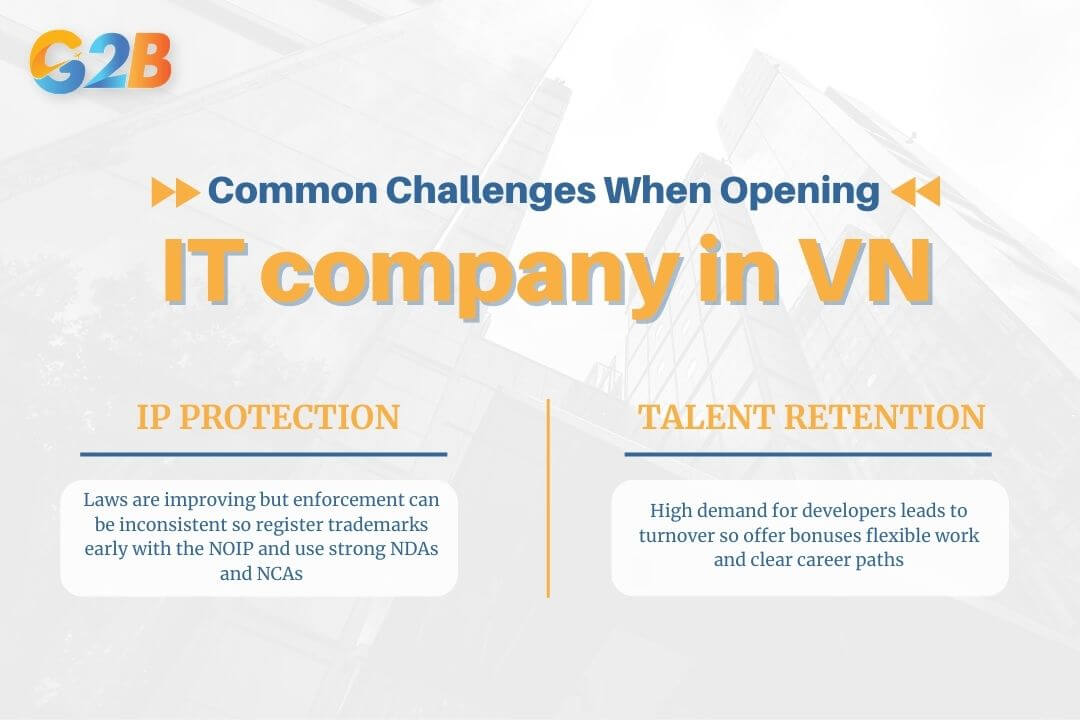
Common IT company setup challenges
Frequently asked questions (FAQ)
This section answers the most frequently asked questions about setting up an IT company in Vietnam for foreign investors. It provides concise clarifications on legal procedures, licensing, and operational considerations during the establishment process.
How long does it take to fully setup an IT company in Vietnam?
The entire process, from submitting the Investment Proposal to receiving the tax code and seal, typically takes 25 to 35 working days, subject to timely consularization of foreign documents and the absence of additional information requests from authorities.
Is an IT degree required to open an IT company in Vietnam?
No. The foreign investor (shareholder) does not need an IT degree. However, for the Work Permit application of foreign employees or foreign experts, a relevant degree is required.
Can foreigners own 100% of an IT company in Vietnam?
Yes. Under Vietnam’s WTO commitments and current investment laws, foreign investors can own 100% of the capital in most software and IT service companies without the need for a local joint venture partner, provided the business does not fall under restricted or conditional sectors such as certain cybersecurity or national security-related services.
What happens if I don't use the Direct Investment Capital Account (DICA)?
Failure to transfer capital via a registered DICA is a critical error. The bank will not recognize the funds as investment capital, meaning you cannot repatriate profits (dividends) abroad later, and the company may face administrative fines for incorrect capital contribution.
Setup a company in Vietnam offers foreign investors a unique competitive advantage through low operating costs, a young and skilled workforce, and potential corporate income tax incentives (including tax holidays) for qualifying software production projects.
