




 Delaware (USA)
  Vietnam
  Singapore
  Hong Kong
  United Kingdom
 How to register an import-export company in Vietnam for foreign investors involves a clear, multi-step legal process governed by the country's investment and enterprise laws. For any international entrepreneur looking to tap into Vietnam's booming trade sector, understanding this pathway is the first critical step toward success. This article provides a complete roadmap for foreign investors, covering the essential legal requirements, step-by-step registration procedures, capital and address stipulations, tax obligations, and crucial post-licensing tasks.
Why choose Vietnam for your import-export business?
Vietnam has firmly established itself as a dynamic and attractive hub for international trade and investment. Its unique combination of geographic advantage, progressive trade policies, and economic stability makes it a prime destination for foreign entrepreneurs looking to establish an import-export company.
- Strategic location & trade hub: Positioned in the heart of Southeast Asia, Vietnam serves as a strategic gateway to the broader ASEAN market, a bloc of over 660 million consumers. Its long coastline with numerous deep-water ports facilitates seamless access to major global shipping routes, reinforcing its role as a critical node in international supply chains.
- Favorable trade agreements (FTAs): Vietnam's proactive integration into the global economy is demonstrated by its participation in numerous significant Free Trade Agreements. These agreements provide preferential access to key markets by reducing or eliminating tariffs and other trade barriers. Key FTAs include the Comprehensive and Progressive Agreement for Trans-Pacific Partnership (CPTPP), the EU-Vietnam Free Trade Agreement (EVFTA), and the Regional Comprehensive Economic Partnership (RCEP). These pacts create a highly favorable environment for importing raw materials and exporting finished goods.
- Stable economic growth: The country has consistently posted impressive GDP growth, making it one of the fastest-growing economies in the region and the world. This stable economic expansion is mirrored by a rapid increase in its import-export turnover, which signals a robust and growing demand for a wide variety of goods.
- Competitive labor & operational costs: Compared to other manufacturing hubs in the region, Vietnam offers competitive labor costs and relatively low operational expenses. This cost-effectiveness allows businesses to maximize their profitability and reinvest in growth, making it a financially sound choice for launching a trading enterprise.
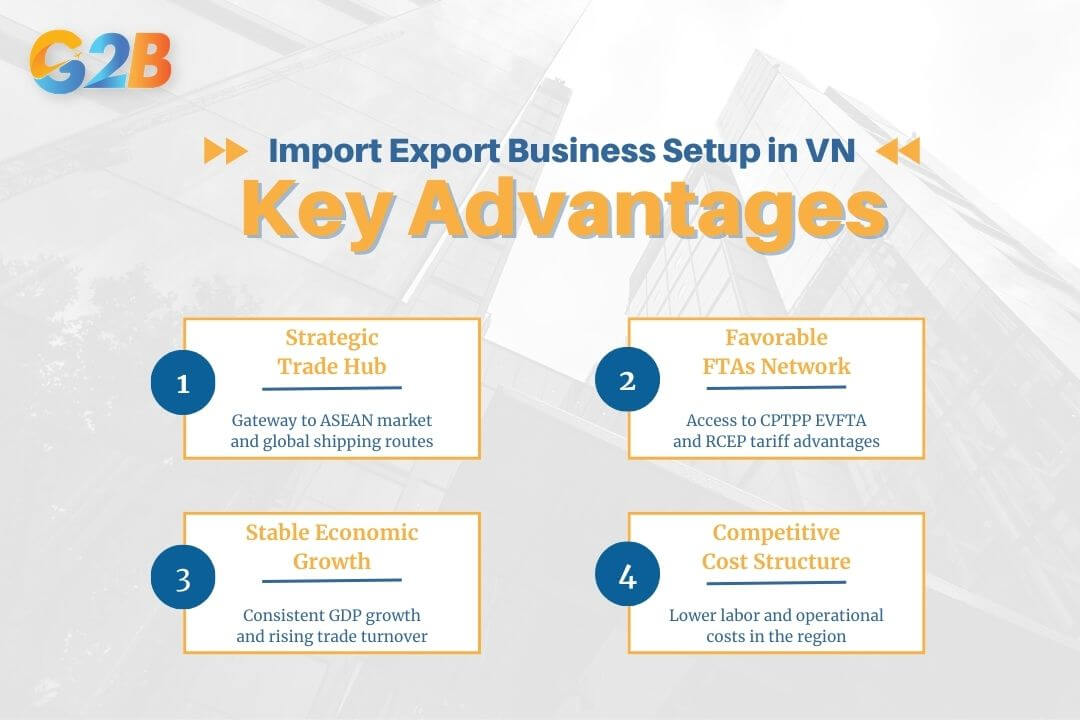
Key advantages of Vietnam for import export business setup
What are the legal requirements for a foreign-owned trading company in Vietnam?
Navigating the legal landscape is paramount for a successful company registration. Fortunately, the framework for foreign-owned trading companies in Vietnam is clear and accommodating in most sectors.
- Company types for foreigners: Foreign investors typically have two primary options for legal structures: the Limited Liability Company (LLC) and the Joint-stock Company (JSC). For the vast majority of foreign investors, especially sole investors or small groups aiming to establish a trading company, the LLC is the most common and practical choice. Its simpler corporate structure and less demanding compliance requirements make it an efficient vehicle for import-export activities.
- Foreign ownership limitations: For general trading and import-export activities, Vietnam's commitment to open trade is clear. 100% foreign ownership is permitted in this sector. This allows international investors to maintain full control over their operations without the need for a local partner. However, it is important to note that certain specific, conditional business lines, such as the distribution of pharmaceuticals or cultural products, may have foreign ownership restrictions or require special permits.
- Is a specific import-export license required? This is a critical and often misunderstood point for new investors. No, Vietnam does not require a separate, single "import-export license." The legal right to import and export goods is automatically granted to a foreign-invested company when it registers the appropriate business lines- such as "import of goods," "export of goods," and "wholesale trade"- on its official registration certificates. Once these business lines are approved on the company's Investment Registration Certificate (IRC) and Enterprise Registration Certificate (ERC), the company is legally entitled to conduct trading activities for non-prohibited goods. However, before conducting the first import or export transaction, the company must register its import–export code with the General Department of Customs to be eligible for customs clearance.
How to register your import-export company in Vietnam
The registration process for a foreign-owned company in Vietnam is a sequential, two-certificate procedure. It begins with securing approval for the investment project and concludes with the official formation of the legal entity.
Step 1: Obtain the Investment Registration Certificate (IRC)
The IRC is the foundational license for any foreign direct investment project in Vietnam. It represents the government's official approval of your investment plan and is a mandatory prerequisite before the company can be legally formed. The application is submitted to the Department of Planning and Investment (DPI).
Required documents:
- Application form for the implementation of the investment project.
- A comprehensive proposal for the investment project, detailing objectives, scale, capital, location, and timeline.
- Legalized copies of the investor's passport (for individuals) or Certificate of Incorporation/Business License (for corporate investors).
- Legalized and translated financial statements for the last two years (for corporate investors) or a bank statement confirming sufficient funds (for individual investors).
- A signed Memorandum of Understanding (MOU) or a lease agreement for the company's proposed head office.
Timeline: The standard processing time for an IRC application is 15–25 working days from the date of submitting a valid and complete dossier. The ERC is typically issued within 3–7 working days after the IRC has been obtained.
Step 2: Obtain the Enterprise Registration Certificate (ERC)
After the IRC is granted, the next step is to obtain the Enterprise Registration Certificate (ERC). This certificate officially establishes your company as a legal entity in Vietnam and functions as its birth certificate. The ERC contains key details such as the company's name, address, charter capital, and legal representative.
Required documents:
- Application form for enterprise registration.
- The company's charter (also known as the Articles of Association).
- A list of members for an LLC or a list of founding shareholders for a JSC.
- Copies of the passports of the legal representative and all members or shareholders.
- A copy of the newly issued Investment Registration Certificate (IRC).
Timeline: The ERC is typically issued within 3-5 working days after the IRC has been obtained and the corresponding application is submitted.
Step 3: Complete post-licensing tasks
Receiving the ERC marks the legal formation of your company, but several essential administrative tasks must be completed before you can begin full operations. These post-licensing steps are mandatory for compliance.
- Make the company seal: While physical seals are still used, the digital signature has become the modern standard for official transactions with government agencies, including the tax department.
- Open bank accounts: The company must open a Direct Investment Capital Account (DICA) to receive capital contributions from the overseas investor. A separate current (or payment) account must also be opened for handling domestic transactions, paying suppliers, and receiving revenue.
- Complete initial tax registration: You must register with the local tax authority to declare and pay applicable taxes, such as the Business License Fee and Value-Added Tax (VAT).
- Pay the annual business license fee: This is an annual tax that must be paid to the state treasury. The amount is based on the company's registered charter capital.
- Contribute charter capital: Investors must contribute the full amount of their registered charter capital within 90 days from the issuance date of the ERC, and the licensing authority may require financial proof of capital availability before granting approval.
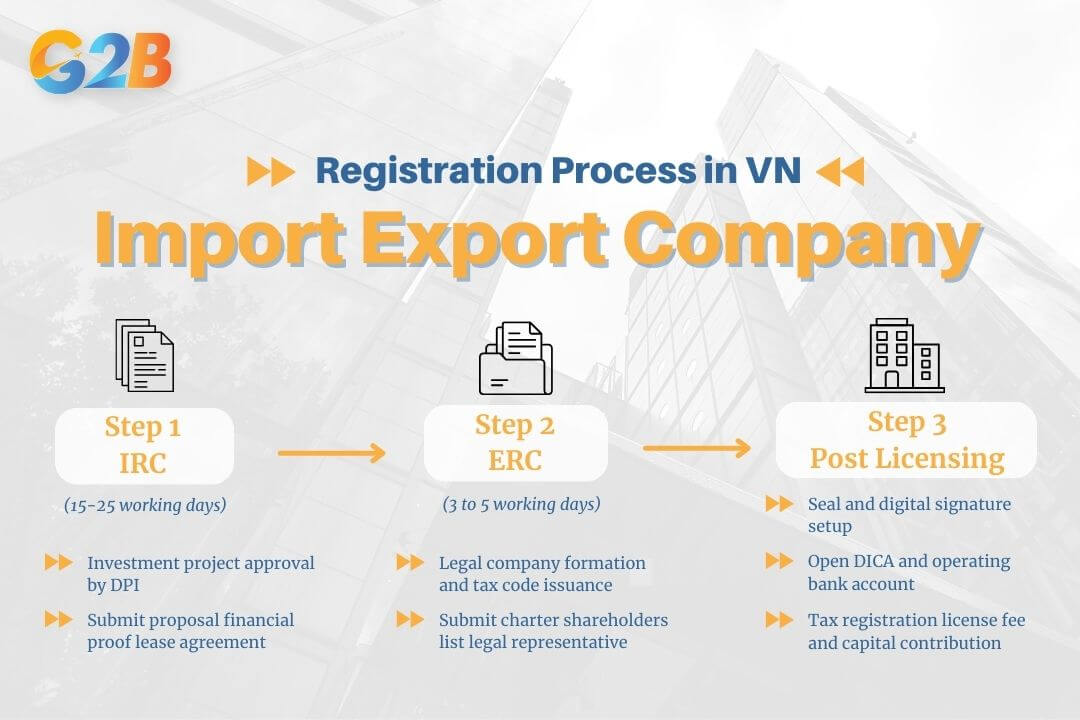
Step-by-step registration process for an import export company in Vietnam
What are the capital and address requirements?
Two of the most practical and immediate questions for investors concern the amount of capital needed and the rules for the company's official address.
- Minimum capital requirement: Vietnamese law does not specify a fixed minimum capital amount for most general trading businesses. However, this does not mean you can register with a negligible amount. The licensing authorities at the Department of Planning and Investment will assess whether the proposed capital is "reasonable and sufficient" to cover the company's operational expenses- such as rent, salaries, and initial inventory- until it can generate its own revenue. For a small to medium-sized import-export company, a practical and safe registered capital amount generally ranges from $10,000 to $30,000 USD to ensure a smooth approval process.
- Registered head office: A company must have a legal physical address in Vietnam to receive official correspondence. This address must be clearly defined and verifiable. A crucial regulation that foreign investors must be aware of is that it is not permitted to use an address in an apartment building (chung cu) or collective housing area for business registration. The address must be in a commercial building, office space, or a private house with a legitimate lease agreement.
What taxes apply to an import-export company in Vietnam?
A clear understanding of the tax regime is essential for financial planning and compliance. Trading companies in Vietnam are subject to several primary taxes.
- Corporate income tax (CIT): The standard Corporate Income Tax rate in Vietnam is 20% on taxable profits. The government may offer tax incentives, such as temporary exemptions or reduced rates, for companies operating in specific encouraged sectors or in geographical areas with difficult socio-economic conditions.
- Value-added tax (VAT): VAT applies to most goods and services consumed in Vietnam. The rates vary, but for trading companies, the most significant rule is that a 0% VAT rate is applied to exported goods and services. To qualify for this 0% rate, the company must provide sufficient supporting documents, including a valid sales contract, customs declarations, and proof of non-cash payment from the foreign buyer.
- Import/export duties: These duties are not a fixed tax but are levied on specific products as they cross Vietnam's borders. The amount of tax depends entirely on two factors: the Harmonized System (HS) code of the product and the product's country of origin or destination. Import and export duties can be significantly reduced or even eliminated if the goods are traded with countries that are part of Free Trade Agreements (FTAs) with Vietnam, such as the EVFTA, CPTPP, or RCEP.
- License fee: This is a minor annual fee paid to the government. The amount is determined by the company's registered charter capital and is typically a very modest sum, payable at the beginning of each year.
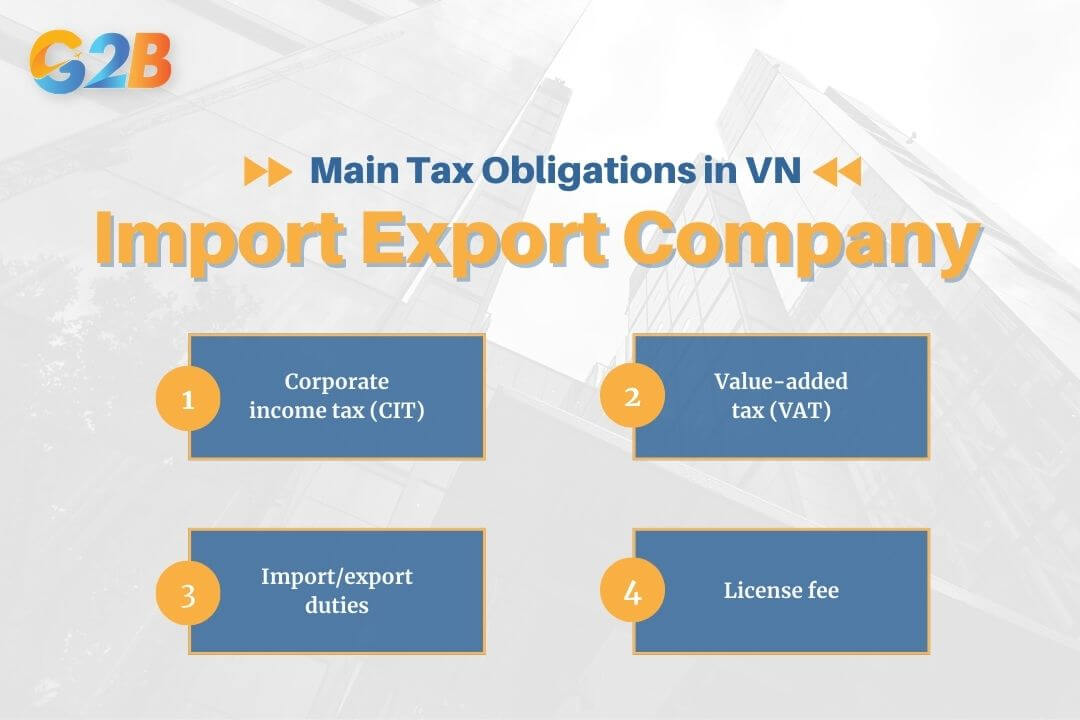
Main tax obligations for import export companies in Vietnam
Frequently asked questions (FAQs)
This section compiles the most frequently asked questions about registering an import-export company in Vietnam for foreign investors.
How long does it take to set up a trading company in Vietnam?
The entire process, from preparing documents to receiving the final licenses, typically takes between 2 to 4 months. This includes about 15-20 working days for the Investment Registration Certificate (IRC) and another 3-5 working days for the Enterprise Registration Certificate (ERC), plus time for document preparation and post-licensing steps.
Can a foreigner 100% own an import-export company in Vietnam?
Yes, for general import-export and trading activities, foreigners are permitted to have 100% ownership of their company. This allows for complete control over the business's operations and strategic direction. Certain specialized or conditional sectors may have ownership restrictions.
What is the estimated cost to register an import-export company?
The total cost varies depending on the service provider and the complexity of the business. Generally, you can expect to budget for both government fees and professional service costs, totaling around $2,000–$4,000 depending on the complexity of your business.
Do I need to be in Vietnam for the registration process?
No, it is not mandatory for the investor to be physically present in Vietnam during the registration process. The entire procedure can be managed remotely by a legally authorized representative or a professional service firm, which can act on your behalf through a power of attorney.
What goods are prohibited from import/export in Vietnam?
Vietnam prohibits the trade of certain goods to protect national security, public health, and cultural heritage. The prohibited list includes items such as military weapons, national relics and antiques, certain toxic chemicals, and specific types of cultural products deemed harmful. Investors should always check the latest regulations, such as those in Decree 69/2018/ND-CP, before planning their product lines.
Registering an import-export company in Vietnam is a structured and attainable goal for foreign investors. The process is clear, requiring the successful acquisition of an Investment Registration Certificate (IRC) followed by an Enterprise Registration Certificate (ERC). Key considerations that demand careful attention include determining a reasonable and sufficient amount of charter capital, securing a compliant physical office address, and diligently completing all post-licensing compliance tasks. While the legal framework is well-defined, the documentation process can be complex and requires meticulous preparation, including the notarization, legalization, and Vietnamese translation of foreign documents. Navigating these procedural intricacies is crucial for a timely and successful market entry.
The opportunities within Vietnam's vibrant trade landscape are immense, driven by its strategic position and extensive network of free trade agreements. However, ensuring every step is handled correctly from the outset is the best way to prevent future complications and build a solid foundation for your business.
Ready to start your journey in Vietnam? Contact G2B today for a consultation on how to establish a company in Vietnam and to follow annual compliance requirements during operations. Let us handle the bureaucracy so you can focus on your business.
