




 Delaware (USA)
  Vietnam
  Singapore
  Hong Kong
  United Kingdom
 Establishing and licensing an English language center in Vietnam is a strategic move for investors seeking to capitalize on one of Southeast Asia's most dynamic education markets. Vietnam is currently experiencing a "Golden Population" phase, where a significant percentage of its 100 million citizens are of working and schooling age. As the country integrates deeply into the global economy through free trade agreements, the demand for English proficiency has shifted from a luxury to a critical necessity for workforce advancement.
Essential licenses required to establish an English language center
Foreign investors must navigate a multi-layered licensing process to legally operate an English center. Simply renting a room and starting teaching is not permitted; specific corporate and operational approvals are required.
The conditional business status
Education in Vietnam is classified as a conditional sector. Unlike a standard trading company, entities face dual-layer scrutiny: first by the Department of Planning and Investment (DPI) for corporate existence, and second by the Department of Education and Training (DOET) for operational capability.
The two-step corporate licensing process
A foreign-invested enterprise (FIE) must be formed before applying for an educational license. This involves two primary certificates:
- Investment Registration Certificate (IRC): Issued by the DPI, the IRC approves the project proposal as the first step for foreign investors. The government evaluates financial capacity and project economic feasibility, requiring declaration of investors and capital brought into Vietnam.
- Business Registration Certificate (ERC): Obtained after the IRC, this document (also known as the Enterprise Registration Certificate) legally establishes the company in Vietnam, including its tax code and details.
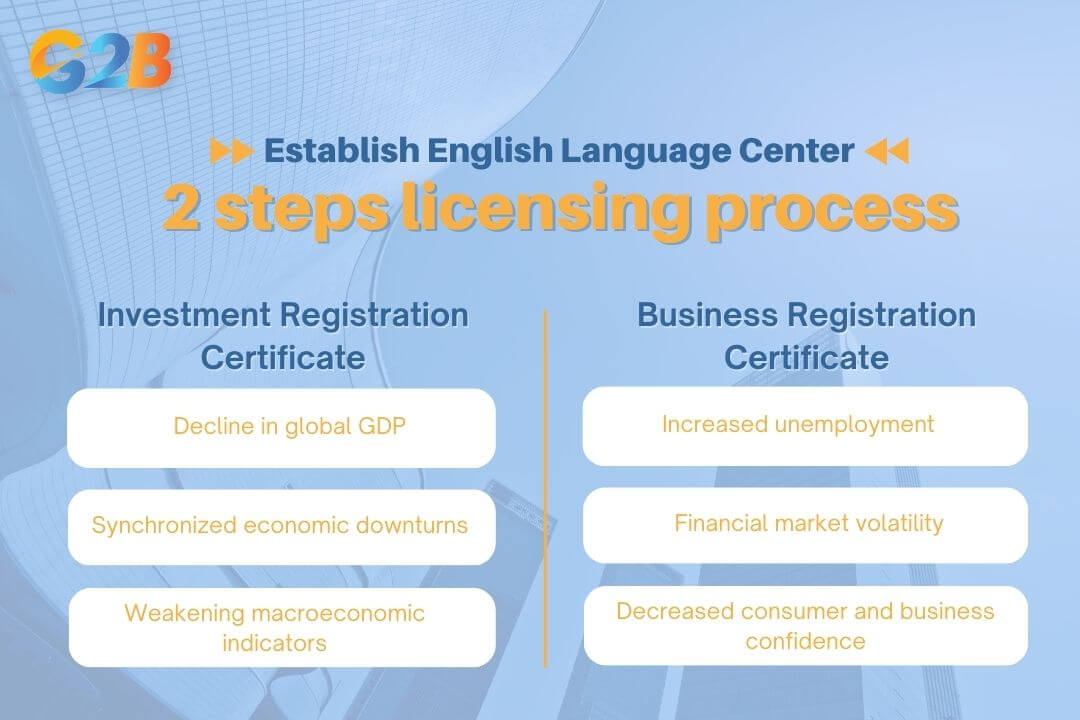
Two-step corporate licensing process for a foreign-invested education center in Vietnam
Strategic industry codes
Precision is vital when submitting application dossiers to register correct business lines and avoid compliance issues. The standard code for an English language center is VSIC 8552 - Education services not elsewhere classified (including foreign languages). This ensures the business scope covers teaching foreign languages, organizing exams, and issuing course completion certificates.
WTO commitments and foreign ownership
A common misconception is that foreign investors need a local Vietnamese partner to open an English center; this is incorrect. Under Vietnam’s WTO Commitments, the education sector allows 100% foreign ownership. Wholly Foreign-owned Enterprise (WFOE) can be established without a local nominee, providing full control over curriculum, brand, and profits.
Selecting and establishing a business location for your English language center
Your choice of location is not just a commercial decision; it is a regulatory one. The DOET is notoriously strict about facility standards, and failure to comply here is the number one reason for license rejection.
The ban on virtual offices
For an English language center, virtual offices are strictly prohibited. You cannot use a shared address or a co-working space registration for the operational license. While you might use a virtual office temporarily for the IRC/BRC stage, you must have a physical, standalone location to obtain the teaching license.
Lease requirements
You must secure a location with a stable lease term sufficient for operations, typically at least 3 years. The government requires this long-term commitment to ensure stability for the students. Short-term leases signal a "hit-and-run" mentality that regulators actively discourage. The lease agreement must be notarized and explicitly allow for educational activities.
Space metrics and functional areas
The physical space must meet the metric of 1.5-2 m² per student in classrooms. This is not just classroom space; it applies to the overall facility capacity.
Your center must include specific functional areas, such as:
- Classrooms: Must be well-lit, ventilated, and equipped with age-appropriate furniture.
- Administrative area: A dedicated space for the Director and staff (Principal's office, reception).
- Resource center: A library or computer lab for student self-study.
- Sanitation: Separate restrooms for male and female students, appropriate for the scale of the center.
- Parking: Sufficient parking space for students and staff (or a contract with a nearby parking lot).
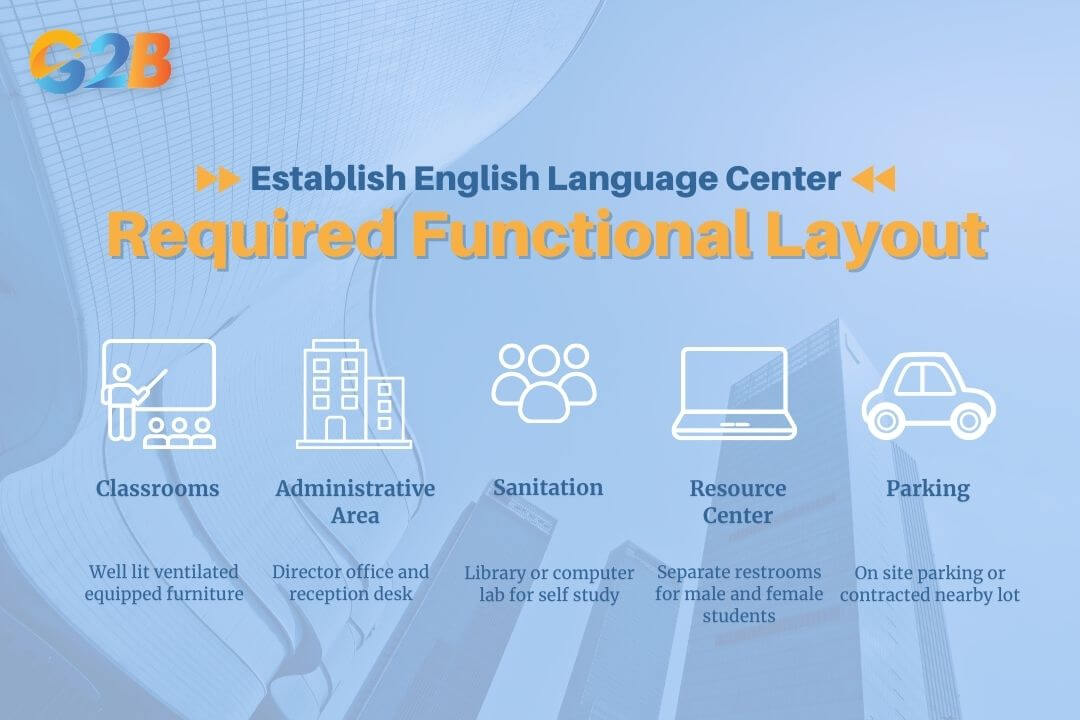
Required functional layout for an English language center in Vietnam
Fire safety (PCCC) - the critical hurdle
In 2024 and 2025, Vietnam intensified its Fire Prevention and Fighting (PCCC) regulations. Your building must have a valid Certificate of Fire Safety Eligibility. Many older buildings in Vietnam do not meet current PCCC codes. Before signing a lease, you must verify that the landlord has the approved PCCC design and acceptance documents. Without PCCC approval, the DOET will effectively freeze your application.
Building team for English center
A compliant English center requires a specific human resources structure. You are not just hiring employees; you are appointing legally responsible individuals.
The legal representative vs. the center director
Investors often confuse these two roles.
- The legal representative: This is the corporate head (CEO) listed on the BRC. They can be a foreign national or Vietnamese. They must have a registered residency address in Vietnam (even if they are foreigners, they need a temporary residence card). They represent the company in legal matters.
- The center director: This is the academic head responsible for the curriculum and teaching quality. The Director must meet specific criteria:
- Possess a university degree in a foreign language (or a degree plus a language certificate).
- Have at least three years of experience in education management.
- The Legal Representative can also be the Center Director if they meet both sets of criteria.
Teaching staff requirements
The quality of education is strictly monitored. You cannot hire backpackers as teachers.
- Foreign teachers: Must hold a University Degree (Bachelor’s or higher in any field) AND a recognized Teaching Certificate (TESOL, TEFL, CELTA). Additionally, they must have a clean criminal record from their home country and Vietnam.
- Local Vietnamese teachers: Must hold a College Diploma or higher in English Language Teaching or a relevant degree with a teaching certificate.
The teacher-to-student ratio
To ensure quality, the regulations stipulate a maximum ratio of 1 teacher per 25-30 students per class, depending on age group. This ratio affects your profitability model, so it must be factored into your business plan from day one.
Work permits and TRC
Foreign teachers and staff must obtain a Work Permit (or Work Permit Exemption) before they start working. Once the Work Permit is secured, they can apply for a Temporary Residence Card (TRC), allowing them to live in Vietnam long-term. G2B handles the legalization of degrees and criminal records to streamline this often bureaucratic process.
Registration and inspection process with the department of education and training
This section explains the registration and inspection procedures required by the Department of Education and Training when establishing an English language center in Vietnam. Understanding these steps helps investors prepare proper documentation and ensure a smooth licensing and approval process.
Phase 1: Corporate formation (DPI)
- Investment registration: Submit the project dossier to the Department of Planning and Investment.
- Output: Investment Registration Certificate (IRC).
- Timeline: ~15-20 working days.
- Enterprise registration: Submit company details to the Business Registration Office.
- Output: Business Registration Certificate (BRC) and tax code.
- Timeline: ~3-5 working days.
Phase 2: Operational licensing (DOET)
This is the "Sub-license" phase.
- Dossier submission: You submit a comprehensive set of documents to the Department of Education and Training (DOET). This includes your curriculum, teaching materials, list of teachers, facility floor plans, and fire safety approvals.
- The on-site inspection: This is the moment of truth. A delegation of officials from the DOET, the local district People's Committee, and the police will visit your center.
- They will count the desks.
- They will measure the light intensity.
- They will inspect the fire extinguishers.
- They will check the copyrights of your textbooks.
- They will interview the Center Director.
- License issuance: If the inspection is successful, the DOET issues the Decision to allow educational activities.
- Timeline: ~20-30 working days (in theory), but often takes 1-2 months depending on corrections required after inspection.
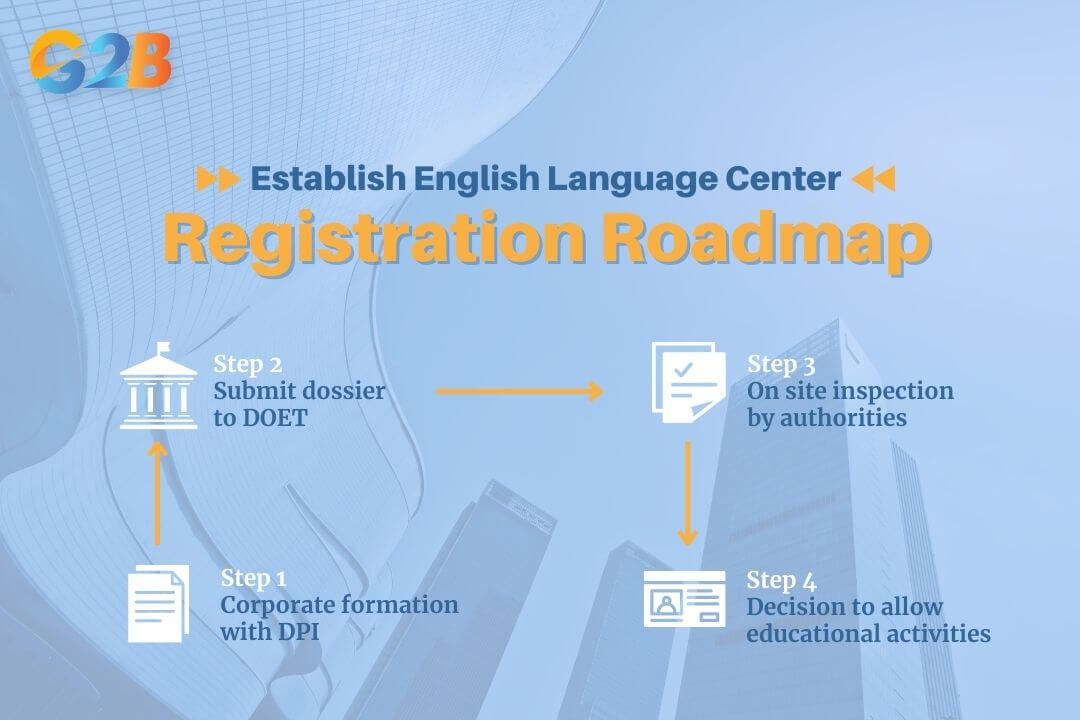
Registration and inspection roadmap for licensing an English language center in Vietnam
Frequently asked questions about opening an English language center in Vietnam
This section will answer the most frequently asked questions about opening an English language center in Vietnam.
Can I use a virtual office to apply for an English center license?
No. Virtual offices are strictly prohibited for the License to Operate an educational center. You must have a physical location that meets the 1.5-2m² per student requirement and fire safety codes. You might use a virtual office only for the initial corporate setup (IRC/BRC) if you are still hunting for a location, but this complicates the process later when you have to amend the license.
How long does it take to complete the licensing process for an English language center in Vietnam?
Realistically, you should plan for 3 to 4 months. This includes 1 month for the corporate setup (IRC & BRC), 1-2 months for the center renovation and fire safety approval, and 1 month for the DOET operational license. Delays usually happen during the renovation or fire safety inspection phase.
How do I obtain work permits for foreign teachers?
Foreign teachers require sponsorship for an entry visa first. Once in Vietnam, their legalized degree, teaching certificate, health check, and criminal record are submitted to the provincial Department of Labor, Invalids and Social Affairs (DOLISA) under the Ministry of Labor, Invalids and Social Affairs (MoLISA). The process typically takes 4-6 weeks. Employment is not legal until the Work Permit is issued.
Establishing and licensing an English language center in Vietnam offers immense potential but comes with rigorous compliance demands. The process requires seamless coordination between legal documentation, physical construction, and academic preparation. A mistake in the capital calculation or a failure in fire safety compliance can set your launch date back by months and cost thousands of dollars. While the "Golden Population" presents a lucrative market, success belongs to those who build on a solid legal foundation. Don't let bureaucratic hurdles derail your educational vision.
Ready to start your journey in Vietnam? Contact G2B today for a consultation on how to establish a company in Vietnam and to follow annual compliance requirements during operations. Let us handle the bureaucracy so you can focus on your business.
