




 Delaware (USA)
  Vietnam
  Singapore
  Hong Kong
  United Kingdom
 Setting up a construction company in Vietnam requires navigating a complex intersection of investment laws, enterprise regulations, and strict technical safety standards. For foreign investors, the process involves more than simply registering a business; it demands a strategic approach to capital structure, personnel certification, and obtaining specific sub-licenses from the Ministry of Construction. This article will explore the legal frameworks, procedural steps, and compliance obligations necessary to establish a fully operational construction entity.
Overview of the construction market in Vietnam
The Vietnamese construction sector is currently one of the most dynamic in Southeast Asia, driven by rapid urbanization and aggressive public investment in infrastructure. Foreign investors entering this market must understand the macroeconomic drivers and legal commitments that shape the industry.
Growth potential and infrastructure demands
Vietnam’s government has prioritized public investment disbursement to fuel economic growth. Key national projects create substantial opportunities for foreign contractors with specialized expertise.
- Transport infrastructure: Major projects include the North-south expressway, the Long Thanh international airport (Phase 1), and various metro line expansions in Hanoi and Ho Chi Minh City.
- Industrial real estate: As global supply chains shift, there is a surge in demand for constructing high-tech industrial parks and factories, particularly in northern provinces like Bac Ninh and Hai Phong, and southern hubs like Binh Duong.
- Green building: There is a rising demand for LEED (Leadership in Energy and Environmental Design) and LOTUS certified buildings, areas where foreign firms often possess superior technology and project management capabilities compared to domestic competitors.
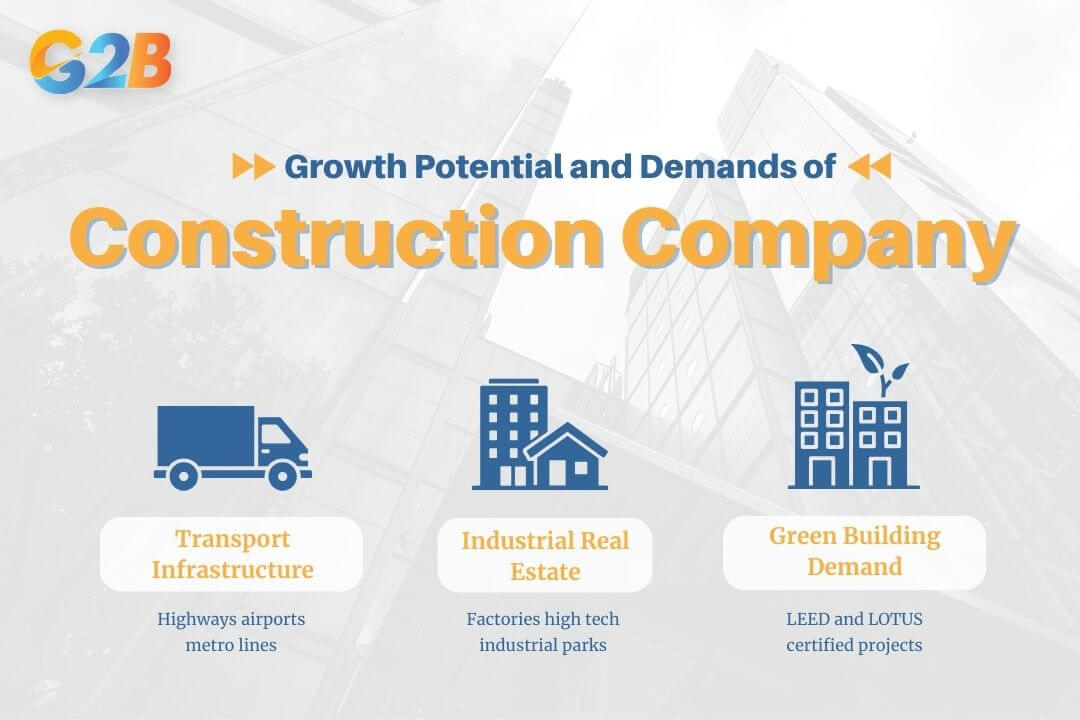
Key growth drivers and opportunity segments in the Vietnam construction market
WTO commitments and market access
Under the World Trade Organization (WTO) schedule of specific commitments in services, Vietnam maintains a liberalized stance on construction services.
- Foreign ownership: Vietnam allows 100% foreign ownership for construction and related engineering services. Foreign investors do not need a local Vietnamese partner to form a company, although Joint Ventures (JV) remain a strategic option for utilizing existing land usage rights or local workforce.
- Applicable CPC codes: Investors must register specific business lines based on the United Nations' Central Product Classification (CPC). Common codes include:
- CPC 511: Pre-erection work at construction sites.
- CPC 512: Construction work for buildings.
- CPC 513: Construction work for civil engineering.
- CPC 514: Assembly and erection of prefabricated constructions.
- CPC 516: Installation work.
- CPC 517: Building completion and finishing work.
Legal forms and ownership structure
Choosing the correct corporate structure is the foundational step of setting up a construction company in Vietnam. The structure impacts your liability, tax obligations, and ability to bid on government tenders.
100% Foreign-owned enterprise (FOE) vs. joint venture (JV)
- 100% FOE: This model grants the foreign investor total control over decision-making and profit repatriation. It is the preferred method for international contractors who possess independent financial strength and technical expertise.
- Joint venture (JV): A JV involves partnering with an existing Vietnamese construction firm. While this can expedite entry by leveraging the local partner’s Construction operating license and relationships, it often leads to management conflicts regarding profit sharing and operational direction.
LLC vs. JSC
Foreign investors typically choose between a Limited Liability Company (LLC) and a Joint Stock Company (JSC).
| Feature | Limited Liability Company (LLC) | Joint Stock Company (JSC) |
|---|---|---|
| Ownership structure | Single-member (1 owner) or Multi-member (2-50 members). | Minimum of 3 shareholders. No maximum limit. |
| Capital mobilization | Cannot issue shares to the public. Capital is raised through member contributions or loans. | Can issue shares (common and preferred) and list on the stock exchange (IPO) later. |
| Management complexity | Simpler management structure. Decisions made by the Members' Council. | Complex governance involving a General Meeting of Shareholders, Board of Management, and Inspection Committee. |
| Suitability for construction | Highly recommended. Ideal for subsidiaries of foreign construction groups where tight control is needed. | Recommended for large-scale consortiums intending to raise public capital in the future. |
Key requirements for establishing a construction company in Vietnam
Before initiating the licensing process, investors must prepare a dossier that satisfies the strict scrutiny of the Department of Planning and Investment (DPI).
1. Charter capital and financial capacity
Vietnam Law on Enterprise does not stipulate a minimum charter capital for general construction companies. However, the capital must be "consistent with the scale of the project" as stated in the feasibility study.
- Bidding implications: To bid on large projects, the company must demonstrate financial capacity. A low charter capital (e.g., $10,000) will result in a low credit rating and an inability to secure performance bonds from banks.
- Recommended levels: For a functional construction firm capable of obtaining Grade II or Grade III certificates, a charter capital between $200,000 USD and $500,000 USD is advisable to cover initial machinery procurement and operational costs.
2. Registered office requirements
- Physical presence: The office must exist physically. Virtual offices are legally permissible for registration, but practically, the Department of Construction (DoC) may inspect the premises when you apply for the Construction Eligibility Certificate.
- Legal restrictions: The address cannot be located in a dormitory or a collective residential apartment. It must be in a commercial building or a standalone house with a clear Commercial lease agreement and documents proving the lessor's ownership (Land use right certificate).
3. Key personnel and technical capacity
This is the most critical vector for construction firms. To operate, the company does not just need money; it needs certified human resources.
- Technical director/site manager: Must hold a valid Construction Practising Certificate relevant to the class of works (Grade I, II, or III).
- Education: Staff must possess university degrees in civil engineering, architecture, or related technical fields.
Step-by-step process to set up a construction company
This section outlines the step-by-step process for setting up a construction company from initial planning to full legal establishment. Following these structured stages helps investors ensure compliance, manage timelines effectively, and minimize potential risks during implementation.
Step 1: Investment Registration Certificate (IRC)
Foreign investors must first register their project with the Department of Planning and Investment (DPI).
- Dossier: Includes the investor’s legal documents (legalized), financial statements (audited), and a proposal for the investment project (expenditure plan).
- Timeline: Statutory time is 15 days, but in practice, it takes 20–30 working days due to inter-agency consultations (e.g., consulting the Ministry of National Defense regarding security if the location is sensitive).
- Outcome: Issuance of the Investment Registration Certificate (IRC).
Step 2: Enterprise Registration Certificate (ERC)
Once the IRC is obtained, the investor applies for the formation of the corporate entity.
- Authority: Business Registration Office under the DPI.
- Timeline: 3–7 working days.
- Outcome: Issuance of the Enterprise Registration Certificate (ERC). This document acts as the certificate of incorporation and contains the company’s Tax Identification Number.
Step 3: Post-licensing procedures
After receiving the ERC, the company is legally formed but not yet fully operational.
- Seal carving: Create the corporate seal.
- Bank account opening: Open a Direct Investment Capital Account (DICA). This is mandatory for receiving charter capital from overseas.
- Capital contribution: The investor must transfer the full charter capital within 90 days of the ERC issuance date. Failure to do so incurs heavy administrative penalties and potential license revocation.
- Tax registration: Purchase a Digital Signature (Token) and register for E-invoice services.
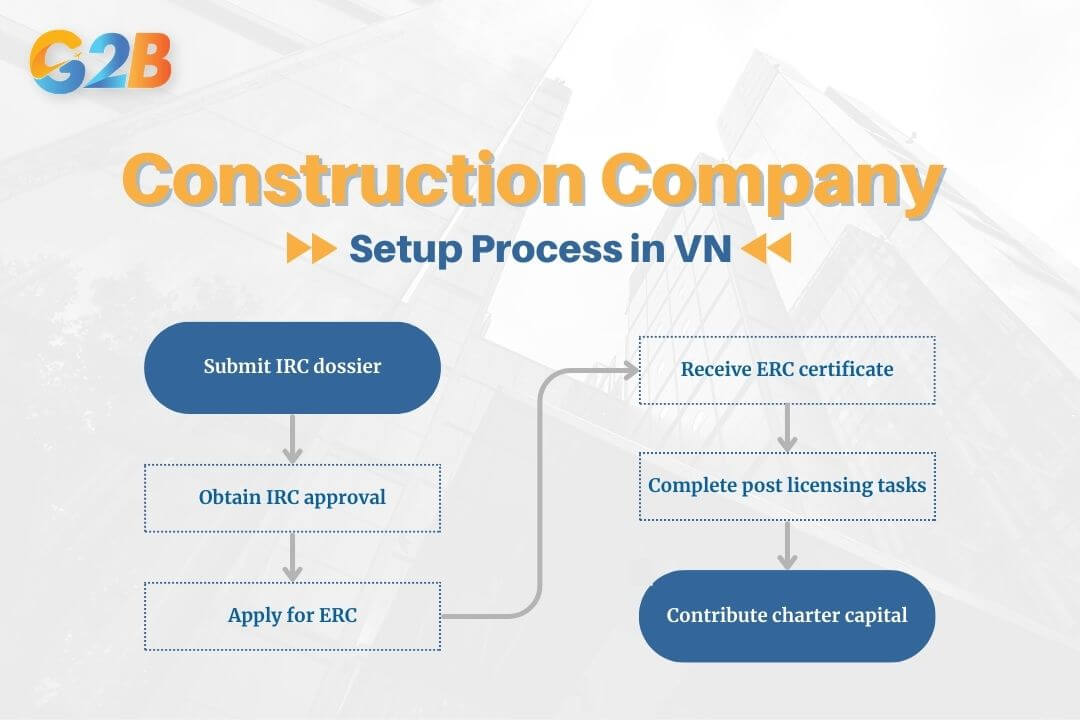
Legal incorporation roadmap for a foreign construction company in Vietnam
Construction activity eligibility certificate
Possessing an ERC allows a company to sign contracts, but it does not allow the company to execute construction work. To legally perform construction activities, the company must obtain the Construction Activity Eligibility Certificate (often called the Construction Operation License or Sub-license).
Classification of construction capability
- Grade I:
- Authority: Issued by the Ministry of Construction (MoC).
- Scope: Allowed to execute projects of special class, Grade I, II, and III (essentially unlimited scope).
- Requirement: Strict requirements on past project experience (must have completed Grade II projects) and high-level personnel.
- Grade II:
- Authority: Issued by the provincial Department of Construction (DoC) or recognized socio-professional organizations.
- Scope: Allowed to execute projects of Grade II and III.
- Requirement: Requires personnel with Grade II practicing certificates.
- Grade III:
- Authority: Issued by the provincial Department of Construction (DoC) or recognized socio-professional organizations.
- Scope: Allowed to execute projects of Grade III (smaller scale).
- Requirement: This is the entry point for most new foreign-owned construction companies.
Criteria for evaluation
The authorities evaluate the application based on 3 vectors:
- Personnel capacity: The number of architects, engineers, and site commanders holding valid practicing certificates.
- Machinery capacity: Proof of ownership or lease contracts for construction machinery and equipment appropriate for the registered work.
- Experience: For Grade I and II, the company must prove it has completed projects of the lower tier. For Grade III (new setup), the focus is on the individuals' experience rather than the company's.
Tax and accounting obligations
Foreign construction companies are subject to the standard Vietnamese tax regime. Understanding these obligations is vital for financial planning.
Corporate income tax (CIT)
- Rate: The standard CIT rate is 20% on net profits.
- Incentives: Certain projects (e.g., infrastructure in difficult socio-economic areas or high-tech zones) may qualify for preferential rates (10% or 15%) and tax holidays (tax exemption for 2-4 years).
Value-added tax (VAT)
- Rate: Generally 10% for construction services.
- Method: Most foreign companies register to pay VAT under the deduction method (Output VAT minus Input VAT).
Foreign contractor tax (FCT)
If a foreign company operates in Vietnam as a contractor without setting up a legal entity (e.g., operating under a project office for a single bid), it is subject to the foreign contractor tax.
- FCT includes a VAT component and a CIT component withheld at the source.
- Establishing a formal Legal Entity (LLC) avoids FCT and places the company under the standard tax regime, which is generally more efficient for long-term operations.
Compliance audits
Foreign-owned enterprises are legally required to have their financial statements audited annually by an independent auditing firm operating in Vietnam. These audited reports must be submitted to the DPI, Tax Authority, and Statistics Office within 90 days of the fiscal year-end.
Common challenges for foreign investors
Despite the open market, foreign investors face several administrative and operational challenges when entering the Vietnamese construction sector.
1. Consular legalization and documentation
Vietnam requires all foreign documents (parent company articles of incorporation, bank statements, passport copies) to be notarized, consular legalized by the Vietnamese embassy in the host country, and translated into Vietnamese. This process is time-consuming and prone to rejection if specific formats are not followed.
2. List employees with valid practicing certificates
To obtain the Construction Eligibility Certificate (Sub-license), the company must list employees with valid practicing certificates. However, the company often cannot hire these employees officially until the ERC is issued.
- Solution: Investors often sign Pre-employment agreements or "In-principle" contracts to satisfy the dossier requirements before formal onboarding.
3. Strict safety and labor compliance
The Ministry of Labor, Invalids and Social Affairs (MOLISA) enforces strict regulations regarding Work permits for foreign experts and Occupational safety and health (OSH) training for workers. Non-compliance can lead to immediate project suspension.
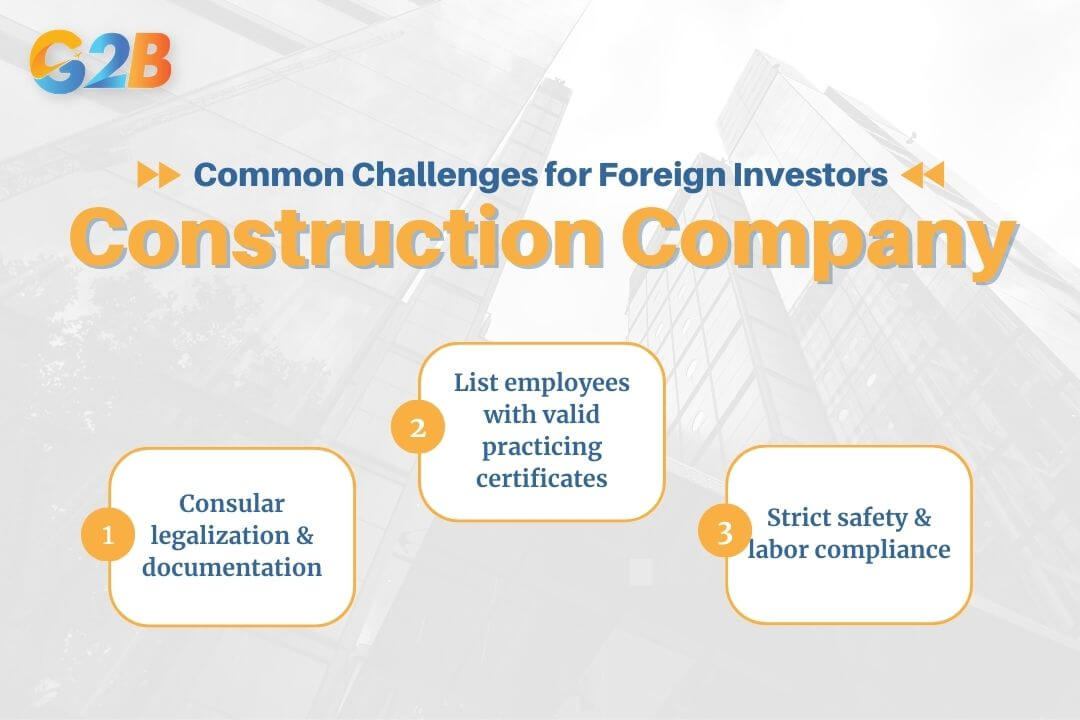
Key challenges for foreign construction investors in Vietnam
Setting up a company in Vietnam offers immense potential due to the country's infrastructure boom and industrialization. However, the barrier to entry is defined by complex compliance layers - from obtaining the Investment Registration Certificate to securing the essential Ministry of Construction capability grades.
