




 Delaware (USA)
  Vietnam
  Singapore
  Hong Kong
  United Kingdom
 How do you check your Vietnam eVisa result and status? You check your Vietnam eVisa status through the official Vietnam Immigration portal using your registration code, email, and date of birth. The system returns approval, rejection, or pending status instantly. This article will outline the required information and the possible results applicants may receive.
What information do you need to check your Vietnam eVisa status?
You need your registration code, email address, and date of birth to check your Vietnam eVisa status. The official system requires these three specific inputs to retrieve your application record. The registration code identifies your specific application record. The immigration system generates this unique alphanumeric code when you submit your initial online form. You receive this code on the final screen of the application. The system also sends this code to your email address. You cannot check your status without this exact code.
Your email address confirms your identity as the applicant. You must type the exact email address that you used during the application. The database links this email directly to your passport record. A small typo in the email field prevents the system from loading your results. Your date of birth validates your personal data. The system uses a standard calendar format. You must select the day, month, and year correctly. This extra layer of security protects your personal information from unauthorized access.
Required actions include:
- Find your registration code in your confirmation email.
- Type the exact email address used during submission.
- Input your date of birth using the dropdown calendar.
- Match all details exactly with your original application.
Where do you check Vietnam eVisa results?
You check your Vietnam eVisa results on the official Vietnam Immigration Department eVisa system. This government portal provides the only authoritative status updates for your application. The official website domain always ends in "gov.vn". The Vietnamese government owns and operates this domain. The system connects directly to the national immigration database. You see real-time updates as immigration officers review your file.
You must avoid third-party agency websites. Third-party sites do not possess real-time database access. These commercial sites often require you to pay extra fees to check your status. They send manual updates via email, which causes delays. Some unverified websites also pose data privacy risks. You must protect your passport information by using only the official government portal.
| Entity | Function | URL Type | Data Source |
|---|---|---|---|
| Vietnam Immigration Portal | Processes eVisa applications | Official government website (.gov.vn) | National database |
| eVisa Search Page | Retrieves application status | Status lookup interface | Real-time system |
| Third-party Agency | Offers visa assistance | Commercial website (.com/.org) | Manual updates |
What steps do you follow to check eVisa status?
You open the official eVisa search page, enter your registration code, email, and birth date, solve the captcha, and click the search button to view your status. The online interface is straightforward. You do not need to create a user account. The system uses a simple form to query the database. The webpage loads on both desktop computers and mobile devices. You follow a simple sequence:
- Open the official Vietnam eVisa website.
- Click the “Search application” or "eVisa search" menu item.
- Enter your registration code, email, and date of birth into the form.
- Complete the visual captcha verification carefully.
- Submit the form to retrieve your current status.
The captcha requires you to type a series of letters and numbers from a distorted image. This step prevents automated bots from overloading the government servers. If you type the captcha incorrectly, the system clears the form. You must enter all your details again.
What do Vietnam eVisa status results mean?
Vietnam eVisa status results indicate whether your application is approved, pending, or rejected. Each status determines your next required action before traveling to Vietnam. The system displays specific terms. You must understand these terms to plan your trip. A pending status means the officers are still reviewing your passport scan and photo. An amending status means you made a mistake. The officers pause your application and ask you to fix the error. An approved status is the final successful step. The system provides a link to download your visa document. A rejected status means you cannot enter Vietnam with this application.
| Status Result | Meaning | Required Action |
|---|---|---|
| Approved | The Immigration Department granted the visa. | Download and print the PDF document. |
| In Processing (Pending) | Officers are currently reviewing the data. | Wait and check the system again later. |
| Amending | The application contains data errors. | Update the requested information in the portal. |
| Denied / Rejected | The application failed to meet requirements. | Review the rejection reason and reapply. |
How long does Vietnam eVisa processing take?
Vietnam eVisa processing usually takes 3 to 5 working days. Peak travel seasons, national holidays, or incomplete applications often extend this timeline up to 7 to 10 days. The Immigration Department processes applications during standard working hours in the Indochina Time zone (UTC+7). Saturdays and Sundays do not count toward the processing time. If you apply on a Friday night, the processing clock begins on Monday morning.
Vietnamese public holidays delay results significantly. The Lunar New Year (Tet holiday) halts government operations for over a week. National Independence Day and Labor Day also pause visa processing. You must check the Vietnamese holiday calendar before applying. Data errors also increase processing time. If the department asks you to amend your application, the 3-5 day timeline restarts after you submit the new data.
Processing timelines involve:
- Expect a 3-5 working day wait under normal conditions.
- Anticipate 7-10 day delays during peak tourist seasons.
- Account for Vietnamese public holidays when planning.
- Review your application carefully to prevent amendment delays.
What should you do after eVisa approval?
You must download the eVisa PDF from the portal, print a physical copy, and verify all personal details against your passport immediately after approval:
- Print your eVisa: Carry a printed (paper) copy of your eVisa approval with you when you travel.
- Prepare supporting documents: Have your passport, invitation letter, business card, and any other relevant documents ready.
- Use approved entry points: Ensure you arrive at one of the airports or seaports you selected when applying for your eVisa.
- Plan your travel within the visa validity: You must enter India before the expiration date stated on your eVisa.
- Complete immigration formalities: Upon arrival, proceed to the eVisa immigration counter. The immigration officer will verify your documents and affix the actual visa to your passport.
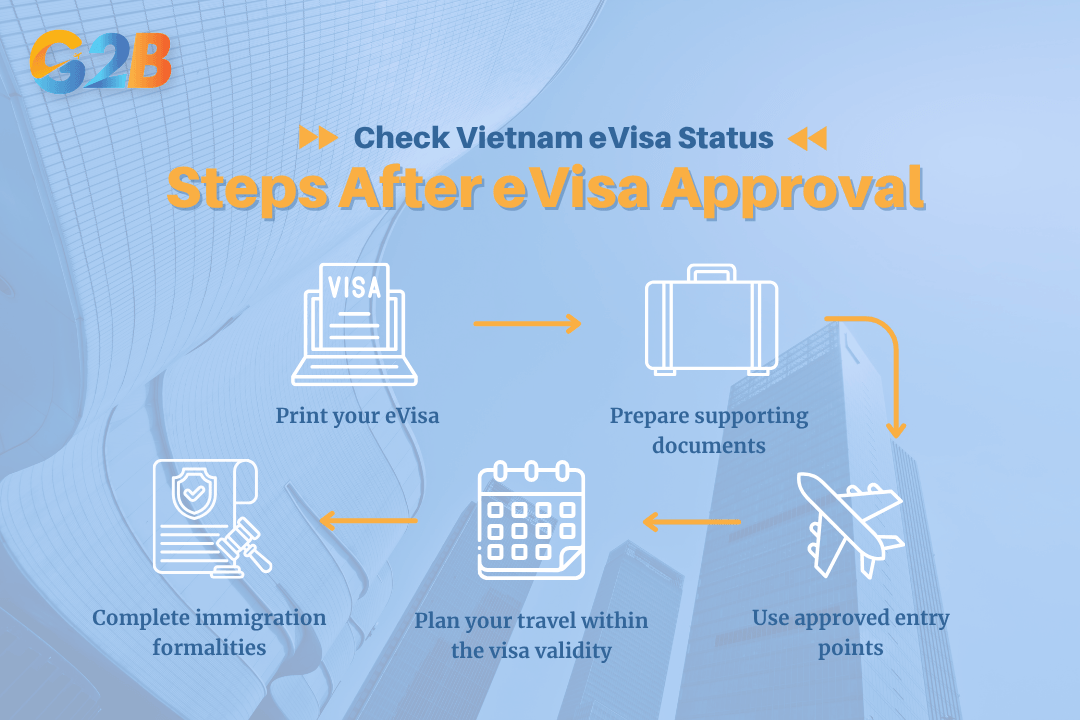
Steps to take after having eVisa approval
What does the Vietnam eVisa PDF look like?
The Vietnam eVisa PDF contains your portrait photo, personal details, an official QR code, and a digital signature from the Vietnam Immigration Department. The document serves as your official entry permit. The top of the page displays the Socialist Republic of Vietnam header. The top right corner contains your portrait photo. The QR code sits near the photo. Immigration officers scan this QR code to access your digital file instantly at the border.
The main body of the document lists your full name exactly as it appears in the machine-readable zone of your passport. It shows your nationality, date of birth, and passport number. The document clearly states the approved entry port. It also explicitly lists the validity period. The bottom of the page features the digital stamp of the Immigration Department. You must not alter or write on this printed document.
What causes Vietnam eVisa delays or rejection?
Incorrect passport data, blurry passport scans, invalid photo formats, and prior visa overstays cause Vietnam eVisa delays or rejections. Accurate data submission ensures a faster approval process. The Immigration Department uses strict verification methods. Mismatched names create the most common errors. Many applicants confuse the order of their first, middle, and last names. You must enter your name exactly as it appears in the ICAO lines at the bottom of your passport data page.
The passport data page scan must remain entirely visible. You must not crop the edges of the passport. The image must not contain light glare covering your personal details. The portrait photo must meet standard dimensions. You must look directly at the camera with a neutral expression. Common error triggers include:
- Avoid typing errors in names and passport numbers.
- Ensure passport scans are clear, full-color, and readable.
- Upload compliant portrait photos without hats or glasses.
- Resolve any previous overstay records before applying.
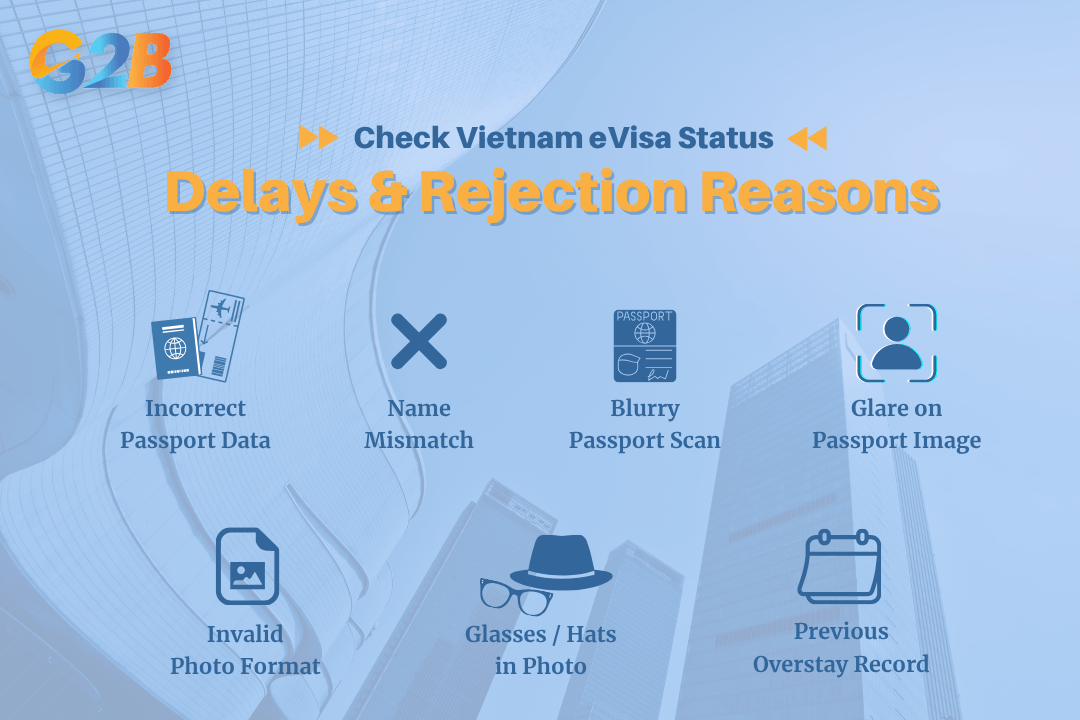
Reasons for Vietnam eVisa delays or rejection
Can you reapply after a Vietnam eVisa rejection?
Yes, you can reapply for a Vietnam eVisa after a rejection by submitting a new application with corrected information and paying a new fee. The online system treats every submission as an independent record. You cannot reuse a rejected application form. You cannot transfer the payment from a rejected application to a new one. The government fee is strictly non-refundable.
You must identify the exact reason for the initial rejection. If you repeat the same mistake, the system will reject you again. You gather your correct documents, fill out the form from the beginning, and generate a new registration code. You use this new code to check your new status. Reapplication steps involve:
- Fix specific errors in your passport number or name order.
- Upload new, compliant photo and document formats.
- Create a completely new application record on the portal.
- Pay the government visa fee again through the payment gateway.
How often should you check your Vietnam eVisa status?
You should check your Vietnam eVisa status once per day after submitting your application. Frequent checking does not accelerate the official government review process. The Immigration Department updates the database in batches. The system changes your status only after an officer physically completes the review of your file. Checking the website multiple times an hour wastes your effort. It also creates unnecessary server load on the government network.
You should perform your first check 24 hours after submission. This check confirms that the system received your payment and changed your status to "In Processing." After that, you wait until the third working day to check again. If you receive an email requesting an amendment, you update your application and resume checking once per day.
What problems occur when checking eVisa status?
Typical problems include incorrect registration codes blocking access, official system downtime interrupting queries, and browser cache issues causing loading errors. You must use perfectly accurate data to access the record. Copying and pasting the registration code often adds an invisible space at the end. This extra space causes an error. You must delete any blank spaces.
Government servers occasionally undergo maintenance. This maintenance causes temporary system downtime. During this time, the webpage fails to load. The browser cache stores old website data. This stored data prevents the page from displaying new status updates. Troubleshooting methods include:
- Verify your registration code matches the email confirmation exactly.
- Remove accidental spaces when copying and pasting your details.
- Wait a few hours if the government system experiences downtime.
- Clear your web browser cache and cookies.
- Switch to a different web browser or device if errors persist.
What happens if you lose your eVisa registration code?
If you lose your eVisa registration code, you must contact the Vietnam Immigration Department support portal to retrieve your lost code. You cannot check your application status without it. The registration code acts as your unique identifier. The system emails this code to you immediately after submission. You should always check your spam or junk email folder. Email providers sometimes filter automated government messages.
If you cannot find the email, you must visit the support section on the official website. You submit a support ticket containing your full name, passport number, and date of birth. The officers verify your identity manually. They reply with your registration code. This manual process takes several days, which delays your ability to check your status.
Who is eligible for a Vietnam eVisa?
Citizens of all countries and territories are eligible to apply for a Vietnam eVisa. The Vietnamese government expanded universal eVisa eligibility to promote international tourism and business. Applicants must hold a valid standard passport. The passport must remain valid for at least six months beyond the planned entry date into Vietnam. The passport must contain at least two blank pages for immigration entry stamps.
The applicant must not fall into the restricted categories under Vietnamese immigration law. People with prior deportation records or serious criminal convictions face automatic rejection. Temporary travel documents and emergency passports do not qualify for the eVisa program. You must possess a standard national passport to proceed.
What documents must you prepare for a Vietnam eVisa?
You must prepare a valid passport, a digital passport data page scan, a digital portrait photo, and a valid credit card to apply for a Vietnam eVisa. The passport scan must display all data clearly, including the machine-readable ICAO lines at the bottom. The portrait photo must measure exactly 4x6 cm. It must feature a solid white background. Applicants must not wear glasses, hats, or head coverings in the photo, except for religious purposes.
| Document Type | Specific Requirement | Purpose |
|---|---|---|
| Passport Data Page | Clear, full-color scan without glare | Verifies identity and nationality |
| Portrait Photo | 4x6 cm, no glasses, white background | Facilitates facial recognition |
| Valid Credit Card | Visa, Mastercard, or JCB | Pays the non-refundable government fee |
| Email Address | Active and accessible | Receives registration codes and updates |
Do children need a separate Vietnam eVisa?
Children holding their own separate passports must apply for their own individual Vietnam eVisa and pay the full government fee. The eVisa system treats every passport as an individual entity. You cannot add a child with a separate passport to a parent's application. The child undergoes the same application process as an adult. The parent fills out the form on behalf of the child, uploads the child's photo, and uses the child's passport details. If the child shares a passport with a parent, the process changes. The parent applies for one eVisa. The parent selects the option indicating a child shares the passport. The parent uploads an additional photo of the child within the same application form.
How much does a Vietnam eVisa cost?
A single-entry Vietnam eVisa costs 25 USD, while a multiple-entry eVisa costs 50 USD. Applicants pay this non-refundable fee online during the application process. The government processes payments through a secure national payment gateway. The fee covers the mandatory application review process. The Immigration Department does not refund the fee if they reject your application. You pay using an international credit or debit card. The payment gateway accepts Visa, Mastercard, and JCB. The system charges the amount in United States Dollars (USD) or Vietnamese Dong (VND). Applicants bear any international transaction fees charged by their local bank.
How long is the Vietnam eVisa valid?
A Vietnam eVisa remains valid for a maximum of 90 days from the approved entry date. Travelers choose between a single-entry or multiple-entry visa within this 90-day validity period. The validity starts strictly from the arrival date registered on your application. You can enter Vietnam on this approved date. You can also enter Vietnam after this approved date. You cannot enter Vietnam before this approved date.
You must leave Vietnam before or on the expiration date printed on the visa. The 90-day period runs continuously. A multiple-entry visa allows you to exit and re-enter Vietnam multiple times during the 90 days. A single-entry visa becomes invalid the moment you exit the country, regardless of how many days remain.
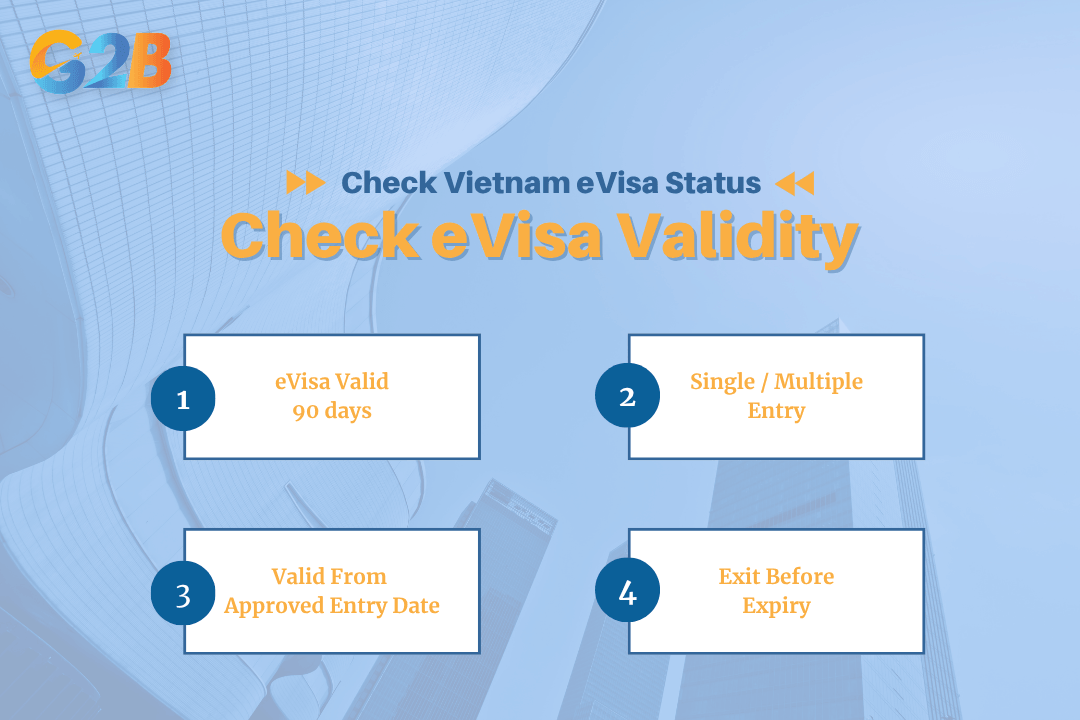
Vietnam eVisa validity lasts up to 90 days
Which entry ports accept the Vietnam eVisa?
You can enter Vietnam using an eVisa through 44 designated international ports. These ports include major international airports, land border crossings, and seaports across the country. The applicant must select the exact entry port during the application process. The approved visa lists this specific port. Changing the entry port later requires a completely new visa application. You cannot arrive at an airport if your visa specifies a land border.
| Port Category | Example Ports | Mode of Transport |
|---|---|---|
| International Airports | Noi Bai (Hanoi), Tan Son Nhat (HCMC), Da Nang | Air travel |
| Land Border Crossings | Moc Bai, Lao Bao, Cau Treo | Road travel |
| Seaports | Hai Phong, Da Nang, Ho Chi Minh City | Cruise and cargo ships |
Can you extend a Vietnam eVisa inside Vietnam?
You cannot extend a Vietnam eVisa directly from within the country. You must leave Vietnam and apply for a new eVisa to return and continue your stay. The Vietnamese government removed internal eVisa extensions to streamline immigration control. Travelers who wish to stay longer practice "visa runs." They exit Vietnam and travel to neighboring countries like Thailand, Cambodia, or Laos. They apply for a new eVisa while outside of Vietnam. Once the government approves the new eVisa, they re-enter Vietnam. This exit and re-entry process resets the 90-day validity period. You must plan your travel carefully to account for the 3-5 day processing time of the new visa.
How do you fix errors on an approved eVisa?
You cannot edit or fix errors on an approved Vietnam eVisa. You must apply for a completely new eVisa and pay the fee again to correct the information. The immigration system finalizes the digital record upon approval. Airlines deny boarding to passengers with mismatched visa information. Border officers refuse entry if your visa name or passport number does not match your physical passport exactly.
Even small typographical errors require a new application. You cannot negotiate with immigration officers at the airport to fix spelling mistakes. You must double-check all your data before the final submission. If you spot an error after approval, you generate a new application immediately to prevent travel disruptions.
Checking your Vietnam eVisa result requires accuracy, patience, and a clear understanding of the official government system. You track your application efficiently by using your registration code, email, and birth date on the official immigration portal. Understanding the differences between pending, amending, and approved statuses allows you to respond correctly to immigration requirements. You avoid unnecessary stress by preparing compliant passport scans and respecting the standard 3 to 5 day processing timeline. Accurate data entry remains the most effective method to secure quick approval and avoid costly reapplication fees. By following these strict procedural steps, business travelers and tourists ensure their travel documents are fully validated before their arrival in Vietnam. For streamlined support, G2B provides work permit / TRC / visa services, ensuring an efficient and fully compliant process for foreigners.
