




 Delaware (USA)
  Vietnam
  Singapore
  Hong Kong
  United Kingdom
 DICA in Vietnam is the specialized payment account denominated in foreign currency or Vietnamese Dong, opened by Foreign Direct Investment (FDI) enterprises or foreign investors to execute legally mandated capital transactions. It serves as the exclusive financial gateway for injecting charter capital, receiving foreign loans, and eventually repatriating profits and legal capital to overseas jurisdictions.
What is DICA?
The Direct Investment Capital Account (DICA) is a mandatory account type for specific foreign investment activities.
The financial gateway for FDI
Vietnam operates under a strict foreign exchange control regime managed by the State Bank of Vietnam (SBV). The government monitors cross-border capital flows to stabilize the macro-economy. The DICA acts as a "monitoring funnel". All capital-related transactions, such as the initial investment subscription and the payout of dividends, must pass through this specific account.
If a foreign investor transfers money directly into a company's standard Current Account (Payment Account), the Vietnamese authorities do not recognize that fund as valid contributed capital. This error renders the capital illegitimate, making future profit repatriation impossible.
Legal basis
The existence and operation of DICA are governed by specific legal frameworks, primarily Circular 06/2019/TT-NHNN (guiding foreign exchange management for FDI) and the Law on Investment 2020. These regulations explicitly state that capital contribution and profit remittance must be effected through a DICA opened at one authorized bank.
Legal and regulatory context in Vietnam
Understanding the regulatory evolution is critical for CFOs and Legal Representatives to maintain compliance.
The role of the State Bank of Vietnam (SBV)
The State Bank of Vietnam (SBV) is the central regulatory body enforcing the Foreign Exchange Management Ordinance. They dictate that while Vietnam encourages FDI, the flow of currency must be transparent and auditable.
The shift: Circular 19/2014 to circular 06/2019
Previously, Circular 19/2014/TT-NHNN governed these accounts. However, the introduction of Circular 06/2019/TT-NHNN (effective from September 2019) introduced critical changes regarding the definition of "FDI Enterprises".
Under the current Circular 06/2019/TT-NHNN, the requirement to open a DICA applies strictly to enterprises that have been issued an Investment Registration Certificate (IRC). This creates a clear distinction between "Direct Investment" (requiring DICA) and "Indirect Investment" (requiring an IICA - Indirect Investment Capital Account), which often applies to M&A deals where the foreign investor holds a minority stake without an IRC. Foreign investors must navigate various statutory documents, including the Law on Credit Institutions, the Ordinance on Foreign Exchange Control, and Decree 70/2014/ND-CP.
Who needs a DICA?
Not every company with foreign elements requires a DICA. The law is specific about the entities compelled to open this account. You must open a DICA if you fall into one of the following categories:
- Foreign Direct Investment (FDI) enterprises: Companies that have been issued an Investment Registration Certificate (IRC) by the Department of Planning and Investment (DPI) or the Management Boards of Industrial Zones.
- Enterprises with foreign ownership > 50% (including M&A cases, as classified as FDI enterprises under Circular 06/2019/TT-NHNN, Article 3): Companies where foreign investors hold 50% or more of the charter capital due to M&A activities and are classified as FDI enterprises.
- Project implementers in PPP: Investors participating in Public-private partnership (PPP) contracts.
- Business cooperation contracts (BCC): Foreign investors operating under a BCC without establishing a legal entity in Vietnam.
If your entity does not fit these criteria (e.g., a foreign investor buying 10% shares on the stock market), you likely require an Indirect Investment Capital Account (IICA) instead.

Foreign investors should determine whether a DICA is required for investment activities
What can you do with a DICA?
The DICA is strictly a "Capital account", not a "Transactional account". You cannot use it to pay for daily operational expenses like rent, salaries, or tax. Circular 06/2019/TT-NHNN outlines specific permitted revenue and expenditure streams:
Permitted revenue (inflows)
- Capital contribution: Transfers of Charter Capital from foreign investors/shareholders.
- Foreign loan drawdown: Receipt of funds from short, medium, or long-term foreign loans approved by the SBV (if applicable).
- Capital assignment proceeds: Money received from the transfer of investment capital or projects within Vietnam.
- Account transfers: Transfers from the foreign investor’s foreign currency payment account opened at a bank in Vietnam.
Permitted expenditure (outflows)
- Principal and interest repayment: Paying back foreign loans (must match the loan registration with SBV).
- Profit repatriation: Remitting net profits abroad after the completion of annual Audited Financial Statements and tax finalization.
- Capital withdrawal: Repatriating the original investment capital upon project termination, dissolution, or capital reduction.
- Project transfer: Transferring funds to the company’s VND Current Account (Payment Account) to be used for domestic business operations.
Crucial rule: In most cases, money enters the DICA and is then transferred to the Current Account for use. Money generally should not flow from the DICA directly to third-party vendors.
How to open a DICA in Vietnam
A Direct Investment Capital Account (DICA) is required for foreign investors to transfer investment capital into Vietnam. The following section outlines the step-by-step process for opening a DICA in compliance with current regulations.
Required documents
Banks require a comprehensive set of legal dossiers, including:
- Corporate documents: Notarized copies of the Investment Registration Certificate (IRC) and Enterprise Registration Certificate (ERC).
- Identification: Valid passports or ID cards of the Legal Representative and the Chief Accountant.
- Internal decisions: The Decision on the Appointment of the Chief accountant and the Board of directors' meeting minutes authorizing the account opening.
- Bank forms: Application for account opening and specimen signature cards.
- FATCA/CRS forms: Compliance forms regarding US tax residency and common reporting standards.
Step-by-step process
- Select a licensed bank: Choose a bank permitted to provide foreign exchange services.
- Submit dossier: Submit the hard copies of legal documents to the bank branch.
- Bank verification: The bank’s compliance team reviews the IRC, ERC, and beneficial ownership structure.
- Counter-signing: The Legal Representative and Chief Accountant sign the specimen cards in the presence of a bank officer (or via consular legalization if abroad).
- Activation: The bank issues the account number and activates internet banking.
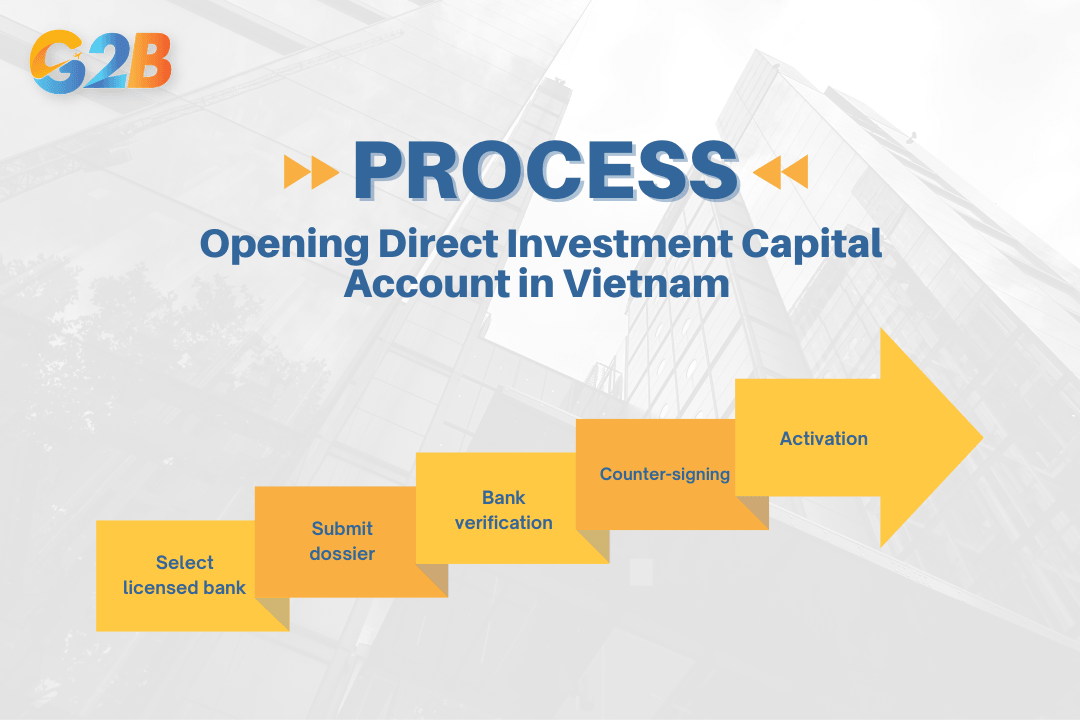
Process to open a DICA in Vietnam
Timeline
The standard processing time is 3 to 5 working days after the submission of a complete dossier. However, if the ownership structure is complex (e.g., multiple layers of offshore holding companies), compliance checks may extend this to 7-10 days.
Fees, limits & operational conditions
Currency regulations
An FDI enterprise can open DICA accounts in different currencies (e.g., USD, EUR, JPY) corresponding to the currency of contribution stated in the IRC. However, you may open multiple DICAs per currency at the same authorized bank if justified. If you wish to change the bank holding your DICA, you must close the account at the old bank and transfer the entire balance to the new bank, accompanied by a confirmation of account closure.
Fees and maintenance
Banks charge various service fees, such as account maintenance fees, telegraphic transfer (TT) fees for repatriation, and incoming remittance fees. While account maintenance is negligible (often $10-$20/month), the foreign exchange rates applied when converting capital from USD to VND for local use can significantly impact your working capital.
DICA vs. Other accounts: What’s the difference?
Confusion between account types is the leading cause of compliance breaches. Below is a comparison of the Direct Investment Capital Account (DICA), the Indirect Investment Capital Account (IICA), and the Payment Account (Current Account).
| Feature | Direct investment capital account (DICA) | Indirect investment capital account (IICA) | Payment account (Current account) |
|---|---|---|---|
| Primary user | FDI enterprises (with IRC), foreign Investors in BCC/PPP | Foreign investors buying shares (<51%) or trading on the stock market | Any registered company in Vietnam |
| Primary purpose | Receipt of Charter capital, foreign loans, and profit repatriation | Receipt of capital for portfolio investment, share purchase | Daily operations (Salary, rent, tax, Vendor Payments) |
| Currency | Foreign currency or VND (if investment is in VND) | VND only (Foreign currency must be converted to VND immediately) | VND or foreign currency |
| Key limitation | Cannot pay vendors directly (must transfer to the current account first) | Cannot retain foreign currency; must convert to VND for investment | Cannot receive direct Charter Capital from overseas |
Common errors & compliance risks
Improper use or management of a Direct Investment Capital Account (DICA) can lead to regulatory violations and financial risks for foreign-invested companies. Below are some common errors and compliance risks that investors should be aware of.
1. Using current accounts for capital injection
This is the most critical error. If a foreign investor transfers $100,000 directly to the company's current account labeled as "Capital contribution", the Department of planning and investment (DPI) and SBV will not recognize this as paid-up charter capital.
- Consequence: The investor is deemed to have not fulfilled their capital contribution obligation. To fix this, the money often has to be wired back out and re-sent correctly through the DICA, incurring double FX losses and fees.
2. Failure to report foreign loans
If the DICA receives funds labeled as a loan from the parent company, but the loan exceeds 12 months and was not registered with the State Bank of Vietnam, the bank may freeze the funds or refuse to allow repayment of principal/interest.
3. Misclassification of M&A deals
Investors involved in Mergers and Acquisitions (M&A) often fail to distinguish whether they need a DICA or an IICA. Using the wrong account type can block the transfer of ownership proceeds.
- Penalties
Administrative penalties for foreign exchange violations can range from VND 40,000,000 to VND 200,000,000, alongside the practical penalty of being unable to repatriate profits.
Frequently asked questions (FAQ)
Do foreign companies need a DICA? Yes, if the foreign company establishes a legal entity in Vietnam (FDI enterprise) and holds an Investment Registration Certificate (IRC), a DICA is mandatory for capital injection and profit repatriation.
Can DICA be opened online? No, current regulations generally require the physical presence of the Legal Representative or their authorized attorney to sign documents at the counter, although some international banks are beginning to accept digital signatures subject to strict conditions.
What happens if capital is not fully paid? Fines and revocation of the business license are potential consequences. If capital is not contributed to the DICA within 90 days of IRC issuance (or as extended per IRC approval), the company faces penalties and must legally reduce its charter capital or face dissolution.
The Direct Investment Capital Account (DICA) is the single most critical financial instrument for any foreign investor in Vietnam. It is the bridge between your capital overseas and your legal operations domestically. Mismanagement of this account does not just result in administrative headaches; it fundamentally jeopardizes your ability to realize a return on investment.
