




 Delaware (USA)
  Vietnam
  Singapore
  Hong Kong
  United Kingdom
 Investor Visa Vietnam serves as the primary legal gateway for foreign nationals seeking to establish and manage commercial enterprises within the country. The Vietnamese government actively encourages foreign direct investment (FDI) by providing structured immigration pathways. In this article, let’s explore the purpose, eligibility criteria, and the broader framework supporting foreign investment.
What is an investor visa in Vietnam?
An investor visa in Vietnam (DT visa) is an official travel document that grants legal residence to foreign investors. The Vietnamese government issues this visa to individuals who contribute capital or establish a business entity in the country. The Vietnam Immigration Department manages the issuance and renewal of DT visas. The Law on Entry, Exit, Transit, and Residence of Foreigners in Vietnam strictly regulates these activities. The state categorizes visas to separate regular employees from business owners. While foreign employees apply for LD (Labor) visas, foreign capital contributors apply for DT visas.
Foreign investors use the DT visa to conduct market research, manage daily business operations, and sign commercial contracts. The document provides a legal basis for a continuous stay, eliminating the need for frequent visa runs. The government divides the DT visa into specific classifications (DT1, DT2, DT3, DT4) based on the financial scale of the investment project.
What are the DT1, DT2, DT3, and DT4 visa types in Vietnam?
The Vietnamese government classifies the investor visa in Vietnam into four distinct categories: DT1, DT2, DT3, and DT4. The classification directly depends on the total investment capital or the specific industry sector. Each tier offers different validity periods and residency benefits. The Immigration Department verifies the capital amount stated on the corporate registration documents before assigning a visa category.
| Visa Type | Investment Capital Threshold | Maximum Validity | Key Attribute |
|---|---|---|---|
| DT1 | ≥ VND 100 billion or priority sectors | Up to 10 years | Long-term residency |
| DT2 | VND 50 billion – VND 100 billion | Up to 5 years | Medium-term stay |
| DT3 | VND 3 billion – VND 50 billion | Up to 3 years | Common investor tier |
| DT4 | < VND 3 billion | Up to 1 year | Short-term entry |
The DT1 visa applies to large-scale investors who contribute at least VND 100 billion. The government also issues DT1 visas to investors in priority sectors or locations with difficult socio-economic conditions, regardless of the exact capital amount. The DT2 visa requires an investment between VND 50 billion and VND 100 billion. The DT3 visa fits medium-sized investors contributing between VND 3 billion and VND 50 billion. The DT4 visa serves small-scale investors who inject less than VND 3 billion into their Vietnamese enterprise.
Who qualifies for a Vietnam investor visa?
Foreign individuals qualify for an investor visa in Vietnam when they invest capital into a Vietnamese company. Eligible candidates include business founders, shareholders, and members of limited liability companies who officially contribute financial resources. The investment must remain legitimate, documented, and registered with the state. Investors either establish a completely new business entity or purchase shares in an existing Vietnamese enterprise. Nominee directors or standard managers who do not own legal shares do not qualify for this specific visa type.
The Department of Planning and Investment (DPI) appraises and approves the corporate investment. The authorities verify the financial commitment through an Investment Registration Certificate (IRC). When an investor buys into an existing company, the DPI updates the Enterprise Registration Certificate (ERC) to reflect the new ownership structure. The Immigration Department checks these certificates to confirm the applicant's eligibility.
What documents are required for an investor visa in Vietnam?
Applicants must prepare a comprehensive dossier containing a valid passport, an Investment Registration Certificate (IRC), and proof of capital contribution. The Immigration Department requires these legal documents to process the investor visa in Vietnam. Accurate documentation prevents application rejections and administrative delays. The applicant's local company acts as the official visa sponsor.
Required application documents include:
- Submit a passport with at least six months of validity remaining.
- Provide a certified copy of the Investment Registration Certificate (IRC).
- Include a certified copy of the Enterprise Registration Certificate (ERC).
- Present official bank statements as proof of capital contribution.
- Complete the official visa application form (Form NA2 for pre-arrival approval or NA5 for in-country issuance).
- Provide the sponsoring company's legal documents, including the official seal registration.
- Submit a valid temporary residence declaration certified by the local ward police.
Local authorities frequently request notarized and translated copies of foreign documents. Consular legalization validates foreign-issued documents for legal use within Vietnam.
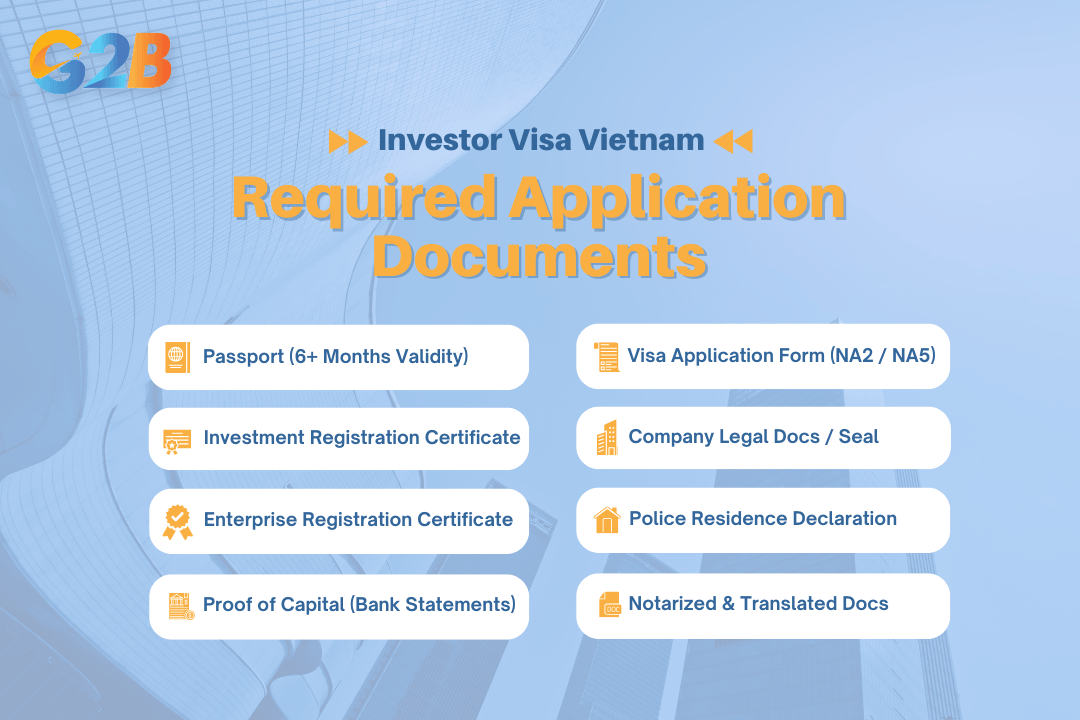
Investor visa applications require many documents in Vietnam
How to apply for a Vietnam investor visa?
To apply for an investor visa in Vietnam, foreign business owners must register their investment, establish a corporate entity, transfer the required capital, and submit a visa dossier to the Immigration Department. The process involves multiple government ministries and banking institutions. Investors must follow strict chronological steps to ensure legal compliance. Required application steps include:
- Register the investment project with the DPI to obtain the IRC.
- Establish the company structure to receive the ERC.
- Open a Direct Investment Capital Account (DICA) at a licensed commercial bank in Vietnam.
- Transfer the required investment funds from overseas into the DICA.
- Submit the complete visa application dossier to the Vietnam Immigration Department.
- Receive the official visa approval letter via the sponsoring company.
- Collect the physical visa stamp at a Vietnamese embassy or an international airport upon arrival.
How long does it take to process an investor visa in Vietnam?
The processing time for an investor visa in Vietnam takes between 3 and 6 weeks. This timeline includes the issuance of necessary corporate documents and the final visa approval from the immigration authorities. Processing speeds depend heavily on the complexity of the investment project. Standard business lines process faster than conditional business sectors.
| Process Step | Estimated Processing Time | Issuing Authority |
|---|---|---|
| Investment Registration (IRC) | 10–30 working days | Department of Planning and Investment |
| Enterprise Registration (ERC) | 3–7 working days | Business Registration Office |
| Visa Approval Letter | 5–7 working days | Vietnam Immigration Department |
Projects requiring land leasing, environmental impact assessments, or approval from the Prime Minister extend the IRC processing time significantly. Errors in the application dossier or missing legalizations also cause administrative delays. Following state guidelines precisely keeps the process within the standard timeframe.
What are the costs of a Vietnam investor visa?
The costs for an investor visa in Vietnam include government stamping fees ranging from USD 25 to USD 135, business registration expenses between USD 500 and USD 1,500, and additional legal consulting fees. Government visa fees change based on the visa's validity period and the allowed number of entries.
Required cost components include:
- Pay USD 25 for a single-entry visa valid for up to 3 months.
- Pay USD 50 for a multiple-entry visa valid for up to 3 months.
- Pay USD 95 for a multiple-entry visa valid for up to 6 months.
- Pay USD 145 for a multiple-entry visa valid for up to 1 year.
- Allocate USD 500 to USD 1,500+ for establishing the business and securing corporate licenses.
- Pay additional state fees for document translation, notarization, and consular legalization.
What benefits does a Vietnam investor visa provide?
An investor visa in Vietnam grants long-term stay rights, enables multiple entries across borders, allows family sponsorship, and provides eligibility for a Temporary Residence Card (TRC) for extended residency. The visa simplifies living and working within the country. It removes the administrative burden of applying for frequent tourist or business visa renewals. Key benefits include:
- Grant long-term residency rights up to 10 years, depending on the investment tier.
- Enable multiple entries without applying for new travel documents.
- Allow the investor to sponsor spouses and children using dependent visas (TT visas).
- Support the legal conversion of the visa into a Temporary Residence Card (TRC).
- Facilitate administrative processes for opening personal bank accounts and leasing property.
- Permit the registration of vehicles in the investor's name.
The TT visa for family members directly matches the validity of the primary investor's visa. This system keeps foreign families together during long-term business assignments.
Read more: How to Convert a Tourist Visa to a Business Visa in Vietnam and TRC for Family
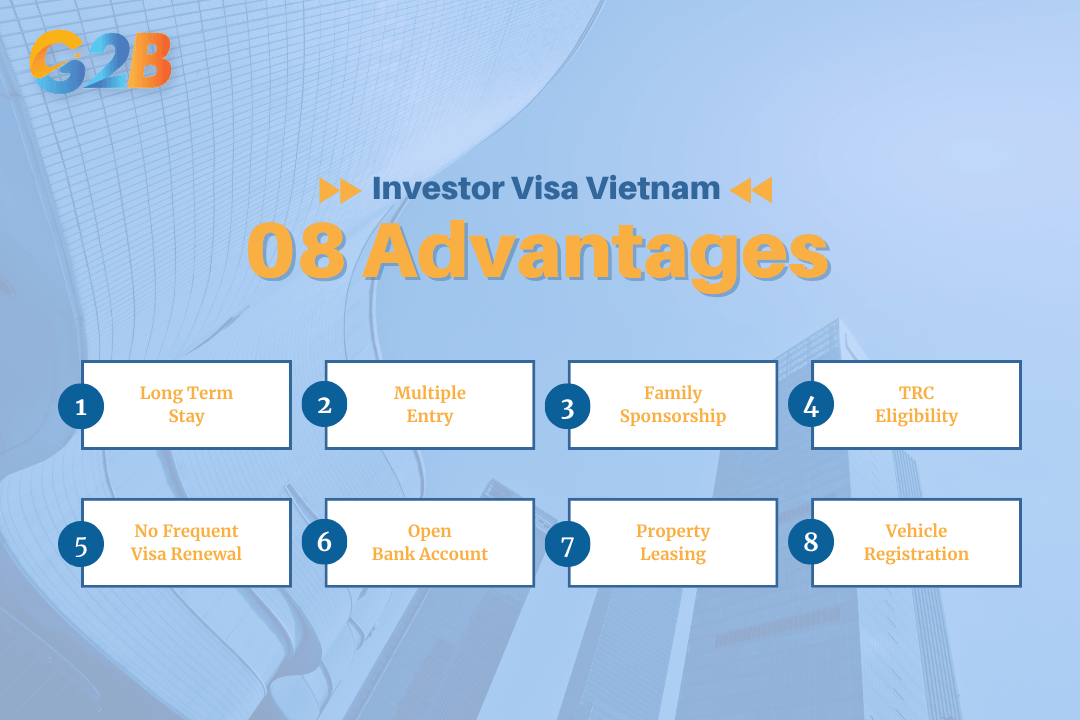
Investor visas provide advantages for foreigners in Vietnam
Can investor visa holders obtain permanent residency in Vietnam?
Holders of an investor visa in Vietnam cannot automatically obtain permanent residency. Investors must first secure a Temporary Residence Card (TRC), as permanent residency status remains highly restricted and heavily case-dependent. The Vietnamese government issues Permanent Residence Cards (PRC) only to very specific groups. Eligible individuals include foreign scientists, experts with national medals, or persons with exceptional contributions to Vietnam's socio-economic development. Ordinary business investment does not guarantee a PRC.
Most foreign investors maintain their legal stay through continuous TRC renewals. A long-term, stable investment history and high capital contributions increase the likelihood of favorable immigration decisions in the future. However, investors must rely on the DT visa or TRC framework to conduct their standard operations in the country.
What is a Temporary Residence Card (TRC) for investors in Vietnam?
A Temporary Residence Card (TRC) is an identity document that replaces the standard investor visa in Vietnam for long-term stays. The Immigration Department issues the TRC to eligible DT1, DT2, and DT3 visa holders. The TRC functions as a multiple-entry visa. It allows foreign investors to exit and enter Vietnam without presenting additional immigration paperwork at border checkpoints.
Key TRC attributes include:
- Replace the passport visa stamp with a standalone, wallet-sized physical card.
- Align the TRC validity period directly with the specific investor visa tier.
- Provide up to 10 years of legal residency validity for DT1 investors.
- Provide up to 5 years of legal residency validity for DT2 investors.
- Provide up to 3 years of legal residency validity for DT3 investors.
DT4 visa holders do not qualify for a TRC because their visa validity remains capped at one year. These short-term investors must renew their DT4 visa annually.
What sectors qualify for priority investment (DT1 visa)?
The Vietnamese government awards the DT1 investor visa in Vietnam to foreign individuals investing in priority sectors. These sectors include high technology, infrastructure development, renewable energy, and other government-approved strategic industries. The government encourages FDI in areas that drive rapid socioeconomic growth. Investors targeting these specific industries receive the highest tier of investor visa regardless of their exact capital amount, provided the project meets strict government criteria.
Priority investment sectors include:
- Invest in high-technology research, artificial intelligence, and software manufacturing.
- Develop national infrastructure projects, including toll roads, seaports, and bridges.
- Produce renewable energy, such as solar power, wind power, and biomass energy.
- Support environmental protection, clean water supply, and waste management initiatives.
- Establish advanced healthcare facilities, specialized clinics, and educational institutions.
The Ministry of Planning and Investment publishes the official list of encouraged investment sectors. Projects located in rural or mountainous regions with difficult economic conditions also qualify for investment incentives and DT1 status.
What are the common challenges in obtaining an investor visa in Vietnam?
Common challenges in securing an investor visa in Vietnam include strict regulatory compliance requiring accurate documentation, strict capital verification demanding banking transparency, and sector restrictions limiting foreign ownership.
The State Bank of Vietnam monitors capital transfers closely. Investors cannot use physical cash to fund their corporate accounts; they must use trackable international bank transfers. Common challenges include:
- Ensure complete accuracy when submitting notarized legal and corporate documents.
- Verify capital contributions strictly through official bank statements and DICA transfers.
- Navigate foreign ownership caps in restricted or conditional business sectors.
- Manage language barriers and complex legal terminology during the administrative processes.
- Respond promptly to requests for additional information from the Immigration Department.
How does the Vietnam investor visa compare to other ASEAN visas?
The investor visa in Vietnam offers lower capital thresholds than Singapore and provides longer visa durations than Thailand. The application processing time remains moderate compared to other member states of the ASEAN region. Vietnam actively attracts small and medium enterprises (SMEs) by removing hard minimum capital requirements for general business setups. The DT4 category allows legal entry with minimal financial investment.
| ASEAN Country | Minimum Capital Requirement | Maximum Visa Validity | Average Processing Time |
|---|---|---|---|
| Vietnam | < USD 130,000 (DT4 tier) | Up to 10 years | 3–6 weeks |
| Singapore | ~ USD 1.8 million (GIP) | Up to 5 years | 3–6 months |
| Thailand | ~ USD 300,000 (BOI/Smart Visa) | Up to 1 year (renewable) | 4–6 weeks |
Singapore demands millions of dollars for its Global Investor Programme (GIP). Thailand requires specific capital minimums and enforces strict hiring quotas for local Thai staff. Vietnam balances accessibility with reasonable regulatory oversight, making it a highly competitive destination for regional entrepreneurs.
What mistakes should investors avoid during the visa process?
Applicants for an investor visa in Vietnam must avoid submitting incomplete legal documents, underestimating minimum capital thresholds for their industry, and ignoring sector-specific foreign ownership caps. Violating the Enterprise Law creates severe consequences. Missing mandatory deadlines or faking financial records leads to immediate application rejection and potential business closure.
Key mistakes to avoid include:
- Submit all required notarized and legalized documents before government deadlines expire.
- Research specific minimum capital requirements for conditional business lines.
- Review Vietnam’s World Trade Organization (WTO) commitments regarding foreign ownership limits.
- Transfer the investment capital strictly within 90 days (extendable to 180 days with DPI approval) of receiving the Enterprise Registration Certificate.
- Avoid using personal bank accounts for corporate capital contributions.
The authorities penalize companies that fail to inject the registered capital within the 90-day window. The Immigration Department denies visa applications if they find discrepancies between the stated investment on the IRC and the actual bank transfers.
What happens after obtaining the investor visa in Vietnam?
After receiving the investor visa in Vietnam, the business owner must maintain active business operations, file tax reports, and renew the visa or convert it to a TRC before expiration. The Immigration Department and the General Department of Taxation monitor corporate activity. Dormant companies lose their ability to sponsor foreign investors.
Required post-visa actions include:
- Operate the business strictly according to the registered business lines listed on the ERC.
- Submit quarterly and annual tax reports to the local tax authorities.
- Maintain a proper accounting system and conduct independent annual audits.
- Apply for a visa extension or TRC at least 30 days before the current travel document expires.
- Update the IRC and ERC immediately if the company changes its charter capital or head office address.
Ongoing corporate compliance ensures uninterrupted legal residency. Tax violations or failure to file reports result in blacklisting. Maintaining good standing with state agencies guarantees smooth renewals for future immigration needs.
The investor visa in Vietnam provides a secure legal pathway for foreign nationals to establish businesses and reside in the country. Understanding the DT1, DT2, DT3, and DT4 classifications helps investors align their financial strategies with state immigration laws. Securing the necessary corporate documents, including the Investment Registration Certificate and Enterprise Registration Certificate, serves as the foundation of the application. Investors must transfer capital transparently through legal banking channels to meet government regulations. The visa offers significant advantages, including long-term residency, family sponsorship, and Temporary Residence Card eligibility. Avoiding common administrative mistakes and maintaining ongoing corporate compliance ensures uninterrupted business operations. For streamlined support, G2B provides work permit / TRC / visa services, ensuring an efficient and fully compliant process for foreigners.
