




 Delaware (USA)
  Vietnam
  Singapore
  Hong Kong
  United Kingdom
 Terminating employees in Vietnam is a complex legal process that requires strict adherence to the 2019 Labor Code, as the regulatory framework heavily favors employee protection over "at-will" employment practices common in Western jurisdictions. For foreign investors and business owners, navigating this landscape demands precision; a single procedural misstep can result in costly litigation, reinstatement mandates, and severe reputational damage with local authorities like the Department of Labor, Invalids and Social Affairs (DOLISA).
This article highlights the key aspects of terminating employees in Vietnam to help businesses understand. We specialize in company formation in Vietnam and corporate services in Vietnam and do not provide labor dispute resolution or legal representation services. For complex employee termination cases, businesses should consult a qualified labor lawyer or legal professional.
Employee termination in Vietnam at a glance
To navigate the legal landscape effectively, employers must view termination through four distinct pillars. Understanding the relationship between these entities is crucial for risk management.
- Statutory triggers: A contract does not end simply because an employer desires it. Termination must be based on specific articles within the Labor Code 2019, specifically Article 34 (Termination of Labor Contract) or Article 36 (Unilateral Termination).
- Procedural compliance: Having a valid reason is only half the battle. Employers must adhere to strict notice periods (3, 30, or 45 days) and, in many cases, consult with the grassroots Trade Union before making a decision.
- Financial obligations: Termination often triggers a cascade of payments, including Severance allowance, Job-loss allowance, and payment for unused Annual Leave.
- Documentation: The process concludes with the issuance of a formal Decision on Termination and the finalization of the Social insurance book.
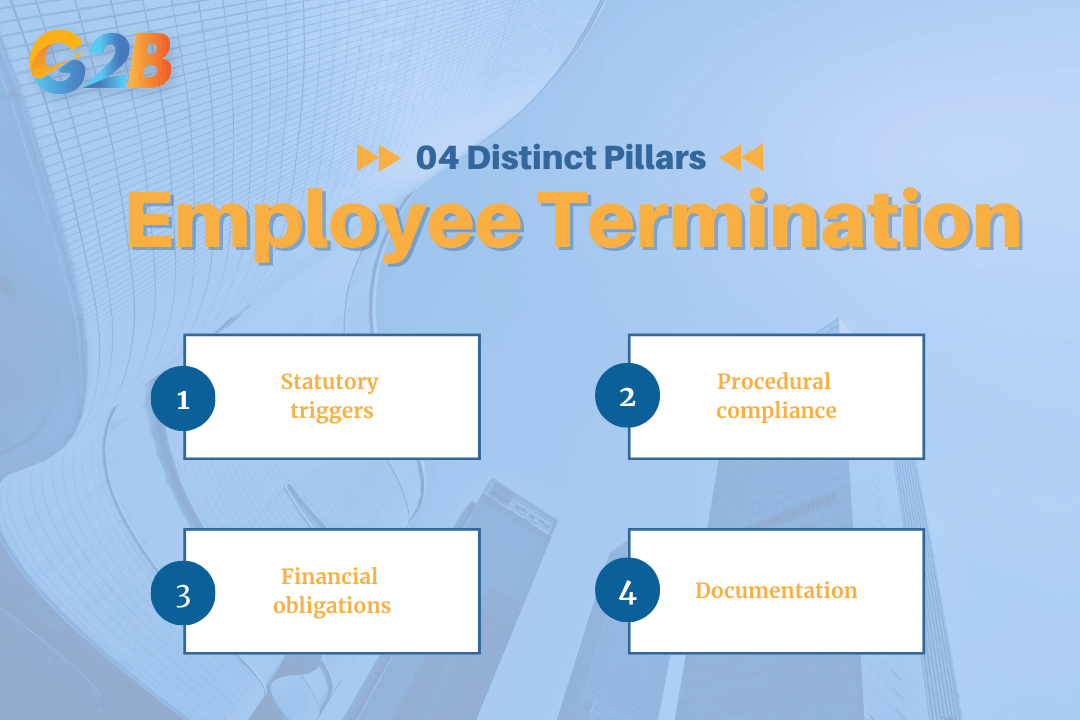
Employers must view termination through four distinct pillars
Contract termination triggers under Vietnamese law
Vietnamese law distinguishes between terminations that happen naturally (or by agreement) and those initiated unilaterally. Understanding Article 34 of the Labor Code 2019 is the first step in classifying a termination event.
Lawful triggers
The safest and most common methods for ending an employment relationship include:
- Expiration of contract: The Fixed-term Labor Contract reaches its end date, and the parties choose not to renew.
- Critical Note: If the employee continues working after the expiration date and no new contract is signed within 30 days, the contract automatically converts to an Indefinite-term contract.
- Mutual agreement: This is the "gold standard" for risk avoidance. The employer and employee voluntarily agree to end the relationship, usually documented via a Termination agreement or Mutual separation agreement (MSA).
- Retirement: The employee reaches the statutory retirement age and has satisfied the social insurance contribution period (20 years) to receive a pension.
- Incapacity or death: The employee is declared missing, deceased, or has lost civil capacity by a valid court decision.
- Criminal sentencing: The employee is sentenced to imprisonment (without a suspended sentence) or capital punishment.
Illegal triggers
Employers must recognize the boundaries set by the law to avoid wrongful termination suits. It is strictly prohibited to terminate an employee based on:
- Personal characteristics: Discrimination based on gender, race, religion, HIV status, or marital status.
- Protected activities: Retaliation for joining a Trade Union or participating in a lawful strike.
- Protected conditions: Terminating a female employee due to marriage, pregnancy, or raising a child under 12 months of age.
To prevent illegal termination from the start, a compliant recruitment and onboarding process is essential. Refer to our guide on hiring employees in Vietnam to build a solid legal foundation for your workforce
Grounds for unilateral termination by employer
When a mutual agreement cannot be reached, an employer may proceed with unilateral termination. However, this is the area of highest risk. Under Article 36, you must prove valid grounds.
Statutory grounds (article 36)
An employer has the right to unilaterally terminate a labor contract in the following specific scenarios:
- Repeated non-performance: The employee frequently fails to perform their work according to the criteria set strictly in the Employment Contract or the company’s Internal Labor Regulations (ILRs).
- Long-term illness: The employee remains ill despite treatment for:
- 12 consecutive months (Indefinite-term contracts).
- 6 consecutive months (Fixed-term contracts 12–36 months).
- Over half the contract term (Contracts under 12 months).
- Force majeure: Natural disasters, fires, major epidemics (like COVID-19), or relocation required by competent state agencies, forcing the employer to narrow production and eliminate jobs.
- Retirement age: The employee reaches the full retirement age.
- Unexplained absence: The employee is absent from the workplace without a valid reason for 5 consecutive working days or more.
- Dishonesty: The employee provided untruthful information during the recruitment process (regarding qualifications, health, or criminal record) that affects the recruitment decision.
Strict evidence requirement
The most common mistake foreign employers make is firing for "poor performance" based on subjective opinion. To legally terminate for repeated non-performance, the employer must possess:
- Registered internal labor regulations (ILRs): The definition of "completion of work" must be codified in regulations registered with the local DOLISA. Registering Internal Labor Regulations is a critical post-licensing task often covered during the company setup process and requirements in Vietnam.
- Quantitative KPIs: Objective standards of measurement (e.g., sales targets, production units, error rates).
- Written warnings: A documented history of Minutes of meetings where the employee was warned about their failure to meet these specific standards.
- Assessment criteria: A transparent scale of assessment (Excellent, Good, Average, Weak) that the employee was aware of.
Without these documents, the court will likely rule the termination as wrongful, regardless of how poor the employee's performance actually was.
Prohibited grounds (protected periods)
Even if an employee has poor performance, Article 37 prohibits unilateral termination during specific times. You cannot fire an employee who is:
- Currently on sick leave or convalescence leave certified by a medical facility.
- On annual leave, personal leave, or other leave types previously agreed upon with the employer.
- A female employee who is pregnant, on maternity leave, or raising a child under 12 months old.
- Exception: The only exception for pregnant women/new mothers is if the enterprise itself ceases operation.
Termination compliance for employers in Vietnam
Executing a termination requires a rigorous procedural workflow. Missing a step, even if the reason for firing is valid, renders the termination illegal.
Process flow
- Establish legal basis: Identify the specific clause in Article 36 or Article 34.
- Gather evidence: Collate performance reviews, timesheets, or medical records.
- Consult trade union (Grassroots level): For unilateral termination based on performance or long-term illness, the employer must solicit the opinion of the internal Trade Union (Executive Committee). If there is no internal union, this step may be omitted, but consulting the district union is best practice.
- Issue notice: Deliver the termination notice in writing, strictly adhering to statutory timeframes.
- Finalize payments: Calculate outstanding salary and allowances.
- Return documentation: Close the Social Insurance Book and return all original papers. These final financial settlements and social insurance closures must be managed by a qualified chief accountant in Vietnam to ensure accuracy and avoid tax-related penalties for the business
Notice period requirements
The Labor Code 2019 mandates specific notice periods based on contract type. Failure to provide this notice results in a financial penalty equivalent to the salary of the missing days.
| Contract Type | Required Notice Period |
|---|---|
| Indefinite-term Contract | At least 45 days |
| Fixed-term Contract (12 – 36 months) | At least 30 days |
| Fixed-term Contract (< 12 months) | At least 3 working days |
Note: For specific specialized industries (e.g., air crew, aircraft maintenance, seafarers), notice periods may differ.
Documentation and handover
Upon termination, the employer is legally obligated to provide:
- Decision on termination: A formal document stating the date and reason for termination.
- Minutes of handover: Documenting the return of company property (laptops, keycards, data).
- Social insurance book: The employer must finalize the closing procedures with the Social Insurance Agency and return the physical book to the employee. Failure to return this can lead to liability for the employee's inability to claim unemployment benefits.
Severance triggers and eligibility in Vietnam
Vietnam utilizes two distinct financial safety nets for terminated employees: Severance Allowance and Job-loss Allowance. These are not interchangeable entities.
Severance allowance
- Trigger: Applies to terminations under Article 34 (Expiration, Mutual Agreement) and Article 36 (Unilateral Termination by Employer/Employee).
- Eligibility: The employee must have worked for the employer for a full 12 months or more.
- Exclusions: Severance is not paid if the employee is terminated for disciplinary reasons (firing) under Article 125, or if the employee unilaterally terminates the contract illegally.
Job-loss allowance
- Trigger: Only applies when employment is lost due to organizational restructuring, technological changes, or economic reasons (Article 42 and 43).
- Eligibility: Employees with 12 months or more of service.
- Minimum: The Job-loss allowance must be at least equal to 2 months’ salary, even if the calculation formula yields a lower amount.
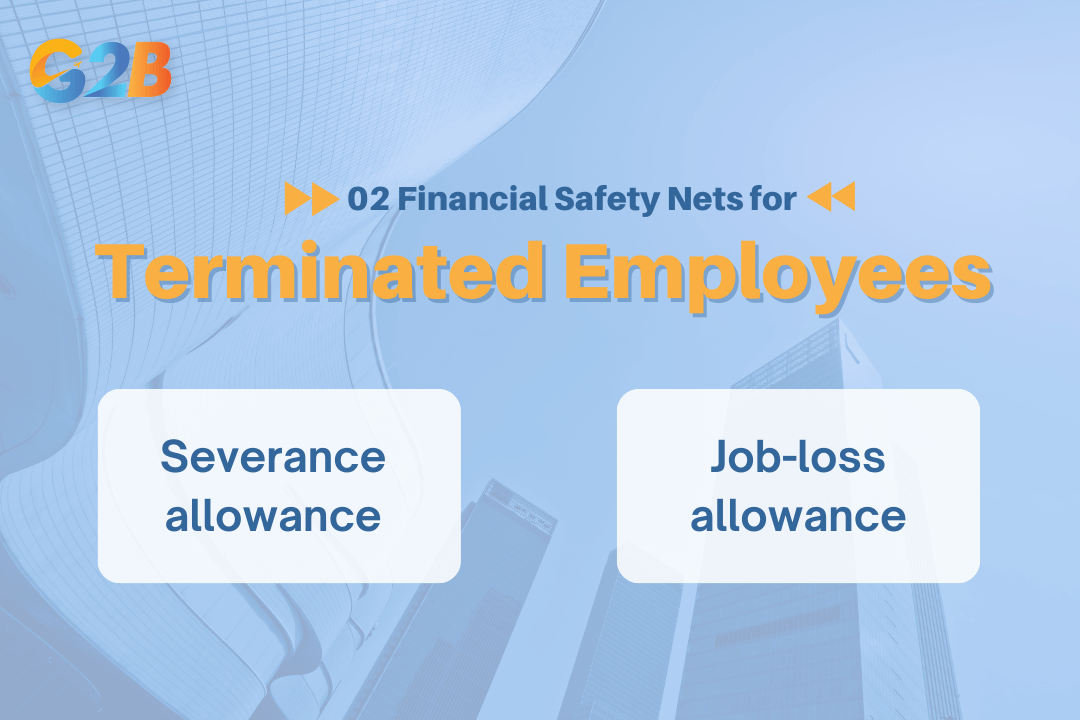
Vietnam utilizes two distinct financial safety nets for terminated employees
The unemployment insurance (UI) deduction
This is a critical technical nuance. The time for calculating Severance Allowance is the total working time minus the time the employee participated in Unemployment Insurance (UI).
Since January 1, 2009, UI participation has been mandatory. Therefore:
- If an employee has been fully covered by UI since 2009, the employer's direct liability for Severance Allowance is often zero or very low (covering only probationary periods or periods before 2009).
- The Social Insurance Fund pays the unemployment benefits, not the employer.
Severance and payment obligations upon termination
When an employer is liable for severance, the calculation must follow strict statutory formulas.
Calculation formula
The Severance Allowance is calculated as: $$ text{Severance Pay} = (text{Total Service Time} - text{UI Participation Time}) times 0.5 times text{Salary} $$
- Service Time: Rounded up.
- 1 month to < 6 months = 0.5 year.
- 6 months or more = 1 year.
- Salary: This is the average salary of the 6 consecutive months preceding the termination. It includes the base salary, position allowances, and other stable supplements stated in the contract. Note that the base salary used for calculation must never be lower than the applicable Vietnam's minimum wage for your specific region
Financial settlement timeframe
According to Article 48 of the Labor Code, both parties must settle all payments (salary, severance, annual leave payout) within 14 working days of the termination date.
- In exceptional cases (natural disasters, business bankruptcy), this may be extended, but cannot exceed 30 days.
Legal consequences of non-compliance
If a court or DOLISA determines that a termination was wrongful termination is the most frequent cause of labor disputes in Vietnam, leading to long-drawn-out legal battles and financial liabilities.
- Reinstatement: The employer is legally required to reinstate the employee to their original position.
- If the position no longer exists, the employer must negotiate to amend the contract.
- If the employee does not wish to return, they are still owed the financial penalties below.
- Back pay: The employer must pay the full salary, social insurance, and health insurance contributions for the days the employee was not allowed to work.
- Financial penalty: A mandatory additional compensation of at least 2 months’ salary.
- Notice penalty: If the notice period was violated, the employer must pay the salary corresponding to the days not notified.
- Severance: If the employee chooses not to return, the employer must pay the standard Severance Allowance in addition to the penalties above.
Practical risk management tips for employers
- Prioritize mutual termination agreements: Whenever possible, negotiate a Mutual separation agreement. Offering a small ex-gratia payment (e.g., 1-2 months' salary) is often cheaper and safer than navigating the strict requirements of unilateral termination.
- Audit internal labor regulations (ILRs): Ensure your ILRs are updated to the 2019 Labor Code and properly registered. You cannot discipline an employee for a rule that does not legally exist.
- Performance management systems: Implement rigorous Performance Improvement Plans (PIPs). Before firing for non-performance, you generally need to show you gave the employee a chance to improve over a specific period (e.g., 30-60 days) with clear support.
- Secure the "paper trail": Maintain signed acknowledgments for every warning, KPI setting, and meeting minute.
- Consult before acting: Never issue a termination notice in the "heat of the moment." Always consult with legal experts to review the grounds and draft the documents.
FAQs about terminating employees in Vietnam
1. Can employers terminate employees "at-will" in Vietnam? No. The concept of "at-will" employment does not exist in Vietnam. Employers must always have a specific legal ground (Article 36) or reach a mutual agreement (Article 34) to end a contract. Firing without cause is illegal.
2. Is severance mandatory in all termination cases? No. Severance is not required if the employee is fired for disciplinary reasons (Article 125) or resigns illegally. Furthermore, if the employee has participated in Unemployment Insurance for the entire duration of their employment, the employer may not owe any direct severance payment, as the UI fund covers the unemployment benefit.
3. What happens if the employer fails to give the required notice? If an employer fails to provide the statutory notice (45, 30, or 3 days), they must financially compensate the employee. The penalty is an amount equivalent to the salary for the days of notice not given.
4. Can I fire an employee who is pregnant if she is performing poorly? No. Generally, you cannot unilaterally terminate a pregnant employee or a female employee with a child under 12 months for performance reasons. They enjoy strict protection under Article 37. You must wait until the child is 12 months old before initiating unilateral termination proceedings.
5. What happens to a foreigner's status after termination? When the labor contract ends, the employer must also report to the authorities to cancel the individual's work permit in Vietnam and coordinate on their visa and employment permits status
Terminating employees in Vietnam is a procedure where the burden of proof rests heavily on the employer. While the Labor Code 2019 provides pathways for workforce restructuring and dismissal, these paths are narrow and require meticulous documentation. The cost of non-compliance - ranging from mandatory reinstatement to significant financial penalties - far outweighs the effort required to follow the correct legal protocols.
