




 Delaware (USA)
  Vietnam
  Singapore
  Hong Kong
  United Kingdom
 Vietnam's minimum wage is set to increase on January 1, 2026, impacting businesses across all sectors. The Vietnamese government has officially issued Decree No. 293/2025/ND-CP, which mandates new, higher wage floors for employees working under labor contracts. This move, which follows extensive negotiations by the National Wage Council, aims to ensure a stable living standard for workers while balancing economic growth. This mandatory adjustment is a key update to the broader labor law in Vietnam, which regulates all employment relationships. Let’s explore the new regional rates, crucial SHUI implications, and strategic advice for foreign-invested companies in Vietnam.
Vietnam's minimum wage increase for 2026
The government's Decree No. 293/2025/ND-CP, issued on November 10, 2025, officially confirms the new regional minimum wage levels effective from January 1, 2026. This decree replaces the previous regulations and is a critical piece of legislation for all employers in Vietnam. The decision reflects the country's socio-economic development and is designed to lift the minimum wage above the estimated minimum living standard for workers.
The update introduces an average increase of approximately 7.2 percent, which translates to a monthly rise of VND 250,000 to VND 350,000 (US$9.5–$13.3), depending on the region. This wage hike introduces several critical changes for employers, such as updated regional pay rates, a direct increase in mandatory Social, Health, and Unemployment Insurance (SHUI) contributions, and the urgent need for payroll adjustments before the deadline. To ensure accuracy in these complex adjustments, businesses often rely on a qualified chief accountant in Vietnam to oversee the payroll system and tax compliance.
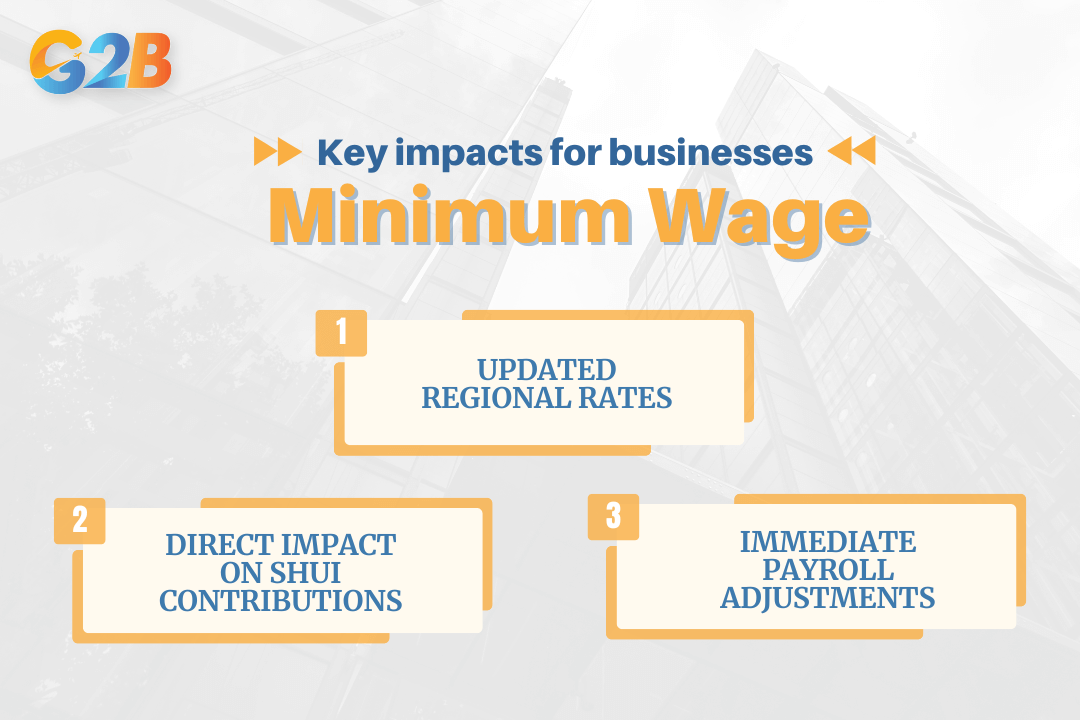
There are three key impacts for businesses on Vietnam's minimum wage
Key impacts for businesses include:
- Updated regional rates: All businesses must adjust their payroll to reflect the new wage floors corresponding to their specific region of operation.
- Direct impact on SHUI contributions: The minimum wage serves as the base for calculating contributions to social insurance, health, and unemployment insurance. An increase in the wage directly raises these mandatory costs for both employers and employees.
- Immediate payroll adjustments: Companies must review all labor contracts and update their payroll systems to ensure compliance from the effective date, avoiding legal penalties.
Official 2026 minimum wage rates by region
This section provides an overview of Vietnam’s official 2026 minimum wage rates by region, helping employers clearly understand how the country’s four wage regions are classified.
Understanding Vietnam's four wage regions
To account for varying living standards and economic conditions across the country, the Vietnamese government classifies provinces and cities into four distinct regions. This tiered system ensures that the minimum wage reflects the local cost of living.
- Region 1 covers the most developed urban centers with the highest cost of living, such as the core districts of Hanoi and Ho Chi Minh City.
- Region 2 includes suburban districts of major cities and other provincial cities with significant economic activity.
- Region 3 consists of smaller provincial cities and districts with developing economies.
- Region 4 covers the least developed rural and mountainous areas of the country.
The Vietnamese government classifies provinces and cities into 04 distinct regions
The 2026 minimum wage table
Effective January 1, 2026, the official monthly and hourly minimum wage rates are as follows:
| Region | Per Month (VND) | Per Month (US$) | Per Hour (VND) | Per Hour (US$) |
|---|---|---|---|---|
| Region 1 | 5,310,000 | 201.84 | 25,500 | 0.97 |
| Region 2 | 4,730,000 | 179.80 | 22,700 | 0.86 |
| Region 3 | 4,140,000 | 157.37 | 20,000 | 0.76 |
| Region 4 | 3,700,000 | 140.64 | 17,800 | 0.68 |
(Source: Decree No. 293/2025/ND-CP)
How the 2026 minimum wage affects your business operations
The 2026 minimum wage plays a crucial role in calculating employee salaries and managing compliant payroll structures for businesses operating in Vietnam. It is also directly linked to social insurance contributions (SHUI), making accurate wage planning essential to control labor costs and ensure full compliance with labor and social security regulations.
Calculating employee salaries and payroll
The regional minimum wage is the lowest legal remuneration an employer can pay to an employee for the simplest work under normal working conditions. This figure represents a mandatory baseline for negotiating and structuring wages in all labor contracts. When hiring employees in Vietnam, employers must ensure that the base salary in the offer letter meets these new regional requirements.
The critical link to minimum wage and social insurance (SHUI)
In Vietnam, mandatory contributions for social insurance, health insurance, and unemployment insurance (collectively known as SHUI) are directly linked to an employee's salary, which must be at least the regional minimum wage. The minimum wage acts as the floor for calculating these contributions.
Furthermore, the 2026 wage increase will also raise the maximum salary caps for certain insurance contributions. For instance, the cap for unemployment insurance is set at 20 times the regional minimum wage. As the regional minimum wage rises, this cap increases, which can affect payroll costs for higher-earning employees.
Important note for skilled workers
Vietnamese labor law requires employers to pay a higher rate to employees who have undergone vocational training. Employers must pay employees who have completed vocational training, including apprenticeships, a salary that is at least 7% higher than the applicable regional minimum wage. For example, a trained worker in a Region 1 company must be paid a minimum of VND 5,681,700 per month (VND 5,310,000 + 7%).
Compliance and strategic planning for foreign companies
Understanding and anticipating regulatory requirements allows foreign-invested enterprises to minimize risks, manage costs, and build sustainable operations in the Vietnamese market.
Is the minimum wage relevant for foreign employees?
While the salaries of most foreign employees are significantly higher than the regional minimum wage, these rates remain crucial for one key reason: mandatory social insurance. For foreign employees subject to Vietnam's social insurance scheme, their contribution is calculated based on their contract salary, but it is capped at 20 times the general minimum salary. Therefore, any adjustment to wage levels can influence the calculation of the maximum SHUI contribution cap. For comprehensive guidance on hiring foreign talent, see our Guide to Getting a Work Permit in Vietnam.
Budgeting and cost forecasting for 2026
The increase in the minimum wage directly translates to higher labor costs, affecting not just base salaries but also SHUI contributions and potential overtime pay calculations. New and existing businesses should immediately update their 2026 financial forecasts to account for this rise in operational expenses. Proactive financial planning is essential to absorb these new labor costs. If you are planning to enter the market, our experts can help you build a compliant and sustainable business model through our Vietnam Incorporation Service.
Avoiding penalties for non-compliance
Failing to update payroll in accordance with Decree 293/2025/ND-CP exposes a business to significant legal risks. Vietnamese authorities actively enforce labor laws, and non-compliance can lead to consequences such as administrative fines, back-payment orders for wages and social insurance, and heightened scrutiny from labor departments. Fines for paying employees below the minimum wage can be substantial, scaling with the number of affected employees.
Frequently asked questions (FAQ) for 2026
This FAQ section addresses common questions businesses may have regarding labor and employment regulations in Vietnam in 2026.
When does the new minimum wage take effect?
The new rates under Decree 293 are effective from January 1, 2026.
Which region does my business fall into?
The applicable region is determined by the physical location of your business operations. Region 1 includes major urban centers like Hanoi and Ho Chi Minh City, while Regions 2, 3, and 4 cover progressively less developed areas. For a detailed list of provinces and districts within each region, please refer to the appendix of Decree 293/2025/ND-CP.
How do I apply the wage if my company has branches in multiple regions?
Each branch or unit must apply the minimum wage rate of the region in which it is located. If a unit operates across areas with different regional rates, the highest applicable rate must be used.
The 2026 minimum wage increase is an official and mandatory change that requires immediate attention from all employers in Vietnam. By understanding the new rates, updating payroll systems to comply with Decree 293, and accounting for the direct impact on SHUI contributions, businesses can ensure smooth operations and avoid legal risks. Staying compliant with wage regulations is just one part of your legal duty. For a complete roadmap, see our guide on the company setup process and requirements in Vietnam
