




 Delaware (USA)
  Vietnam
  Singapore
  Hong Kong
  United Kingdom
 Capital contribution in Vietnam is the foundational legal process in which investors and shareholders transfer approved assets into a corporate entity to secure ownership rights, define financial liabilities, and enable business operations. Navigating the strict regulatory environment requires absolute precision, as the Vietnamese government enforces rigid timelines and documentation standards for both domestic and foreign investors. Missing these statutory deadlines triggers severe administrative penalties and compromises the legal standing of the enterprise.
What is capital contribution in Vietnam?
Capital contribution in Vietnam represents the transfer of legally acquired assets from an individual or institutional investor to an enterprise to form or increase its charter capital. The Law on Enterprises 2020 dictates that the committed capital determines the exact proportion of ownership for each member or shareholder. This ownership ratio subsequently governs vital corporate rights, such as voting rights, profit distribution, and financial liability limits.
In the context of Vietnamese corporate law, a clear distinction exists between registered capital and contributed capital. Registered capital is the total asset value investors commit to transferring during company registration in Vietnam, whereas contributed capital represents the actual assets physically or electronically transferred to the company’s ownership within the prescribed statutory timeframe.
Why is the capital contribution deadline important?
The capital contribution deadline serves as the primary enforcement mechanism to ensure companies possess the financial capacity they claim on their registration documents. Adhering to this statutory timeline guarantees the legal validity of the enterprise and protects creditors from undercapitalized shell companies. Timely contribution establishes investor credibility with local authorities, which proves essential when applying for sub-licenses, work permits, and tax incentives. Conversely, failing to meet the deadline exposes the company and its investors to severe legal consequences. The regulatory authorities impose immediate administrative penalties, such as monetary fines, forced capital adjustment, and investment license revocation. Furthermore, foreign investors who miss their deadlines face the freezing of their Direct Investment Capital Account (DICA), immediately halting their ability to remit profits abroad or inject further capital.
Who must comply with capital contribution rules?
The legal obligation to execute capital contributions strictly binds multiple corporate entities, such as Foreign-Invested Enterprises (FDI companies), domestic Limited Liability Companies (LLCs), Joint-Stock Companies (JSCs), and joint ventures. Any company executing a charter capital adjustment procedure to increase its financial base must also adhere to identical capitalization rules for the newly issued shares or capital portions. Conversely, representative offices and branches generally do not have this obligation, as they act as dependent units of a parent company and do not possess independent charter capital or legal personhood under Vietnamese civil law.
Legal framework governing capital contribution in Vietnam
The regulation of investment capital in Vietnam operates through an interconnected network of laws and decrees. Understanding this framework is vital for maintaining corporate compliance.
1. Law on Investment 2020
The Law on Investment 2020 (Law No. 61/2020/QH14) primarily regulates foreign direct investment, conditional business lines, and investment incentives. This law mandates the issuance of the Investment Registration Certificate (IRC) for foreign investors. The IRC legally codifies the total investment capital, separating it into equity capital (chartered capital) and mobilized capital (loans). The Law on Investment establishes the fundamental schedule that foreign investors must follow to inject their registered capital.
2. Law on Enterprises 2020
The Law on Enterprises 2020 (Law No. 59/2020/QH14) governs the establishment, management, reorganization, and dissolution of enterprises. This statute regulates the mechanics of the Enterprise Registration Certificate (ERC) and explicitly defines the universal 90-day capital contribution deadline for newly established companies. It provides the statutory definitions for asset types eligible for contribution, the internal valuation procedures, and the specific mechanisms for reducing charter capital when members fail to fulfill their financial commitments.
3. Decree 31/2021/ND-CP
Decree 31/2021/ND-CP details and guides the implementation of various articles within the Law on Investment 2020. This decree provides exact administrative instructions on modifying investment capital, transferring investment projects, and executing the administrative procedures required by the Department of Planning and Investment (DPI). It clarifies how foreign investors must report on the progress of their investment execution.
4. Relevant circulars and administrative guidelines
The State Bank of Vietnam (SBV) issues critical circulars governing foreign exchange and capital accounts. Circular 06/2019/TT-NHNN explicitly dictates the usage of the Direct Investment Capital Account (DICA). This circular mandates that foreign investors must route all capital contributions, profit remittances, and capital transfers through a registered DICA to ensure transparency and prevent money laundering.
Capital contribution deadline requirements in Vietnam
Establishing the exact timeline for capital injection prevents the immediate triggering of administrative penalties. The state strictly enforces these statutory timers.
Definition of the capital contribution deadline
The capital contribution deadline is the definitive statutory timeframe beginning from the issuance date of the requisite incorporation certificates until the final date by which investors must successfully transfer their committed assets to the enterprise. The state measures this deadline in absolute calendar days, strictly limiting extensions to specific statutory exceptions.
When does the deadline start?
The activation of the deadline clock depends precisely on the corporate structure and the origin of the investors. For domestic enterprises, the deadline begins on the exact date the licensing authority issues the Enterprise Registration Certificate (ERC). For Foreign-Invested Enterprises (FDI), the timeline fundamentally links to the issuance dates of both the Investment Registration Certificate (IRC) and the subsequent ERC. When a company executes a charter capital increase, the deadline clock starts on the date the company passes the internal resolution approving the capital increase per Article 186 of Law on Enterprises 2020, or as explicitly dictated by the amended incorporation certificates.
How long is the capital contribution period?
The Law on Enterprises 2020 establishes a definitive 90-day period from the issuance date of the ERC for members of Limited Liability Companies (LLCs) and founding shareholders of Joint-Stock Companies (JSCs) to fully contribute their committed capital. This 90-day calculation strictly excludes the time required to transport, import, or perform administrative ownership transfers for non-cash assets. For FDI enterprises, the Vietnam investment capital deadline aligns with the specific phased schedule approved and printed on the IRC. While the charter capital portion must generally adhere to the 90-day ERC rule, the total investment capital (including loan capital) follows the broader milestone schedule authorized by the investment authorities.
Capital contribution obligations by company type
Different corporate structures carry distinct obligations regarding how and when members inject capital.
Foreign-invested enterprises (FDI Companies)
FDI capital contribution regulation imposes the highest level of scrutiny. Foreign investors cannot simply transfer funds into standard corporate checking accounts. They must legally open a Direct Investment Capital Account (DICA) at an authorized credit institution in Vietnam. Every dollar or yen transferred for capital contribution must route through this specific account. Failure to use the DICA renders the capital contribution invalid under State Bank of Vietnam regulations, blocking future profit repatriation.
Limited liability companies (LLCs)
Members of multi-member and single-member LLCs face immediate structural consequences for late contributions. If a member fails to contribute the full committed amount within the 90-day window, their legal status and voting power immediately reduce to reflect only the actual paid-up capital. The LLC then holds a strict legal obligation to register a charter capital adjustment procedure with the DPI within 30 days after the deadline expires, formally reducing the company’s registered capital to match the actually contributed capital.
Joint-stock companies (JSCs)
In a JSC, founding shareholders must pay in full for their subscribed dividend shares within 90 days of receiving the ERC. If a shareholder fails to pay for their subscribed shares, those shares revert to unsold shares available for offering. The defaulting shareholder immediately loses voting rights associated with the unpaid shares and faces financial liability to the company for any damages caused by their failure to fulfill the subscription contract.
Joint ventures
Joint ventures, formed through contractual partnerships between foreign and domestic investors, must synthesize the requirements of both the IRC and the ERC. The joint venture contract strictly defines the capital contribution schedule, but this internal contract cannot legally supersede the statutory 90-day limit for charter capital. Dispute resolution over capital valuation in joint ventures requires consensus among the founding board of management.
Types of capital contribution in Vietnam
The Law on Enterprises 2020 permits investors to fund their companies using diverse asset classes, provided the assets possess clear, quantifiable value.
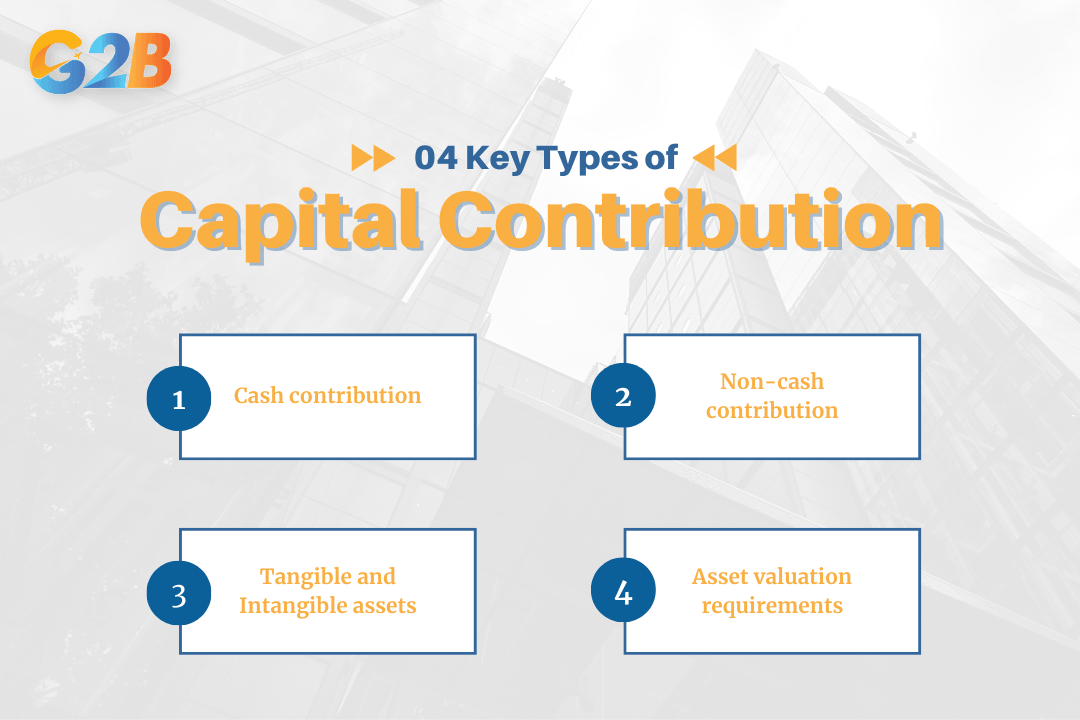
Types of capital contribution in Vietnam
1. Cash contribution
Cash constitutes the most common form of capital contribution. Domestic investors must execute cash contributions using Vietnamese Dong (VND). Foreign investors hold the statutory right to contribute capital using freely convertible foreign currencies, such as United States Dollars (USD), Euros (EUR), and Japanese Yen (JPY). The receiving Vietnamese bank automatically executes the conversion based on the exchange rate at the time of the transfer into the DICA.
2. Non-cash contribution
Investors maintain the right to fund enterprises using eligible non-cash assets, such as intellectual property rights, machinery, and land use rights. When utilizing non-cash contributions, the investor must execute a formal legal transfer of ownership rights to the enterprise. For assets requiring ownership registration (like vehicles or real estate), the investor physically files a transfer of title with the relevant state registry.
3. Tangible vs. Intangible assets
Tangible assets possess physical form and include industrial equipment, raw materials, and commercial real estate. Intangible assets lack physical form but hold quantifiable commercial value. Vietnam company law capital contribution specifically recognizes intangible assets, such as copyrights, patents, and industrial designs. Cryptocurrencies and virtual assets currently lack legal recognition as legitimate capital contribution assets under Vietnamese law.
4. Asset valuation requirements
Asset valuation remains mandatory for all non-cash capital contributions. The members, founding shareholders, or an independent professional valuation organization must evaluate and formally appraise non-cash assets before transferring them to the company. If members perform the valuation internally, they must reach a unanimous consensus. If the agreed valuation exceeds the actual market value of the asset at the time of contribution, the members or shareholders bear joint and several financial liability for the overvalued difference. This strict liability protects the enterprise's creditors from artificially inflated balance sheets.
Capital contribution timeline examples
To provide clarity on the exact capital contribution timeline in Vietnam, refer to the statutory deadlines detailed in the table below.
| Entity type | Capital contribution requirement | Typical deadline | Notes |
|---|---|---|---|
| Domestic LLC | Full registered charter capital | 90 days from ERC issuance date | Excludes time for importing/transporting physical assets. |
| Domestic JSC | Payment for subscribed shares | 90 days from ERC issuance date | Unpaid shares become unsold shares immediately after the deadline. |
| FDI Enterprise | Charter capital | 90 days from ERC issuance date | Must strictly route through the corporate DICA. |
| FDI Enterprise | Total investment capital (mobilized/loans) | As specified on the IRC schedule | Schedule approved by DPI based on project scale and feasibility. |
| Capital Increase (Domestic) | Payment of new capital portions | As stipulated in Member Council Resolution | Usually completed before filing the amended ERC with the DPI. |
Consequences of missing the capital contribution deadline
The Vietnamese government penalizes non-compliance through a rigid framework of administrative fines and corporate restructuring mandates. Under Decree 122/2021/ND-CP, which dictates administrative penalties for non-compliance in the planning and investment sector, missing the Vietnam contributed capital deadline triggers direct monetary fines. Enterprises failing to contribute capital on time face penalties of 30,000,000 VND to 100,000,000 VND, depending on the violation (e.g., failure to adjust capital or IRC).
Beyond the immediate financial sting, the corporate consequences are severe. Upon missing the 90-day deadline, the company loses the legal right to utilize the unpaid capital. The enterprise holds a rigid statutory requirement to execute a charter capital adjustment procedure to lower its registered capital to the actual paid-up amount within 30 days. If the company fails to register this reduction voluntarily, the DPI will force the adjustment and apply additional fines for failing to update corporate records. For foreign investors, an unresolved capital contribution failure results in the DPI refusing to renew the Investment Registration Certificate. It directly blocks the issuance of new work permits for foreign managers and triggers the banking system to freeze profit remittance mechanisms on the DICA.
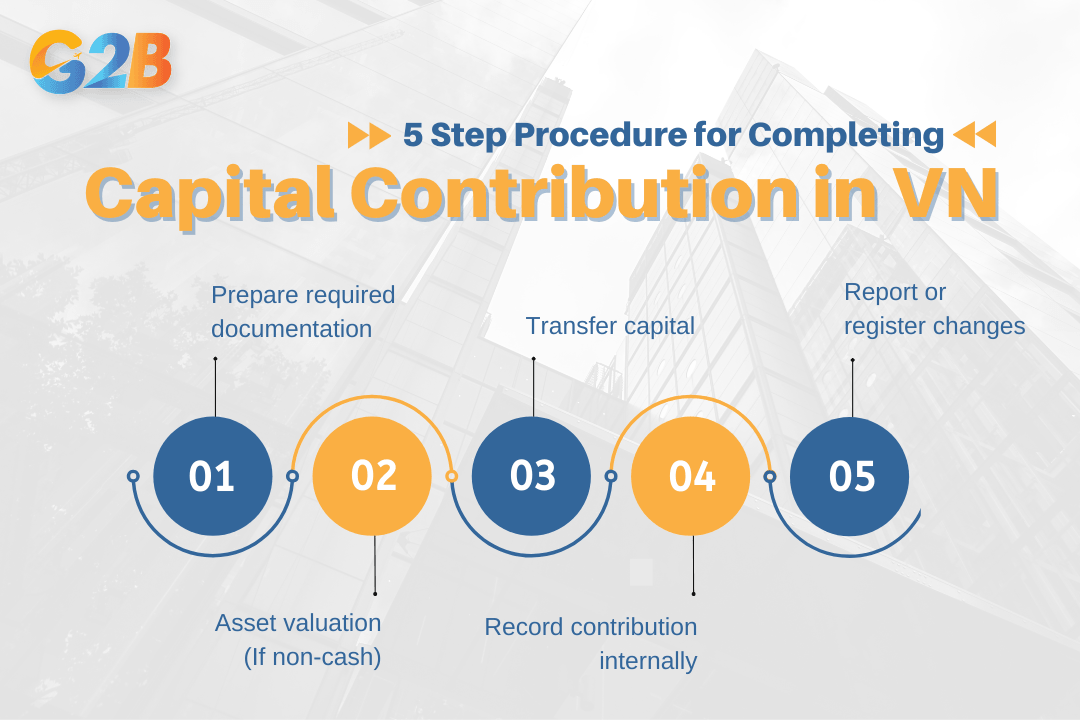
Procedure for completing capital contribution in Vietnam
Step 1: Prepare required documentation
The investor must draft and execute a formal Capital Contribution Agreement. This legal document clearly defines the exact monetary value, the asset type, the required timeline, and the precise ownership percentage the investor will receive in exchange. For foreign investors, this documentation must align perfectly with the figures approved on the IRC.
Step 2: Asset valuation (If non-cash)
If the investor contributes physical equipment or intellectual property, the founding members must draft a Valuation Minute. This legally binding document records the agreed-upon monetary value of the asset in Vietnamese Dong. If utilizing an independent valuation firm, the enterprise must secure the official valuation certificate and attach it to the corporate records.
Step 3: Transfer capital
Investors must execute the physical or electronic transfer of assets. For cash contributions in domestic companies, transfers execute via the standard corporate bank account. For foreign investors, the transfer must strictly route from the foreign investor's offshore account directly into the enterprise's Direct Investment Capital Account (DICA) at a licensed Vietnamese bank.
Step 4: Record contribution internally
Upon receiving the funds or physical assets, the legal representative of the company immediately issues a Capital Contribution Certificate to the investor. The company's internal accountant then updates the official Register of Members or Register of Shareholders to reflect the fully paid-up status. This register serves as the definitive internal proof of ownership under the Law on Enterprises 2020.
Step 5: Report or register changes (If required)
If the investors fulfill their obligations within the 90-day deadline, no immediate reporting to the DPI is required for domestic companies. However, if the members fail to contribute the total amount, the company must proactively submit a dossier to the DPI within 30 days to officially decrease the charter capital on the Enterprise Registration Certificate (ERC). FDI enterprises must also update their quarterly investment progress reports on the National Foreign Investment Information System to reflect the successful capital injection.
Procedure for completing capital contribution in Vietnam
Frequently asked questions (FAQ)
Understanding the rules on capital contribution is essential for both local and foreign investors doing business in Vietnam. The FAQs below answer common questions about contribution methods, deadlines, and legal requirements.
What is the capital contribution deadline in Vietnam?
The capital contribution deadline in Vietnam is exactly 90 days from the issuance date of the Enterprise Registration Certificate (ERC) for charter capital. This strictly applies to both domestic and foreign-invested limited liability and joint-stock companies.
Can the capital contribution deadline be extended?
No, the 90-day statutory deadline for charter capital contribution cannot be legally extended. The only exception is the exclusion of the actual time required to physically transport, import, or perform state-mandated administrative procedures for transferring ownership of non-cash assets.
What happens if the capital contribution is late?
If the contribution is late, the company faces immediate administrative fines ranging from 30,000,000 VND to 100,000,000 VND, the defaulting member loses voting rights for the unpaid portion, and the company must formally reduce its registered charter capital to match the actually contributed amount within 30 days.
Is valuation mandatory for non-cash capital contribution?
Yes, valuation is strictly mandatory for all non-cash capital contributions. The founding members must reach a unanimous consensus on the value, or they must hire an independent professional valuation organization to appraise the assets before the official transfer occurs.
Can foreign shareholders contribute capital after 90 days?
Foreign shareholders cannot contribute charter capital after the 90-day deadline expires. If they miss the deadline, the company must first reduce its charter capital, update its ERC, and only then initiate a new procedure to legally increase the charter capital to allow the foreign shareholder to inject new funds.
Are there tax implications for delayed capital contribution?
Yes, a delayed capital contribution directly impacts tax deductibility. The tax authorities will disallow the deduction of interest expenses on business loans corresponding to the missing portion of the charter capital when calculating corporate income tax (CIT).
The rigorous enforcement of capital contribution rules in Vietnam underscores the government's commitment to maintaining a transparent, adequately capitalized, and legally sound business environment. Adhering to the 90-day statutory deadline, correctly utilizing the Direct Investment Capital Account, and executing precise asset valuations are not merely administrative suggestions, but fundamental legal obligations. Navigating this landscape requires absolute accuracy to protect corporate voting rights, ensure uninterrupted business operations, and avoid severe state-imposed penalties.
