




 Delaware (USA)
  Vietnam
  Singapore
  Hong Kong
  United Kingdom
 Vietnam Accounting Standards (VAS) form the mandatory legal framework governing the preparation and presentation of financial statements for all enterprises operating in Vietnam. For foreign investors, Chief Financial Officers (CFOs), and business owners, understanding VAS is not merely a technical exercise; it is a critical requirement for ensuring statutory compliance, optimizing tax liabilities, and maintaining operational legitimacy in one of Southeast Asia's fastest-growing economies.
What are Vietnam’s accounting standards?
The Vietnam Accounting Standards (VAS) are a set of 26 accounting standards issued by the Ministry of Finance (MoF) between 2001 and 2005 through five separate Decisions. These standards, combined with the Law on Accounting and various guiding Circulars - most notably Circular 133/2016/TT-BTC (replacing Circular 200/2014/TT-BTC for most enterprises from 2017) - constitute the bedrock of the Vietnamese financial reporting system.
Unlike jurisdictions where accounting standards are principles-based and allow for professional judgment in presentation, the Vietnamese system is rules-based and highly prescriptive. Vietnam is transitioning to IFRS for certain large enterprises and state-owned groups under Decision 345/QD-BTC (pilot phase 2022-2025, full adoption phased from 2025).
The role of circular 133
To truly understand VAS, one must understand Circular 133/2016/TT-BTC (the current key guidance replacing Circular 200). While VAS provides the theoretical framework (e.g., "Revenue should be recognized when risks transfer"), Circular 133 provides the rigid instruction manual for implementation. It dictates the specific Uniform Chart of Accounts, the exact format of financial statements, and the required accounting entries for specific transactions.
Scope of application
VAS applies to all enterprises operating in Vietnam under the Accounting Law, including:
- Foreign Direct Investment (FDI) enterprises.
- State-owned enterprises.
- Domestic private limited liability companies and joint-stock companies.
- Foreign branches and representative offices (with some exceptions).
Failure to comply with VAS not only results in administrative penalties but can also lead to the rejection of deductible expenses by tax authorities during audits, significantly impacting corporate income tax obligations.
List of 30 Vietnamese accounting standards
The Ministry of Finance issued the 30 standards (26 core + 4 additional) to cover the majority of economic transactions. However, it is vital to note that Vietnam has not yet adopted standards equivalent to IFRS 9 (Financial Instruments) or IFRS 15 (Revenue from Contracts with Customers), nor does it have a specific standard for Impairment of Assets. Below is the complete list of the 30 Vietnamese Accounting Standards currently in effect, categorized for clarity.
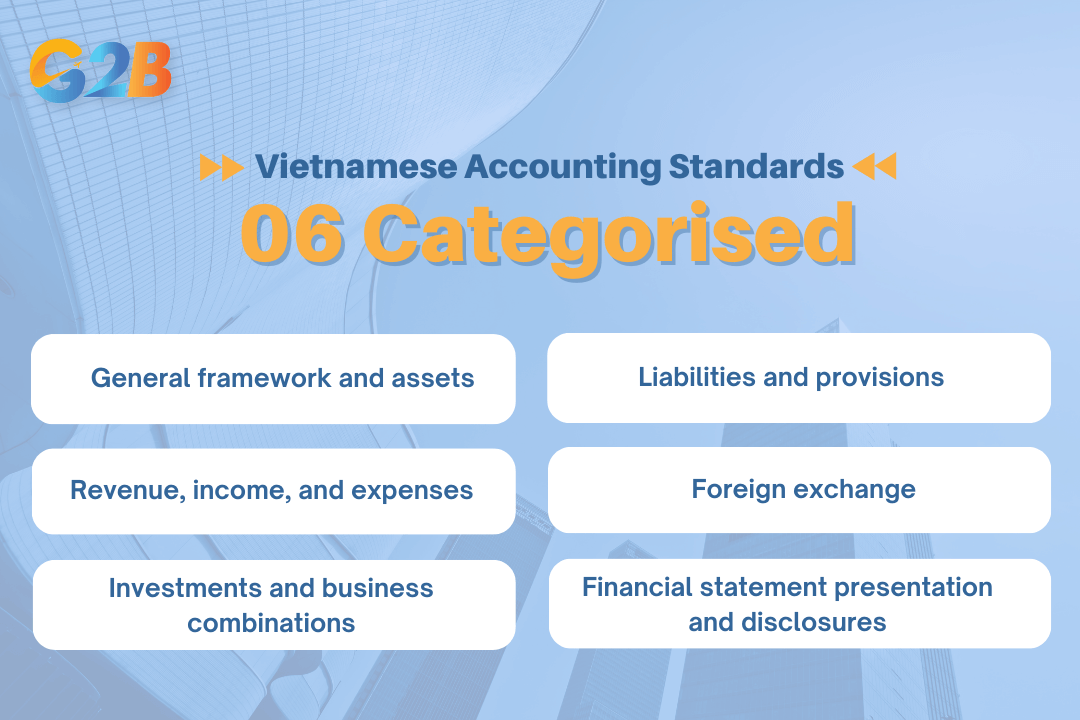
30 Vietnamese Accounting Standards categorised for clarity
General framework and assets
- VAS 01: Framework
- Establishes the basic concepts and principles for financial reporting, such as the accrual basis, going concern, and consistency.
- VAS 02: Inventory
- Guidelines for valuing inventory at the lower of cost or net realizable value. It does not permit the LIFO (Last-In, First-Out) method.
- VAS 03: Tangible fixed assets
- Strict rules on depreciation and capitalization thresholds.
- VAS 04: Intangible fixed assets
- Notably, land use rights are often treated as intangible assets or long-term prepaid expenses depending on the tenure.
- VAS 05: Investment property
- VAS 06: Leasehold prepayment (or prepaid rental lease)
Investments and business combinations
- VAS 07: Accounting for investments in associates
- VAS 08: Financial reporting of interests in joint ventures
- VAS 11: Business combinations
- Generally uses the purchase method, but the goodwill calculation differs from IFRS.
- VAS 25: Consolidated financial statements and accounting for investments in subsidiaries
Revenue, income, and expenses
- VAS 09: Construction expenditure
- VAS 14: Revenue and other income
- A critical standard. Revenue is recognized only when the significant risks and rewards of ownership have transferred, and the amount can be reliably measured.
- VAS 15: Construction contracts
- VAS 16: Borrowing costs
- Allows capitalization of borrowing costs that are directly attributable to the acquisition or construction of a qualifying asset.
- VAS 17: Income taxes
- Covers both current and deferred income tax, aligning somewhat with IAS 12.
Liabilities and provisions
- VAS 18: Provisions, contingent liabilities and contingent assets
- VAS 19: Insurance contracts
Financial statement presentation and disclosures
- VAS 21: Presentation of financial statements
- VAS 22: Disclosures in the financial statements of banks and similar financial institutions
- VAS 23: Events after the balance sheet date
- VAS 24: Cash flow statements
- Classifies flows into operating, investing, and financing activities.
- VAS 26: Related party disclosures
- Essential for FDI companies with transfer pricing scrutiny.
- VAS 12: Effects of changes in foreign exchange rates
- VAS 27: Interim financial reporting
- VAS 28: Segment reporting
- VAS 29: Changes in accounting policies, accounting estimates and errors
- VAS 30: Earnings per share
Foreign exchange
- VAS 10: Effects of changes in foreign exchange rates
- Dictates how to record transactions in foreign currencies and revalue monetary items at year-end.
Differences between Vietnam accounting standards (VAS) and Global accounting standards (IFRS/IAS)
For foreign investors, the gap between VAS and IFRS creates a "dual reporting" requirement for consolidated statements of qualifying groups: One set of books for statutory compliance in Vietnam (VAS) and another for group consolidation (IFRS). The fundamental divergence lies in the philosophy: VAS focuses on prudent historical cost and legal form, while IFRS focuses on fair value and economic substance.
Comparison Matrix between VAS and IFRS
| Feature | VAS (Vietnam accounting standards) | IFRS / IAS (Global standards) |
|---|---|---|
| Chart of accounts | Mandatory & uniform. Companies must use the account codes defined in Circular 133/2016/TT-BTC (replacing Circular 200 from 2017) (e.g., Cash is 111, Revenue is 511). Modification requires written MoF approval. | Flexible. Companies design their own chart of accounts to suit their business model and management reporting needs. |
| Asset valuation | Historical cost. Revaluation is rarely permitted (except in consolidation or privatization). Assets sit on the books at purchase price regardless of market appreciation. | Fair value. Assets can often be revalued to market price to reflect true economic worth. |
| Financial instruments | Limited guidance. Derivatives and complex instruments are generally recorded at cost or not explicitly covered. | IFRS 9. Complex recognition of financial assets, liabilities, and hedging using fair value models. |
| Impairment of assets | No specific standard. Assets are generally not written down for impairment unless they are inventory or bad debts. | IAS 36. Mandatory annual impairment testing to ensure assets are not carried above their recoverable amount. |
| Presentation format | Strict templates. Balance sheets and P&L must follow the exact line items and layout prescribed by the MoF. | Principles-based. Minimum line items are required, but the layout is flexible to enhance readability. |
| Functional currency | Generally VND. Using a foreign currency (e.g., USD) requires satisfying strict criteria and notification to tax authorities. | Functional currency is determined solely by the primary economic environment in which the entity operates. |
Practical implications for business owners
The reliance on historical cost in VAS often means that the Net book value of a company in Vietnam may differ significantly from its actual market value. For example, a factory purchased 10 years ago will appear "cheap" on a VAS balance sheet because its land use rights cannot be revalued upward, whereas an IFRS report would reflect the current high property value.
Future of VAS is VFRS (Vietnam’s financial reporting standards)
Recognizing the limitations of the current system and the need to attract high-quality foreign capital, the Ministry of Finance approved Decision No. 345/QD-BTC, outlining the roadmap for the application of Vietnam financial reporting standards (VFRS). VFRS will be essentially identical to IFRS, with minor modifications for local language and legality.
The roadmap to 2030
The transition from VAS to VFRS is divided into two distinct phases, targeting specific types of entities.
Phase 1: Voluntary application (2022 – 2025)
During this current phase, the following entities are encouraged to voluntarily adopt VFRS (IFRS) for their consolidated financial statements:
- Parent companies of large-scale state-owned groups.
- Listed companies.
- Large-scale unlisted public companies.
- Large-scale FDI enterprises (subject to MoF approval).
Phase 2: Compulsory application (After 2025)
Post-2025, the MoF intends to make VFRS mandatory for the consolidated financial statements of:
- All State-owned enterprises.
- Listed companies.
- Large-scale unlisted public companies.
Vietnam accounting standards remain the compulsory law of the land for the foreseeable future. Adherence to the 30 standards and Circular 133 is non-negotiable for operational stability and tax compliance. However, the horizon is shifting toward VFRS, demanding a higher level of transparency and financial sophistication.
