




 Delaware (USA)
  Vietnam
  Singapore
  Hong Kong
  United Kingdom
 Foreign investors often consider a nominee director in Vietnam as a way to navigate market entry, but this strategy carries immense and often underestimated risks. The landscape of Vietnamese corporate governance is evolving rapidly, with increased scrutiny on transparency and beneficial ownership, making informal arrangements more dangerous than ever. This guide dissects the legal realities, the severe liabilities for both the nominee and the investor, and outlines safer, fully compliant alternatives for your investment in Vietnam.
What is a nominee director?
In Vietnam, a nominee director is an individual or entity whose name appears on the official business registration certificate as the company's legal representative but who acts under the direction of the actual beneficial owner - the foreign investor. This unofficial arrangement is typically used for two primary reasons: to circumvent foreign ownership restrictions in certain conditional sectors like advertising or logistics, or to satisfy the legal mandate that a company must have at least one legal representative residing in Vietnam.
The nominee is essentially a figurehead, while the foreign investor provides the capital, controls the business strategy, and reaps the profits. This structure is often cemented by a series of private contracts, such as a Power of Attorney (POA) and a Declaration of Trust (DOT), intended to give the beneficial owner full control. However, the critical flaw in this strategy is that these private agreements are not recognized by Vietnamese law, a fact that becomes devastatingly clear when the arrangement breaks down.
Legal status and framework of the nominee director in Vietnam
It is crucial for every foreign investor to understand a fundamental truth: the nominee director arrangement is not legally recognized under Vietnamese law. This single point is the source of nearly all the risks associated with this structure. Vietnamese courts and authorities only recognize the individual named on the official company documents as the legal owner and representative.
An unrecognized concept
Vietnamese law, including the Law on Enterprises, does not have any provisions for nominee structures. Any private agreement created to conceal the true ownership of a company for the purpose of circumventing investment regulations can be deemed a "sham transaction" by the courts. If a dispute arises - for example, if the nominee refuses to follow instructions or transfer shares - a Vietnamese court is likely to declare the nominee agreement invalid. This leaves the foreign investor with no enforceable legal rights to the assets they funded.
Increased scrutiny: UBO disclosure and AML laws
The risks have been amplified by new regulations aimed at increasing financial transparency. Vietnamese authorities have implemented strict regulations, such as Decree 116 on Anti-Money Laundering and the requirement for Ultimate Beneficial Owner (UBO) disclosure in business registration. Companies are now legally obligated to identify and report their UBO - the individual who ultimately owns or controls 25% or more of the company - to regulatory bodies.
This development makes using a nominee for anonymity or to bypass ownership caps illegal and highly dangerous. Failure to disclose, or providing false information about, the UBO can lead to administrative sanctions and trigger investigations from tax authorities and anti-money laundering agencies. Anonymity is no longer a viable outcome, and attempts to achieve it through a nominee structure can lead to severe penalties.
Severe liabilities for the nominee director
While foreign investors face the loss of their investment, the Vietnamese individual acting as the nominee is exposed to a different, more personal set of severe consequences. Many nominees enter these arrangements without fully grasping the extent of their legal exposure.
The core issue is that under Vietnamese law, the nominee is personally and fully liable for all company activities, including debts, unpaid taxes, regulatory breaches, and even criminal acts. They cannot simply claim they were acting on behalf of someone else.
Specific risks for the nominee include:
- Tax liabilities: If funds are transferred from the company to the foreign investor, tax authorities may classify this as the nominee's personal income. This can result in a massive, unexpected tax bill and penalties for tax evasion.
- Criminal liability: The nominee bears full legal responsibility for any illegal activities conducted by the company. If the business is involved in smuggling, fraud, or violates anti-dumping duty regulations, the nominee is the one who will face prosecution.
- The "stuck" scenario: A common and devastating problem arises when the foreign investor disappears or abandons a failing business. The nominee, whose name is on all official documents, cannot simply resign. They remain legally responsible for the company's debts and the formal liquidation process, which can be costly and time-consuming.
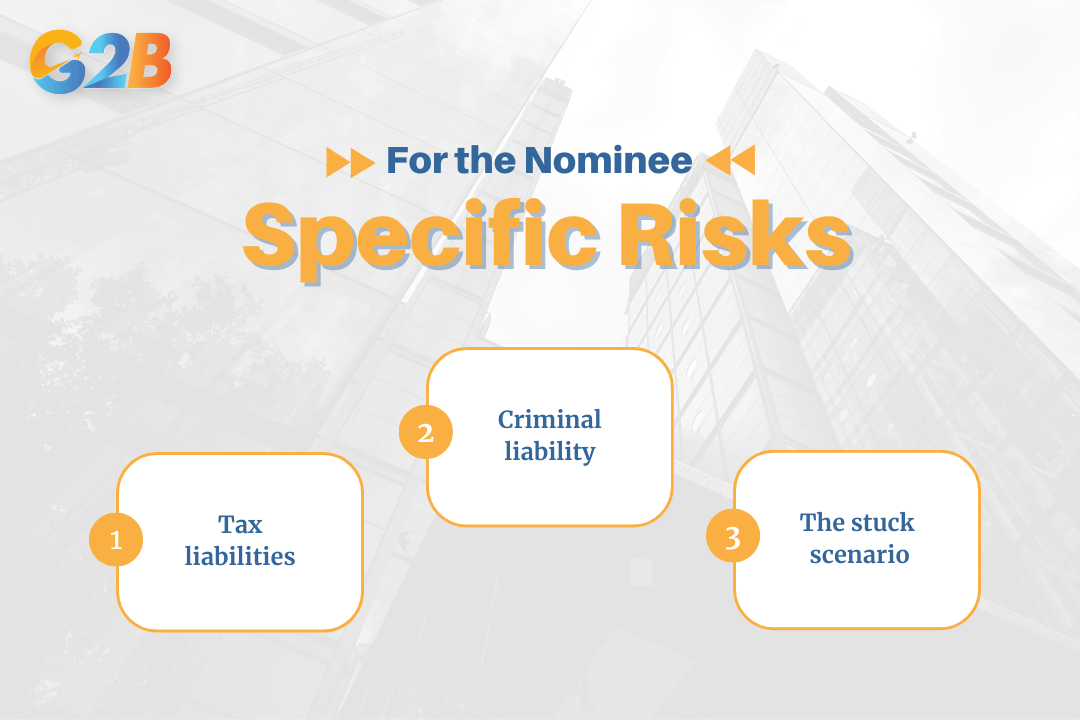
Three specific risks for the nominee
The immense risks for foreign investors
For the foreign investor, the illusion of control offered by a nominee arrangement can shatter in an instant, leading to a total loss of their investment. The risks are substantial and multifaceted.
The most significant danger is the "rogue nominee" problem. Since the nominee is the legal owner of the company and its assets, they have the legal power to sell assets, take out loans using company property as collateral, or make disastrous business decisions with no legal recourse for the investor.
Investors often try to mitigate this risk with a web of private contracts. Investors rely on various legal documents to control the nominee, like a Power of Attorney, a share pledge agreement, and a Declaration of Trust, but these can be easily challenged. If these agreements were created to circumvent Vietnamese law, the courts will likely refuse to enforce them, viewing them as invalid from the outset.
Potential consequences for the foreign investor include:
- Total loss of assets: A dispute with the nominee can lead to the complete and irrecoverable loss of the entire investment.
- Transaction voidance: If authorities discover the nominee structure was used to illegally enter a restricted sector, they have the power to terminate the entire investment project. This could lead to the voidance of all company contracts, licenses, and transactions.
- Fines and blacklisting: The foreign investor may face significant administrative fines for violating investment laws. In severe cases, they could be blacklisted, preventing them from conducting any future business in Vietnam.
- Criminal investigation: Using a nominee to facilitate illegal activities can lead to criminal investigations into the beneficial owner for offences such as money laundering or illegal investment.
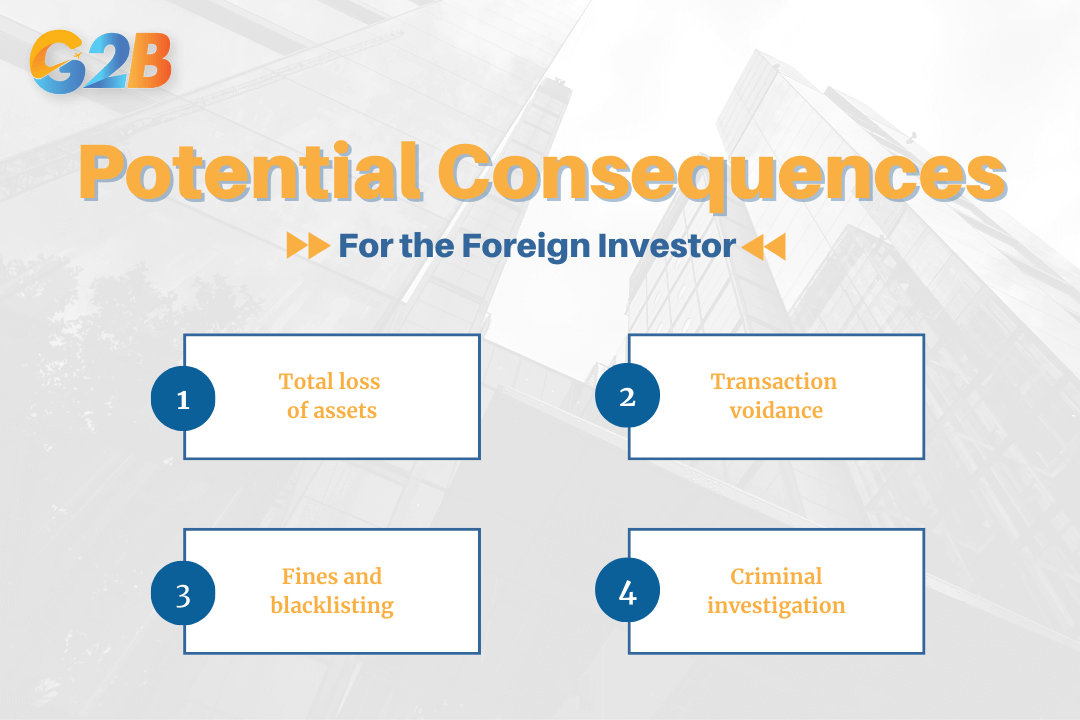
Potential consequences for the foreign investor
Safer, compliant alternatives to nominee directors
The most effective way to avoid the dangers of a nominee director is to use a legally sound and fully compliant investment structure from the outset. Fortunately, Vietnam offers several viable alternatives.
Direct foreign investment in open sectors
Before considering any complex structures, the first step is to verify the current regulations for your specific business sector. Vietnam has opened up many industries to foreign capital, and many now permit 100% foreign ownership. In such cases, a nominee is entirely unnecessary, and you can establish a fully foreign-owned company, giving you direct and undisputed legal control.
Legitimate joint venture
If your intended sector has a foreign ownership cap, the safest and most transparent alternative is to form a legitimate joint venture (JV) with a Vietnamese partner. Unlike a nominee, a true JV partner contributes capital, expertise, or resources and shares in the risks and rewards. Control mechanisms can be embedded within a well-drafted Shareholders' Agreement, which can grant the foreign investor significant influence over key business decisions, board appointments, and profit distribution, even as a minority shareholder.
Business Cooperation Contract (BCC)
A Business Cooperation Contract is an investment form where parties cooperate on a specific project and share profits or products without establishing a new legal entity. This structure is suitable for projects with a defined scope and timeline. For foreign investors, a BCC must be registered with the licensing authorities, making it a fully compliant method of collaborating with a local partner.
Using a nominee director in Vietnam is a fundamentally high-risk and legally unrecognized strategy. The introduction of mandatory Ultimate Beneficial Owner (UBO) disclosure and stricter anti-money laundering enforcement has closed the loopholes that once made this practice seem viable. The arrangement now poses an unacceptable level of danger to both the foreign investor, who risks a total loss of assets, and the nominee, who faces immense personal liability. The only prudent path forward is to embrace transparency and utilize legally compliant structures.
Ready to start your journey in Vietnam? Contact G2B today for a consultation on how to establish a company in Vietnam and to follow annual compliance requirements during operations. Let us handle the bureaucracy so you can focus on your business.
