





 Delaware (USA)
  Vietnam
  Singapore
  Hong Kong
  United Kingdom
 Setup a travel agency in Vietnam is a strategic move for foreign investors looking to capitalize on one of Southeast Asia's most dynamic tourism markets. With its stunning landscapes, rich cultural heritage, and rapidly growing economy, Vietnam presents a compelling opportunity for investment in the travel sector. This article will explore the immense market opportunities, detail the mandatory legal requirements, outline the procedural steps for establishment, and clarify the critical business conditions.
Overview of the market and investment opportunities in Vietnam’s tourism industry
Vietnam's tourism industry is on a remarkable upward trajectory. The country has consistently registered impressive growth in international arrivals, setting a new record in January 2026 with nearly 2.5 million visitors. This surge is fueled by strategic government policies, including more favorable visa regulations and significant investment in infrastructure. The country welcomed 12.6 million international visitors in 2023, a dramatic increase from previous years, and continues to attract tourists to world-renowned destinations like Ha Long Bay, Hoi An, and Phu Quoc.
This sustained growth creates a wealth of opportunities for foreign investors. There is a high demand for specialized and high-quality tour services catering to an increasingly diverse international clientele from key markets like South Korea, China, Japan, and a rapidly expanding European segment. Vietnam's tourism industry presents numerous advantages, such as a rapidly growing middle class, significant government investment in infrastructure, and a rich cultural heritage.
Within this ecosystem, a foreign-invested travel company - legally defined as a tour operator for inbound services - plays a pivotal role. By leveraging international marketing expertise and offering unique, curated experiences, investors can tap into niche markets such as wellness retreats, adventure travel, and luxury cultural tours.
Legal framework and key requirements for foreign investors
Navigating the legal landscape is the most critical aspect of establishing a travel business in Vietnam. The industry is classified as a "conditional business line," meaning foreign investors must adhere to specific regulations stipulated by Vietnamese law and international commitments.
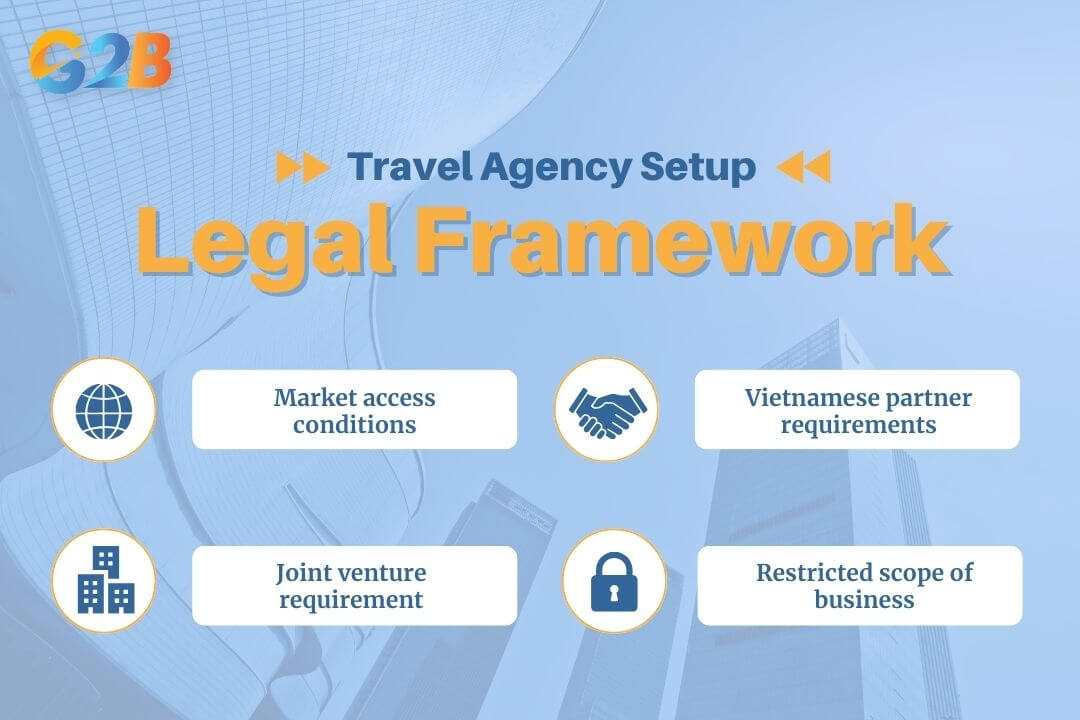
Key legal requirements for foreign investors setting up a travel agency in Vietnam
Market access conditions: Under Vietnam's commitments to the World Trade Organization (WTO) and various Free Trade Agreements, there are specific rules for foreign participation in the travel services sector. The most important of these is the ownership limitation. Foreign investors are not permitted to establish a 100% foreign-owned travel agency in Vietnam.
Joint venture requirement: To operate in this sector, forming a joint venture with a Vietnamese partner is mandatory. This structure allows foreign investors to hold a significant majority stake, but a local partner is essential for legal compliance. The foreign capital contribution ratio is not capped, meaning investors can own a high percentage of the charter capital in the joint venture.
Vietnamese partner requirements: A crucial condition is that the Vietnamese partner in the joint venture must be an enterprise that already holds an International Travel Service Business License and has been operating for at least 2 years with a valid license. This ensures that the local partner has the necessary legal standing and experience in the industry.
Restricted scope of business: Foreign-invested travel companies have a clearly defined and restricted scope of operation. The joint venture is permitted to provide:
- Inbound tours for international tourists visiting Vietnam.
- Domestic tours for those international tourists as part of their inbound tour packages.
Crucially, the company is not permitted to provide outbound travel services for tourists (including Vietnamese citizens and expatriates) traveling from Vietnam to other countries. This restriction is in place to protect domestic businesses operating in the outbound market.
Procedures and processes for establishing a travel company in Vietnam
The establishment process for a foreign-invested travel company is a multi-stage procedure requiring careful preparation and adherence to legal protocols. Investors can either establish a new joint venture or contribute capital to an existing, licensed company. The primary process involves three main steps.
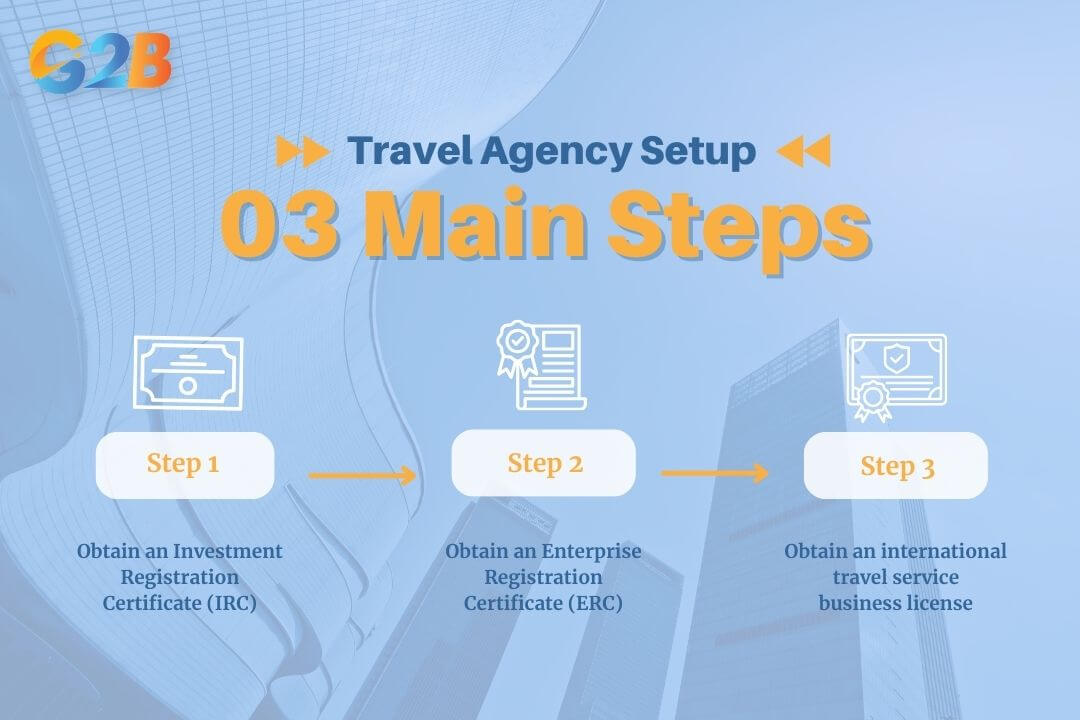
The primary process for establishing a travel company involves 3 main steps
Step 1: Obtain an Investment Registration Certificate (IRC)
The IRC is the first essential document, serving as the government's approval of your investment project. It legitimizes the foreign investor's capital injection into Vietnam. The application is submitted to the Department of Planning and Investment (DPI) and requires a comprehensive dossier. Key documents for the IRC application include the Investment Registration Certificate application, the company charter, passport copies of the foreign investors, and proof of financial capacity. The processing time for an IRC is typically around 15 working days upon submission of a valid application.
Step 2: Obtain an Enterprise Registration Certificate (ERC)
Following the issuance of the IRC, the next step is to obtain the ERC, which officially establishes the joint venture as a legal entity in Vietnam. The ERC application is also submitted to the DPI. The certificate contains vital information such as the company’s name, address, legal representative, and business lines, and its number also functions as the company's tax identification number. The standard processing time is approximately three to five working days. Once you have your ERC, the next phase involves setting up your accounts. Learn more about our packaged accounting and tax services for new businesses.
Step 3: Obtain an international travel service business license
This is the most critical "sub-license" that grants the company the legal right to operate as a tour provider. The application is submitted to the Vietnam National Authority of Tourism (VNAT). To be granted this license, the company must prove it meets several key business conditions, which are detailed in the next section. The VNAT will appraise the application and issue the license, typically within 15 working days of receiving a valid dossier.
Key business conditions to be fulfilled
Beyond the initial registration certificates, a foreign-invested tour company must meet and maintain specific operational conditions as mandated by the Law on Tourism.
Deposit requirement: To ensure financial accountability and protect tourists, the company must place a mandatory deposit at a commercial bank in Vietnam. For a company providing inbound international travel services, the business must maintain a deposit of VND 250,000,000 (approximately USD 10,000) at a Vietnamese bank throughout its operation. A temporary 80% reduction to this deposit was in effect post-COVID but expired permanently from January 1, 2025, per Circular 02/2025/TT-BVHTTDL at the end of 2023. The bank will issue a certificate of deposit, which is a required document for the International Travel Service Business License application.
Person in charge of travel operations: The law mandates that the manager responsible for the travel service business must have specific professional qualifications. This ensures a standard of expertise in the industry. The person in charge must hold either a college degree (or higher) in a travel and tourism major, or a degree in another major plus a professional certificate in international tour operation management. Relevant majors include tourism management, travel management, and tour guiding.
Tour guides: A critical regulation that foreign investors must understand is that all official tour guides must be Vietnamese citizens. Foreign employees can work in management, marketing, or administrative roles, but they are legally prohibited from directly guiding tours. This rule underscores the importance of hiring qualified local staff for tour execution.
Distinguishing between a travel agency and a tour operator
In Vietnam, the law makes a clear distinction between a "travel agency" and a "tour operator" (officially a travel service business). Understanding this difference is vital for foreign investors, as their licensed joint venture will operate as the latter.
| Feature | Travel agency | Tour operator (travel service business) |
|---|---|---|
| Primary role | Acts as an intermediary or agent. | Designs, organizes, and directly operates tours. |
| Core function | Sells tour programs designed by licensed tour operators to earn a commission. | Creates itineraries, arranges transportation and accommodation, and manages all logistical details of a tour. |
| Legal authority | Cannot create, operate, or invoice for its own tours. | Authorized to design, sell, and directly organize tour programs for tourists. |
| Foreign investment | The model available to foreign investors is legally a tour operator for inbound services, not a commission-based agency. | This is the licensed business model for a foreign-invested joint venture in Vietnam's tourism sector. |
The foreign-invested joint venture, once it obtains the International Travel Service Business License, is legally a Tour Operator. It is authorized to create, market, and execute its own inbound tour programs for international visitors.
Important considerations during operation
Successfully establishing the company is only the beginning. Long-term success depends on diligent operational management and ongoing compliance.
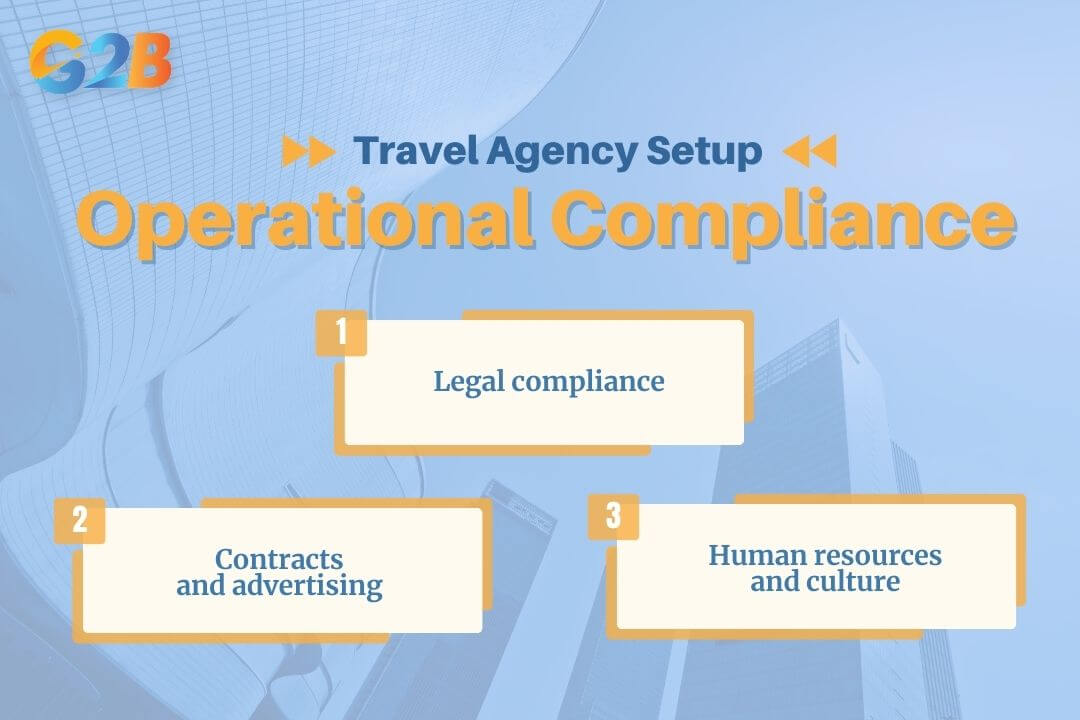
Key operational compliance pillars for foreign-invested travel agencies in Vietnam
Contracts and advertising: Transparency is legally required in all business dealings. All tour contracts, brochures, and digital advertisements must clearly state the full name and license number of the tour-operating entity (the joint venture). This ensures customers know they are dealing with a legally recognized and licensed tour operator.
Legal compliance: The tourism industry is closely regulated. It is imperative to maintain ongoing compliance with all relevant laws, including tax, labor, and tourism-specific regulations. Failure to comply can result in significant fines or, in severe cases, the revocation of the business license. Navigating ongoing legal requirements can be complex. Explore how our retained legal advisory services can help your business stay compliant.
Human resources and culture: Building a strong local team is fundamental to success. Your business's reputation will depend on the quality of your Vietnamese tour guides and operational staff. Successful operation depends on key factors, such as building strong relationships with local suppliers, understanding cultural nuances, and ensuring excellent customer service. Invest in training your personnel to meet the high standards expected by international tourists.
Frequently asked questions (FAQ)
Can a foreign investor own 100% of a travel company in Vietnam? No, under Vietnam's WTO commitments and local laws, a 100% foreign-owned travel company is not permitted. A joint venture with a licensed Vietnamese partner is mandatory.
What is the minimum capital required to establish a travel agency? There is no statutory minimum charter capital requirement for a tour company. However, you must register an amount that is reasonable and sufficient to cover your business expenses. This is distinct from the mandatory VND 250,000,000 deposit required for the international tour operator license.
How long does it take to complete the company establishment procedures? A realistic timeline for completing all three steps (IRC, ERC, and International Travel Service Business License) is typically between 3 and 4 months, assuming a complete and valid application dossier is submitted.
Can a foreign-invested company provide outbound travel services? No, the business license for a foreign-invested travel company is strictly limited to inbound tourism for international visitors and any associated domestic tours during their trip. Organizing tours for people to travel from Vietnam to other countries is not permitted.
While setting up a travel agency in Vietnam involves navigating specific legal requirements, particularly the mandatory joint venture, the market's vast potential makes it an exceptionally rewarding venture. The country’s tourism growth shows no signs of slowing, offering a prime opportunity for investors who can deliver high-quality, unique travel experiences. By understanding the legal framework, meticulously following the establishment procedures, and committing to operational excellence, foreign investors can build a thriving and profitable business in this vibrant sector.
Planning to launch your business in Vietnam? Get in touch with G2B for expert guidance on setting up a company in Vietnam and ongoing annual compliance. We will take care of the regulatory procedures, so you can concentrate on growing your business.
