




 Delaware (USA)
  Vietnam
  Singapore
  Hong Kong
  United Kingdom
 Setup manufacturing in Vietnam is the primary tactical maneuver for global conglomerates and SMEs. As supply chains diversify, Vietnam has emerged as a leading manufacturing hub in Asia, offering a network of 15 Free Trade Agreements (FTAs), including the EVFTA and CPTPP, alongside competitive labor costs and specialized Industrial Parks (IPs). This article outlines the legal frameworks, location selection criteria, environmental compliance requirements, and step-by-step licensing procedures required to operationalize a manufacturing facility.
Strategic location selection in North, Central or South Vietnam
Selecting the geographical location is the first critical variable in the investment equation. The decision depends on the specific manufacturing sub-sector and supply chain integration requirements.
Regional industrial ecosystems
- Northern Vietnam (Hanoi, Hai Phong, Bac Ninh): This region is the hub for Heavy Industry, Electronics and High-tech component manufacturing and Automotive. It offers direct proximity to the Chinese border, facilitating the import of raw materials and components. Key tenants include Samsung, LG, and Foxconn.
- Southern Vietnam (Ho Chi Minh City, Binh Duong, Dong Nai): The South dominates in Textiles, Garments, Furniture, and FMCG. It possesses the most mature logistics infrastructure, centered around the Cat Lai Port and Tan Son Nhat Airport.
- Central Vietnam (Da Nang, Quang Ngai): This region focuses on Light Industry, Food Processing, and Petrochemicals. It offers lower land lease rates and labor costs compared to the North and South.
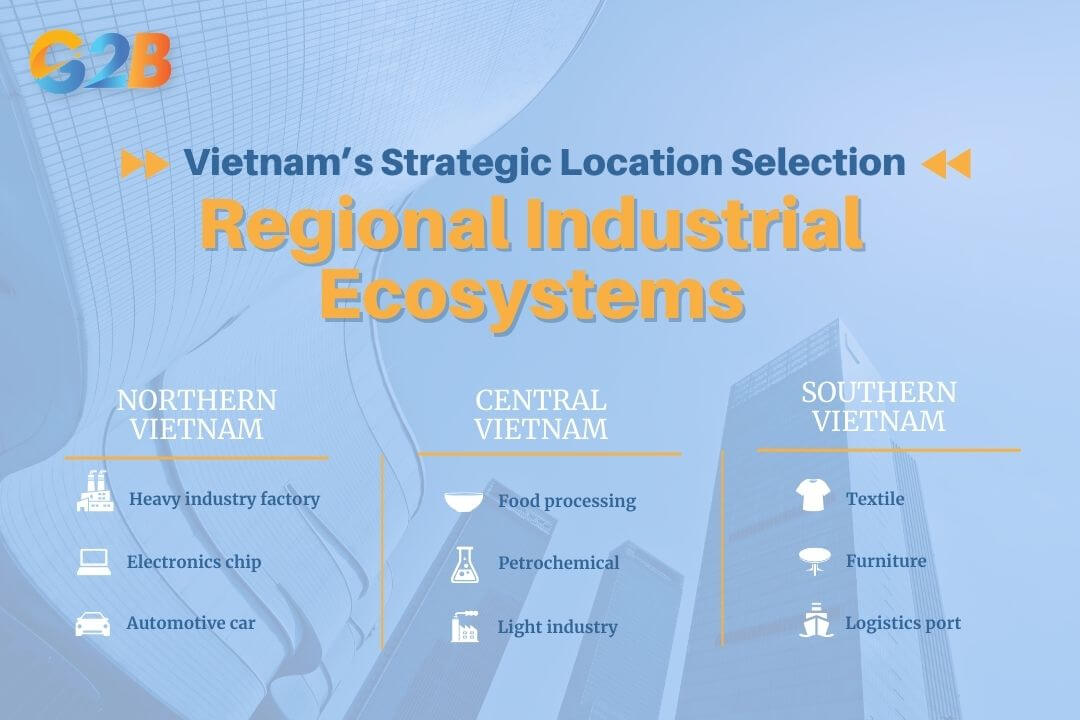
Overview of Vietnam’s strategic location selection
Industrial parks vs. economic zones
Investors must choose between locating within a standard Industrial Park or a specialized Economic Zone.
- Industrial parks: Designated areas with ready-built factories (RBF) or land plots with completed infrastructure (electricity, water, waste treatment).
- Economic zones: Special areas that offer superior tax incentives and customs privileges, often located in difficult socio-economic areas to spur development.
Legal structures for manufacturing companies, EPE and non-EPE
When foreign investors setup manufacturing company, they must classify the entity based on the target market for their products. This distinction dictates the tax liabilities and customs procedures.
Comparison between export processing enterprises and non-EPE models
| Feature | Non-EPE (Standard manufacturing) | export Processing enterprise (EPE) |
|---|---|---|
| Primary market | Domestic Vietnam & Export | 100% Export (Strictly monitored) |
| Import duties | Payable on raw materials (refundable upon export) | Exempt (0%) on raw materials |
| VAT on imports | 10% (or 8%) | Exempt (0%) |
| Customs procedure | Standard inspection | Simplified, often with on-site customs |
| Physical barrier | Not required | Mandatory (Fence/Wall separating EPE from outside) |
| Selling locally | Allowed unrestricted | Treated as "Import/Export" (Buyer pays duties) |
Prerequisites for manufacturing company setup
Before establishing a manufacturing company, investors must meet several legal, technical, and operational prerequisites. Preparing these requirements in advance helps ensure regulatory compliance and a smooth project implementation process.
Land or factory lease agreement
Unlike IT companies, manufacturing requires a physical footprint before licensing.
- Option A (land lease): Leasing land in an Industrial Park to build a factory. Lease term usually lasts until the IP's license expires (typically 50 years).
- Option B (ready-built factory - RBF): Leasing a pre-constructed facility. This reduces setup time significantly.
- Requirement: The investor must sign a Memorandum of Understanding (MOU) and pay a deposit to the landlord to reserve the location during the licensing phase.
Capital requirements
There is no statutory minimum capital, but the Department of Planning and Investment (DPI) examines the Total investment capital (Charter capital + Loan capital).
- Ratio: Authorities look for a realistic capital-to-scale ratio. For a light manufacturing plant, in many practical cases, a range of around USD 200,000 - 500,000 is expected to cover machinery, land rental, and initial Opex.
Step-by-step process to set up a manufacturing company
The timeline for manufacturing is longer than for services due to environmental and construction regulations. The process typically spans 3 to 6 months.
Phase one pre-licensing
Duration: 15-30 days.
- Site scouting and technical due diligence (wastewater capacity, power load).
- Signing the MOU and Land Lease Agreement (in principle).
Phase two licensing IRC and ERC
Duration: 30-45 days.
- Investment Registration Certificate (IRC): The investor submits the dossier to the Industrial Zone Management Board (if in an IP) or the DPI (if outside).
- Key document: Explanatory Statement on Technology (listing machinery, production flow, and environmental impact).
- Enterprise Registration Certificate (ERC): Issuance of the tax code and legal entity formation.
Phase three post-licensing sub-licenses
Duration: 2-4 months. Manufacturing entities cannot operate immediately after receiving the ERC. They must obtain specific sub-licenses:
- Environmental impact assessment (EIA) or Environmental Protection Plan (EPP): One of these procedures is mandatory depending on the project's environmental risk classification; the company must prove how it treats noise, dust, and wastewater.
- Fire prevention and fighting (FPF) license: The factory design must be approved by the Fire Police.
- Construction permit: Required if the investor builds their own factory on leased land.
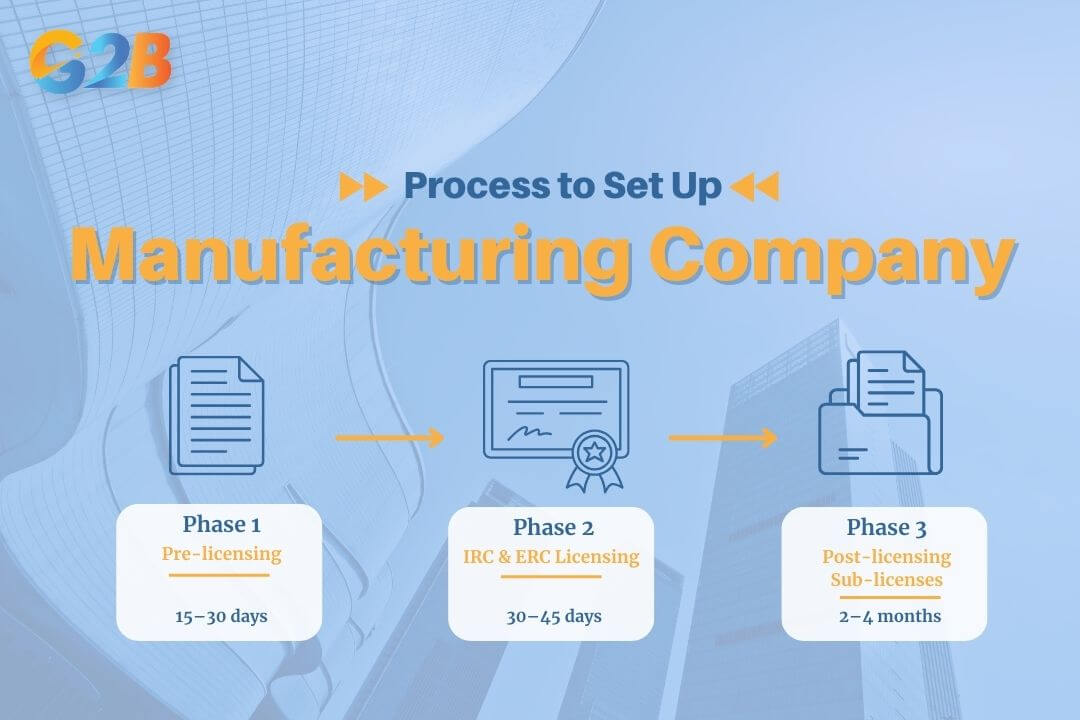
End-to-end timeline to set up a manufacturing company in Vietnam
Estimated manufacturing costs in Vietnam
Investors must account for fixed asset investment and recurring operational costs.
Industrial land and factory rental costs
| Region | Land lease (USD/m2/term) | Ready-built factory (USD/m2/month) |
|---|---|---|
| North (Hanoi, Bac Ninh) | 120 – 160 | 4.5 – 6.0 |
| South (HCMC, Binh Duong) | 140 – 200 | 4.8 – 6.5 |
| Central (Da Nang) | 70 – 100 | 3.0 – 4.5 |
| Management fee | 0.5 – 1.0 (Annual) | Included or +0.5 |
(Note: Land lease may be paid either as a one-off payment for the remaining lease term or annually, depending on the industrial park's policy and the land lease contract).
Labor costs
Wages depend on the Region classification of the factory location.
- Region I (Urban HCMC/Hanoi): ~USD 190 / month (Basic minimum).
- Region II (Industrial districts): ~USD 170 / month.
- Region III & IV (Rural): ~USD 140 – 150 / month.
- Reality check: Actual gross salaries for factory workers are typically in the range of USD 300 – 450 per month including overtime and insurance.
Corporate income tax incentives for manufacturing companies
Manufacturing projects often qualify for standard or special incentives depending on location and industry.
- Standard rate: 20%.
- Incentive locations: Factories located in difficult socio-economic areas or High-tech zones may be eligible for corporate income tax holidays (for example, up to 2–4 years of exemption followed by 4–9 years of 50% reduction, depending on the specific regime).
- High-tech industries: Projects involving renewable energy, biotechnology, or advanced electronics can apply for preferential CIT rates (often 10% for up to 15 years or other enhanced incentive packages, subject to approval).
Common risks and challenges in manufacturing investment
Manufacturing investments involve a range of operational, regulatory, and market-related risks that investors should carefully evaluate. Identifying these common challenges early can help businesses develop effective mitigation strategies and maintain long-term stability.
Environmental compliance violations
Vietnam has tightened environmental regulations. Failure to maintain wastewater treatment systems (standard A or B) results in severe fines and potential shutdown orders.
- Solution: strictly adhere to the commitments made in the EIA report.
Supply chain localization challenges
While assembly is easy, sourcing raw materials locally can be difficult (low localization rate).
- Solution: Investors often need to import initially. Utilizing the EPE structure mitigates the duty costs associated with this import-export cycle.
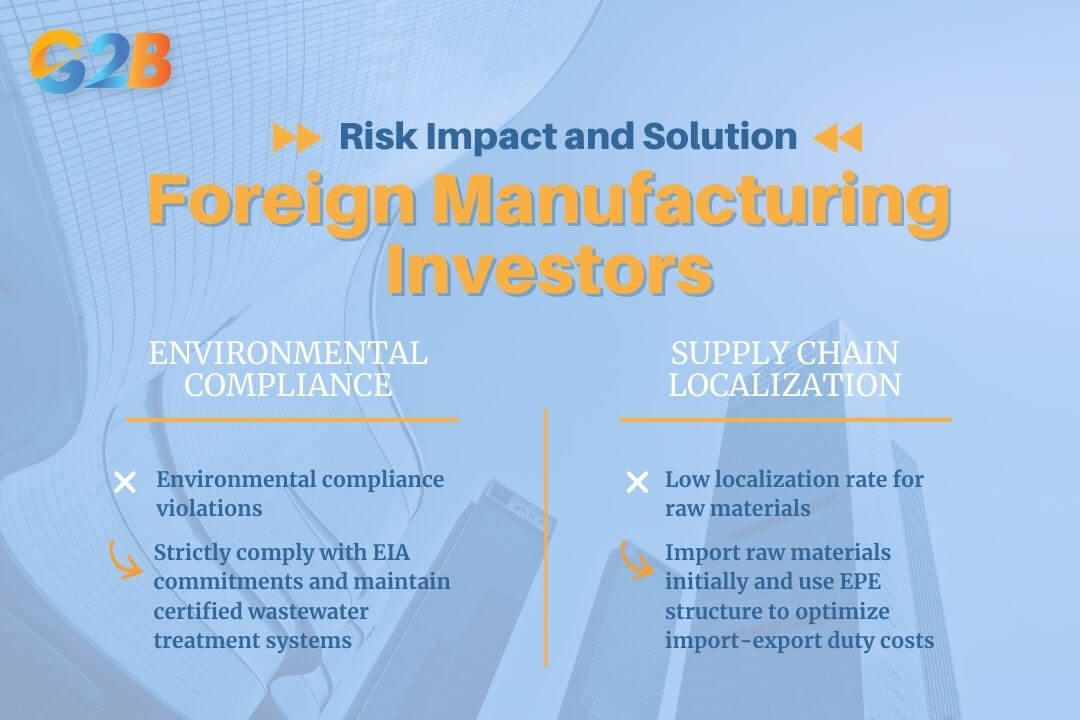
Key manufacturing investment risks and practical mitigation strategies in Vietnam
Frequently asked questions about manufacturing setup in Vietnam
To help investors better understand the process, this section addresses the most frequently asked questions about setting up a manufacturing company in Vietnam.
Minimum capital requirements for a manufacturing company
There is no fixed legal minimum. However, for a small assembly plant, authorities typically expect at least USD 200,000. For medium-scale manufacturing, USD 1 Million+ is the standard to secure IRC approval.
Importing used machinery from overseas factories
Yes, but with strict conditions. Under Decision 18/2019/QD-TTg, used machinery must not be older than 10 years and must meet Vietnamese safety and energy-saving standards. The equipment must comply with recognized technical standards and energy-efficiency requirements, and an inspection certificate from an accredited organization is required.
Land lease term duration in Vietnam
Land in Industrial Parks is leased for a maximum of 50 years (or 70 years in special economic zones). The term counts down from the date the Industrial Park was established, not the date you sign the lease.
Differences between IRC and ERC
The IRC (Investment Registration Certificate) validates the foreign project and capital. The ERC (Enterprise Registration Certificate) validates the legal company entity. Foreign manufacturers need both. Domestic investors only need the ERC.
Setup company in Vietnam requires meticulous planning regarding location, customs classification (EPE), and environmental compliance. The shift from a simple sourcing hub to a sophisticated manufacturing ecosystem offers immense potential for investors who navigate the regulatory landscape correctly.
