




 Delaware (USA)
  Vietnam
  Singapore
  Hong Kong
  United Kingdom
 A fire safety license in Vietnam is a mandatory administrative and technical certification required by the government to ensure that commercial and industrial facilities operate safely without endangering public life or property. Navigating the rigid fire safety standards, technically demanding blueprints, and complex bureaucratic procedures at the Ministry of Public Security demands absolute precision. This guide outlines steps, legal requirements, document structures, and costs required to secure certification.
This article highlights the key aspects of fire safety license requirements in Vietnam to help businesses better understand the regulations and procedures. We specialize in Vietnam incorporation service and do not provide legal representation or fire safety compliance advisory services.
What is a Fire Safety License in Vietnam?
A fire safety license in Vietnam - officially known in the legal system as the Verification Conclusion on Fire Prevention and Fighting Technical Design Documents and Certificate of Fire Safety Acceptance - is a legally binding document issued by competent state police authorities. It serves as proof that a facility's architectural design, construction materials, and operational layouts completely satisfy the national fire prevention and fighting standards.
The government strictly enforces this license to preemptively suppress potential hazards, ensure safe emergency evacuation pathways, and guarantee that facilities are equipped with rapid-response suppression tools. The certification confirms that an enterprise possesses the exact technical capacity to manage emergencies, deploy localized firefighting strategies, and safely evacuate personnel before state responders arrive.
| Attribute | Official detail |
|---|---|
| Official name | Verification Conclusion on Fire Prevention and Fighting Technical Design Documents and Certificate of Fire Safety Acceptance |
| Issuing authority | Fire Prevention and Fighting Police Department (C07) or Provincial/District Police |
| Primary legal basis | Decree 136/2020/ND-CP |
| Validity period | Indefinite (remains valid unless structural/functional changes occur; subject to regular state inspections) |
| Processing time | 15 to 30 working days (depending on project scale and dossier accuracy) |
Which businesses must obtain a Fire Safety License in Vietnam?
Not all businesses require a complex fire safety license, but high-risk physical establishments absolutely do. Decree 136/2020/ND-CP precisely categorizes commercial entities based on their operational nature, building height, volumetric capacity, and the specific combustible materials they handle. Establishments falling under Appendix III and Appendix IV of this decree must formally apply for design appraisal and fire safety acceptance before commencing any operational activities.
Common establishments requiring certification
- High-rise commercial buildings: Office towers, mixed-use complexes, and apartment buildings exceeding 7 stories or 25 meters in height.
- Hospitality and entertainment venues: Hotels, karaoke lounges, discotheques, and bars, regardless of their foundational scale.
- Manufacturing and industrial facilities: Factories producing flammable goods, garment manufacturing plants, and electronics assembly lines with a total volume exceeding 3,000 cubic meters.
- Storage and logistics hubs: Warehouses storing chemicals, petroleum products, textiles, or paper materials.
- Educational and medical institutions: Hospitals, multi-story clinics, universities, and private boarding schools.
| Business category | Scale/Capacity trigger for mandatory licensing |
|---|---|
| Hotels and guesthouses | 7 stories or higher, or total volume exceeding 5,000 m³ |
| Warehouses (flammable goods) | Total internal volume exceeding 3,000 m³ |
| Garment/Textile factories | Total internal volume exceeding 3,000 m³ |
| Gas stations & petroleum storage | All establishments, regardless of exact scale |
| Karaoke lounges & nightclubs | All establishments, regardless of exact scale |
What legal regulations govern fire safety licensing in Vietnam?
Fire prevention and fighting (PCCC) compliance in Vietnam relies heavily on a strictly layered hierarchy of laws, decrees, and technical construction codes. Authorities appraise every single building blueprint against these exact texts.
Primary legal frameworks
- Law on Fire Prevention and Fighting (2001, amended 2013): The foundational parliamentary statute dictating the fundamental obligations of citizens, enterprises, and state agencies in preventing and suppressing fires.
- Decree 136/2020/ND-CP: The most critical operational document detailing the exact list of facilities requiring PCCC management, the rules for design appraisal, and the step-by-step procedures for acquiring licenses.
- Circular 149/2020/TT-BCA: Issued by the Ministry of Public Security, this circular provides the specific administrative forms, internal logs, and operational guidelines for local fire police departments.
- QCVN 06:2022/BXD (and subsequent amendments like QCVN 06:2023/BXD): The National Technical Regulation on Fire Safety for Buildings and Constructions. This highly technical code defines the precise measurements for emergency exit routes, the required fire resistance ratings of building materials, and the mandatory installation of smoke extraction systems.
What conditions must a business meet to obtain a Fire Safety License?
To successfully pass the stringent evaluations conducted by the C07 department, an enterprise must fulfill both structural (hardware) and administrative (software) conditions. The state heavily scrutinizes the physical capability of the building to withstand heat and the organizational readiness of the staff to respond to emergencies.
Administratively, the enterprise must formally establish a grassroots fire prevention and fighting team. These designated employees must undergo official state-certified training and receive individual certificates of competency in fire safety. The business must also draft and visibly display the official rules on fire safety, establish emergency contact protocols, and formulate a state-approved rescue plan.
Structurally, the facility must integrate specialized fire protection systems, such as automatic sprinklers, smoke exhaust ventilators, and heat detectors, corresponding exactly to the building's specific risk category.
| Mandatory condition | Specific requirements & fire protection equipment |
|---|---|
| Safe evacuation routes | Must feature clearly marked emergency exit routes, specialized fireproof staircases, illuminated exit signs, and emergency backup lighting lasting a minimum of 2 hours. |
| Fire detection & alarm systems | Mandatory installation of automatic smoke detectors, heat sensors, and manual call points (alarms) integrated into a centralized monitoring control panel. |
| Fire suppression equipment | Must include easily accessible portable fire extinguishers (CO2 and dry powder), indoor fire hose reels, and automatic sprinkler systems linked to high-capacity water pumps. |
| Structural fire resistance | Building materials, fireproof doors, and internal separation walls must maintain specific fire resistance ratings (e.g., EI 60, EI 90) to prevent rapid fire spread across different operational zones. |
| Administrative documentation | Must maintain an active PCCC management logbook, officially approved fire-fighting and rescue plans, and valid training certificates for the internal rapid-response team. |
What documents are required for a Fire Safety License application?
The core of the dossier involves intricate technical layout drawings. These blueprints cannot be drafted by standard architects; they must be developed by a legally certified fire protection design company. Every measurement regarding staircase widths, water reservoir capacities, and pipe diameters must explicitly reference a specific article within the QCVN fire safety standards.
| Document name | Description | Quantity |
|---|---|---|
| Official application form | Written request for design appraisal and fire safety acceptance (Form No. PC06) | 1 original |
| Enterprise registration certificate | Certified copy proving the legal status and registered business lines of the investing company | 1 certified copy |
| Technical design blueprints | Detailed A0/A1 layout drawings showing site plans, architectural elevations, fire separation sections, and M&E routing for sprinkler and alarm systems | 2 original sets |
| Investment approval/construction permit | Documentation proving the local government has authorized the overall construction or renovation of the facility | 1 certified copy |
| Cost estimation statement | A formal breakdown of the total capital investment for the project, which the state uses to calculate the exact design appraisal fee | 1 original |
What is the procedure to obtain a Fire Safety License in Vietnam?
Acquiring the certification is a rigid, multi-stage legal procedure. Businesses cannot skip steps or retroactively apply for approval after constructing a non-compliant building. Attempting to bypass the exact sequence will result in immediate construction halts and severe financial penalties.
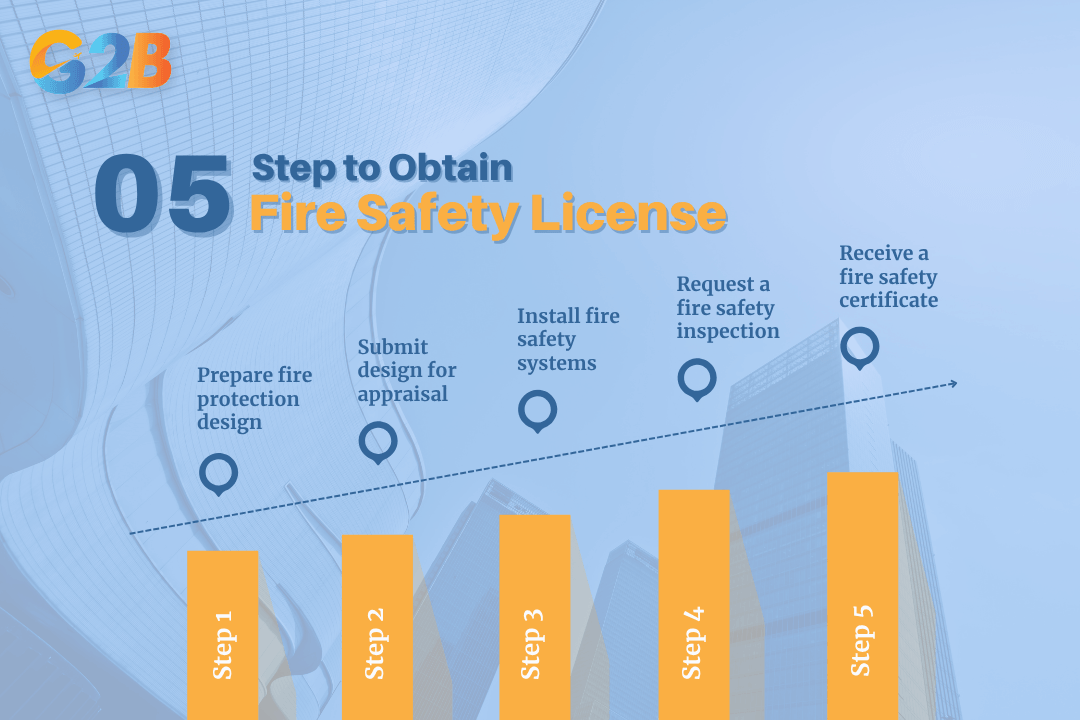
The procedure to obtain a Fire Safety License
Step 1: Prepare fire protection design
Before laying a single brick or signing a lease for a raw commercial space, the investor must hire a licensed fire protection design firm. This firm evaluates the structural plans and overlays specialized PCCC designs. They calculate the required volume of the underground fire water reservoir, draft the wiring for fire alarm installations, and map out the emergency exit routes. This design must mathematically prove absolute compliance with the QCVN 06:2022/BXD regulations.
Step 2: Submit design for appraisal
Once the technical blueprints are finalized, the enterprise compiles the complete dossier and submits it to the relevant Fire Prevention and Fighting Police Department (C07 at the provincial or ministerial level, depending on the project's scale). The state engineers will forensically review the layout drawings. If the design features dead-end corridors exceeding maximum length limits or inadequate fireproof walls, the authorities will issue a formal rejection notice requiring immediate architectural modifications. This step generally takes 10 to 15 working days for a compliant dossier. Upon success, the police stamp the blueprints with the official "Appraised Design" seal.
Step 3: Install fire safety systems
With the formally appraised design in hand, the business proceeds with physical construction and the installation of the specialized fire safety infrastructure. The investor must utilize a licensed fire safety installation contractor. The contractor must strictly adhere to the approved blueprints. Any arbitrary deviations - such as substituting a 100mm water pipe with an 80mm pipe or changing the location of automatic sprinkler systems - will automatically cause the project to fail the final inspection. Furthermore, all specialized equipment (such as fireproof doors and fire pumps) must undergo rigorous state quality accreditation before physical installation.
Step 4: Request a fire safety inspection
After completing the installation, the enterprise formally requests the state police to conduct a physical site inspection. A team of state inspectors will arrive at the facility to verify that the physical construction perfectly matches the appraised design. They will rigorously test the systems by physically triggering smoke alarms, measuring the water pressure of the fire hose reels, and verifying the automatic activation of smoke exhaust ventilators. They also check the validity of the internal fire safety team's training certificates.
Step 5: Receive a fire safety certificate
If the physical site passes all technical stress tests and the administrative documentation is flawless, the authorities draft an official inspection minute. Following a final administrative review, the competent police department officially issues the Certificate of Fire Safety Acceptance. At this exact moment, the facility is legally authorized to commence commercial operations. However, the business must continuously maintain these systems, as local police will conduct unannounced annual inspections to penalize degraded equipment.
How long does it take to obtain a Fire Safety License in Vietnam?
Securing fire safety compliance is a time-intensive process that investors must strategically factor into their project launch timelines. Unrealistic scheduling often forces businesses to delay grand openings while paying unnecessary commercial rent. The timeline heavily depends on the precision of the initial technical blueprints and the speed of physical construction.
| Project phase | Estimated duration |
|---|---|
| Phase 1: Blueprint drafting & preparation | 15 to 30 days (depends entirely on the design agency's capacity and project complexity) |
| Phase 2: State design appraisal | 10 to 15 working days (state processing time upon receiving a valid dossier) |
| Phase 3: Physical installation | 30 to 90 days (varies dramatically based on the physical size of the factory/building) |
| Phase 4: Site inspection & testing | 7 to 10 Working days (scheduling the state inspectors and conducting on-site stress tests) |
| Phase 5: Issuance of certificate | 5 to 7 Working days (post-inspection administrative processing) |
Total administrative time with the government typically ranges from 20 to 30 working days, but the holistic end-to-end process (including drafting and construction) spans 2 to 5 months.
What is the cost of a Fire Safety License in Vietnam?
The financial investment required to achieve fire safety compliance consists of statutory state fees and private market costs for design, equipment, and installation. Investors must budget meticulously, as specialized fire protection infrastructure represents a significant capital expenditure. State appraisal fees are strictly regulated by the Ministry of Finance and are mathematically calculated based on a percentage of the project's total investment capital.
| Cost category | Estimated range (VND) |
|---|---|
| State design appraisal fee | as per Circular 199/2021/TT-BTC: 0.1% of total investment (min. 1,000,000 VND, max. 200,000,000 VND). |
| Consulting & design drafting fees | 20,000,000 VND to 100,000,000+ VND (depends on the square footage and complexity of the architectural layout). |
| Equipment & physical installation | 150,000,000 VND to over 2,000,000,000 VND (Highly variable based on the required pumps, sensors, and structural fireproofing materials). |
| Equipment quality accreditation fees | Varies by the exact volume of imported equipment; state laboratories charge testing fees per batch of fireproof doors, hoses, or extinguishers. |
What are the penalties for not having a Fire Safety License?
The Vietnamese government exhibits zero tolerance for fire safety violations. Attempting to operate a commercial or industrial facility without official fire safety acceptance triggers immediate and aggressive state interventions. The penalties, codified under Decree 144/2021/ND-CP (updated by Decree 98/2024/ND-CP), target both the corporate entity and the legal representative.
Common penalties for violations
- Massive financial fines: Operating a mandated facility without a Certificate of Fire Safety Acceptance incurs immediate administrative fines ranging from 80,000,000 VND to 100,000,000 VND.
- Immediate business suspension: Authorities possess the legal right to force an immediate operational shutdown. The state will physically seal the premises, legally prohibiting the company from conducting business until the facility physically retrofits the building to achieve full compliance.
- Forced remedial actions: The state mandates that the enterprise systematically dismantle non-compliant architectural structures (such as illegal extensions blocking emergency exit routes) at its own expense.
- Criminal prosecution: In the catastrophic event that a non-compliant facility experiences a fire resulting in property damage, severe injury, or loss of life, the legal representatives and corporate directors face direct criminal prosecution under the Penal Code, leading to multi-year prison sentences.
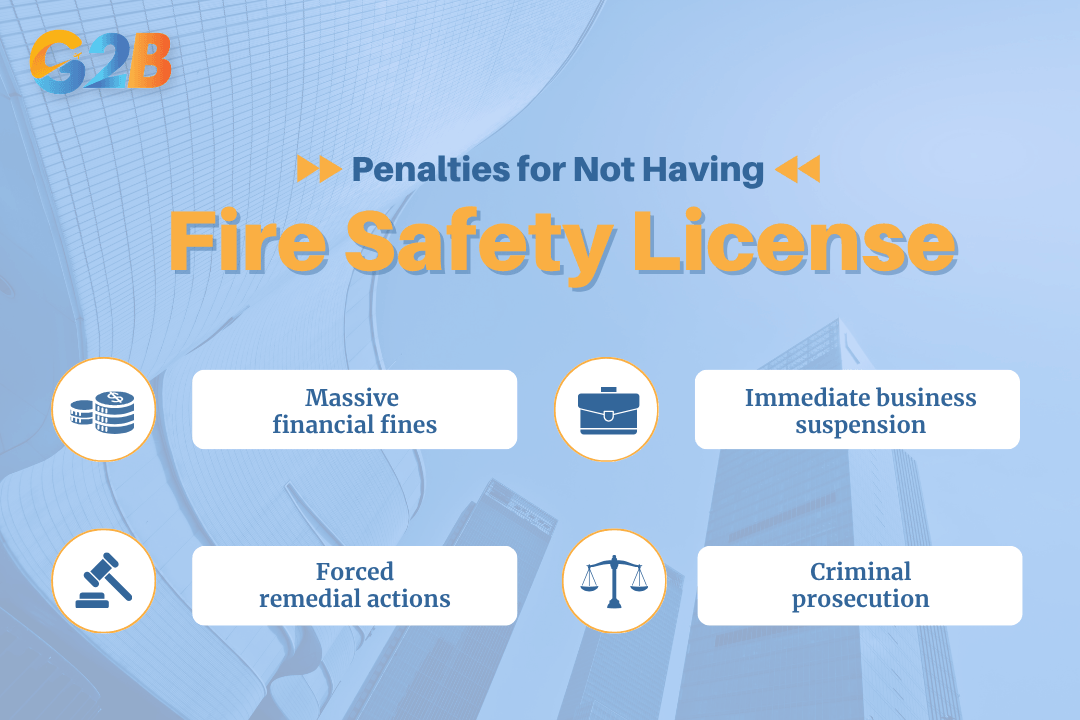
The penalties for not having a Fire Safety License
Do foreign businesses need a Fire Safety License in Vietnam?
Absolutely. The legal system dictates that foreign-invested enterprises (FIEs) are subject to the exact same stringent fire safety regulations as domestic companies. The Law on Fire Prevention and Fighting makes no exceptions regarding the nationality of the investor. If a foreign corporation establishes a manufacturing plant, leases a high-rise office space, or constructs a commercial warehouse in Vietnam, it must absolutely comply with Decree 136/2020/ND-CP and QCVN 06:2022/BXD.
However, foreign enterprises frequently face severe friction when navigating these requirements. The extreme technical density of the QCVN standards, localized bureaucratic procedures, and the absolute necessity of submitting all dossiers in flawless Vietnamese create immense operational bottlenecks. Foreign investors often struggle to interpret specialized Vietnamese technical jargon related to fire separation sections and smoke extraction flow rates.
FAQs about Fire Safety Licenses in Vietnam
Is a Fire Safety License mandatory for all businesses?
No, a fire safety license is not mandatory for all businesses. Small-scale retail shops, standard low-rise street-front cafes, and small administrative offices typically do not require the formal Certificate of Design Appraisal and Fire Safety Acceptance. However, they must still maintain basic localized safety standards, such as keeping portable fire extinguishers on-site. The rigorous formal licensing process strictly applies only to medium-to-large-scale facilities, high-risk operational sectors, and multi-story buildings explicitly listed in Appendices III and IV of Decree 136/2020/ND-CP.
How long is a fire safety certificate valid?
The Certificate of Fire Safety Acceptance is generally valid indefinitely. Unlike certain environmental or operational licenses that require renewal every few years, the PCCC certificate remains active as long as the facility maintains its exact structural layout and operational purpose. However, the certification instantly becomes invalid if the enterprise alters the building's architecture, physically expands the premises, or completely changes the business sector (e.g., converting a standard warehouse into a chemical storage facility). Additionally, validity is contingent upon passing routine, unannounced annual maintenance inspections conducted by the local police.
Who issues Fire Safety Licenses in Vietnam?
The Ministry of Public Security officially issues fire safety licenses in Vietnam. Depending on the physical scale, national importance, and investment structure of the project, the specific issuing body will either be the central Fire Prevention and Fighting Police Department (C07) under the Ministry of Public Security, or the localized Provincial/Municipal Police Departments of Fire Prevention and Fighting (PC07). For specific, highly localized low-risk projects, district-level police units possess the delegated authority to inspect and approve the facilities.
Securing total legal compliance with Vietnam's complex fire safety regulations is not an area where businesses can afford bureaucratic experimentation or technical shortcuts. From deeply technical architectural design appraisals to rigorous on-site physical inspections, every single step demands perfect alignment with the state’s uncompromising QCVN standards. Operating without proper certification exposes enterprises to crippling financial fines, forced business suspensions, and legal liabilities.
Planning to launch your business in Vietnam? Get in touch with G2B for expert guidance on setting up a company in Vietnam and ongoing annual compliance. We will take care of the regulatory procedures, so you can concentrate on growing your business.
