





 Delaware (USA)
  Vietnam
  Singapore
  Hong Kong
  United Kingdom
 A gazelle company is a high-growth enterprise that plays a vital role in economic expansion and job creation. In the vast landscape of the global economy, among corporate giants and small local businesses, exists a category of companies defined by incredible speed and agility. These firms, known as gazelles, are instrumental engines of prosperity, distinguished by their rapid and sustained growth. This guide will explore every aspect of a gazelle company, from its core definition and identifying traits to its profound economic impact.
What is a gazelle company?
The term "gazelle company" was first popularized by economist David Birch in his 1987 book, Job Creation in America: How Our Smallest Companies Put the Most People to Work. His research sought to identify the primary sources of new employment and economic vitality. He discovered that a small fraction of companies was responsible for the vast majority of job growth.
Birch established a precise, data-driven definition for these high-growth firms. A gazelle company is an enterprise that increases its revenues by at least 20% annually for four years or more, starting from a revenue base of at least $100,000. This specific metric means the company effectively more than doubles its revenue over a four-year period. The name "gazelle" was chosen to evoke an image of speed and agility, contrasting sharply with other business types. This metric separates gazelles from other business types, such as large, slow-growing corporations (“elephants’) and small, stagnant businesses (‘mice”). While "elephants" like Fortune 500 companies provide stability, and "mice" like local mom-and-pop shops form the backbone of communities, it is the gazelles that inject the most dynamism and new employment opportunities into the economy.
How to identify a gazelle?
While the 20% revenue growth metric is the technical definition, identifying a gazelle company involves looking beyond the numbers to its qualitative characteristics and its tangible impact on the economy. These companies share a distinct DNA that sets them apart from slower-moving enterprises.
First and foremost, a gazelle is identified by its outsized role in job creation and its focus on market-disrupting innovation. According to David Birch's original research, gazelles comprised only about 4% of all U.S. companies yet were responsible for up to 70% of new jobs at that time; more recent studies estimate that high-growth firms account for around 45-50% of new jobs created. This incredible contribution to employment is a primary identifier. They are not just hiring; they are hiring at a scale that significantly outpaces larger corporations and smaller businesses. High-growth firms are credited with accounting for up to 50 percent of new jobs created.
Innovation is the fuel for a gazelle's growth. These companies often introduce new technologies, novel business models, or innovative services that disrupt established industries. They spot market gaps, challenge incumbent players, and create new demand where none existed before. This relentless drive to innovate is what allows them to capture market share so rapidly and sustain their high-growth trajectory.
Furthermore, it is a common misconception that gazelle companies are confined to the technology sector. While many tech startups do fit the profile, gazelles can be found across a diverse range of industries, including retail, food and beverage, apparel, and even manufacturing. The defining factor is not the industry, but the company's ability to scale rapidly and consistently. Any company with a scalable business model and a clear competitive advantage can become a gazelle.
Finally, gazelles are inherently scalable. Their business models are not constrained by the limitations that keep "mice" small. They have systems, processes, and products that can be replicated and expanded to serve a much larger market without a proportional increase in costs. This scalability is what attracts investors and enables the company to manage its rapid expansion.
Pros and cons of being a gazelle company
The following sections will detail the distinct advantages that make the gazelle model so attractive and the significant disadvantages and risks that leaders must navigate to survive and thrive.
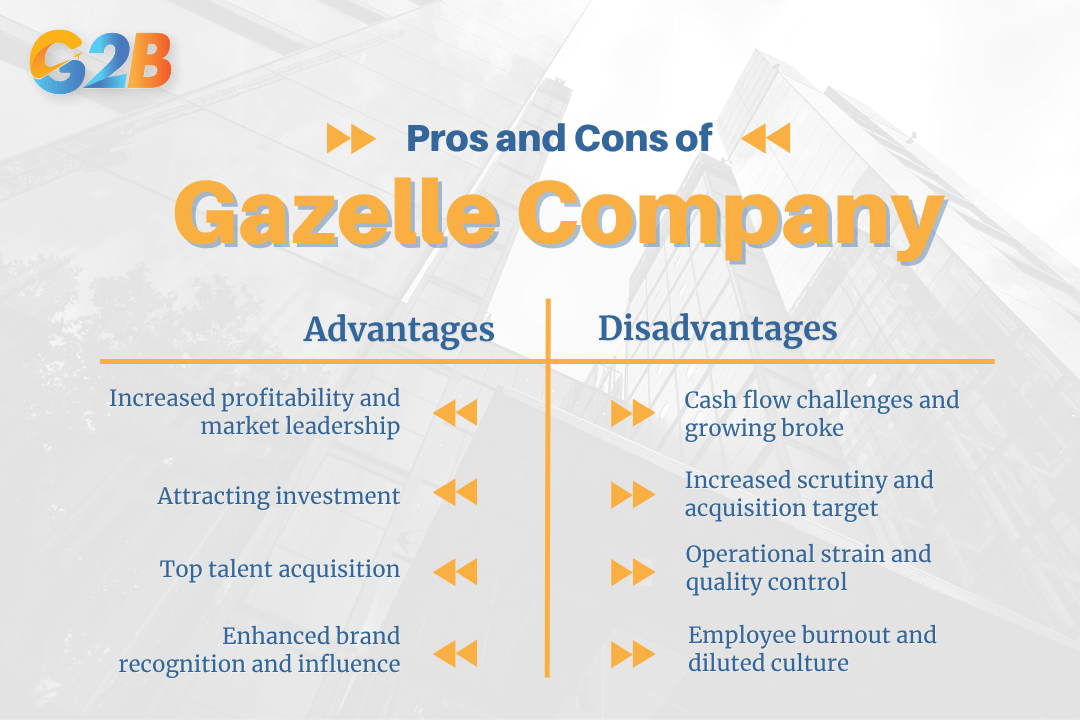
Pros and cons of being a gazelle company
Advantages (pros)
The benefits of achieving and sustaining high growth are substantial, impacting everything from profitability and market position to the ability to attract top-tier resources.
- Increased profitability and market leadership: Sustained rapid growth often leads to a commanding market share. As a gazelle expands, it can achieve economies of scale, improve its bargaining power with suppliers, and build a strong brand presence. This combination directly translates to increased profitability and establishes the company as a leader in its industry. When an economy expands, it often leads to increased consumer spending and business investments, boosting the revenues and profits of companies.
- Attracting investment: Venture capitalists and other investors are constantly searching for the next gazelle. These companies' proven track record of rapid, predictable growth and demonstrated product-market fit makes them highly attractive investment opportunities. The potential for massive returns means gazelles can often secure significant funding rounds, providing the capital necessary to fuel further expansion, research, and development.
- Top talent acquisition: High-growth companies are magnets for ambitious and talented individuals. The opportunity for rapid career advancement, meaningful impact, and potentially lucrative stock options draws in top performers who might otherwise work for larger, more established corporations. This influx of talent creates a virtuous cycle, as skilled employees drive further innovation and growth.
- Enhanced brand recognition and influence: The momentum and success of a gazelle naturally generate buzz. Media coverage, industry awards, and positive word-of-mouth build a powerful brand reputation. This recognition not only helps in acquiring customers but also opens doors to strategic partnerships and gives the company a greater voice in its industry.
A Gazelle Company is a fast-growing business that creates jobs and drives innovation. Through proper company formation in Vietnam, local and foreign entrepreneurs can establish a limited liability company or a joint-stock company to turn their business ideas into a true Gazelle Company.
Disadvantages (cons)
The intense pace of a gazelle's growth can create significant internal strains that, if left unmanaged, can lead to its downfall.
- Cash flow challenges and "growing broke": This is one of the most dangerous paradoxes of rapid growth. A company can be highly profitable on paper but run out of cash. This phenomenon, known as "growing broke," happens when the upfront costs of expansion - hiring new staff, purchasing inventory, investing in infrastructure - outpace the revenue coming in. A 2018 U.S. Bank study found that 82% of the time, poor cash flow management leads to small business failure.
- Employee burnout and diluted culture: The relentless pressure to maintain a 20%+ growth rate can take a heavy toll on employees. Long hours and a constantly changing environment can lead to widespread burnout. Furthermore, hiring dozens or hundreds of new employees in a short period makes it incredibly difficult to maintain a cohesive company culture. The values and mission that defined the early-stage company can become diluted, leading to a disengaged workforce.
- Operational strain and quality control: Rapid scaling can push a company's operations to the breaking point. A gazelle might face challenges such as a supply chain that can't meet demand, customer support teams overwhelmed by inquiries, and website infrastructure crashing from high traffic. In the rush to meet demand, quality control can suffer, potentially damaging the company's reputation and leading to customer churn.
- Increased scrutiny and acquisition target: A gazelle's success does not go unnoticed. Competitors, including the large "elephants," may enter their market to claim a share of the profits. The company's rapid growth and innovative model also make it a prime acquisition target for larger corporations looking to absorb its technology or market share, which can derail the founders' original vision.
Challenge and risk when becoming a gazelle company
Beyond the general disadvantages, gazelle companies face a specific set of operational and strategic hurdles that must be proactively managed. Overcoming these challenges is the true test of a gazelle's long-term viability.
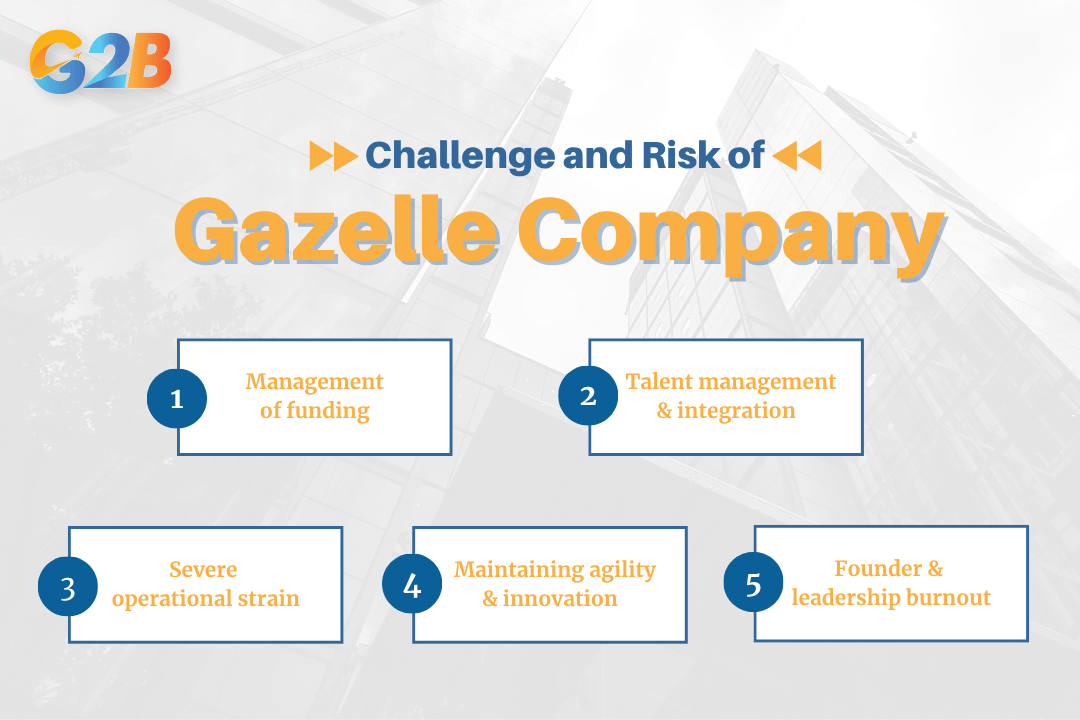
Challenge and risk when becoming a gazelle company
- Access to and management of funding: While gazelles are attractive to investors, securing the right kind of funding at the right time is a constant challenge. Each growth stage requires different levels of capital, and a failed funding round can halt momentum instantly. Even with successful funding, managing that capital effectively to ensure a positive return on investment is a high-pressure task. Mismanagement of funds can be just as fatal as a lack of them.
- Talent management and integration: The challenge goes beyond simply hiring people; it's about integrating them effectively. The primary risk in talent management is failing to integrate hundreds of new hires while retaining the core early employees who built the company. Without robust onboarding, training, and leadership development programs, new hires may struggle to contribute effectively, and the cultural divide between old and new employees can create internal friction.
- Severe operational strain: The operational systems that work for a small company often break under the weight of rapid scaling. A key risk is experiencing catastrophic failures in core business functions because the infrastructure was not built to scale. This can manifest in many ways, such as a website repeatedly crashing during peak traffic, a logistics network failing to fulfill orders on time, or financial systems being unable to process the volume of transactions accurately. These failures not only cost money but also erode customer trust.
- Maintaining agility and innovation: The irony of growth is that it often leads to the loss of agility that enabled the success in the first place. As a company grows, it adds management layers, formal processes, and bureaucracy to maintain control. The primary risk here is that these new structures strangle the speed and innovative spirit that defined the company's early success. The decision-making process slows down, risk aversion increases, and the company becomes more like the slow-moving "elephants" it once disrupted.
- Founder and leadership burnout: The immense pressure of steering a gazelle falls squarely on the shoulders of the founders and the leadership team. The constant fundraising, hiring, problem-solving, and strategic planning can be all-consuming. The greatest personal risk is founder burnout, where the leaders become so physically and emotionally exhausted that their ability to lead effectively is compromised, jeopardizing the entire enterprise.
Importance and impact of gazelle companies
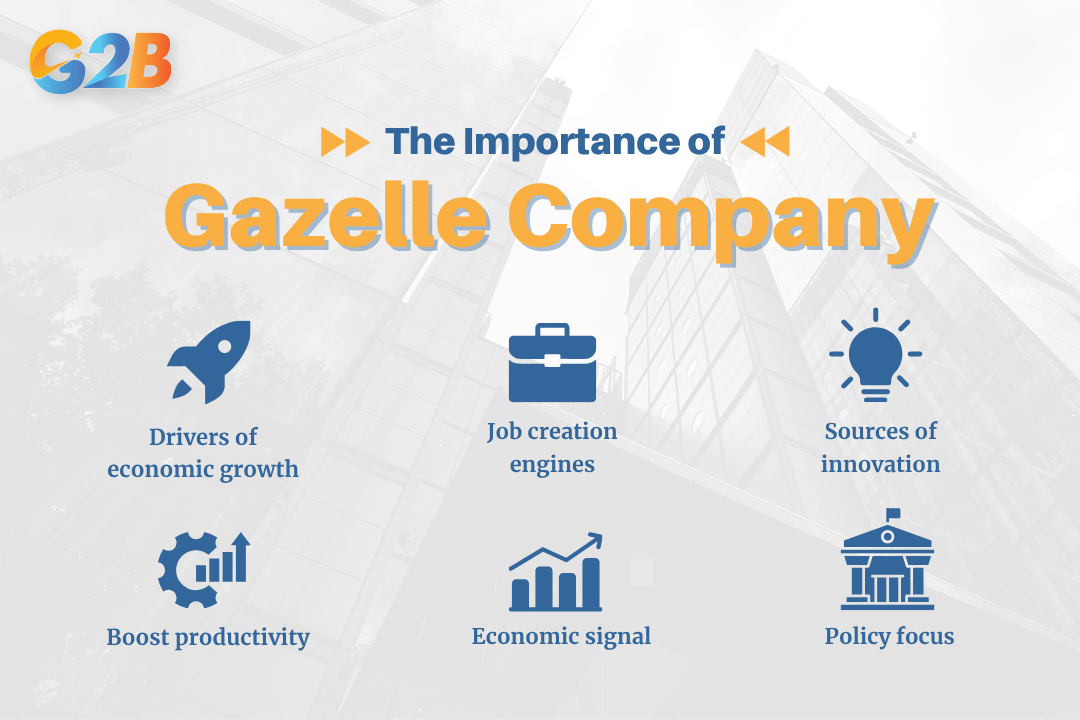
Importance and impact of gazelle companies
Gazelle companies are far more than just successful businesses; they are a cornerstone of economic prosperity and a key indicator of a healthy, dynamic economy. Their impact extends far beyond their own balance sheets, creating ripple effects that benefit entire industries and communities.
The most significant contribution of gazelle companies is their role as a job creation engine. Research consistently shows that these high-growth firms are responsible for a disproportionately large share of new jobs. While large corporations may shed jobs during economic downturns and small businesses often maintain a steady number of employees, gazelles are continuously hiring to fuel their expansion. This dynamic job creation provides employment opportunities, reduces unemployment rates, and stimulates consumer spending, which in turn drives further economic growth.
Furthermore, gazelles are a primary source of innovation and productivity growth. They challenge the status quo by introducing new products, services, and business models that force entire sectors to adapt and evolve. This competitive pressure prevents market stagnation and encourages established "elephant" companies to become more efficient and innovative themselves. The technological advancements and productivity gains pioneered by gazelles can have a profound, lasting impact on the entire economic landscape. A 2017 report by the U.S. Census Bureau found that high-growth firms make disproportionate contributions to output and productivity growth.
Economically, a thriving ecosystem of gazelle companies signals a vibrant and forward-looking economy. It indicates that there is access to capital, a skilled workforce, and a culture that supports entrepreneurship and risk-taking. Policymakers and economic developers often focus on nurturing these high-growth firms because they understand that supporting gazelles is an effective way to foster widespread economic health and ensure long-term competitiveness on a global scale.
Gazelles are the engines of job creation, the disruptors that drive innovation, and the benchmarks of a thriving economic ecosystem. They push industries forward and create widespread prosperity. Ultimately, the Gazelle Company represents both a challenging path and a powerful force for economic progress, driven by innovation, speed, and an unwavering focus on growth. Fostering an environment where these agile and ambitious firms can thrive is essential for any economy aspiring to a dynamic and prosperous future.
