




 Delaware (USA)
  Vietnam
  Singapore
  Hong Kong
  United Kingdom
 Registering a trademark in Vietnam is a critical step for any international business intending to manufacture, distribute, or sell goods within this rapidly growing Southeast Asian market. For foreign investors and global entrepreneurs, the Vietnamese intellectual property landscape can be complex. Unlike jurisdictions that recognize "common law" rights based on usage (such as the United States), Vietnam generally does not protect unregistered marks. This article will help you navigate the Intellectual Property Office of Vietnam (IP Vietnam), secure your exclusive rights, and establish a robust defense against counterfeiting and trademark squatting.
Trademark registration is a cornerstone of a comprehensive asset protection strategy for international businesses.
What can be protected under a trademark in Vietnam?
Before initiating the filing process, it is essential to determine if your brand assets meet the statutory requirements. Under the Intellectual Property Law of Vietnam (as amended in 2022), a trademark is defined as a visible sign or any sign (including sound signs that can be graphically represented) used to distinguish the goods or services of different organizations or individuals.
The criteria for protection
To obtain a Trademark Registration Certificate, your mark must satisfy two fundamental conditions:
- Capability of distinction: The mark must be distinctive enough to identify the source of the goods.
- Non-conflict: The mark must not conflict with prior registered trademarks or well-known marks.
Eligible types of marks
Vietnam has modernized its IP laws to align with international standards, such as the CPTPP and EVFTA agreements. You can now protect a wide array of visible signs and sensory elements:
- Word marks: These include brand names, slogans, acronyms, and letters. (e.g., "NIKE" or "Just Do It").
- Figurative marks: These encompass logos, drawings, emblems, and stylized characters.
- Three-dimensional (3D) marks: This refers to the shape of goods or their packaging, provided the shape is not purely functional (e.g., the unique shape of a Coca-Cola bottle).
- Color marks: Protection is available for combinations of colors arranged in a specific way that identifies the brand.
- Sound marks (New): Following the 2022 amendment, Vietnam now accepts sound marks provided they are submitted with an audio recording and graphical representation (e.g., musical notation or spectrogram). This allows you to register distinctive audio branding, such as jingles, musical chords, or specific sound effects associated with your product. This is particularly important for businesses operating under a franchisee model, where brand consistency across sounds and visuals is strictly mandated
Absolute grounds for refusal
The Intellectual Property Office of Vietnam (IP Vietnam) will automatically reject applications containing prohibited signs, such as:
- National symbols: Flags, emblems, or anthems of Vietnam or other nations, names or images of leaders, national heroes.
- Deceptive indications: Signs that mislead consumers regarding the origin, nature, function, or quality of the goods (e.g., using "Swiss" for watches made in Vietnam).
- Generic terms: Signs that are common names of the goods (e.g., registering "Computer" for selling laptops).
- Signs containing copies of copyrighted works, unless permitted by the copyright owner.
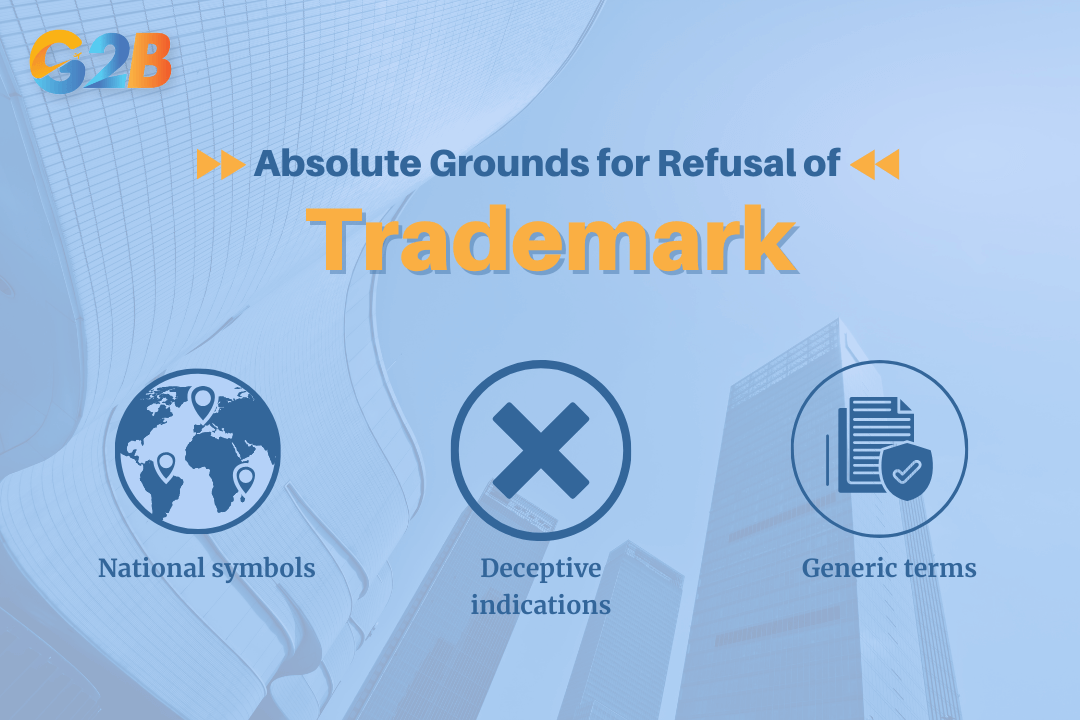
The IP Vietnam will automatically reject applications containing prohibited signs
Critical filing rules in Vietnam
Vietnam’s legal system is civil law-based, and its trademark regulations differ significantly from those in the US, UK, or Australia. Understanding these nuances is vital.
The "first-to-file" principle
This is the cornerstone of Vietnamese trademark law. Priority is granted to the person who submits their application first, regardless of who used the mark first.
- The risk: If a distributor or a third party files your brand name before you do, they become the legal owner. This is known as trademark squatting.
- The solution: You must file immediately. If you have filed a corresponding application in a Paris Convention member country within six months prior to the Vietnamese filing date and submit a certified copy of the priority application, you can claim a Priority Date, effectively backdating your Vietnamese application to your original foreign filing date.
Mandatory local representation
Foreign applicants who do not have a registered permanent residence or headquarters in Vietnam cannot file directly with IP Vietnam.
- The rule: You are legally required to appoint a licensed Vietnamese IP Agent to act on your behalf.
If you already have an entity in the country, your legal representative in Vietnam can work alongside these agents to ensure compliance
The nice classification system
Vietnam utilizes the latest version of the Nice Classification system to categorize goods and services (Classes 1–45).
- Single vs. multi-class applications: Vietnam allows multi-class applications. You can file one application that covers multiple classes (e.g., Class 25 for clothing and Class 35 for retail services).
- Strategy: While multi-class filing reduces administrative paperwork, some attorneys prefer single-class filings to prevent a partial rejection in one class from stalling the entire application.
Step-by-step guide to register a trademark in Vietnam
The process to register a trademark in Vietnam involves several distinct administrative phases. From start to finish, the procedure is rigorous.
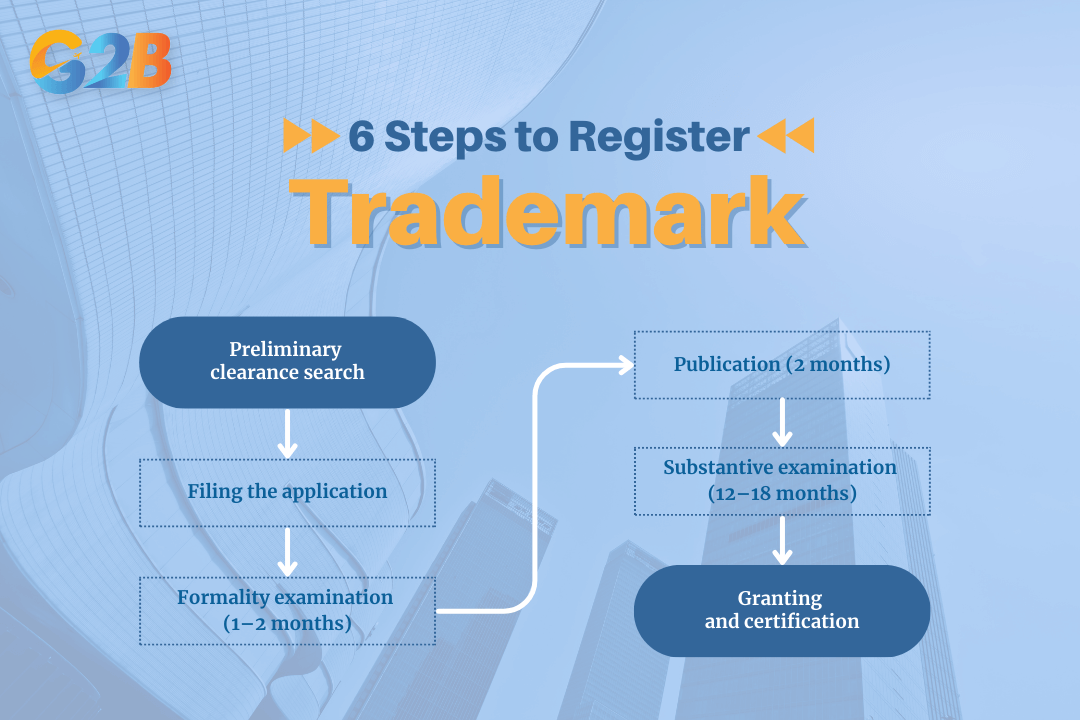
There are 6 steps to register a trademark in Vietnam
Step 1: preliminary clearance search
While optional, skipping this step is dangerous. A comprehensive search of the IP Vietnam National Database helps identify identical or confusingly similar marks.
- Why it matters: If you file blindly and are rejected 18 months later, you lose time and filing fees.
Step 2: filing the application
Once the dossier is prepared, it is submitted to IP Vietnam. You must provide the required documents, such as:
- The power of attorney (POA): Signed by the applicant.
- The trademark specimen: High-quality digital files of the logo.
- The list of goods/services: Classified according to the Nice Agreement.
- Priority documents: If claiming priority under the Paris Convention.
Step 3: formality examination (1–2 months)
The IP Office reviews the application for administrative compliance. They check formality criteria, such as correct classification, fee payments, and document validity.
- Acceptance: A "Notice of acceptance of valid application" is issued.
- Refusal: If there are errors, a deficiency notice is issued, and you have a limited time to amend.
Step 4: publication (2 months)
Valid applications are published in the Industrial Property Gazette.
- Opposition window: This publication triggers a 2-month opposition period. During this time, third parties can challenge your application if they believe it infringes on their rights.
Step 5: substantive examination (12–18 months)
This is the most critical phase. Examiners analyze the mark against absolute and relative grounds for refusal.
- Distinctiveness check: Is the mark too descriptive?
- Similarity check: Does it conflict with a prior mark?
- Result: The examiner issues either a Notice of intention to grant or a Notice of refusal.
Step 6: granting and certification
If approved, you must pay the granting fees.
- The Trademark Registration Certificate is typically issued 1–2 months after fee payment.
- Validity: The trademark is valid for 10 years from the filing date and is renewable indefinitely.
Realistic timelines and managing delays
Investors often ask: "How long does it take?"
- Statutory timeline: Theoretically, the process takes about 12 to 15 months.
- Actual timeline: Due to a significant backlog at IP Vietnam, the process currently takes 16 to 18 months on average.
Common challenges and how to overcome them
Registering a trademark in Vietnam is not always straightforward. Here are the most common hurdles foreign brands face.
The "descriptiveness" trap
Vietnam is stricter than many Western countries regarding "descriptive" marks.
- The issue: Marks that describe the quality or function of the product (e.g., "Best burger" or "Fast delivery") will be rejected.
- The fix: If your brand name is descriptive, you must combine it with a distinctive device component (a unique logo) or stylize the font significantly so that the distinctiveness comes from the visual presentation, not the words.
Trademark squatting and bad faith
As mentioned, the "First-to-file" rule invites bad actors.
- Scenario: A squatter registers your brand. When you enter Vietnam, they sue you for infringement or demand a high price to sell the mark back.
- Defense: If this happens, you must initiate invalidation proceedings based on "Bad Faith". However, proving bad faith is legally burdensome and expensive.
Issues with IP ownership often surface during mergers and acquisitions, where a clouded trademark title can significantly devalue a target company
Non-use cancellation
Once registered, you must use the mark.
- The rule: If a registered trademark is not used for five consecutive years, except where use is commenced or resumed at least three months before the request for cancellation, any third party can request its cancellation.
- Action: Ensure your products are officially circulating in the Vietnamese market with invoices to prove usage.
This usage must be part of your legitimate business activities, documented through proper accounting and commercial records
In a dynamic market like Vietnam, your brand is your most valuable asset. The "First-to-File" nature of the legal system means that hesitation can lead to the permanent loss of rights. Navigating the bureaucratic nuances of the Intellectual Property Office of Vietnam requires local expertise. By preparing the correct dossier, conducting thorough clearance searches, and monitoring the examination timeline, you can ensure your intellectual property is safe. For a seamless entry into the Vietnamese market and to ensure full compliance with local IP regulations, contact G2B for consultation on trademark rights or how to set up a company in Vietnam.
