




 Delaware (USA)
  Vietnam
  Singapore
  Hong Kong
  United Kingdom
 A general agreement on tariffs and trade, known as GATT, was a foundational pillar that reshaped the post-war global economic order. For nearly five decades, this multilateral legal agreement functioned as the de facto world trade constitution, laying the groundwork for unprecedented growth in international commerce. This article explores the definition, history, and core principles of GATT, its transformation into the World Trade Organization (WTO), and its lasting legacy on global trade, including the economic rise of nations like Vietnam.
This article outlines the key principles of the General Agreement on Tariffs and Trade (GATT) to help businesses and investors gain a clearer understanding of international trade rules. We specialize in company formation and do not provide legal or dispute resolution advice. For any legal matters, please consult a qualified lawyer or the relevant authorities.
What is the general agreement on tariffs and trade (GATT)?
The General Agreement on Tariffs and Trade (GATT) was a multilateral legal agreement aimed at promoting international trade by substantially reducing or eliminating trade barriers such as tariffs and quotas. Signed in Geneva on October 30, 1947, and entering into force on January 1, 1948, its primary purpose was to liberalize trade on a "reciprocal and mutually advantageous basis”. It was designed to create a stable and predictable environment for international commerce, which had been severely damaged by the protectionist policies of the 1930s and the devastation of World War II.
GATT's core mission was to dismantle various trade barriers, such as high tariffs, restrictive quotas, and preferential trade arrangements. By establishing a set of rules and a forum for negotiations, it sought to ensure that trade flowed as smoothly, predictably, and freely as possible. It evolved through a series of multilateral trade negotiation rounds, including the Kennedy, Tokyo, and Uruguay Rounds, which progressively expanded its scope and commitments. While it was technically an agreement and not a formal organization, GATT established an ad-hoc secretariat based in Geneva and functioned as a de facto international organization for decades. This framework governed the majority of global trade for 47 years until its provisions were incorporated as the GATT 1994 under the newly established World Trade Organization (WTO) in 1995.
History and origin of GATT
The creation of GATT was a direct response to the global economic turmoil of the preceding decades. The post-war economic climate was fragile, and world leaders were determined to avoid repeating the mistakes of the 1930s, when escalating protectionist policies choked off international trade and deepened the Great Depression. The consensus was that economic cooperation was essential for securing peace and prosperity.
The original vision was more ambitious than GATT. Allied planners during World War II envisioned a trio of international economic institutions to manage the post-war economy: the International Monetary Fund (IMF), the World Bank, and the International Trade Organization (ITO). While the IMF and World Bank were successfully established, the ITO failed to launch. The ITO's charter was exceptionally comprehensive, but it was ultimately not ratified by the U.S. Congress, which effectively ended its prospects.
While the ITO charter was being negotiated, a group of 23 founding nations decided to proceed with a separate agreement focused purely on reducing tariffs. This negotiation became the General Agreement on Tariffs and Trade. GATT was signed on October 30, 1947, in Geneva by these 23 founding nations, which included major economies like the United States, the United Kingdom, and Canada. Initially intended as an interim agreement that would be absorbed by the ITO, GATT became the permanent framework for international trade when the ITO charter was abandoned. The signatories of GATT were formally known as "contracting parties," reflecting its status as a legal agreement rather than a formal organization. The legal frameworks established then still influence global business today.
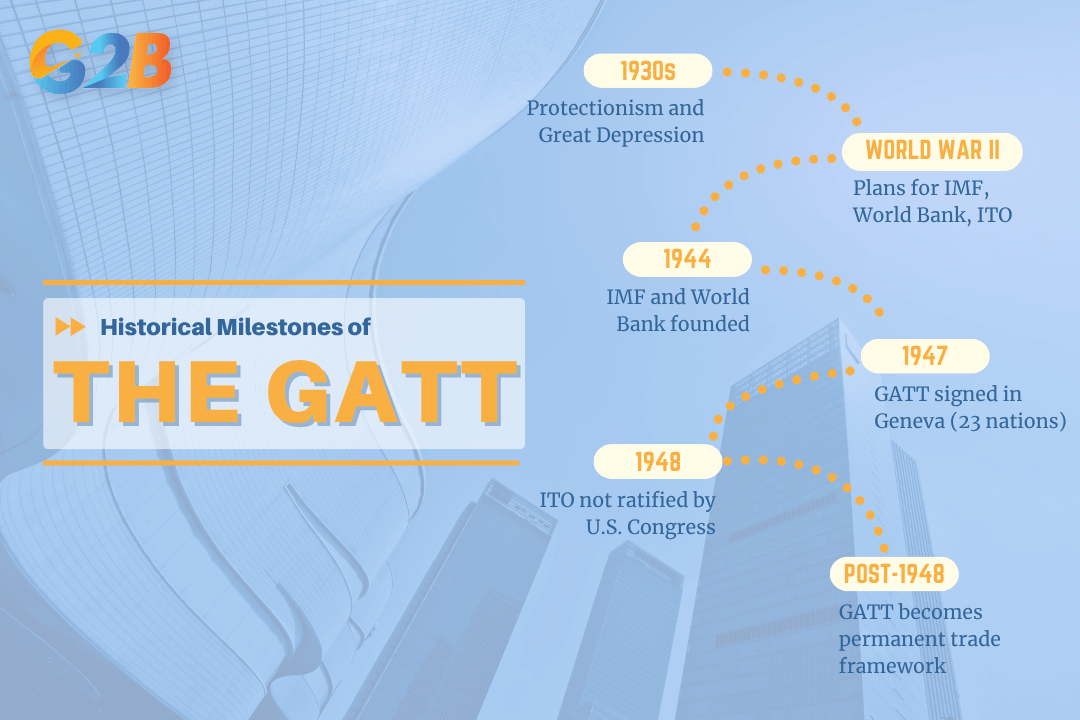
The creation of GATT was a direct response to the global economy
Core principles of GATT
The effectiveness of GATT rested on a set of powerful, foundational principles designed to create a system of free and fair trade. These principles were enshrined in its articles and formed the bedrock of the multilateral trading system for nearly half a century.
- Non-discrimination: This is arguably the most critical principle of GATT, expressed through two key policies: the Most-Favoured-Nation (MFN) rule and the National Treatment policy.
- Most-favoured-nation (MFN): The MFN principle, found in Article I, ensures that any special trade advantage, such as a lower tariff, granted by one member country to another must be immediately and unconditionally extended to all other GATT members. For example, if one country negotiated a lower tariff for another's cars, that same low tariff had to apply to car imports from all other GATT signatories. This prevented preferential bilateral deals and promoted trade equality.
- National treatment: Outlined in Article III, this principle focuses on non-discrimination after goods have entered a market. It states that imported goods must be treated the same as domestically produced goods with respect to internal taxes or local regulations. It applies only after goods have cleared customs, and does not cover customs duties or quantitative restrictions imposed at the border. This prevents countries from using domestic policies, like higher taxes on foreign products, to undermine the spirit of a tariff reduction.
- Reciprocity and mutual advantage: Trade liberalization under GATT was a two-way street. The process was based on reciprocal negotiations where countries would make mutual concessions, ensuring that the benefits of opening markets were shared among the participants.
- Commitment to lowering trade barriers: The central goal of GATT was the progressive reduction of trade barriers, primarily through multilateral trade "rounds" where contracting parties negotiated tariff reductions and other concessions. The impact was profound; average tariffs for major participants dropped from about 22% in 1947 to around 5% after the Uruguay Round. GATT also sought to limit the use of other protectionist measures, such as import quotas, export subsidies, and customs valuation procedures, making them more transparent and aiming for their elimination. These principles of fair competition are reflected in national business laws.
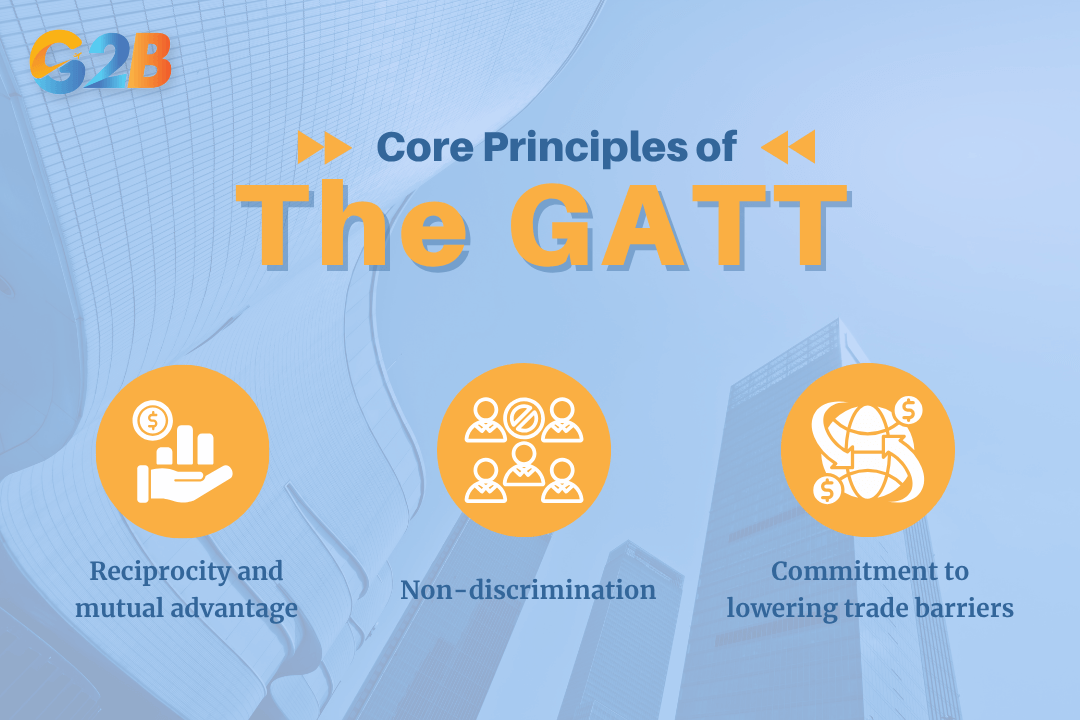
GATT has 3 foundational principles
The Transition from GATT to the World Trade Organization (WTO)
As global trade evolved, the limitations of the provisional GATT framework became clear. GATT 1947 was primarily focused on trade in goods, leaving out massive and growing sectors of the global economy like services and intellectual property. Furthermore, its dispute settlement mechanism was slow and could be easily blocked by a single contracting party, hindering enforcement.
To address these shortcomings, the eighth and most ambitious round of trade negotiations, the Uruguay Round, was launched in 1986. Lasting over seven years and involving 123 countries, this round dramatically expanded the scope of trade rules. It culminated in the Marrakesh Agreement of 1994, which officially established the World Trade Organization (WTO). The WTO began operations on January 1, 1995, absorbing the original GATT agreement and creating a more powerful, permanent institutional structure for global trade.
The transition from GATT to the WTO was a significant upgrade. Here are the key differences:
| Feature | General Agreement on Tariffs and Trade (GATT) | World Trade Organization (WTO) |
|---|---|---|
| Structure | A provisional agreement with no formal institutional body, only a small secretariat. | A permanent institution with a strong legal standing and its own secretariat. |
| Scope | Primarily focused on trade in goods. | Covers goods, services (through GATS), and intellectual property (through TRIPS). |
| Dispute Settlement | A slower, consensus-based system that could be easily blocked by the losing party. | A faster, more automatic, and binding dispute settlement system with an appellate body, making rulings harder to block. |
| Membership | Signatories were called "contracting parties." | Members are formally "members," reflecting the organization's permanent international status. |
How have trade agreements opened Vietnam’s economy?
The principles of trade liberalization championed by GATT and the WTO have had a profound impact on many nations, with Vietnam serving as a prime example. Since initiating its Doi Moi economic reforms in 1986 and progressively integrating into the global economy, Vietnam has leveraged free trade agreements (FTAs) to fuel remarkable growth.
Vietnam's accession to the WTO in 2007 was a critical milestone that accelerated its transformation. Since then, the country has become a participant in over 17 FTAs, including major pacts like the Comprehensive and Progressive Agreement for Trans-Pacific Partnership (CPTPP) and the EU-Vietnam Free Trade Agreement (EVFTA). This network of agreements has opened access to markets representing approximately 75% of global GDP.
This commitment to open trade has transformed Vietnam’s economy from being primarily agricultural to a modern, manufacturing-driven powerhouse. The reduction of trade barriers has fueled a massive surge in exports, particularly in key sectors like electronics, machinery, textiles, and footwear. The country has also become a top destination for foreign direct investment (FDI), as multinational corporations establish factories to capitalize on its strategic location and preferential market access. In the first nine months of 2025 alone, Vietnam attracted an estimated $28.54 billion in FDI, according to preliminary data.
The influx of FDI has not only created millions of jobs but has also spurred technology transfer and infrastructure development, helping Vietnam move up the global value chain. For those looking to register a company in Vietnam, G2B provides expert guidance to navigate the process efficiently, leveraging the opportunities presented by Vietnam's dynamic and open market.
The general agreement known as GATT was a landmark achievement that established a rules-based system for international trade, pulling the world away from protectionism and fostering decades of economic growth. Its core principles of non-discrimination and tariff reduction created a more predictable and open global market. The successful transition to the more powerful and comprehensive World Trade Organization was built upon this legacy, expanding its scope to cover services and intellectual property while strengthening its enforcement mechanisms. The enduring impact of this framework is clearly visible in the economic success of nations like Vietnam, which has leveraged trade liberalization to become a global manufacturing hub.
