




 Delaware (USA)
  Vietnam
  Singapore
  Hong Kong
  United Kingdom
 Food safety certificate in Vietnam is a mandatory legal requirement for domestic and foreign enterprises operating within the nation's food and beverage industry. This document proves the business complies strictly with the Law on Food Safety No. 55/2010/QH12 and related governmental decrees. This guide outlines the exact legal frameworks, facility compliance conditions, required documentation, and step-by-step application timelines required to pass state inspections successfully.
This article highlights the key aspects of food safety certificate requirements in Vietnam to help businesses better understand the regulations and procedures. We specialize in Vietnam incorporation service and do not provide legal representation or food safety compliance advisory services.
What is a Food Safety Certificate in Vietnam?
A Food Safety Certificate in Vietnam is an official state license confirming that a food establishment meets Vietnamese food hygiene and safety standards. Competent regulatory authorities inspect physical facilities, processing equipment, and personnel health records before issuing the certificate.
This certification acts as the legal backbone for consumer protection and market standardization within the Vietnamese food industry. Authorities verify hygiene conditions rigorously to ensure that toxic substances, harmful bacteria, and cross-contamination do not compromise the public food supply. Businesses must maintain sanitary production environments from the initial raw material sourcing stage through to the final product distribution. Inspectors evaluate storage and processing systems, including cold storage units, ventilation networks, and waste management pipelines, to verify that the operational setup mitigates health risks.
Authorities approve compliant establishments only after a physical on-site audit yields satisfactory results. Relevant sectors bound by these regulations encompass a wide array of enterprises, such as restaurants, food production facilities, catering services, and food trading companies. Without this foundational license, business owners cannot legally process, manufacture, or serve food items to the public, nor can they distribute packaged food products into major retail channels like supermarkets or convenience stores.
Which businesses must obtain a Food Safety Certificate in Vietnam?
Vietnamese law requires most food production, processing, and food service businesses to obtain a Food Safety Certificate before operating. Establishing compliance early in the business registration phase prevents operational disruptions and regulatory fines. Common regulated businesses that fall under this strict mandate include:
- Restaurants and food service establishments
- Food processing factories
- Beverage production facilities
- Catering kitchens and industrial canteens
- Food storage warehouses
- Food trading companies and wholesale distributors
For instance, a foreign-invested enterprise launching a chain of coffee shops or a manufacturing plant producing canned goods must undergo the exact same rigorous evaluation process. The government applies these standards universally across high-risk environments where raw ingredients undergo thermal processing, fermentation, or chemical alteration.
However, Decree No. 15/2018/ND-CP explicitly outlines typical exemptions to streamline administrative burdens for lower-risk entities. Exemptions apply specifically to operations that do not alter the biological state of the food or operate on a micro-scale. Typical exemptions include:
- Small-scale food trading businesses processing minimal daily volumes
- Pre-packaged food retailers without processing or repacking activities
- Street food vendors with limited operations
- Enterprises holding recognized international certifications (e.g., GMP, HACCP, ISO 22000, IFS, BRC, FSSC 22000 issued by designated foreign authorities such as JAS or USDA), which may substitute for the certificate upon authority approval per Decree 15/2018/ND-CP Article 4.
If enterprises fall into the exempt category, they must still strictly adhere to basic hygiene regulations, even though they do not require the formal paper certificate. For all others, ignoring this mandate directly violates the Law on Food Safety and triggers immediate enforcement actions.
What laws regulate Food Safety Certificates in Vietnam?
Vietnam regulates food safety certification through national food safety legislation, implementing decrees, and specific ministerial circulars. Navigating the Vietnamese legal landscape requires a precise understanding of which laws govern specific operational activities.
Primary legal entities dictating the regulatory framework include:
- Law on Food Safety 2010 (Law No. 55/2010/QH12): Establishes the national food safety framework, outlining the fundamental rights and obligations of food producers and consumers.
- Decree No. 15/2018/ND-CP: Provides implementation guidelines, detailing specific exemptions, product self-declaration procedures, and state inspection protocols.
- Circulars of the Ministry of Health (MOH): Define hygiene standards for food additives, functional foods, and acceptable limits of heavy metals and micro-organisms.
Jurisdiction over food safety is distinctly divided among three responsible authorities, depending entirely on the specific product category produced or traded by the enterprise. Understanding the MOH vs MOIT vs MARD food safety certification matrix is essential for submitting the application to the correct state body.
- Ministry of Health (MOH): Governs the functional food sector, nutritional supplements, bottled water, natural mineral water, edible ice, and food additives.
- Ministry of Industry and Trade (MOIT): Supervises the production and distribution of alcohol, beer, beverages, processed milk, vegetable oil, flour, starch, pastries, and jam. MOIT also manages commercial infrastructure, including supermarkets and convenience store chains.
- Ministry of Agriculture and Rural Development (MARD): Oversees the primary production and processing of agricultural goods, such as cereals, meat, poultry, seafood, vegetables, fruits, salt, and raw spices.
When an enterprise produces multiple products falling under the management of two or more ministries, the ministry overseeing the product with the highest production output typically assumes primary regulatory authority.
What conditions must businesses meet to obtain a Food Safety Certificate in Vietnam?
Vietnamese authorities issue a Food Safety Certificate only when a facility satisfies strict infrastructure, equipment, and personnel hygiene requirements. Passing the physical inspection dictates that the business must transition theoretical blueprints into actual, highly sanitary operational spaces.
Facility requirements
Authorities require food establishments to maintain hygienic infrastructure designed specifically to prevent cross-contamination and bacterial growth. The physical layout dictates the flow of operations and must strictly adhere to the one-way processing principle, meaning raw materials enter one door, move linearly through preparation and cooking, and exit as finished products through a separate channel.
Key requirements include:
- Production areas must prevent contamination by physically separating the processing environment from toxic pollution sources, industrial chemicals, and waste sites.
- Processing zones must separate raw and cooked food entirely to eliminate cross-contamination risks.
- Waste disposal systems must operate effectively, featuring covered, pedal-operated bins and enclosed drainage systems that flow away from the production floor.
- Water supply must meet sanitary standards mandated by the Ministry of Health, utilizing separate pipelines for clean processing water and wastewater.
- Walls and floors must feature smooth, bright-colored, waterproof, and easily cleanable materials, such as epoxy resin coatings, ceramic tiles, and stainless-steel baseboards.
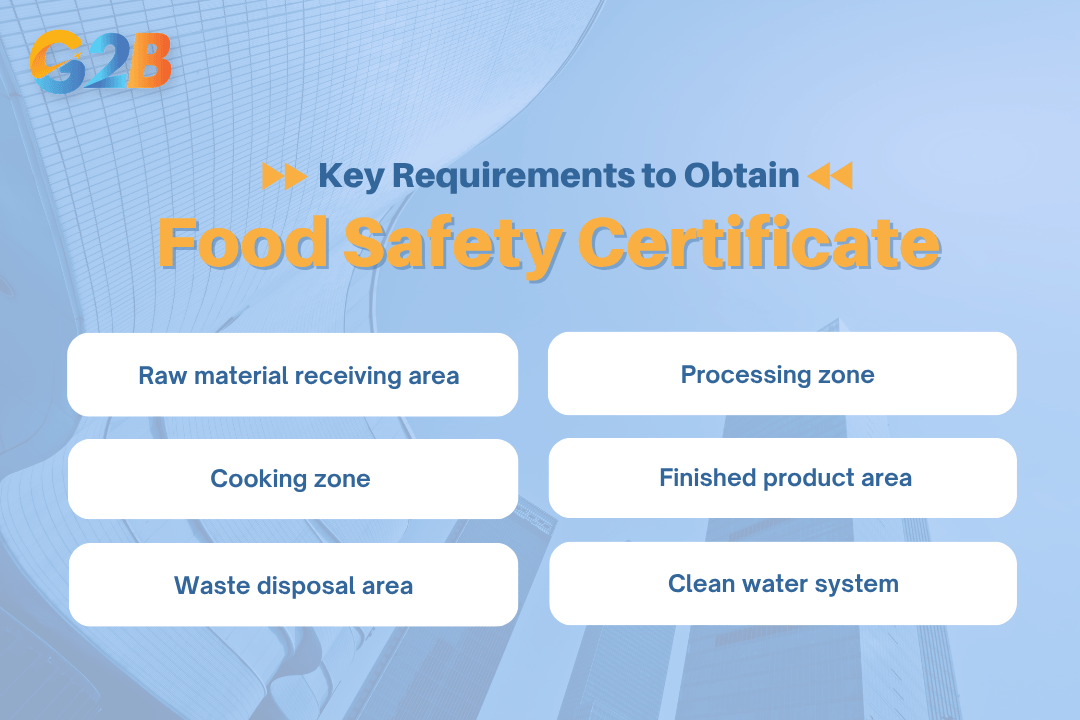
Key requirements businesses meet to obtain a Food Safety Certificate
Equipment and utensil standards
Food equipment must meet sanitation criteria that ensure zero chemical leaching and complete physical cleanliness. Authorities inspect all machinery used during manufacturing, storage, and serving to ensure it does not compromise the biochemical integrity of the ingredients.
Requirements include:
- Equipment must use safe materials, specifically avoiding toxic metals, rust-prone iron, or porous woods that harbor bacteria.
- Tools must undergo regular sanitation, supported by clearly documented Standard Operating Procedures (SOPs) for daily, weekly, and monthly deep cleaning.
- Storage equipment must maintain temperature control, utilizing highly calibrated industrial units, such as blast chillers, walk-in freezers, and dry-aging cabinets, all equipped with external temperature display monitors.
- Businesses must utilize distinct, color-coded utensils for handling raw meat, raw vegetables, and fully cooked items.
Personnel hygiene requirements
Employees must follow strict health regulations, as human contact remains the highest vector for foodborne illnesses. The Vietnamese government mandates that anyone directly interacting with raw ingredients or finished products prove their physical fitness to do so safely.
Requirements include:
- Staff must complete food safety training, culminating in a standardized test administered by an approved local health department or certified training agency.
- Workers must hold valid health certificates issued by a district-level or provincial hospital, proving they test negative for transmissible diseases, such as tuberculosis, hepatitis A, hepatitis E, and severe dermatological infections.
- Employees must wear protective clothing during food handling, consistently utilizing mandatory gear, such as hairnets, single-use gloves, waterproof aprons, and specialized non-slip footwear.
What documents are required for a Food Safety Certificate in Vietnam?
Applicants must submit a comprehensive food safety dossier to the competent authority, proving theoretical compliance before the physical inspection occurs. Gathering these documents correctly is a highly bureaucratic process requiring meticulous attention to detail. Typical application documents include:
- Application form for food safety certificate, drafted in the precise legal format mandated by the respective governing ministry.
- Business registration certificate (Enterprise Registration Certificate - ERC) proving the company holds the legal right to engage in food manufacturing, catering, or trading.
- Facility layout diagram illustrating the specific dimensions and physical flow of the one-way processing system.
- Equipment and utensil list, detailing the specifications, material composition, and origins of all major production tools.
- Employee health certificates, properly stamped by an authorized state medical facility within the last 12 months.
- Food safety training certificates for the business owner and all direct food handlers.
Additionally, depending on the specific industry, authorities may request supplemental traceability documents, such as raw material supplier contracts, chemical testing logs for the facility's water source, and product quality specification sheets. Authorities review the dossier comprehensively to verify legal compliance before formally scheduling a facility inspection. Missing a single signature or providing an improperly formatted layout diagram will trigger an immediate request for modification, significantly delaying the operational launch.
How do businesses apply for a Food Safety Certificate in Vietnam?
Businesses apply by submitting standardized legal documents to the competent authority and subsequently passing an extensive on-site food safety inspection. Understanding the procedural timeline allows enterprise owners to schedule their grand openings accurately.
Typical process:
- Prepare the application dossier: The business owner or legal representative compiles all mandatory paperwork, including health records, training certificates, and facility blueprints.
- Submit documents to the relevant authority: Applications enter the system via direct submission at the provincial/municipal administrative center or through the National Public Service Portal online platform.
- Authorities review the documentation: Within 5 working days, the state agency appraises the dossier. If the documents contain errors, the agency issues a written request for amendment.
- Inspectors conduct an on-site facility inspection: If the dossier is valid, the agency forms an inspection delegation. This team visits the business premises within 10 working days to verify that the physical environment matches the submitted diagrams and meets all sanitation regulations.
- Authorities issue the certificate if requirements are met: Once the facility passes the on-site audit, the agency formally drafts and releases the final license.
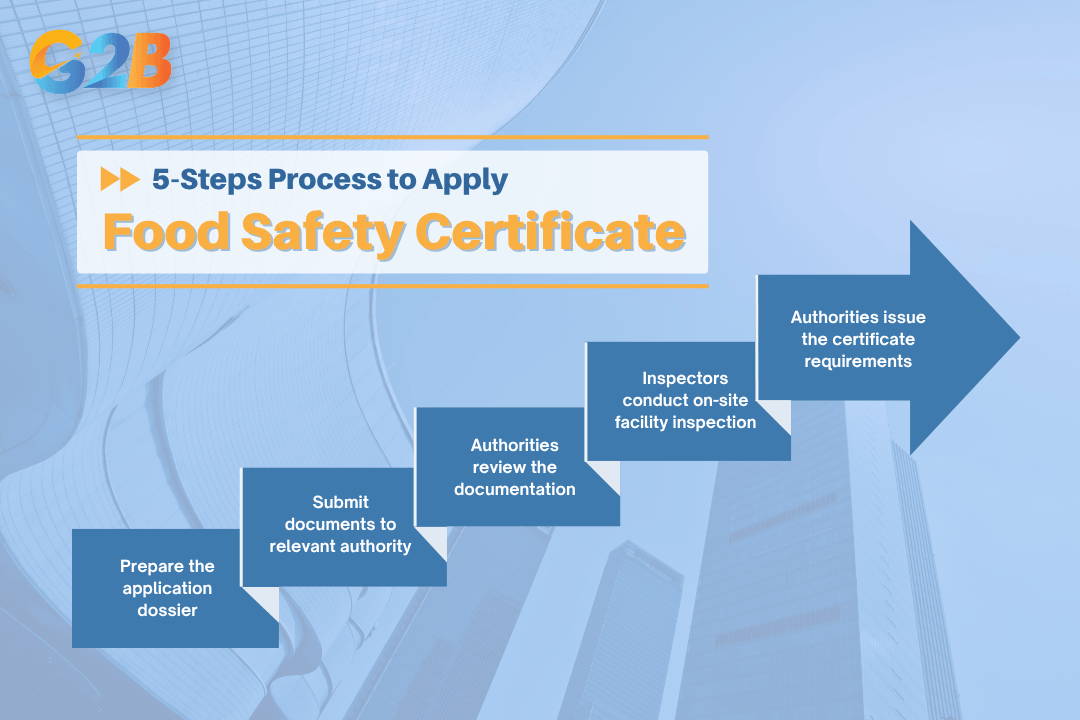
Typical process to apply for a Food Safety Certificate
The entire process normally takes 15 - 25 working days from the date the authority accepts a fully compliant dossier. However, if the inspection delegation identifies minor violations during the audit, they may grant a temporary grace period for the business to rectify the issues, pushing the final issuance date back. Failing food safety inspections in Vietnam entirely requires the business to restart the application procedure from the beginning.
How long is a Food Safety Certificate valid in Vietnam?
A Food Safety Certificate in Vietnam remains valid for exactly three years from the official date of issuance. Tracking this expiration date is a critical administrative duty, as operating with an expired license constitutes a severe legal violation.
Businesses cannot simply pay a fee to extend the certificate; the state requires a complete re-verification of the establishment's sanitary standards. Renewing an expired food safety certificate (proactively applying for renewal) must occur strictly six months before certificate expiration. Renewal requirements include:
- Complete re-evaluation of hygiene conditions at the operational site.
- Updated employee health certificates, demonstrating that current staff members remain free of transmissible illnesses.
- Facility inspection by authorities to ensure the structural integrity of the processing zones has not deteriorated over three years.
- Submission of updated water quality test results and recent pest control logs.
If a business allows the certificate to lapse, even by a single day, regulatory agencies hold the legal authority to halt business operations instantly. Working alongside F&B compliance consulting professionals ensures automated tracking of these expiration deadlines, preventing catastrophic operational shutdowns.
How do Vietnamese authorities inspect food safety compliance?
Vietnamese authorities conduct rigorous inspections to ensure businesses maintain food safety standards continually after initial certification. Receiving the license is not the end of state oversight; it marks the beginning of continuous regulatory compliance. Inspection activities focus heavily on actionable data and physical evidence. Inspectors prioritize:
- Verifying sanitation procedures by swabbing equipment surfaces for bacterial culture tests.
- Checking food storage temperatures by reviewing written logbooks and analyzing the digital thermometers attached to freezers.
- Evaluating production facilities for newly introduced risks, such as structural cracks, pest infestations, or improper ventilation.
- Reviewing employee health documentation to guarantee that newly hired workers hold valid certifications.
- Examining supply chain transparency by auditing purchase receipts, import declarations, and supplier contracts to trace the exact origin of ingredients.
Inspection types fall into three specific categories:
- Periodic inspections: Pre-scheduled audits are typically conducted once or twice a year to ensure ongoing compliance with the approved baseline standards.
- Surprise inspections: Unannounced visits triggered by seasonal health campaigns (such as during the Lunar New Year or Mid-Autumn Festival) to evaluate real-time, daily hygiene habits.
- Complaint-based inspections: Immediate, emergency audits launched in response to consumer reports of food poisoning, whistleblowers, or widespread media scrutiny regarding the establishment's food quality.
What are the penalties for operating without a Food Safety Certificate in Vietnam?
Operating without a valid Food Safety Certificate may result in severe administrative fines and immediate business suspension under Vietnamese law. Decree No. 117/2020/ND-CP firmly establishes the punitive measures targeting non-compliant entities to safeguard public health. Possible penalties scale based on the severity of the violation and the size of the enterprise. Typical consequences include:
- Financial fines ranging from tens of millions to hundreds of millions of Vietnamese Dong are often calculated based on the total value of the uncertified food products distributed.
- Temporary suspension of operations, forcing the business to close its doors for one to three months while they attempt to achieve regulatory compliance.
- Confiscation of unsafe food products, leading to mandatory and costly forced destruction protocols overseen by state environmental agencies.
- Permanent closure of food establishments and the revocation of the foundational Enterprise Registration Certificate in cases where repeated violations lead to severe consumer illness.
Authorities impose penalties aggressively to prevent food safety violations from turning into public health crises. In extreme scenarios where food poisoning results in mass hospitalization or fatalities, business owners face severe criminal liabilities under the Vietnamese Penal Code. Securing a Food Safety Certificate prevents these administrative fines, neutralizes legal risks, and ensures uninterrupted, profitable business operations.
Can businesses use legal services to obtain a Food Safety Certificate in Vietnam?
Legal and consulting firms in Vietnam actively assist businesses with Food Safety Certificate applications, streamlining compliance preparation and ensuring rapid governmental approval. Navigating the nuanced demands of the MOH, MOIT, and MARD proves exceptionally difficult for foreign investors and first-time entrepreneurs lacking localized bureaucratic experience. Professional F&B compliance consultants act as the bridge between private enterprise and state regulators. Typical services include:
- Preparing application documents with precise legal formatting to guarantee immediate acceptance during the initial dossier appraisal.
- Advising on facility compliance requirements, including reviewing architectural blueprints and kitchen layouts to ensure they strictly meet the mandatory one-way processing principle.
- Coordinating inspections with authorities, acting as the official representative to answer technical questions posed by the state delegation during the on-site audit.
- Supporting certificate issuance procedures, including tracking document status, expediting bureaucratic bottlenecks, and collecting the final license.
- Conducting mock facility inspections to identify and resolve hygiene violations before the actual state regulators arrive.
Professional support often reduces approval delays, eliminates costly documentation errors, and prevents the financial losses associated with failed facility audits. By leveraging expert knowledge, businesses launch faster and operate with complete legal confidence.
Obtaining a Food Safety Certificate in Vietnam is a fundamental legal requirement designed to protect consumer health and enforce high-quality operational standards across the F&B sector. Successfully navigating the rigid compliance standards of the Ministry of Health, Ministry of Industry and Trade, and Ministry of Agriculture and Rural Development requires meticulous preparation, flawless facility design, and comprehensive administrative oversight. Failing to secure this mandatory license exposes the enterprise to crippling fines, supply chain disruptions, and forced business closures.
Ready to start your journey in Vietnam? Contact G2B today for a consultation on how to establish a company in Vietnam and to follow annual compliance requirements during operations. Let us handle the bureaucracy so you can focus on your business.
