




 Delaware (USA)
  Vietnam
  Singapore
  Hong Kong
  United Kingdom
 Company stamps remain widely used in business transactions, contracts, and official documents, signifying a document's authenticity and the company's commitment. Understanding these rules is essential for legal compliance and smooth operations. This article from G2B will explain the legal rules, usage, and compliance of company stamp regulations in Vietnam.
What is a company stamp?
A company stamp, often referred to as a corporate seal, is an official mark used to authenticate documents and signify that they have been issued with the company's approval. In the Vietnamese business context, stamping a document confirms its legal validity and binds the enterprise to the contents therein, distinguishing it from a document signed only by an individual employee.
The primary purpose of stamping a document is to provide a physical representation of the company's consent and authority. Historically, the seal was a closely guarded symbol of corporate power. Today, while its legal necessity has evolved, its practical importance remains. Company stamps are commonly used on a variety of official papers, such as:
- Contracts and agreements: To formalize and execute legally binding agreements.
- Official correspondence: To authenticate letters and notices sent to government agencies, partners, and clients.
- Corporate resolutions and minutes: To validate internal decisions made by the board of directors or members' council.
- Financial documents: Including invoices and accounting reports.
- Powers of attorney: To officially delegate authority.
In Vietnam and much of Asia, the presence of a company stamp on a document lends significant credibility and is often expected as standard business practice, even as digital methods become more prevalent.
Enterprise law and regulations on company seals
The legal framework governing company seals in Vietnam has undergone a significant transformation, moving from strict state control to greater corporate autonomy. The principal laws dictating these rules are the Enterprise Law 2014 and, more recently, the Enterprise Law 2020, which came into effect on January 1, 2021.
Under the Enterprise Law 2020, businesses are granted substantial freedom regarding their seals. Key provisions include:
- Autonomy in design and form: Enterprises can now decide on the form (e.g., round, square), quantity, and content of their company seals. This is a major departure from older rules that often prescribed a specific shape and ink color.
- Self-management: Companies are responsible for the management, use, and storage of their seals. This responsibility must be outlined in the company's charter or internal regulations.
- Digital signatures as seals: The law officially recognizes a digital signature, compliant with electronic transaction laws, as a valid form of a company seal. This aligns Vietnam with global trends in digital business.
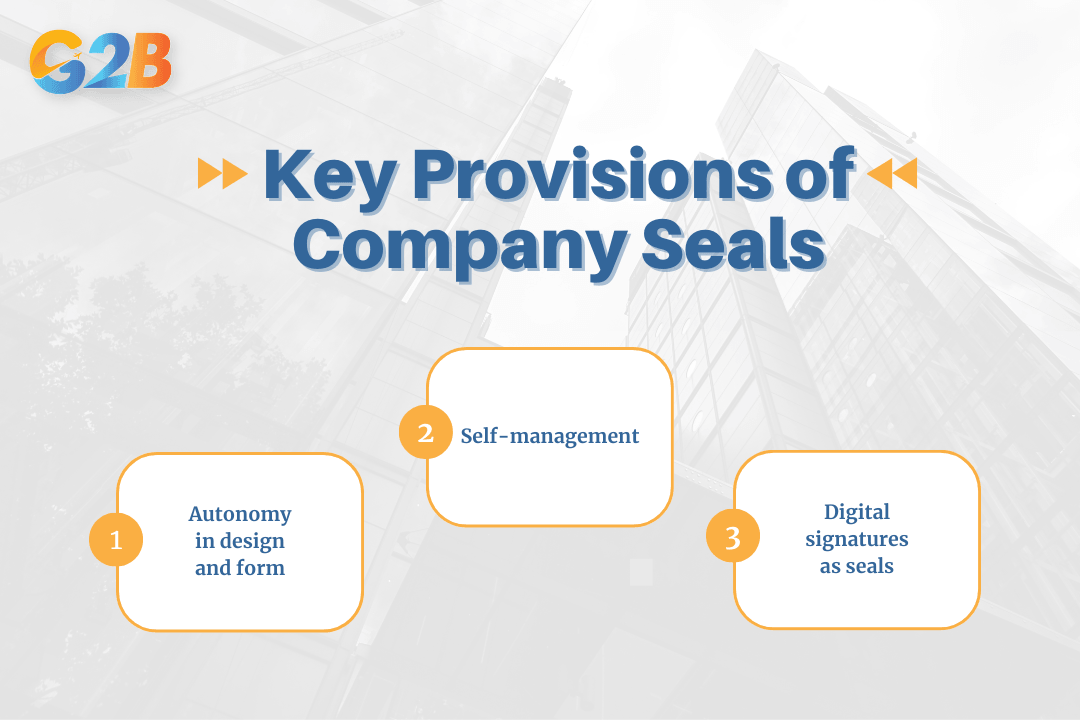
Key provisions of enterprise regulations on company seals
Historical regulations on seal management
To appreciate the current flexibility, it's useful to understand the previous, more rigid systems.
- Under the Enterprise Law 2005: Companies were required to register their physical seal with the Public Security Department (the police). This process involved obtaining a seal specimen registration certificate, which was the official proof of the seal's legitimacy.
- Under the Enterprise Law 2014: The process was simplified but still required state oversight. Instead of police registration, companies had to "notify" the provincial Department of Planning and Investment of their seal specimen. This information was then published on the National Business Registration Portal (NBRP), allowing counterparties to verify the seal's authenticity.
These older regulations positioned the company seal as a quasi-public instrument, with government agencies playing a key role in its creation and validation. The Enterprise Law 2020 marked a definitive shift, privatizing the seal and placing control firmly in the hands of the enterprise itself.
Is a company seal mandatory in Vietnam?
A common question from businesses is whether a physical seal is still required. The direct answer is: No, under the Enterprise Law 2020, a company seal is no longer legally mandatory for all business transactions. Enterprises have the freedom to decide whether or not to use a seal in their daily operations. The law explicitly states that authorized signatures and legally compliant digital signatures can serve as valid alternatives to a physical stamp. This change is designed to facilitate modern, paperless transactions and reduce administrative friction.
However, despite this legal flexibility, the use of company stamps remains deeply ingrained in Vietnamese business culture. In practice, many companies continue to use them for several reasons:
- Tradition and trust: A physical stamp is still widely seen as a definitive mark of authenticity and is often expected by partners, banks, and even some government officials.
- Verification: For companies established before 2021, their seals can still be verified on the National Business Registration Portal, providing a layer of trust.
- Internal governance: It serves as a final checkpoint in the document approval process, ensuring the legal representative has authorized the document.
Types of company seals allowed
Under the current regulations, companies can choose between physical and digital seals.
Physical company stamps
These are the traditional seals that create an ink impression on paper.
- Forms: Common forms include traditional rubber stamps and more durable metal engraved seals. While companies now have freedom over the shape, the round design remains the most conventional.
- Customization: Businesses can customize the size, shape, and ink color of their seals. This allows for greater branding and differentiation, a significant change from the past when red ink was the standard.
Digital company seals
The Enterprise Law 2020 gives legal equivalency to digital signatures that comply with the Law on Electronic Transactions and its guiding decrees, like Decree 47/2021/ND-CP.
- Legal recognition: A compliant digital signature is considered a valid company seal and can be used to authenticate electronic documents.
- Use cases: Digital signatures are essential for modern business operations in Vietnam and are widely used for:
- Online tax declarations and e-invoicing.
- Electronic customs clearance.
- Submitting documents to government portals, such as business registration amendments.
- Executing electronic contracts.
To be legally valid, a digital signature must be obtained from a public certification service provider licensed by the Ministry of Information and Communications (MIC).
What information must appear on a company stamp?
While the Enterprise Law 2020 grants companies freedom over the content of their seal, certain information is considered standard practice for clear identification.
- Essential content: The two most crucial pieces of information are the company's full official name and its enterprise registration code (which also serves as its tax code).
- Purpose: Including this information ensures that the document can be unequivocally linked to the specific legal entity that issued it.
- Optional information: Companies may also choose to include other details, such as their address, logo, or an English translation of their name, although this is not required.
Under the previous Enterprise Law 2014, the company name and enterprise code were mandatory. The 2020 law removed this explicit requirement, but it remains the universal standard for practical reasons.
Restrictions on seal content
Despite the newfound freedom, there are important restrictions on what can be included in a seal's design. Businesses are prohibited from using symbols that could cause public confusion or imply an official state function. These restricted elements include:
- The national flag or national emblem of Vietnam.
- The logos, names, or symbols of state agencies, armed forces, political organizations, or socio-political organizations.
These rules exist to maintain a clear distinction between commercial enterprises and government bodies, preventing any misuse or misrepresentation of authority.
How to create a company stamp in Vietnam?
The process for creating a company stamp has been greatly streamlined:
- Design the stamp: The company's legal representative or management decides on the shape, size, ink color, and the information to be displayed on the seal. This decision should align with the company's charter and internal regulations.
- Engage a seal maker: Once the design is finalized, the company can order the physical stamp from any licensed seal engraving service. There is no longer a need for government pre-approval or registration of the design.
- Establish internal regulations: The most critical step is to implement clear internal rules for the seal's management and use. This should be formally documented in the company charter or a separate internal bylaw. This regulation should specify who is authorized to hold and use the seal.
For foreign-invested enterprises (FIEs), the process is identical. They enjoy the same autonomy and bear the same responsibilities for seal management as domestic companies.
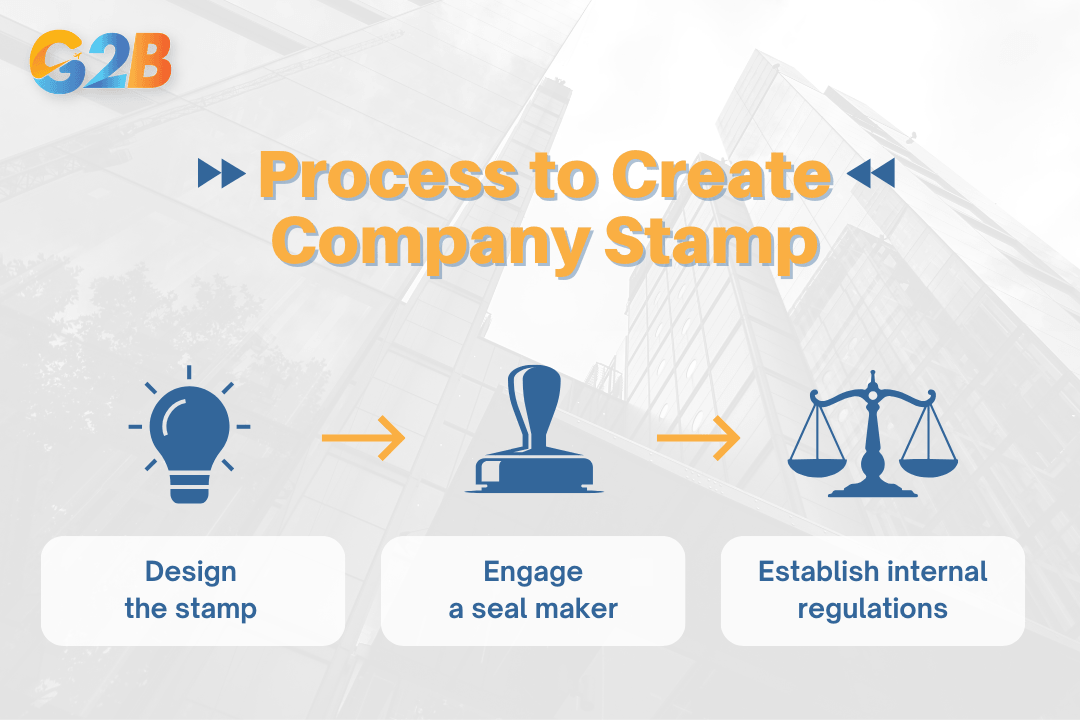
Simple 3-step process to create a company stamp
Responsibility of the legal representative
The legal representative of the company holds the ultimate responsibility for the management and lawful use of the company seal. Their duties typically include:
- Secure storage: Ensuring the seal is kept in a safe and secure location to prevent loss or unauthorized access.
- Proper usage: Guaranteeing that the seal is only used for official company business and is affixed by an authorized person, typically alongside the legal representative's signature.
- Developing internal rules: Overseeing the creation and implementation of the company's internal regulations on seal management.
A company may designate another manager or a trusted employee as the seal custodian, but the legal representative remains accountable for any misuse. If the legal representative is absent from Vietnam, they must authorize another person in writing to manage the seal on their behalf.
When should a company stamp be used?
While no longer universally mandatory, the stamp is still expected or required in many situations.
Documents commonly stamped
In practice, a company stamp is almost always used on the following types of documents to ensure their acceptance and enforceability:
- Business contracts: Especially high-value commercial agreements.
- Official letters to government authorities: Such as tax offices, licensing bodies, and customs agencies.
- Corporate resolutions and decisions: Including minutes of board meetings.
- Powers of attorney.
- Bank documents: When opening accounts or applying for loans.
- Documents requiring notarization.
Risks and compliance issues
The flexibility of the new regulations comes with increased risks that businesses must actively manage.
Misuse of company seals
Potential risks include:
- Unauthorized stamping: An employee using the seal without proper authority to validate a fraudulent document.
- Forged seals: The creation and use of counterfeit seals to commit fraud.
- Disputes over document validity: If a seal is used improperly, it can lead to contractual disputes where one party challenges the authenticity or authority of a stamped document.
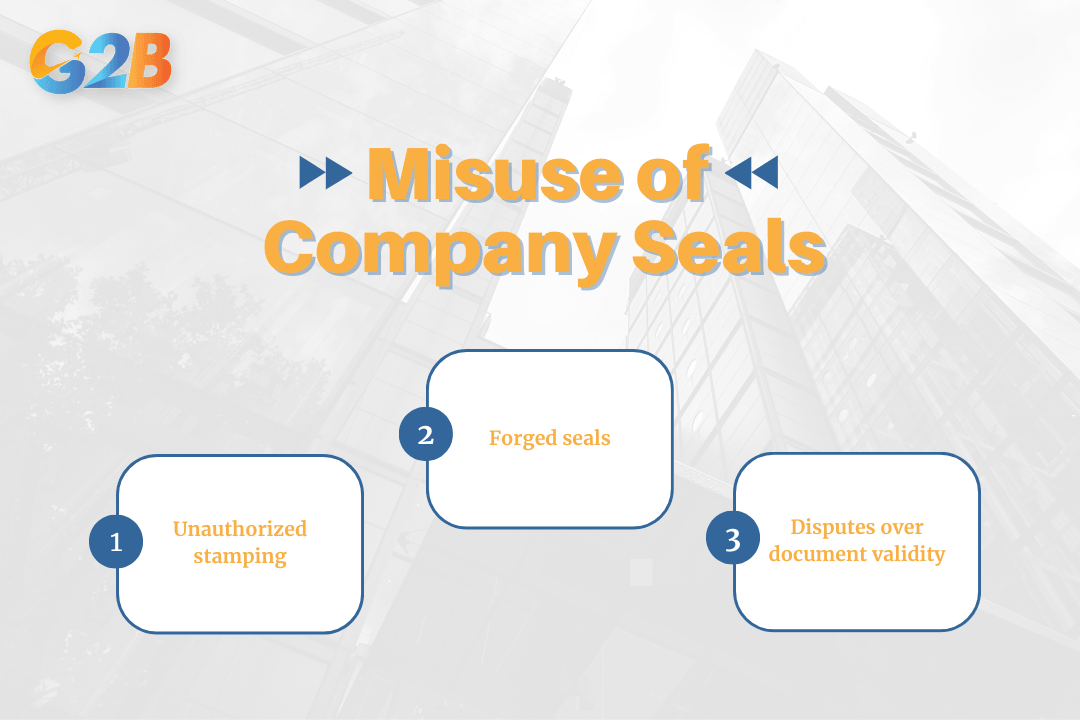
Misuse of company seals leads to severe legal consequences
Legal consequences
The consequences of misuse can be severe:
- Administrative penalties: Fines may be imposed for violations of corporate governance rules.
- Civil liability: The company could be held liable for damages arising from contracts or commitments made through the unauthorized use of its seal.
- Criminal liability: Forgery of seals or using a seal to commit fraud are criminal offenses under the Vietnamese Penal Code, which can lead to imprisonment.
Frequently asked questions
Can a company have multiple seals in Vietnam?
Yes. Under the Enterprise Law 2020, an enterprise has the right to decide on the number of seals it uses. It is common for a company to have identical seals for its head office and various branches or for different departments to streamline operations. The management of these multiple seals must be consistent and governed by the company's internal regulations.
Do foreign-invested companies need a company stamp?
Foreign-invested enterprises (FIEs) are subject to the same regulations as domestic companies. They can choose whether to create and use a company stamp. Given the local business customs, most FIEs find it highly advantageous to have a company stamp to facilitate transactions with Vietnamese partners, banks, and government agencies.
Can a digital signature replace a company seal?
Yes. The Enterprise Law 2020 explicitly recognizes a legally compliant digital signature as an equivalent to the physical company seal. For electronic transactions, such as e-invoicing, online tax filings, and e-contracts, a digital signature is not only a replacement but the required method of authentication.
Navigating the nuances of corporate compliance in Vietnam can be challenging. While company stamp regulations have been liberalized, proper management and strategic use remain essential for legal security and operational efficiency. Contact G2B today for expert consultation on company setup service in Vietnam, compliance, and corporate governance needs in Vietnam!
